


Imagine ordering your favourite dish at 2 a.m., bypassing crowded third‑party apps, and receiving a perfectly tracked meal delivered just when you want it. You are using an online food ordering system that is powered by smart tech, minimal friction, and full control.
Today, food lovers and restaurant owners expect more than just convenience; they are looking for speed, personalisation, and ownership. That’s exactly why modern online food ordering systems have become a game‑changer. From AI-personalised menus to data‑driven upsells, they deliver seamless user experiences while giving restaurants control, insights, and brand loyalty.
But the major question is: how can startup owners and CTOs build their own online food ordering system and achieve a position in this rapidly growing digital market? Understanding the opportunities, benefits, and strategy behind this shift is the first step toward making the right investment.
So, if you are an entrepreneur or a startup owner looking to build an online food ordering system, partner with a top food delivery app development company and see how you can enter this digital revolution and boost sales with tech-first ordering. By the end of this blog, you will learn about the perks of investing in an online food ordering app to boost your business. Let’s get started
Key Takeaways
- A custom online ordering app system becomes a growth engine that supports recurring revenue in the long term.
- Restaurants are shifting from aggregator dependence to direct digital ordering to recover margins and own customer relationships.
- First-party customer data enables loyalty programs, lifecycle marketing, and higher long-term customer lifetime value.
- AI-powered forecasting, automation, and personalised recommendations improve efficiency, reduce waste, and increase average order value.
- An API-first architecture with POS and logistics integrations creates a scalable and automation-driven ordering ecosystem.
Table of Contents
What is an Online Food Ordering App System?
An online food ordering system is no longer just an app that provides meals to customers; instead, it has evolved into a complete digital ordering ecosystem. This ecosystem allows restaurants to sell directly to customers, thus reducing the need for third-party providers and also building customer relationships in the long run.
Traditional aggregator platforms like Uber Eats, Zomato, and Deliveroo made online ordering mainstream, but they also created the commission trap, where restaurants lose 15 to 30% of every order. This is why today, modern restaurants are now shifting toward direct-to-consumer (D2C) ordering systems that help them keep 100% of the revenue while owning their customer experience and first-party customer data.
In 2026, the modern online food ordering systems will directly integrate with the restaurant’s POS (Point of Sale), KDS (Kitchen Display System), and delivery operations through secure APIs. This creates a POS-integrated ordering app that reduces the need for manual work and helps restaurants to handle labour shortages effectively.
If you are a new restaurant owner and want to partner with an experienced food delivery app development company, RipenApps can help you design a secure and fully customised food ordering platform. We can help you choose between SaaS vs. custom development depending on your scale, growth goals, and integration needs.
Online Food Delivery App Market Overview
The online food delivery industry is in its platform maturity phase, where the focus is shifting from marketplace growth to direct digital ownership, automation, and profitability. To stand out in this rapid marketplace app development industry, your priority should be on building a scalable, API-driven ordering infrastructure, not on building a longer marketplace presence alone. Here are some key market shifts:
- Market Size and Revenue: According to the latest Statista report, overall revenue in the Online Food Delivery market is projected to reach $1.54 trillion in 2026. Revenue is expected to show an annual growth rate (CAGR) of 7.20%, resulting in a projected market volume of $2.03 trillion by 2030. This shows that the demand for food delivery apps is going to increase even more.
- User Adoption: There had been a significant impact on the food delivery market, driving a surge in user adoption as people turned to food delivery apps for safe dining options. User penetration in the meal delivery market is at 29.2% in 2026.
- Delivery and Operational Trends: Many apps introduced contactless delivery options. Delivery times were a crucial factor for users, and apps worked on optimising delivery efficiency by following new strategies and building new trends. Also, the integration of AI in the food industry helped a lot to provide a seamless experience to the users.
Modern platforms now use AI demand forecasting, inventory sync to reduce out-of-stock (“86’d”) items, automated order bumps and cross-selling to increase ticket size, and AI menu engineering and personalisation.
- Restaurant Partnerships: Food delivery apps continued to partner with a wide range of restaurants, from local eateries to large chains. Nowadays, many restaurants are investing in D2C ordering platforms, thus resulting in enhanced long-term customer retention and also enabling first-party customer data ownership.
- Loyalty Programs and Discounts: Subscription models like DashPass by DoorDash and Uber Pass by Uber Eats are offering perks like free delivery. In 2026, restaurants are replicating these recurring revenue models by utilising in-house loyalty ecosystems and restaurant CRM integrations.
- Sustainability Initiatives: Sustainability initiatives are emerging as a competitive differentiator. Some food delivery apps started these initiatives, such as promoting eco-friendly packaging and delivery options to reduce the environmental impact of their operations. Restaurants are focusing more on Green App Development, delivery batching, Eco-friendly packaging workflows, etc., to reduce environmental impact and stand out from their competitors.
- Rising Demand for Custom Development: As competition increases, more businesses are evaluating SaaS vs custom development to build scalable, API-first ordering platforms. This shift is driving growing demand for specialised food ordering app development partners. Overall, the market is transitioning from aggregator dependency to owned digital ordering infrastructure as a long-term strategic investment.
Read here: Top Features To Build a Successful Food Delivery App
Benefits of a Direct Online Food Ordering System for Restaurants
Online food ordering systems go beyond simple delivery convenience and act as a revenue and customer retention engine for modern restaurants. These systems offer several advantages for restaurants, which is why many establishments partner with them to expand their customer base and increase sales.
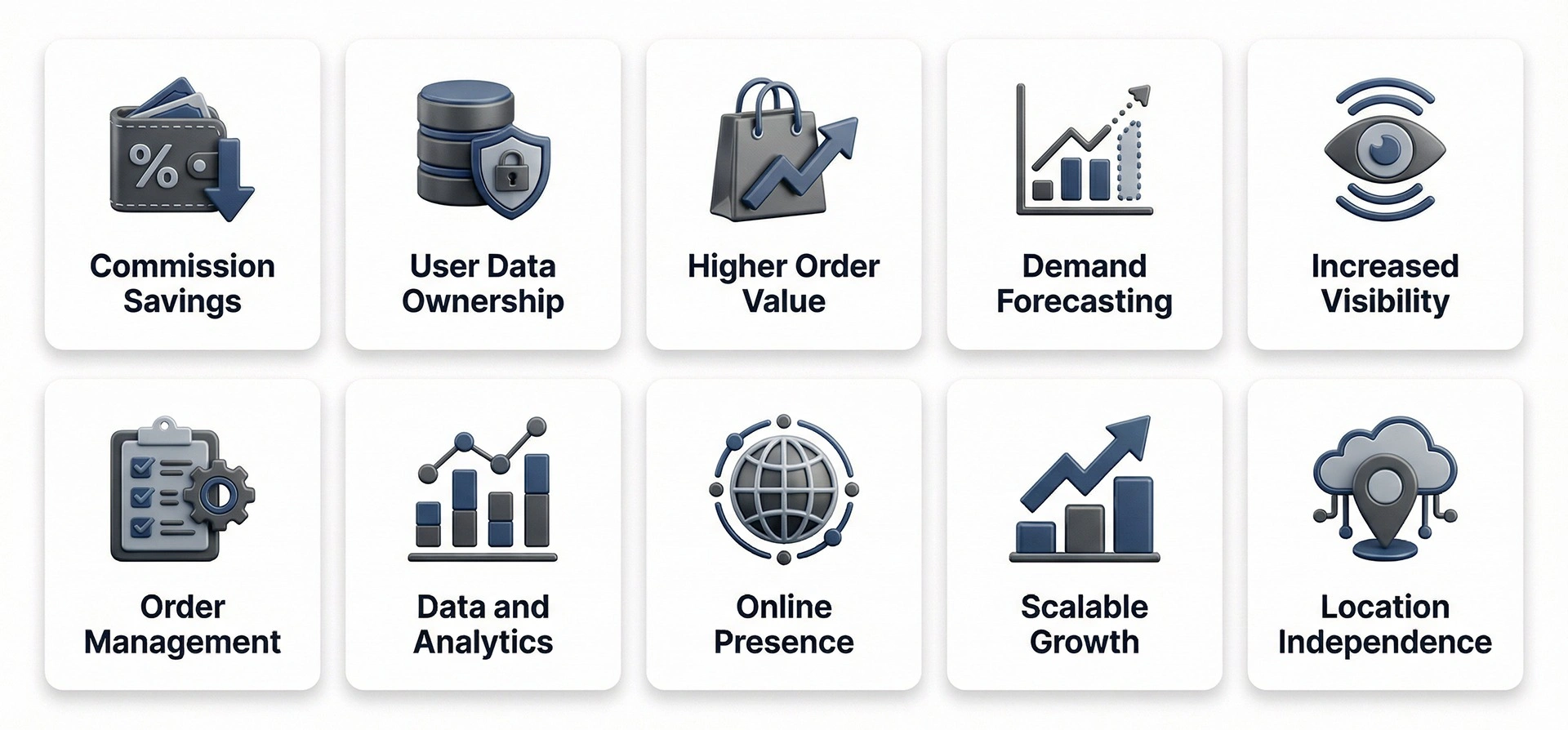
Here we have listed some of the key advantages of utilising a food delivery app, especially for restaurant owners or entrepreneurs running a food-related business:
1. Commission Savings and Margin Control
Using a direct online ordering system helps restaurants retain more revenue by avoiding the heavy commissions charged by third-party apps. This improves their long-term profitability and thus creates a stronger brand position in this competitive app development industry.
2. First-Party Customer Data Ownership
Owning customer data enables restaurants to build loyalty programs, run targeted marketing campaigns, and increase repeat orders without relying on third-party platforms. With direct access to ordering behaviour, preferences, and feedback, restaurants can personalise offers, optimise menus, predict demand, and strengthen long-term customer relationships. This data also supports smarter decision-making, better retention strategies, and higher lifetime customer value.
3. Higher Average Order Value
Online orders are typically up to 30% higher in value because customers can browse visual menus, explore add-ons, and respond to upselling opportunities. Smart recommendations, combo offers, and limited-time promotions encourage customers to add more items to their cart, while a frictionless checkout reduces drop-offs. Over time, this consistently lifts revenue per order and improves overall sales performance.
4. AI-Driven Demand Forecasting
Modern systems use AI to predict peak hours, popular dishes, and inventory needs. This helps reduce food waste and prevents out-of-stock (“86’d”) items. With better forecasting, restaurants can optimise staffing, streamline prep workflows, and negotiate smarter supplier orders. The result is lower operational costs, faster service during rush periods, and more consistent customer experiences.
5. Increased Visibility and Customer Reach
When it comes to third-party vs direct ordering, online food delivery apps provide restaurants with a platform to reach a larger audience. They can attract new customers who might not have otherwise discovered their restaurant. By appearing in search results, promotions, and category listings, restaurants can generate more first-time orders and expand their market reach beyond their immediate neighbourhood.
6. Streamlined Order Management
Food delivery apps and online food ordering systems often have user-friendly interfaces for restaurants to manage incoming orders. This helps streamline order processing, improve efficiency, and reduce the chances of errors compared to traditional phone-based ordering.
7. Access to Data and Analytics
These apps provide valuable data and analytics to restaurants, allowing them to understand customer preferences, food tech trends, and peak hours. This information can inform menu adjustments and marketing strategies. Insights such as top-selling dishes, delivery performance, customer ratings, and seasonal demand patterns help restaurants make smarter operational decisions, optimise pricing, and identify new growth opportunities.
8. Online Presence
In a competitive food app development market, having a presence on food delivery apps can give restaurants an edge over competitors. It separates them from those who may not offer delivery or who are not listed on these platforms. This intuitive and engaging presence also helps restaurants to evolve with changing customer needs, thus providing them enhance convenience and fast service.
9. Scalable Growth
A digital ordering system allows restaurants to expand into new areas, support cloud kitchens, and scale operations efficiently. With centralised order management, standardised menus, and integrated delivery logistics, restaurants can handle higher order volumes without significantly increasing overhead. This makes it easier to test new locations, launch virtual brands, and grow revenue while maintaining consistent quality and service.
10. Weather and Location Independence
Restaurants can maintain a steady flow of orders regardless of weather conditions or their physical location. They can reach customers even in areas where they do not have a physical presence. However, restaurant owners need to work closely with top food delivery app development companies to build an intuitive app and keep a steady flow of orders.
While food delivery apps offer many advantages, it is important for restaurants to carefully consider the terms and fees associated with these platforms to ensure that the benefits outweigh the costs. During the initial stage, you must discuss the food delivery app development cost with an industry expert to know the accurate estimate for your project.
Benefits of a Modern Online Food Ordering System for Customers
Food delivery apps offer several advantages to users, making it more convenient and enjoyable to order food from their favourite restaurants.
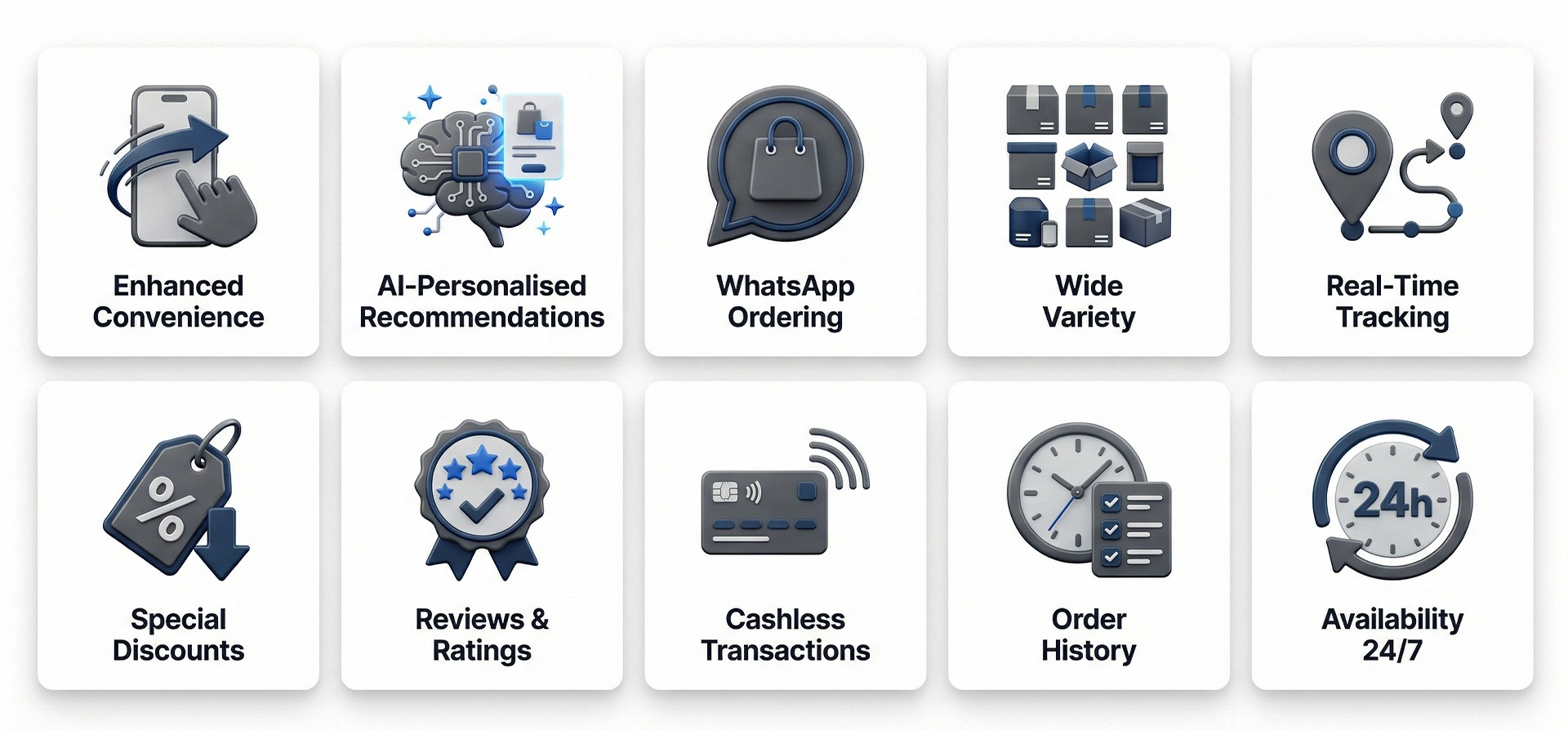
Here are some of the key advantages of online food ordering systems for customers:
1. Enhanced Convenience
Food delivery apps provide a convenient way for users to order food from their preferred restaurants without the need to visit the restaurant in person. Users can order from the comfort of their homes or workplaces. With real-time tracking, secure digital payments, and quick reordering, the user experience becomes faster and more seamless, thus keeping them engaged for a longer run.
2. AI-Personalised Recommendations
Modern apps now use AI to recommend meals based on past orders, preferences, and time of day, helping users discover relevant dishes faster. These smart suggestions highlight trending dishes, repeat favourites, and timely promotions, reducing decision fatigue and encouraging more frequent ordering.
3. Voice and WhatsApp Ordering
Customers can place orders through voice assistants or chat platforms, making the ordering process faster and more convenient. Conversational ordering simplifies reorders, enables quick customer support, and makes food delivery more accessible for busy users who prefer hands-free or chat-based interactions.
4. Wide Variety
These apps offer access to a wide range of restaurants and cuisines, giving users an extensive choice of food options. Users can explore different menus and try new dishes easily with the help of curated collections, filters, and top customer ratings, all within just a few minutes or taps.
5. Real-Time Tracking
Many food delivery apps provide real-time order tracking, allowing users to monitor the status of their orders and know exactly when to expect their food delivery. Modern online food ordering systems come with delivery partner location tracking, accurate ETAs (estimated times of arrival), and live updates. These functionalities reduce the chances of uncertainties and create a smoother and more transparent ordering experience.
6. Special Offers and Discounts
Food delivery apps often offer exclusive discounts, promotions, and loyalty programs for users. This can lead to cost savings and encourage repeat orders. Limited-time deals, bundle offers, and personalised coupons make ordering more appealing and help users get better value for money.
7. Reviews and Ratings
Users can read reviews and ratings for restaurants and dishes, helping them make informed choices about where to order and what to eat. This can lead to more satisfying dining experiences. If your online food ordering system has honest feedback and detailed user ratings, it can build enhanced user trust and reduce the risk of a disappointing experience.
8. Cashless Transactions
Food delivery apps typically support cashless transactions, reducing the need for users to have cash on hand. They can make secure payments through credit cards, digital wallets, or other payment methods. Your online food ordering system should have secure payment gateways and multiple payment options that can save user data, thus enabling the checkout process to be faster and safer.
9. Order History
Food delivery apps often maintain a history of past orders. This makes it easy for users to reorder their favourite dishes or check their order history for reference. Additionally, your online food ordering system can have a one-tap reordering feature that can simplify the repeat purchase journey and thus lead to enhanced convenience that saves users’ time.
10. Availability 24/7
Many online food ordering systems operate 24/7, ensuring that users can order food at any time, including during late-night cravings or in emergencies. Round-the-clock access makes food delivery a reliable and convenient option whenever hunger strikes.
Overall, food delivery apps enhance the dining experience by offering convenience, choice, and a range of features that cater to individual preferences and needs. However, your application should be built by an expert MVP development company to ensure a maximum user base.
Read Also: Best Food App Ideas For Your Startup
A Step-by-Step Guide to Building an Online Food Ordering System
An online food ordering system development requires a complete platform strategy discussion that revolves around topics like revenue growth, operational efficiency, and long-term cost control. If your goal is to create a scalable digital commerce engine that reduces platform fragmentation and enables runtime efficiency, you need to follow the steps given below:
1. Define the Business Case and Long-Term TCO
For founders and CTOs, the first step is to frame the initiative as a margin recovery and cost control strategy. This step will determine how much margin the business retains, how fast new locations launch, and how effectively customer relationships are owned.
Without a structured cost control strategy, you will have potential issues such as marketplace commissions, fragmented ordering channels, and manual workflows. These can increase operational overhead and thus erode profitability.
Your teams must evaluate SaaS vs custom development through the lens of total cost of ownership, vendor lock-in risk, and long-term capital efficiency. Therefore, the platform should be positioned internally as a revenue and retention engine rather than a technology upgrade, thus designing an online food ordering system that supports long-term growth.
2. Design an API-First, Scalable App Architecture
Once you have defined the business case and validated your cost control strategy, your next step is to define the architectural foundation. The architecture must be designed as an extensible ecosystem from day one. You should leverage an API first, web native architecture that prevents platform fragmentation and ensures runtime efficiency as the business scales.
Deep integrations with POS Integration, KDS, logistics partners, payment gateways, and Restaurant CRM systems are essential. This creates POS integrated ordering where menus, pricing, and order data synchronise automatically across operations. The strategic outcome is improved developer velocity, reduced manual overhead, and faster integration cycles.
3. Prioritise First Party Customer Data as a Strategic Asset
After establishing the architectural foundation, the next strategic development phase is designing the platform around 1st-party customer data. Ownership of first-party customer data becomes the foundation for long-term growth. Earlier, the aggregator platforms were optimising for discovery, but limited the customer ownership and repeat purchases authority to the restaurant itself.
Whereas modern and direct ordering platforms enable lifecycle marketing, subscription programs, loyalty automation, and predictive engagement strategies. This data becomes the foundation for CRM workflows, loyalty programs, subscription models, and lifecycle marketing automation. The business transition shifts the business model from transactional revenue toward recurring revenue and improves the efficiency of acquisition spend.
4. Position AI as the Core Optimisation Layer
With customer data foundations in place, the platform must evolve into an intelligence-driven system. Currently, artificial intelligence is no longer a differentiator. It is the optimisation layer that drives revenue growth, operational efficiency, and long-term cost control. For CTOs and startup founders, embedding AI within the online food ordering system helps them create a continuous optimisation engine that drives profitability and scalability.
AI menu engineering allows restaurants to optimise pricing, placement, and menu structure using real demand signals instead of intuition. AI restaurant personalisation enables predictive ordering, tailored promotions, and dynamic recommendations that increase engagement and repeat purchases. Automated order bumps and cross-selling strategies increase average order value without increasing customer acquisition costs.
5. Build a Channel-Agnostic Ordering Experience
Customer behaviour is now channel agnostic. A modern platform must support mobile and web ordering, voice search ordering, conversational commerce, QR-based dine-in workflows, and subscription ordering models. Omnichannel support strengthens hyperlocal SEO visibility and reduces reliance on marketplace discovery. The strategic outcome is lower customer acquisition costs and stronger direct demand capture.
From a strategic perspective, omnichannel ordering reduces platform dependency and diversifies acquisition channels. Restaurants gain greater control over customer journeys while improving speed to market for new engagement channels. This step ensures the platform remains adaptable as consumer behaviour continues to evolve.
6. Automate Workflows to Improve Runtime Efficiency
Operational scalability in the restaurant industry is increasingly constrained by labour availability and rising staffing costs. A modern ordering platform must be designed as an automation-first system that reduces manual coordination across the entire order lifecycle. Automation should orchestrate order routing, kitchen workflows through KDS integration, delivery dispatch, customer notifications, and marketing campaigns.
When these workflows operate as a unified system, restaurants can handle higher order volumes without proportional increases in staffing. By reducing repetitive manual tasks and streamlining internal processes, your organisation can focus more on growth and innovative initiatives rather than on these repetitive tasks.
7. Implement Secure, Frictionless Payment Infrastructure
Payment infrastructure should be treated as a revenue protection and conversion optimisation layer. In digital ordering, checkout friction directly impacts conversion rates, cart abandonment, and customer trust. A modern platform must support biometric and invisible payments, multiple digital wallets, subscription billing models, and full PCI compliance.
Reducing friction in the checkout flow increases completed transactions and improves customer satisfaction. At the same time, strong compliance and security standards reduce operational risk and protect brand reputation. Payment infrastructure is no longer just a transactional component. It is a critical part of the platform’s ability to scale securely and efficiently.
8. Architect for Multi-Location and Cloud Kitchen Expansion
Scalability must be embedded into the platform from the beginning. A modern ordering platform must be designed with expansion in mind from the very beginning. Many restaurant brands now operate across multiple locations, cloud kitchens, and virtual brands. Without scalable infrastructure, expansion introduces operational complexity and rising costs.
A centralised platform enables standardised menus, unified analytics, and integrated delivery logistics across locations. This ensures consistency in customer experience while allowing leadership teams to launch new locations quickly without rebuilding infrastructure. From a strategic perspective, this phase improves capital efficiency and accelerates speed to market for new locations and service areas.
9. Future-Proof the Online Food Ordering Ecosystem
The final step is a mindset shift. A food ordering platform should not be treated as a one-time project or feature release. It must be positioned as a long-term digital infrastructure that continuously evolves alongside the business.
Organisations that adopt a platform mindset unlock faster product development research, and iteration cycles, improved developer velocity, and reduced dependency on third-party marketplaces. The ordering ecosystem becomes a foundation for ongoing experimentation, optimisation, and innovation. From a strategic perspective, this step ensures the platform remains adaptable as customer expectations, technologies, and market dynamics evolve.
Wrapping Up
In 2026 and beyond, online food ordering is not just a convenience, but it’s a growth engine. Restaurants that embrace digital ordering systems are not only streamlining operations but also owning the customer experience, cutting third-party dependencies, and unlocking long-term profitability.
From smarter order flows to AI-powered personalisation, today’s platforms do more than deliver; they connect, convert, and create loyal customers. So, whether you’re running a cloud kitchen, a fine dining outlet, or a quick-service brand, the digital shift is non-negotiable. Building a feature-rich online food ordering app is your next move to lead the competitive industry. Let your restaurant serve beyond tables, digitally, efficiently, and on your terms.
FAQs
1. Why should my restaurant invest in an online ordering system in 2026?
In 2026, customer expectations are digital-first. An online ordering system helps your restaurant boost revenue, reduce third-party commission costs, and improve customer retention with personalised experiences.
2. Can small restaurants benefit from a custom online food ordering platform?
Yes, even small or local restaurants benefit by creating a branded experience, owning customer data, and avoiding aggregator fees.
3. What features should an online food ordering system include in 2026?
Must-have features include mobile optimisation, real-time order tracking, payment gateway integration, push notifications, and AI-driven personalisation to match evolving user behaviour.
4. How secure are online food ordering systems?
Modern systems use end-to-end encryption, secure payment gateways, and GDPR-compliant data practices to protect user information and transaction details. You can reach out to a leading mobile app development company in USA to seamlessly integrate security features into your app.
5. How much ROI can a restaurant expect from a direct online ordering system?
A direct ordering platform helps restaurants reduce aggregator commissions, increase average order value through upselling, and improve repeat purchases using loyalty programs and first-party customer data. This leads to stronger customer retention, lower acquisition costs, and higher long-term profitability.

SHARE
WRITTEN BY

Vaibhav Sharma
Business Head
Vaibhav Sharma bridges product vision with real-world execution. He shares consultation with startups and enterprises to shape digital strategies, refine user journeys, and create app experiences that feel intuitive from day one. His strength lies in transforming early concepts into clear development roadmaps that set products up for long-term success.
View All Articles







 India
India USA
USA Australia
 Canada
 UK
UK UAE
UAE