


You have a winning marketplace app idea. Before you invest $150K or more in building it, there is one question that matters more than any feature list: Does the supply side actually want to use your marketplace app?
Currently, marketplace app businesses do not fail because of weak technology. They are failing because of liquidity imbalance. Buyers will not come without sellers, and sellers will not stay without buyers. Solving this is more important than having a perfect UI or leveraging advanced AI-driven features. This is where a strategic yet modern marketplace app development process becomes critical.
The smart approach is validation first and scale second. A well-designed MVP marketplace built within $40K to $80K over 3 to 6 months is often enough to test real demand, enable genuine transactions, and validate your monetisation model before committing to enterprise-level infrastructure.
But the main question is: how do you build a marketplace app that scales sustainably? And how does your MVP marketplace evolve into a scalable digital infrastructure powered by microservices architecture, AI-driven personalisation, fintech integration, API-first systems, and embedded compliance layers?
For startup founders and CTOs, this end-to-end marketplace app development guide walks you through market overview, marketplace app architectural layers, essential features, monetisation models, development roadmap, and realistic cost expectations. So, let’s break it down step by step:
Key Takeaways
- Marketplace success depends first on solving liquidity by balancing buyer demand and seller supply before scaling technology.
- Validation through an MVP marketplace helps test demand, monetisation, and transactions before enterprise investment.
- Scalable architecture requires API-first systems, microservices, fintech integrations, and embedded compliance layers.
- Core features like secure payments, listings, discovery, and governance dashboards drive trust, transactions, and growth.
- Marketplace development costs range from $40,000 for MVP to $400,000 for enterprise platforms.
Table of Contents
What is Marketplace?
A marketplace is an independent digital platform that connects various buyers & sellers within a single, unified ecosystem. Unlike traditional retail models, this marketplace app development process facilitates product discovery and secure transactions without owning an inventory or warehouse.
Modern marketplaces operate on a microservices architecture. This architecture helps development teams to scale independent modules such as user management, payments, listings, and analytics. In 2026, marketplaces are AI-first by design and leverage data predictive search, automated fraud detection, personalisation engines, and zero-party data. It results in enhanced user experience without compromising user privacy.
In simple words, modern-day marketplace app development is not just about building a platform to connect buyers and sellers. But it is about creating a scalable platform that can handle real-time transactions, compliance requirements, KYC verification, and seamless multi-vendor operations.
Current Market Overview of the Marketplace App Development
Marketplace app platforms are the de facto architecture of digital commerce, including ecommerce applications. From a technical perspective, the global marketplace app development industry has shifted from having isolated digital platforms to distributed and scalable commerce apps.
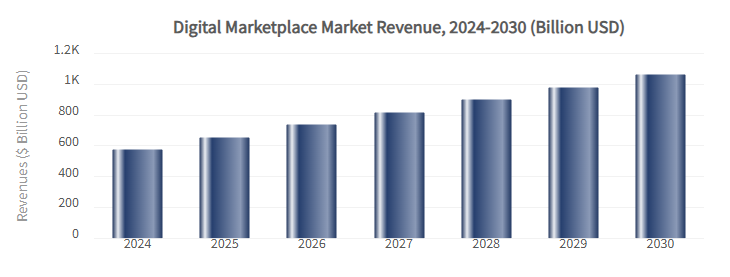
Here is a list of strategic stats that have impacted the rise ofthe marketplace app development industry:
- The global digital marketplace market revenue was valued at $580.31 billion in 2024 and is predicted to reach $1064.90 billion by 2030, with a CAGR of 10.6% from 2025 to 2030 forecast period.
- In 2026, total revenue from online transactions is set to reach $6.88 trillion, which is a 7.2% increase from the previous year.
- The Indian ecommerce market was valued at $125 billion and is projected to grow to $345 billion by 2030, reflecting a compound annual growth rate (CAGR) of 15%.
- The AR/VR market, encompassing augmented reality and virtual reality, continues to grow at a CAGR of 29.7% from 2026 to 2033, projected to reach $1050.56 billion by 2033.
- Subscription commerce is projected to reach $46.05 billion globally by 2034, driven by the integration of recurring billing engines and automated renewal systems within marketplace apps.
Why these marketplace app development statistics matter:
For CTOs and founders, you should not read these numbers as “growth indicators”. Instead, read these as infrastructure signals.
When a market moves from $580B to $1T+ in six years, when ecommerce is pushed toward $6T+ in 2026, when AR/VR approaches and subscription commerce strategies compound steadily, this is not incremental growth. Instead, this is a structural re-platforming of the global commerce industry.
Marketplace app platforms have become economic infrastructure, and it demands data-driven decisions related to architecture, capital allocation, and operational resilience. This is the reason you should modernise your marketplace app development strategies.
Leverage effective IT consulting management services that ensure the marketplace app architecture, compliance frameworks, cloud strategy, and fintech integrations are aligned with long-term business objectives.
Marketplace App Architecture: The Main Fundamental Layers
Usually, the explanation of the marketplace app development strategy is around three core layers, which are. Backend, admin panel, and user interface. But in 2026, modern marketplace platforms require a strategic architectural approach that ensures scalability and a long-term cost control strategy.
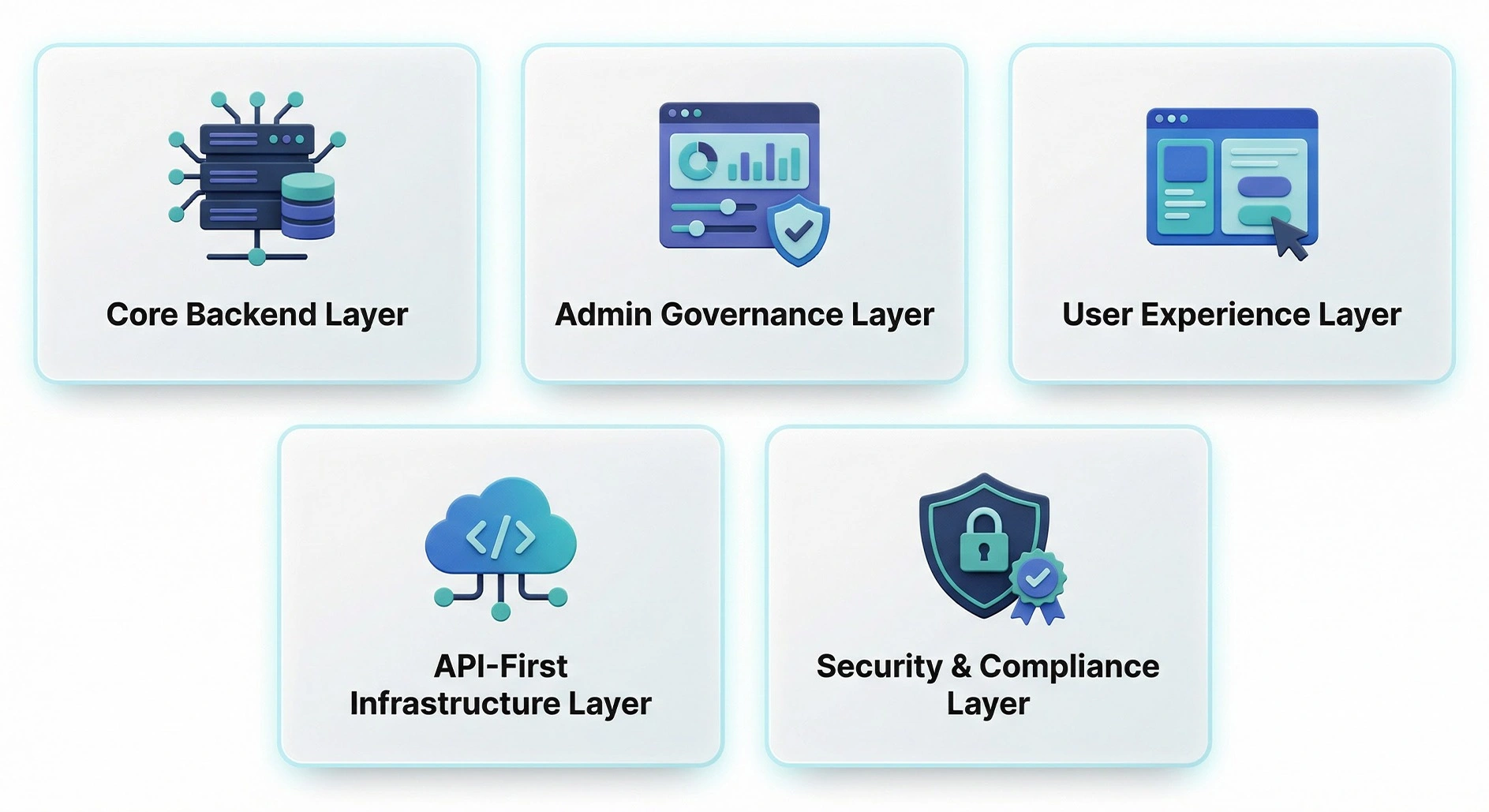
You should use the below given marketplace app architecture strategy that combines both basic, traditional structure and modern infrastructure-driven thinking:
Backend (Intelligence Core Layer)
Think of the backend as the brain of your marketplace app. It’s not just where your data lives, but it’s where every important decision happens in real time. A modern marketplace backend handles a lot more than CRUD (create, read, update, and delete) operations. It’s running recommendation logic, calculating commissions, routing orders, detecting fraud, and managing the rules that govern how your platform behaves.
For long-term cost control, the key is polyglot persistence. This term means: using the right database for each type of data. Transactional data goes into PostgreSQL. Product catalogues go into MongoDB. Search goes into Elasticsearch. Caching goes into Redis, thus not using one repetitive database for everything.
Admin Panel (Operational Governance Layer)
It’s tempting to ship a basic dashboard and move on. But your admin panel is actually your operational backbone. It’s where your team manages vendors, resolves disputes, configures platform rules, tracks performance, and makes day-to-day business decisions. A weak admin panel means your team spends hours doing manually what should take minutes.
The modern admin panel needs to be thought of as an operational governance layer. That means implementing a full vendor lifecycle management, from onboarding and KYC to performance tracking and payouts. Always make sure to leverage role-based access control, so your support agents can see orders but can’t touch your commission structure or any other crucial user or business data.
User Interface (Conversion Layer)
Every pixel of your UI is either earning you revenue or losing it. Currently, the cart abandonment rate is around 70-75% for most of the marketplace apps. Here, the user interface’s design is not the problem. If you have a beautiful marketplace that loads slowly on mobile, you will lose customers to a less polished competitor that loads in under two seconds.
Your marketplace app development strategy should have real-time mobile app features such as offline support, push notifications, home screen installation, and also layout stability and interactivity.
API-First Infrastructure Layer
This is the layer that separates platforms from products. An API-first marketplace is one where every capability, like product search, order placement, vendor management, and payments, is accessible through a well-documented, versioned API. Your website, your mobile app, your partner integrations, and your B2B clients all consume the same API. Nothing is hardcoded into the UI.
Why does this matter? Because it’s what makes your marketplace expandable. When you’re ready to launch a mobile app, you’re not rebuilding your backend; you’re just building a new consumer for the API. When a logistics partner wants to integrate directly, they can. When an enterprise client wants to embed your marketplace into their procurement system, it’s possible without a custom build.
Security and Compliance Layer
This layer determines whether your marketplace survives long-term. Security is not a feature you add at the end. It’s a discipline embedded into every other layer. And in 2026, between HIPAA, GDPR, CCPA, PCI DSS, and a growing number of regional data privacy laws, compliance isn’t optional; it’s table stakes.
The most important thing for payment security is scope reduction. Use a PCI-compliant payment processor and let them handle raw card data. Your system never sees card numbers, only tokens. This moves you from the most complex compliance tier to the simplest one, saving you months of audit work.
Essential Features of a Modern Marketplace App
A marketplace application is only as strong as its core feature architecture. To get a fully functional marketplace app, you need to leverage various useful yet essential features for your app. These vital features will decide the uniqueness of your product in the market, and they are the actual revenue enablers, compliance safeguards, and scalability drivers.
Below are the essential features every marketplace app must integrate:
1. Account and User Profile Management
Login, signup, profile creation and account management are foundational components of your multi-vendor ecosystem. This secured and scalable identity management system is required for both sellers and purchasers.
Your online marketplace app should include:
- Secure sign-up and login
- Social authentication (Google, LinkedIn, etc.)
- Email verification & password recovery
- Profile creation and customisation
- Account status controls (ban, delete, suspend)
- GDPR-compliant data handling
- Role-based access (buyer, seller, admin)
Additionally, in advance marketplace app setups, onboarding flows also include KYC (know your customer) verification for sellers to ensure compliance and fraud prevention.
2. Listing and Catalogue Management
Listings are the core revenue drivers of a marketplace app. The listing must be descriptive, exclusive, and visually appealing so that it can give users a clear picture of products and services, thus improving product discoverability and conversion rate.
Your marketplace should include core capabilities like:
- Create, edit, draft, and delete listings
- Upload listing images and media management
- Geolocation tagging and listing approval workflows
- Pricing information and listing variations
3. Search and Discoverability
Search and discoverability functionalities can directly impact user engagement and transaction volume. Your app should have the precise placement of search & discoverability to get the proper access to authentic products and services.
The main features that need to be included are:
- Map and location search
- Location auto-complete
- Listing categories
- Filtered search
- Keyword search
- Availability search
To enhance performance and personalisation, platforms may leverage zero-party data and AI-driven recommendation engines.
4. Transactions and Commission Management
Transaction architecture must support multi-vendor complexity. Designing a secure and flexible transaction process is a mandatory requirement of marketplace app development.
Rather than embedding one transaction gateway, there should be multi-channel payment handling and commission logic. A well-designed transaction system within a marketplace app improves user trust and reduces operational and transaction-related disputes.
Core features include:
- Secure checkout
- Multi-payment options
- Commission calculations
- Cancellation policies
- Automatic listing expiration
- Refund workflows
- Delayed payouts
- Invoicing & tax calculation
- PDF receipts
- Post-transaction reviews
5. Payment and FinTech Integration
Marketplace payments are more complex than standard ecommerce payments because payouts must be distributed among multiple sellers. If you are trying to build a modern marketplace app, you need to rely on embedded FinTech integration that supports subscription billing, multi-currency settlements, etc.
Your marketplace app should include features such as:
- Geographic (area-wise) payment gateways
- Seller-onboarding flow that fulfils (KYC) requirements
- Authorise and capture workflow payments
- Strong customer authentication (3D security)
- Refund processing and delayed payout management
- Split payments between the seller and the marketplace
6. Availability and Booking Management
For building service-based or rental marketplace apps, the availability and booking management feature is a core infrastructure factor. These features ensure that inventory or time slots are accurately synchronised in real time, thus directly impacting overall platform reliability and customer trust.
You should include must-have features like:
- Booking calendar
- Availability-based search filtering
- Stock tracking and management
- Search/filter for finding availability
7. Admin and Governance Panel
To provide a best-in-class marketplace app experience, your admin panel should include comprehensive management capabilities. This layer works as the operational and governance control centre of your platform. A strong governance panel reduces manual intervention, improves response time to user issues, and results in scalable business growth.
Key features should include:
- Intuitive admin UI
- User search
- User account status
- User management
- Managing products or services that are being sold
- Access to all user-generated content
- Access to messages
- Ability to manage transactions
- Notification management
How to Develop a Marketplace App from Scratch?
Marketplace app development is one of the most strategic steps for businesses looking to align with evolving commerce trends. However, to develop a fully-functioning marketplace app, there should be proper placement of design, development, and alignment between product vision, technical architecture, and app monetisation strategies.
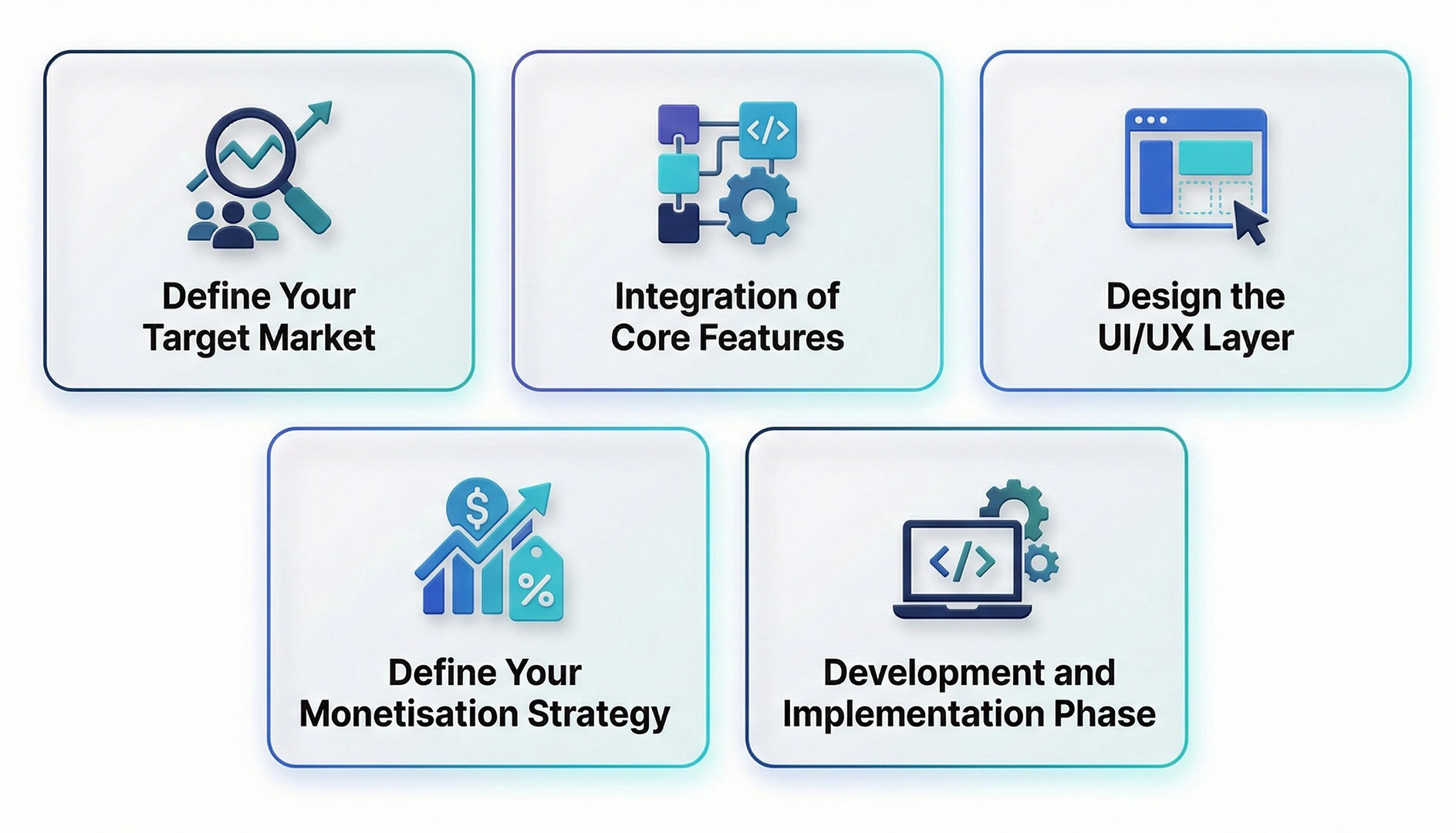
Below is a clear framework to understand how marketplace app development should be approached:
Define Your Target Market
To develop your marketplace app, you need to decide on the market segment first. There are three major types of marketplace apps:
- B2B (Business-to-Business)
- B2C (Business-to-Customer)
- P2P (Peer-to-Peer)
While selecting the market segment to target, you need to consider domain expertise, industry experience, available resources, and long-term growth potential. The chosen segment will decide the type of app you will build, the networking you should do, the associated marketing & promotional strategies & business models. A clear market focus ensures better positioning and faster liquidity growth.
Integration of Core Features
Once your segment is defined, the next step is to integrate the core features that are required for the seamless functioning of your marketplace applications. Your platform should include app architecture layers that we have discussed above.
Beyond essential features and architecture, foundational layers, modern marketplace apps should incorporate:
- AI and Machine Learning for personalisation
- Recommendation engines
- Advanced predictive analytics
- Voice search for improved discovery
- In-app messaging to enable direct buyer-seller communication
These elements enhance user engagement, improve conversion rates, and strengthen platform trust.
Design the UI/UX Layer
Marketplace platforms offer convenience. However, not all platforms successfully deliver a smooth user experience. One common mistake organisations make is failing to develop an effective UI/UX strategy. To avoid such issues, partner with a reliable MVP app development company and implement modern design trends that can keep your app minimal and user-friendly. This way, you can avoid clutter and not overwhelm users with excessive information.
One of the primary objectives should be to allow users to quickly search for their preferred products or services. Most visitors come to your platform with a specific purpose, and your app should help them accomplish that first. Upselling and product recommendations should follow naturally rather than dominate the experience.
For this, develop a proper prototype and wireframe that allows users to navigate freely and shop comfortably. You may launch an MVP (Minimum Viable Product) to test user behaviour, validate assumptions, and continuously improve your marketplace development strategy for better retention and satisfaction.
Define Your Monetisation Strategy
As mentioned earlier, there are multiple ways to monetise your marketplace. Let’s explore some of the common approaches.
Commission Model:
This is the most popular marketplace business model, where platform owners take a percentage commission on every product or service sold through the platform.
Premium Listings:
If you have used a marketplace app, you may have noticed that it lists products from multiple brands. To help sellers gain visibility, you can introduce a premium listing option where brands pay to appear at the top of search results. This increases exposure and improves sales opportunities.
Sponsored Promotions:
Apart from listing brands and companies, you can offer advertising space within your platform. For example, brands can run banner ads, featured promotions, video placements, or interactive campaigns for a fee.
Brand Collaborations:
This is another effective method to generate additional revenue. You can collaborate with selected brands or businesses as partners or exclusive sellers of specific products. Such collaborations can benefit both parties while strengthening marketplace positioning.
Development and Implementation Phase
Marketplace app development is more complex than standard mobile application development. It involves multiple modules, layered transaction systems, and advanced feature integration. Additionally, your marketplace app must remain stable under consistent usage and handle high traffic during peak periods.
This is why partnering with an experienced app development company and leveraging digital product engineering services is important. The right team will help determine the appropriate tech stack, programming languages, database systems, and deployment infrastructure required for scalability.
A strong technical foundation ensures long-term stability, performance efficiency, and smoother expansion as your marketplace grows.
Marketplace App Development Cost Breakdown
The cost of developing a marketplace app depends on multiple factors, including feature complexity, architecture choice, compliance requirements, and scalability expectations. Unlike a standard mobile app, a marketplace platform involves multi-vendor management, payment orchestration, commission logic, and real-time infrastructure.
Your investment should align with your business model, growth strategy, and long-term technical roadmap. Below is a realistic app development cost overview based on marketplace scope and complexity.
|
Marketplace App Type |
Estimated Cost (In USD) |
Approximate Development Timeline |
Ideal Use Case |
|
MVP Marketplace App |
$40,000 – $80,000 |
3–6 months |
Startups validating product-market fit |
|
Mid-Level Marketplace App |
$80,000 – $150,000 |
6–9 months |
Growing businesses expanding features |
|
Advanced Marketplace App |
$150,000 – $250,000 |
9–12 months |
Scaling platforms with personalisation & automation |
|
Enterprise-Grade Marketplace App |
$250,000 – $400,000+ |
12+ months |
Large platforms requiring high scalability & compliance |
Please note that these are only estimates that typically include backend development, user interface, admin panel, payment integration, and core marketplace features. Advanced technologies such as AI-driven recommendations, subscription billing systems, AR capabilities, or multi-country compliance layers may increase overall cost.
Wrapping Up
Marketplace app development requires a structured approach that balances technology, user experience, and business strategy. From choosing the right market segment to integrating secure payment systems, scalable architecture, and monetisation models, every decision plays a role in long-term sustainability. Conducting proper market research and defining clear objectives before development begins can significantly reduce risk and improve overall execution.
Since marketplace platforms involve multi-vendor management, compliance requirements, and performance optimisation, working with an experienced and best software development company like RipenApps is crucial. At RipenApps, we help businesses design and develop scalable marketplace applications backed by robust architecture, seamless user experience, and future-ready technology. With the right planning and execution, your marketplace can evolve into a reliable and growth-driven digital platform.
FAQs
Q1: Why should I build a marketplace app?
Building a marketplace app allows you to create a scalable business model without holding inventory. It enables you to connect multiple buyers and sellers on one platform, diversify revenue streams through commissions or subscriptions, and operate a system that can run continuously with automated transactions and payments. A well-architected marketplace also strengthens network effects, helping your platform grow organically as supply and demand increase.
Q2: What are the types of online marketplaces?
By target audience, they are separated into three classes:
- Peer-to-Peer (P2P) Marketplace App: Used by individuals to sell their services directly to other individuals.
- Business-to-Customer (B2C) Marketplace App: Used by businesses to sell their services directly to the end user base.
- Business-to-Business (B2B) Marketplace App: Used by businesses to transact and sell their products to other yet same-niche businesses.
Q3: How can a marketplace app ensure secure exchanges between the buyers and sellers?
The general purpose of the marketplace app, a stage that interfaces sellers and purchasers, is to offer the most practical and secure experience possible. A secure marketplace integrates robust payment gateways, encrypted data storage, PCI-DSS compliant payment processing, and automated KYC (Know Your Customer) verification for sellers.
Q4: What is the ideal approach to building a marketplace app?
The ideal approach depends on your budget, timeline, and scalability goals.
- Custom development offers full control, flexibility, and long-term scalability.
- Open-source or SaaS solutions may reduce initial costs and speed up launch, but can limit customisation and scalability.
- No-code or low-code platforms can help validate ideas quickly, but may require migration later.
Many businesses start with an MVP (Minimum Viable Product) to validate product-market fit before investing in a fully customised solution.
Q5: How much investment is required to build a marketplace app?
Marketplace app development typically ranges from $40,000 for an MVP to $400,000+ for enterprise-grade platforms, depending on feature complexity, scalability, and compliance needs. Development timelines are usually between 3 to 12 months based on the marketplace app type.

SHARE
WRITTEN BY

Ishan Gupta
CEO & Founder
Ishan Gupta is a seasoned entrepreneur and CEO with extensive 8+ years of experience in business and mobile app development landscape. He believes that the right digital product allows companies to focus on what they do best, while technology handles the rest. With deep exposure to global markets, he understands what makes an app succeed. His approach translates business needs into clear product strategies, ensuring that every feature contributes to measurable ROI.
View All Articles




 India
India USA
USA Australia
 Canada
 UK
UK UAE
UAE