



Australia continues to strengthen its position as a high-growth digital economy. Mobile-first behavior, AI adoption, fintech expansion, and strong startup funding are reshaping the mobile app development ecosystem nationwide.
The Australian app economy has shown consistent growth over the past few years. With smartphone penetration exceeding 90 percent and over 27 million active expected smartphone users in 2026, businesses are accelerating investments in scalable digital products. The demand for advanced, secure, and AI-enabled applications is increasing across fintech, healthcare, retail, logistics, and gaming.
If you are planning to enter the Australian market, understanding current trends is critical for long-term success. This blog will give you some useful insights about the market and emerging trends. So, let’s get started:
Table of Contents
Overview of Mobile App Development Industry in Australia
Australia is a leading hub for technology innovation and mobile app development. In recent years, it has made its strong presence in the field of mobile application development bagging position among the top 20 markets worldwide. From consumers to businesses, the adoption of mobile apps continues to rise breaking all the odds.
As the usage of mobile applications is expanding, the number of app developers and mobile app development companies in Australia is also increasing. Take a look at the latest market statistics and industry reports that demonstrate the prospering state of the mobile app industry in this country.
- According to the reports of the Business of Apps, the total revenue of the app market in Australia is estimated to reach approximately US$11.5 billion by 2027.
- In 2024, the Australian app market generated revenue of around $3 billion. Thus, showing steady growth driven by smartphone adoption and digital services.
- Approximately 34.4 million cellular mobile connections were active in Australia in early 2025. This accounts for over 90 % penetration of the population. Moreover, the number is increasing at a rapid rate.
- There are 2,500 + Australian mobile app developers actively publishing apps on Google Play and the App Store.
- Australian mobile apps average around 323 k downloads per app, reflecting broad user engagement.
- The total app market revenue in Australia is projected to exceed USD 11 billion by 2027, encompassing consumer spend, in-app purchases, and advertising income.
Why Is Australia A Booming Hub for Mobile App Development?
Australia is brimming with technology advancements and relentless innovation in digital and mobile app technologies. With the continuous rise in the usage of smartphones and mobile apps across industries, businesses today look to build ground-breaking apps for a wide range of use cases and business needs.
There has been a drastic growth in the number of mobile app developers and mobile app development companies in Australia. Nowadays, developers use emerging technologies such as artificial intelligence, augmented and virtual reality, wearables, blockchain, IoT, and more to create cutting-edge mobile app solutions to meet evolving user expectations.
This country is grabbing global attention by creating tech-driven mobile apps and digital solutions that not only resonate with smartphone users but also enable businesses to leverage market opportunities. Then a question must arise as to why this country is evolving as a hub in the field of mobile app development services worldwide. Below are the reasons
1. Thriving Tech Ecosystem
Australia is drawing global attention by emerging as a leading innovation Hub. Popular cities like Sydney, Melbourne, and Brisbane host numerous tech hubs and innovation centres, which, as a result, contribute to fostering a collaborative environment for start-ups and tech companies.
2. Highly Skilled Workforce
Australia boasts world-class universities and technical institutes that produce a steady stream of skilled graduates in computer science, engineering, and related fields. This strong talent ecosystem allows businesses to hire mobile app developers who are proficient in the latest technologies, frameworks, and industry best practices.
3. Government Support and Policies
The Australian government offers numerous grants, funding programs, and tax incentives for tech start-ups and companies to encourage investment in mobile app development. There are many policies to support innovation, research, and development to create a conducive environment for tech businesses to thrive.
4. High Smartphone Penetration
This country has a high rate of smartphone penetration. It is famous for having a tech-savvy population that eagerly adopts new mobile applications. So, when a country has a strong demand for innovative mobile apps it will definitely drive the growth of the mobile app development services in Australia.
5. Strong Economy and Business Environment
Australia’s stable and robust economy provides a solid foundation for business growth and investment in technology. It has a favourable business environment with supportive regulations and infrastructure which attracts both local and international tech companies across the globe.
6. Emerging Technologies and Innovation
App developers and top mobile app development company in Australia are quick to adopt and integrate emerging technologies such as AI, IoT, blockchain, and AR/VR into mobile applications. This country has regular tech meetups, hackathons, and conferences. All of these help in cultivating collaboration and knowledge sharing among dev community and tech enthusiasts.
Top Emerging Trends in Mobile App Development Australia
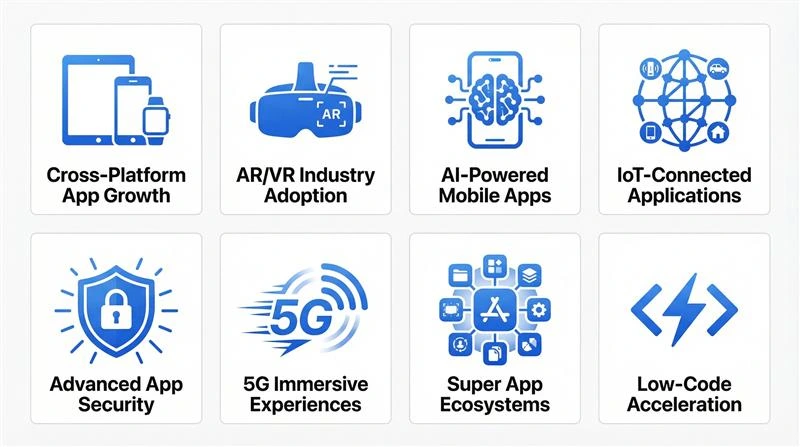
Now, it’s time to see what are the emerging trends that foretell the future of mobile app development in this country.
1. Increased Demand for Cross-Platform App Development
As businesses seek to reach a wider audience with minimal development costs, the demand for cross-platform app development is rising. Australian app developers nowadays expertly utilize top cross-platform frameworks like React Native, Flutter, and Xamarin to build and deploy apps for multiple platforms including iOS and Android.
Since this approach reduces costs and time to market, its adoption will increase more by start-ups and enterprises alike. Therefore, in Australia, this trend driven by the market need, will change market demands and user preferences.
Read Also: React Native VS Flutter: Which is Better For Your Business?
2. Integration of AR/VR Across Industry Verticals
Augmented and virtual reality are widely used technologies in Australian industry. Its interaction in mobile apps paves the way for more business scope. Hence, the integration of Augmented Reality (AR) and Virtual Reality (VR) is transforming various industry sectors, including retail, real estate, healthcare, and education.
Australia’s growing tech ecosystem is contributing to the advancement of AR/VR, which, as a result, leads to the development of applications that provide interactive and engaging user experiences.
3. Implementation of AI in Mobile Apps
Artificial Intelligence (AI) is becoming a cornerstone of mobile app development. Its unique capabilities like personalized recommendations, predictive analytics, and advanced user interactions through chatbots and virtual assistants empower industries to build cutting-edge apps.
Leading mobile app development company in Australia leverages AI to create smarter, more intuitive apps that can adapt to user behavior and preferences. The implementation of AI enhances app functionality and helps businesses to make informed decisions. So, in the near time, the integration of AI in mobile app development will grow more.
4. Expansion of IoT-Integrated Mobile Apps
The expansion of IoT-integrated applications is emerging as one of the most impactful mobile app development trends in Australia for 2026. Businesses are increasingly connecting mobile apps with smart devices, wearables, industrial sensors, connected vehicles, and home automation systems to deliver real-time monitoring and control. This shift reflects broader app development industry trends focused on automation, operational efficiency, and data-driven decision-making.
From healthcare and logistics to mining and smart cities, IoT-powered ecosystems are reshaping how enterprises approach digital transformation. As part of current trends in mobile app development, companies are investing in scalable architectures that support device connectivity, real-time analytics, and secure data exchange. Thus, making IoT integration a strategic priority rather than an experimental upgrade.
Read Also: IoT in Smart Cities: How IoT Apps Will Transform The Future of Living?
5. Growing Importance of Security in Mobile Apps
In 2026, cybersecurity is no longer a feature, but it is a foundation. With rising data breaches, AI-driven fraud, and stricter compliance requirements, users expect complete transparency and airtight data protection from every app they download. Privacy, biometric authentication, encrypted transactions, and secure cloud architecture have become standard expectations rather than premium add-ons.
For every leading mobile app development company in Australia, prioritizing security is now a strategic necessity. Compliance with regulations such as the Australian Privacy Act and global standards like GDPR, along with zero-trust security frameworks and real-time threat monitoring. Thus, this ensures apps remain trusted, resilient, and future-ready in an increasingly regulated digital ecosystem.
6. 5G-Enabled Real-Time & Immersive App Experiences
With Australia’s mature 5G infrastructure in 2026, mobile apps are delivering ultra-fast, low-latency experiences across industries. Businesses are now building real-time streaming platforms, cloud-powered gaming apps, AR-based shopping experiences, and live collaboration tools that were previously limited by network speed.
For mobile app development in Australia, 5G is no longer optional, but it’s a competitive advantage. From telehealth consultations and fintech transactions to IoT-controlled smart systems, real-time responsiveness is redefining user expectations. Companies investing in advanced mobile app development are leveraging 5G to create immersive, always-connected digital ecosystems that drive engagement and long-term retention.
7. Rise of Super Apps
One of the top mobile app development trends in 2026 is the rapid rise of super apps. Instead of using multiple standalone applications, users now prefer unified platforms that combine payments, shopping, bookings, messaging, and financial services in one ecosystem. This shift reflects major app development industry trends where businesses aim to increase user retention and lifetime value. In Australia, companies are adopting this model as part of broader business app development trends to create seamless digital journeys and reduce app-switching friction.
8. Low-Code and No-Code Acceleration
Among the current trends in mobile app development, low-code and no-code platforms are transforming how digital products are launched. Startups and enterprises are leveraging these tools to build MVPs faster, reduce development timelines, and validate ideas before full-scale deployment. While complex platforms still require custom engineering, this approach is becoming a key part of current mobile app development trends in Australia. It allows faster innovation cycles and allows businesses to respond quickly to evolving market demands.
Conclusion
The mobile app landscape in Australia is evolving faster than ever. From AI-driven innovation and IoT-enabled ecosystems to super apps, 5G experiences, and cross-platform efficiency, these mobile app development trends are redefining how businesses build, scale, and compete. For startups and enterprises alike, staying aligned with current trends in mobile app development is no longer optional, but it’s the foundation for sustainable digital growth.
As one of the top mobile app development trends shaping 2026, user-centric design combined with advanced technology is driving the next wave of transformation. At RipenApps, we help businesses turn these app development trends into scalable, future-ready digital products. So, if you’re planning to innovate in Australia’s fast-moving app ecosystem, now is the time to act and build with the right strategy, technology, and partner.

FAQs
Q1. What are the top mobile app development trends in Australia in 2026?
The leading trends include AI-powered applications, cross-platform development, cybersecurity-first architecture, AR and immersive experiences, super app ecosystems, and rapid growth in gaming and fintech apps.
Q2. Why is cross-platform app development growing in Australia?
Businesses want faster launches and lower development costs. Frameworks like Flutter and React Native allow companies to build apps for iOS and Android using a single codebase, improving efficiency and scalability.
Q3. How is AI transforming mobile apps in Australia?
AI enables personalized recommendations, predictive analytics, fraud detection, smart chatbots, and automation. Australian enterprises are integrating AI to improve user engagement and operational efficiency.
Q4. Is Australia a good market for launching a mobile app in 2026?
Yes. With over 22 million smartphone users, high digital adoption, and strong startup support policies, Australia offers a mature and innovation-driven app ecosystem.
Q5. What is the average cost of mobile app development in Australia in 2026?
Costs vary depending on complexity. A basic app may start around USD 40,000, while AI-powered or enterprise-level apps can exceed USD 150,000 based on features and integrations.
Q6. How long does it take to develop a mobile app in Australia?
An MVP typically takes 3 to 5 months. A full-scale enterprise application with advanced features may require 6 to 12 months, depending on the scope.

SHARE
WRITTEN BY

Ishan Gupta
CEO & Founder
Ishan Gupta is a seasoned entrepreneur and CEO with extensive 8+ years of experience in business and mobile app development landscape. He believes that the right digital product allows companies to focus on what they do best, while technology handles the rest. With deep exposure to global markets, he understands what makes an app succeed. His approach translates business needs into clear product strategies, ensuring that every feature contributes to measurable ROI.
View All Articles






 India
India USA
USA Australia
 Canada
 UK
UK UAE
UAE