

Cross-platform app development has unlocked ample opportunities for businesses with its robust single-code line feature. It’s the development strategy that is shaping how businesses capture diverse audiences faster and more cost-effectively. With over 6.9 billion smartphone users worldwide in 2025 and consumer demand for seamless app experiences on multiple devices, the pressure on businesses to launch apps that work everywhere is at an all-time high.
For startups and enterprises alike, the question is no longer “Should we build cross-platform apps?” but rather “How can we make them faster, smarter, and more scalable than the competition?” That’s where market research comes into the picture.
From tracking evolving frameworks like Flutter, React Native, and .NET MAUI to understanding user behavior shifts, a clear data-backed strategy can help you lead the industry. If you are an app owner looking to build cross-platform apps, this blog breaks down key market insights, latest statistics, and emerging trends that reveal where cross-platform app development is headed and what you need to do now to future-proof your strategy. Stay tuned till the end for some useful insights :
Table of Contents
Why Cross-Platform Development Matters in 2025?
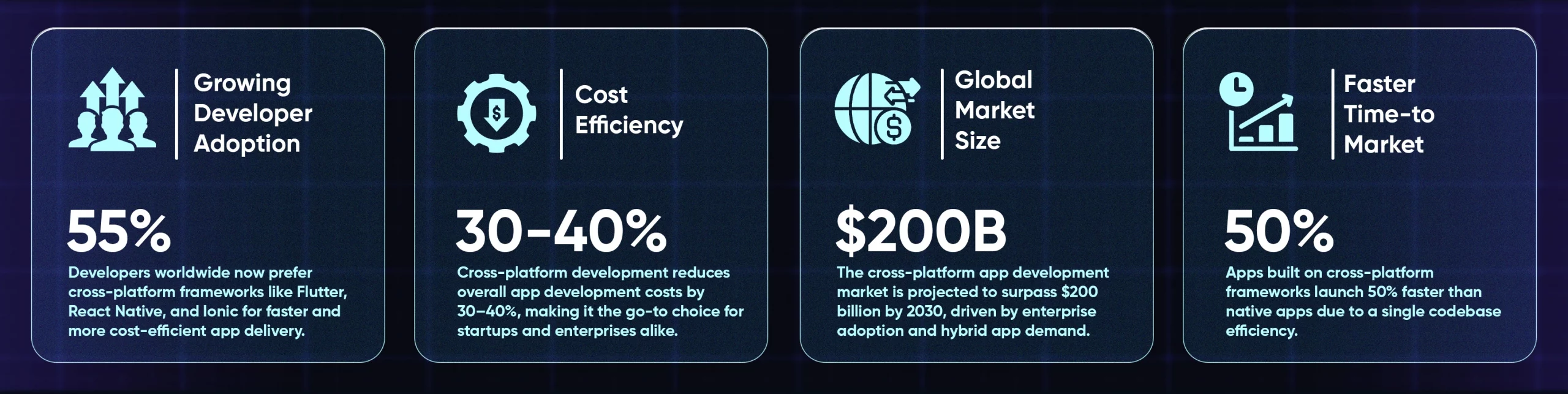
Over the past few years, cross-platform development has shifted from a cost-saving alternative to a strategic advantage. Moving ahead in 2025, with global smartphone users expected to exceed 7.33 billion and mobile app revenue projected at over $613 billion, businesses must deliver across platforms without compromising quality.
1. Wider Reach, Faster Time to Market
Cross-platform frameworks like Flutter and React Native allow you to build once and launch everywhere. Thus, you save up to 50% in development time and reduce costs significantly.
2. Market Momentum
The market for cross-platform frameworks is growing rapidly, projected to climb from $50 billion in 2025 at a 20% CAGR through 2033. This momentum positions them as sound long-term technology investments.
3. Shifting Developer Preference
Hybrid platforms like Ionic and Cordova lead in usage, but Flutter and React Native are gaining favor due to performance and versatility.
Most Popular Cross-Platform Frameworks With Updated Market Insights
By 2033, the cross-platform app development market is expected to reach $546.7 billion. It showcases how popular the cross-platform app development approach will be in the future. Moving ahead, we will briefly discuss some of the top cross-platform frameworks and how they are performing in the market. Flutter, React Native, Ionic, and Xamarin are the top ones on the list.
1. Flutter
Flutter is an open-source UI (User Interface) software development toolkit created by Google. It is used to build natively compiled applications for mobile, web, and desktop from a single codebase. Flutter is known for its fast development, expressive and flexible UI, and ability to create high-quality, visually appealing applications.
Here’s why Flutter matters:
- It leads the market: 46% of software developers chose Flutter in 2025. Thus, making it the most widely used cross-platform framework.
- Apps built with Flutter keep growing: 28% of all new apps launched on the iOS App Store today use Flutter.
The above stats show Flutter’s real momentum. It’s not just popular among developers, but it’s actively being chosen for new apps across platforms. For businesses aiming to scale faster, its the right time to hire hybrid app developers and stay ahead
2. React Native
React Native is an open-source framework for building cross-platform mobile applications. It was developed by Facebook and is now maintained by a community of developers and organizations. React Native allows developers to create mobile apps for multiple platforms, such as iOS, Android, and even some web platforms, using a single codebase.
Here’s how it’s shaping up in 2025:
- Growing market share: The share of newly released apps using React Native rose from 4.73% in 2022 to 6.75% in 2024. This shows a steady adoption.
- Strong revenue contribution: In Q4 2024, apps built with React Native generated around $287 million in net revenue, nearly matching Flutter’s $283 million.
- Performance upgrades: The framework has cut startup times by up to 40%, delivered smoother UI performance, and boosted memory efficiency by around 20–30%.
React Native is holding solid in 2025. All thanks to these useful insights. It remains a compelling choice for businesses seeking fast, near-native performance with wide platform coverage.
Also Read: React Native vs Flutter
3. Xamarin
Xamarin is a cross-platform app development framework that allows developers to create native mobile applications for iOS, Android, and Windows using a single codebase and the C++ programming language. Xamarin was initially an independent company, but it was acquired by Microsoft in 2016, and its tools are now integrated into Microsoft’s development ecosystem.
Here are the latest insights for 2025:
- Over 1.5 million developers actively use Xamarin for mobile app development.
- Xamarin holds roughly 15% market share among cross-platform frameworks, backed by strong enterprise adoption.
- Businesses value Xamarin’s integration with Visual Studio and its compatibility with .NET libraries. Therefore, making it a reliable choice for legacy Microsoft-centric projects.
Despite the rise of newer frameworks like Flutter and React Native, Xamarin remains a solid, trusted platform, especially for teams prioritizing enterprise-grade tools and Microsoft-based stacks.If you are a non-tech entrepreneur, you can also reach out to the best custom app development company to create apps using the best frameworks. The experts know well how to tailor the architecture, integrations and user interface to match your business needs.
4. Ionic
Ionic is an open-source framework for building cross-platform mobile and web applications using web technologies such as HTML, CSS, and JavaScript. It provides a set of tools, libraries, and components that enable developers to create high-quality, native-like user experiences for iOS, Android, and the web from a single codebase.
Here’s how Ionic stacks up in 2025:
- Still widely used: Over 5 million apps across 200 countries now run on Ionic.
- Developer base: About 3.5% of professional developers use Ionic, comparable to its market share among other frameworks.
- Installed app share: Ionic appears in approximately 3.7% of all mobile apps, holding its position among the top cross-platform tools.
Several top cross-platform app development companies in USA are also using the Iconic framework for building apps. It remains a compelling choice for teams that value web expertise, cross-platform reach, and ease of development, especially for PWAs and hybrid app deployments.
Top Apps Using Cross-Platform App Development Approach
Now that we have analyzed the top cross-platform app development frameworks and the market statistics associated with them, it is time to check out the top players using this approach. We will analyze these top apps through the categorization of the frameworks discussed in the previous section. This, in turn, will lead us to conclude the development of the cross-platform app.
Top Apps Using Flutter
- BMW: BMW adopted Flutter to adopt a more flexible, domain-based organizational structure. The challenge of building applications for multiple platforms in diverse countries was solved since Flutter used a single codebase, easing the overall work of developers and making the solution cost-effective.
- Google Pay: With Flutter, Google Pay was able to adopt a 70% reduction in engineering effort and a 35% reduction in lines of code, making it a chartbuster app for payments. To build a feature-rich platform like Google Pay, you can work closely with a top-rated cross platform app development company. They will provide you with a complete guide.
- Dream 11: Flutter is supporting 50 million fantasy sports users in India. Through Flutter, Dream 11 built a new multiplatform solution to more quickly deliver an innovative user experience
- eBay: The eCommerce giant was able to achieve 98.3% shared code and 2x faster development compared to native solutions.
- Tencent: One of the largest Chinese organizations, Tencent achieved 80% increased efficiency in debugging, 90% multi-platform code, and a 33% reduction in development efforts using Flutter.
Top Apps Using React Native
- Messenger Desktop: The application leveraged React Native technology and migrated from Electron to React Native flawlessly in a very short period. The entire application was built on React Native. This showcases how brands can achieve faster, scalable, and high-performance desktop experiences when they hire React Native developers with strong technical expertise.
- Microsoft Office: 345 million people are currently using Microsoft Office, which is built completely on React Native technology.
- Discord: React Native helped Discord achieve a native performance, holding a 4.8% star rating, and 99% of the app is now crash-free.
- Flipkart: The application is the largest eCommerce player in India, having several million weekly visits and millions of downloads. Through React Native, the company fixed delayed experiments and bug fixes. This results in decreased development efforts.
Also Read: Why choose React for Web Development- Features & Reasons?
Top Apps using Ionic
- Sworkit: The top-featured fitness app enhanced user experience for millions of users through a single codebase and the top-notch design flexibility of Ionic.
- Instant Pot: America’s #1 pressure cooker seller, secured positive ratings after leveraging Ionic technology. Today, the community has millions of active users.
- Shipt: A growing leader in grocery, Shipt aligned with the user requirements using Ionic technology. The team can keep its app updated effectively.
Top Apps using Xamarin
- Spotify: One of the top music streaming apps, Spotify is accessible in 183 countries, and 30% of Americans use Spotify every month. The app is built using the cross-platform app development framework Xamarin. You can also reach out to industry experts to build a music streaming app like Spotify.
- The World Bank: World Bank mobile apps use Xamarin technology to achieve cross-platform flexibility. The organization has leveraged a single base code line feature and deployed smooth apps on the iPhone and Android platforms.
Future of Cross-Platform App Development
We have researched enough dynamics to come up with the main question of the future of cross-platform app development. As you can see, the majority of brands have moved to a cross-platform app development approach to leverage maximum benefits.
Flutter has been taking over the market, with React Native coming later. Shortly, it is no doubt true that the majority of the apps will use cross-platform tech stacks. It is because the technology delivers a native experience, keeping the cost-effective, especially for startups. If you want to build a leading cross-platform app, we suggest you hire mobile app developers for your business. They will provide you with a complete roadmap and the best ideas to develop a competitive cross-platform app.
Wrapping Up
Cross-platform app development in 2025 is no longer about saving costs, but it’s more about reaching wider audiences faster, maintaining consistent experiences, and staying competitive in a rapidly shifting market. If you are a business leader, knowing the latest statistics and future trends can provide you with signals on where to invest, which technologies to prioritize, and how to align app strategies with user expectations. Therefore, if you want your next app to perform across devices without compromising on quality, now is the time to act on the above useful insights and partner with the right mobile app development company.

Frequently Asked Questions
Q1. What makes cross-platform development essential in 2025?
Cross-platform development lets you use one codebase for multiple platforms. Therefore, it is one of the best approaches to save time and money. With rising smartphone usage, it’s now a strategic move to reach users faster and with consistent experiences.
Q2. Which framework leads the market right now?
Flutter holds the top spot in popularity among developers today, reflecting its performance and flexibility. Many new apps prefer Flutter for rapid feature delivery and visual consistency.
Q3. How big is the cross-platform app market right now?
The market is expanding rapidly, with forecasts placing it in the hundreds of billions by the next decade. That makes it a key domain for businesses planning long-term digital strategy.
Q4. What benefits do businesses get from using cross-platform app frameworks?
You get faster time-to-market, cost savings with a single codebase, consistent UI/UX, and simpler maintenance. It empowers teams to innovate instead of reinventing for each platform.
Q5. Can cross-platform apps match native performance?
Yes, modern frameworks like Flutter and React Native produce near-native performance. Many leading brands report development times cut in half without sacrificing speed or fluidity.

SHARE
WRITTEN BY

Prankur Haldiya
Chief Technical Officer
A tech innovator and engineering leader, Prankur Haldiya drives RipenApps’ product development strategy and oversees cutting-edge solutions in mobility, AI, and cloud ecosystems. He is passionate about building high-performance teams and helping brands launch secure, scalable, and user-centric digital products.
View All Articles