

Imagine opening a website and feeling a digital world where every click feels instantaneous, and every transition is smooth. With some websites offering these capabilities and a clean, app-like experience, modern users now expect every brand to deliver the same level of speed and fast navigation. This is where React for web application development becomes essential.
React has rapidly grown and is known as one of the most used front-end web development technologies. In 2026, around 6.2% of all websites and web apps worldwide use React due to its reusable UI library and a rich ecosystem. What sets it apart from other frontend technologies is its component-based architecture that allows teams to build and reuse interactive UI elements that update instantly.
But delivering world-class digital experiences isn’t always effortless. As applications scale up, many development teams face code complexity and major performance-related bottlenecks. So, how can your development team ensure that your web application remains stable, even as new traffic comes in and new features are added?
React Solves This Problem at its Core. But How?
That’s what we will be talking about in this blog. From the core features that make React uniquely suited for modern interfaces to the top reasons why organizations across industries continue to choose React as their frontend foundational technology. You will also discover its real-world use cases, helping growing startups and enterprises to build scalable web apps that suit their unique requirements.
Table of Contents
What is React & How It Works?
React, or ReactJS, is an open-source JavaScript library designed to build fast, dynamic, and highly intuitive user interfaces. In simple words, React lets your development teams build modern and responsive UI experiences for websites, mobile applications, and desktop apps.
With its powerful features, it aims to allow your developers to create modular and reusable components that update efficiently as data changes. Instead of manually updating all the UI elements, React allows your developers to build apps wth modular components that automatically update themselves when the foundation code is changed.
Briefing ReactJS: Its History and Popularity
Before we look at the notable features of ReactJS and why it has become so popular, it’s equally important to look back at how it was developed and its rising adoption statistics. So, let’s dive briefly:
The invention of the ReactJS library was led when Meta, formerly known as Facebook, faced and met a real challenge. Before they built React, its own interface had become a memory-heavy application and struggled while rendering and updating dynamic UI elements as the platform scaled.
To solve this challenge, the company decided to develop its own JavaScript library that could deliver a smoother and faster user experience. After being successful and providing its capabilities internally, it was released as an open-source library in 2013.
Since its release, it has become one of the widely used and rapidly evolving front-end web development technologies in this modern app development ecosystem. With its powerful capabilities, it is now being used by major global tech brands that includes the following:
- PayPal
- Netflix
- Airbnb
- Microsoft
- Shopify
- BBC News
It has become a trusted choice for companies building high-impact and powerful user experiences across industries.
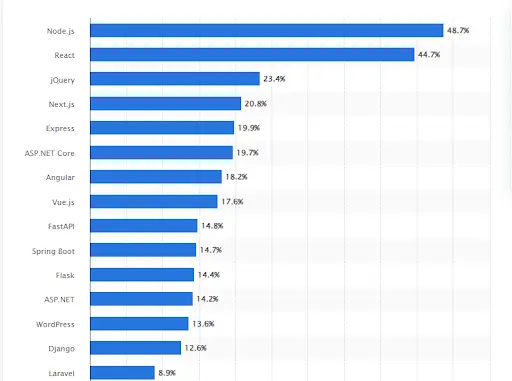
According to this recent Statista Survey, worldwide as of 2025, ReactJS is used by over 44.7% developers. In 2026, it continues to rank among the most widely used JavaScript technologies worldwide. This wide usage also shows how learning React has become a valuable skill and a strategic choice for web application development and future-ready digital experiences.
Why Choose ReactJS for Web Application Development?
For web application development, ReactJS has become the go-to choice for many growing startups and enterprises. With its component-based architecture along with strong core features, it enables your developers to maintain a clean and scalable code development approach, even while building complex UIs.
Whether you are utilizing React for a single-page web application development or creating a high-traffic enterprise-grade dashboard, it helps your teams to deliver fast performance without compromising the web app’s stability. To understand how ReactJS offers these real-world use cases, let’s look into the key features of ReactJS.
Notable Features of ReactJS: A Curated List
ReactJS packs many notable features that make it one of the most popular JavaScript libraries for web application development. Here are some of the notable features of ReactJS that hook your web developers to build a website using ReactJS.
1. Follows Declarative Programming Paradigm
ReactJS follows the Declarative programming paradigm to deploy the website interface. This means that your web developers do not have to define the control flow while coding, focusing on what to accomplish rather than how to achieve it.
It makes the overall web mobile app development process faster since your web developers do not have to worry about steps like DOM. For every change in ReactJS code, the declarative programming paradigm renders components as the data changes.
2. Maximum Utilization of Reusable Components
ReactJS code comprises components, so it features maximum utilization of the power of components. Components are designed with the re-usability approach and are rendered into the DOM by React DOM library. Your developers can declare the components either through functional components or class-based components. Here is an example of components in ReactJS.
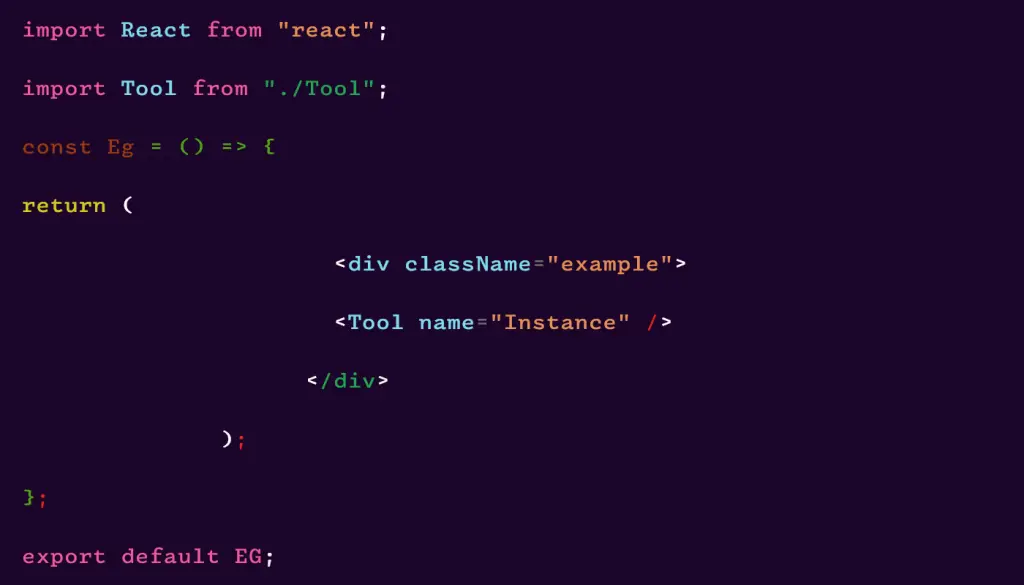
In the above example, the name property took value from the “Eg” component sending it further to the “Tool” component.
3. Use of Virtual DOM
ReactJS uses virtual DOM to create an in-memory data structure cache and the process is known as Reconciliation. A virtual representation of UI is stored in the memory which syncs with the real DOM.
Whatever state a web developer has to maintain in the UI, the real DOM updates itself accordingly, fetching attributes from Virtual DOM. This saves your developers’ time and boosts the web app’s performance since there is no need to recalculate the complete CSS style, page layout, and rendering.
4. Lifecycle Management of Components
When the code executes components, they are either reused or destroyed. ReactJS offers lifecycle management for components letting your web developers manage them effectively.
Modern React primarily manages React components’ lifecycle using hooks, which simplifies the overall code logic and also helps your developers reduce boilerplate code.
Some of these are:
- useState: This hook enables your developers to create and manage state within functional components. Whenever the state changes, the component re-renders automatically, ensuring that the UI remains updated always.
- useEffect: This ReactJS hook lets your developers synchronize a component with an external system. It handles functions or side effects such as fetching data from external APIs or updating the DOM.
- useCallback: This hook lets your developers cache a function definition between component re-renders. It returns a memoized version of a function and prevents it from being recreated again, unless there are any dependencies.
- useMemo: This hook helps improve performance by caching heavy memory usages or computations. If the inputs remain unchanged, React reuses the stored data or information, instead of recalculating it again, resulting in minimized processing.
5. Unleashing JSX
JavaScript Syntax Extension or JSX offers a way to structure the components that are familiar to most developers. Although your developers can completely use JavaScript, they have the option of writing code in JSX.
Another example of a JSX-like extension is XHP for PHP, developed by Facebook. When you write code in JSX, the written code converts to JavaScript syntax in the compilation process. The main motive of JSX is to extend the use of JavaScript, where your web developers can use multiple attributes together.
The feature set offered by ReactJS can easily hook your web developers. Once you have understood it, you can finally understand the top reasons to choose ReactJS.
Read Also: React Vs Angular: Which Framework is the Best Choice for App Development?
Where React Works the Best: Top Use Cases
React is widely adopted across various industries due to its features that maximize flexibility and enable your development teams to build scalable and next-gen user interfaces for your web apps. Features like reusable components, virtual DOM, and efficient state management, discussed earlier, power React the preferred frontend library for modern web application development.
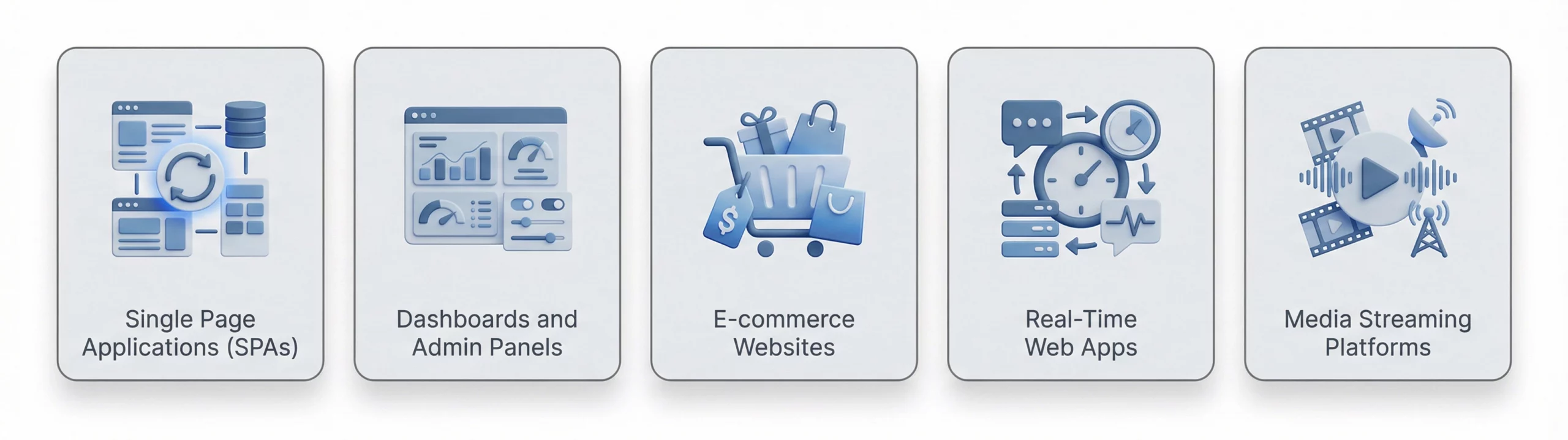
Here are some of the most common use cases where React proves its popularity:
1. Single Page Applications (SPAs)
React is one of the best technologies for SPAs, where users interact with content without needing to reload the page. For future-proofing web development, many startups and enterprises heavily rely on ReactJS as it allows them to launch MVPs quickly and scale features over time.
With React’s dynamic component rendering, your developers can build web apps that have seamless navigation, thus providing a smooth and truly app-like experience to your end user base. It is perfect for companies that want to achieve high engagement levels.
2. Dashboards and Admin Panels
React is a powerful fit for dashboards and admin panels that require real-time updates, data visualization, and dynamic user interactions. With reusable UI widgets and efficient state handling, your developers can build interactive tables, forms, graphs, and filters that respond instantly to user input.
Combined with libraries like React Query, Redux, and D3.js, React makes it easy to build complex data-driven interfaces that remain fast, intuitive, and scalable as the data scales.
3. E-commerce Websites
E-commerce platforms demand speed, personalization, and seamless user journeys, maintaining all the steps, from browsing products to final checkout. React stands out here as it enables your development teams to render UI components dynamically, leading to fast updates and personalized UI experiences.
Paired with frameworks like Next.js and integrations like Stripe or Shopify APIs, React supports high-performing storefronts capable of handling thousands of SKUs and user sessions. This ensures a smooth shopping experience.
4. Real-Time Web Apps
Applications like chat systems, collaboration tools, messaging platforms, and live chatbot apps rely on immediate UI updates. React’s state-driven architecture, combined with WebSockets or libraries like Socket.IO, enables your developers to build real-time features without performance lag.
This allows your developers to deliver responsive, interactive apps where every update, from messages to notifications, appears instantly without manual refresh.
Read Also: Progressive Web App Vs Website: Which One Suits Your Business Needs?
5. Media Streaming Platforms
Media-heavy platforms such as video streaming, live content feeds, or interactive media portals benefit from React’s rendering efficiency and modular UI structure. React helps your developers to deliver smooth interfaces, organized content using grids, and personalized recommendations while minimizing buffering or UI glitches.
Combined with CDN delivery and adaptive streaming, React enables your developers to provide a seamless user experience for high-traffic platforms.
Top Business Reasons to Choose React Web Development
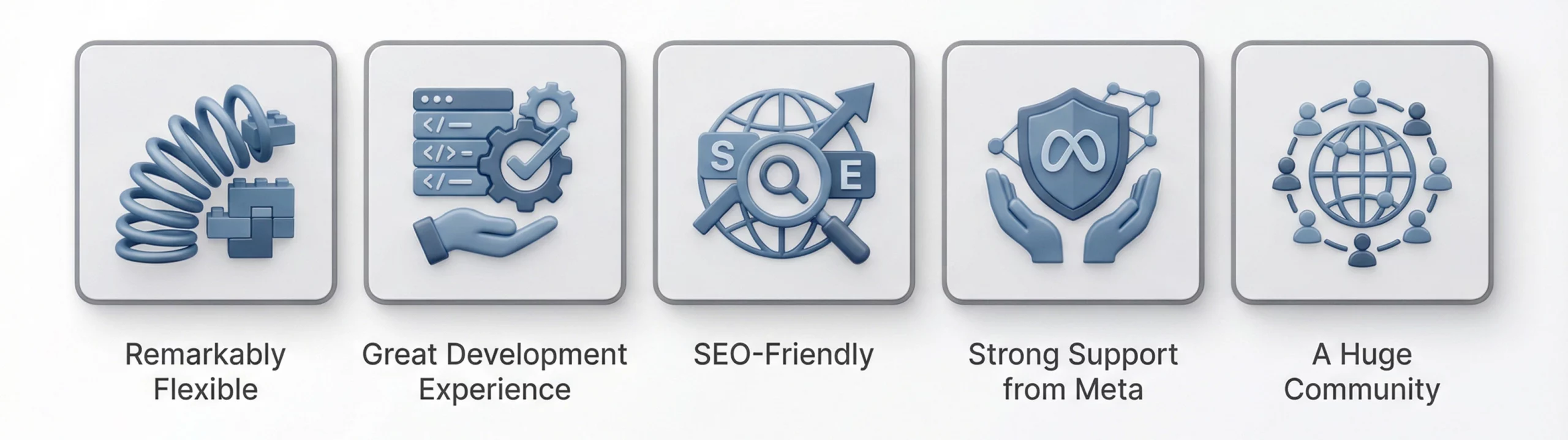
After understanding the core features of React, it is clear why React and leveraging website design and development services have become a popular choice for many growing startups and enterprises. Let’s walk through the key reasons for utilizing ReactJS application development. This will help you understand why React web development companies and their developers choose ReactJS for web development:
1. Remarkably Flexible
ReactJS is flexible since you can build a variety of user interfaces using just this library. Although it is technically a library, some developers easily confuse it with a framework because of the powerful features it offers.
2. Great Development Experience
Many developers prefer technologies that offer ease of learning and a strong community. The API of ReactJS is simple and lightweight. This enables them to start quickly and deliver interactive user interfaces with faster development cycles.
3. SEO-Friendly
ReactJS encourages fast page rendering, which supports search performance. When paired with server-side rendering tools like Next.js, React-based web apps can significantly improve SEO visibility, especially for content-rich or dynamic websites.
4. Strong Support from Meta
React is heavily used across Meta-owned platforms, including Facebook and Instagram. Continuous enhancements, bug fixes, and innovation from Meta benefit the entire open-source community, ensuring long-term reliability and growth.
5. A Huge Community
ReactJS has been growing actively since 2015, and the GitHub repository of ReactJS has achieved and earned 242k stars so far. Also, StackOverflow hosts thousands of discussions and solutions around React, helping any fellow developer to get support instantly while utilizing ReactJS application development.

Wrapping up
React has moved far beyond being just another JavaScript library. Today, it stands at the centre of modern web innovation. With its reusable component architecture and ever-expanding ecosystem, React empowers your developers to build applications that are easily scalable whenever user demand increases over time.
Whether you’re launching an MVP, modernizing a legacy platform, or building a complex enterprise product, partnering with an experienced website development company can help you unlock the full potential of React. At RipenApps, we believe successful products are built through partnership, not just code. Our web app development process blends strategy, UX thinking, and engineering principles to deliver solutions that truly make an impact.
From Cilio in smart automation, to Stoklo in B2B ordering, and Shubhra Ranjan in civil service learning, we’ve helped brands in diverse domains bring their ideas to market and scale them confidently. Our clients trust us because we deliver digital products that grow alongside their users and ambitions.

FAQs
Q1. Is React for web application development?
Yes, React is widely used for web application development. However, it does not limit you to only building web apps. You can build websites, mobile apps and desktop apps as per your business requirements.
Q2. Why use ReactJS for web development?
With the increasing focus of users on the UI quality of any website, ReactJS helps you build highly interactive and visually appealing applications. The rich JavaScript library ecosystem simplifies the development process while ensuring your app stays responsive and scalable.
Q3. How popular is React?
React remains one of the most widely adopted frontend technologies and a reusable JavaScript library. If you look at the popularity worldwide, more than 44% of the developers leverage ReactJS technology to meet their project requirements.
Q4. How to hire a React app development company?
While hiring a React app development company, you need to explore the portfolio of the shortlisted website development companies. Further, check out the client testimonials to identify the client satisfaction level. Finally, go through the social media page of the company to get an idea of the working environment.
Q5. Is React better than Angular or Vue for web apps?
While comparing React with Angular and Vue, React stands out the most due to its flexibility and faster learning curve. React is more lightweight and provides easy integration with other third-party tools and libraries, as compared to the other two frontend technologies.

SHARE
WRITTEN BY

Prankur Haldiya
Chief Technical Officer
A tech innovator and engineering leader, Prankur Haldiya drives RipenApps’ product development strategy and oversees cutting-edge solutions in mobility, AI, and cloud ecosystems. He is passionate about building high-performance teams and helping brands launch secure, scalable, and user-centric digital products.
View All Articles