

Web application development is not only a tech trend but a necessity for every business owner to achieve their goals. Web apps allow business owners to connect seamlessly to their target audience and offer more personalised services, instantly and at scale. In 2026, the demand for building web applications is increasing at a rapidly growing scale.
But the main question here is: why must businesses navigate the evolving demand of web app development to remain impactful and competitive? Today, users expect instant access, seamless experience, and effective real-time solutions. For business owners, this means going beyond chasing the static online presence and creating web apps that truly serve the user while driving growth.
For startup founders, product leaders, and CTOs, the challenge has shifted. It is no longer about simply launching a product; it’s about building responsibly and creating dynamic apps. Development teams now need to balance innovation, security, and scalability as expectations and technologies evolve faster than ever.
In this expert guide, you will get a complete roadmap to web application development for 2026. From understanding the rising demand for web applications to how much they cost, you will explore all the key aspects required to create a high-performing and functional web application.
Table of Contents
What is Web Application Development & Why It Matters?
Web Application Development is the process of creating software that runs directly on remote servers, and users can access it through web browsers. These web applications provide a more convenient and better cross-platform experience on any device, be it a desktop, tablet, or mobile.
Business owners build web applications for various tasks, and that’s why they come in different forms to perform specific business tasks. You can choose to build from customer service portals to complex e-commerce platforms to meet the unique needs of your business.
Today, web applications are considered a strategic asset or tools that help you to improve efficiency, engage customers, and stay ahead in the competitive market. This is why, in 2026, many businesses are increasingly adopting modern web application development trends such as AI-powered features or serverless deployments, thus improving flexibility and performance.
By availing professional website design and development services, you can also utilise these modern trends and provide your users with valuable information and enhance customer service. This will help you in driving more engagement and growth.
Current Market Scenario of Web Application Development
The global web app development market has been growing rapidly for the past few years. According to the Business Research Insights report, the market size is expected to reach by $165.13 billion by 2035 at a CAGR of 8.03%, from 2026 to 2035. This demand is skyrocketing in various sectors, including healthcare, education, e-commerce, and others.
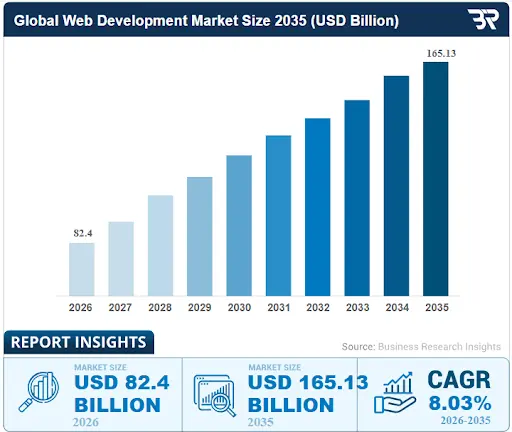
The scope of web applications will continuously expand in 2026. This is because of the digital transformation, wider cloud adoption, the rise of Progressive Web Apps (PWAs), AI, and various other emerging security protocols. Thus, by leveraging web application development, business owners can provide a better user experience than ever before.
The growth is fueled by continuous technological advancements and the ongoing shift toward online-first business models. No doubt, in 2026 and the upcoming years, web apps will evolve with more advanced features meeting the user expectations and highest standards of security, scalability, and personalisation.
Key Steps in the Web Application Development Process
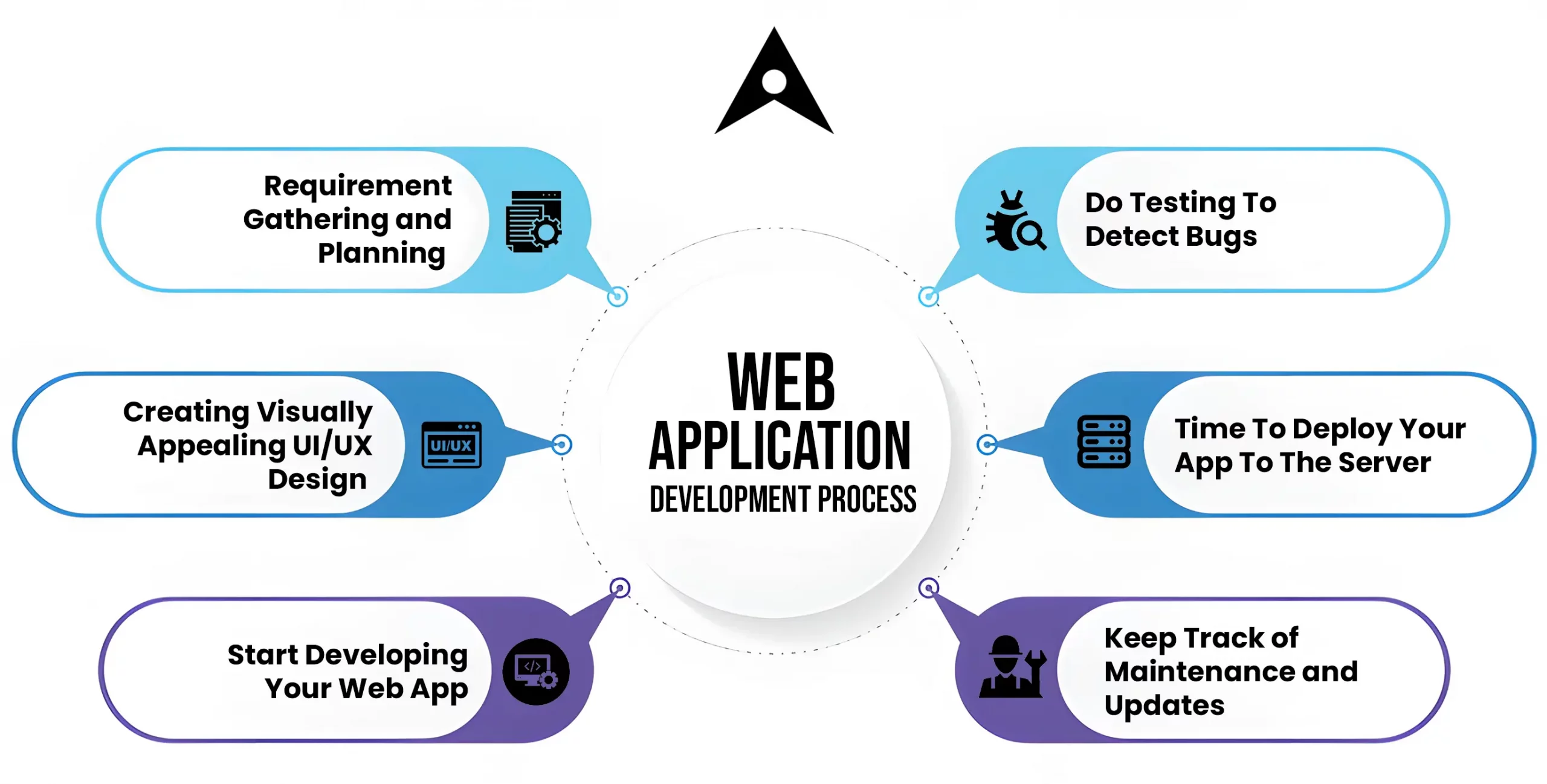
If you are looking to create a successful web application, then it will involve some critical steps. Each of the web application processes contributes to the functionality, design, and user experience of your app. Here we have mentioned the step-by-step web app development process:
1. Requirement Gathering and Planning
Making an effective plan acts as the groundwork for the development of web-based applications. First, you need to understand your target audience and define your mobile application goals. Business owners need to gather all the necessary information to build a high-performing web app.
During this initial step, you also need to decide what features or functionalities you need to include in your app. In 2026, business owners should also leverage AI in web development to validate ideas and prioritise features with a more accurate prediction.
2. Creating Visually Appealing UI/UX Design
User Interface (UI) and User Experience (UX) design play a very crucial role in creating intuitive and more visually appealing applications. One of the major advantages of having a unique and well-designed web application is that it not only attracts more targeted users. It also helps you to improve retention and engagement rates.
With the help of wireframing and prototyping, you can easily visualise your web app design before moving toward a full-fledged development process. A well-recognised UI UX design agency can work with you to create more unique and appealing designs for your apps.
3. Start Developing Your Web App
The next crucial custom web application development process includes the actual coding of building the app. The front-end developers are responsible for working on the look and feel of your application, whereas the back-end developers ensure seamless performance and functionality. That’s why it’s advisable to hire full stack developers who have an in-depth knowledge of both front-end and back-end development processes.
Business owners should work closely with a globally recognised web application development company. They are familiar with multiple programming languages such as React, Angular, Node.js, and Django and adopt modern frameworks such as Next.js, and work according to your project needs.
Read More: A Guide On Web & Mobile App Development Using AngularJS Framework
4. Do Testing To Detect Bugs
Testing is also a necessary step in the process of web and application development. It is done to ensure that your application is free from all bugs and is compatible with multiple browsers.
During the testing phase, the custom website development company focuses on usability, improving security, and overall performance. They also need to rely on automated testing suites, CI/CD pipelines, and AI-enabled testing tools, thus speeding up the testing process to catch issues earlier.
5. Time To Deploy Your App To The Server
After the testing of your web app, it’s time to deploy it to the server so that users can easily access your application. This process also includes several steps, such as setting up the server environment, configuring databases, incorporating various security measures, etc.
Many modern deployments now use serverless platforms like Vercel or Cloudflare Workers, microservices-based architectures, and containerization tools such as Docker and Kubernetes for smooth scaling.
6. Keep Track of Maintenance and Updates
Once the development and deployment process is completed, you need to continuously keep track and monitor your app to ensure that it performs well post-launch. A top-notch web application development company can monitor your app in the best possible way.
Your application may need regular updates to add new exciting features and fix bugs to improve app performance. With the evolving user demand, your web app should also adapt to stay useful for a long period. You can consider to hire mobile app developers to monitor and improve the ongoing performance of your web application.
Benefits of Developing Web Applications
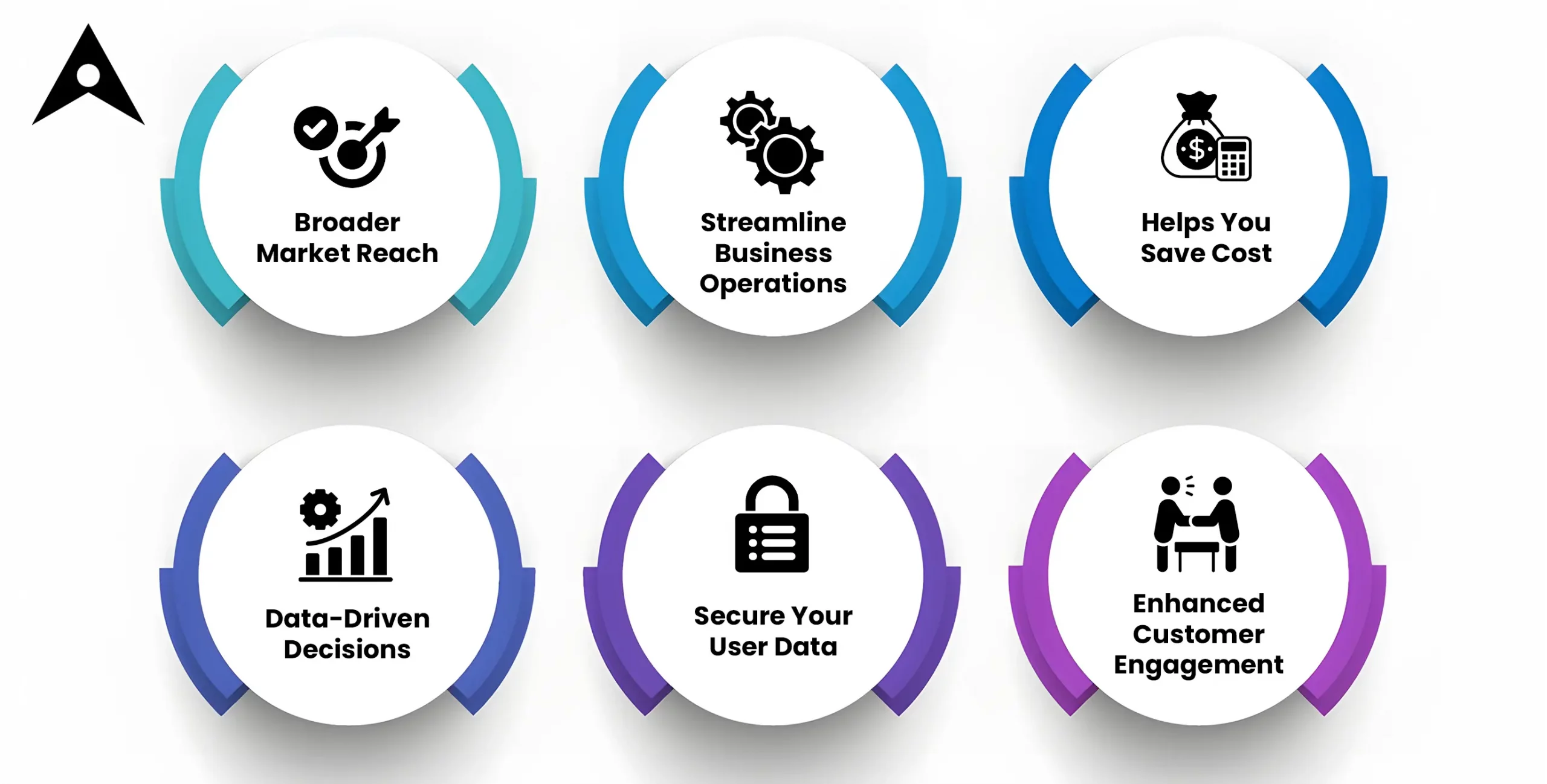
Custom web application development comes with numerous advantages that help app owners grow their businesses. Business owners can also make the best use of web application architecture for developing a dashboard to manage large datasets. Moreover, the pointers below tell you whether Native, Hybrid, or Web is right for mobile app development. To give you a bigger picture, here we have mentioned some major key benefits that showcase why web applications are an important part of business strategies.
1. Global Accessibility and Broader Market Reach
Users can easily access your web applications anywhere, anytime, or from any device or browser. Therefore, investing in web and application development offers you cross-platform solutions to reach a wider target audience globally. Due to this universal accessibility, entrepreneurs can reach more target audiences. You can also opt for custom business web app development services to support international growth and simplify your customer engagement as well.
2. Business Automation To Streamline Operations
Intelligent automation solutions, including building AI-driven web apps, can minimise your operational costs and enhance efficiency. If you are planning to create web applications, they can help automate several tasks, such as customer service and inventory management. Therefore, these AI-driven web apps can reduce the workload on employees and aim to enhance efficiency. After that, your team can focus on high-level priority tasks.
3. Develop and Maintain Your Web App At Minimum Cost
You can host your web apps on the cloud, which also eliminates the need to incur higher upfront costs due to extensive hardware requirements. But when your app is hosted on-premise, it will need some investment in hardware and infrastructure.
Moreover, if you choose to develop a single web app, it will be more cost-effective compared to building separate apps for each operating system. Businesses can invest in custom web application development services to save their development and maintenance costs in the long run and maximise their ROI.
4. Helps You To Make Data-Driven Decisions
Web applications allow you to gather valuable user data and offer some valuable insights into customer preferences and their buying behaviour. Entrepreneurs can make the best use of collected data to drive better decisions, make strategic plans, and improve their custom web application development services over time.
Moreover, business owners are also using web application architecture for developing a dashboard for a large dataset on AWS to make even better decisions.
5. Secure Your User Data and Business Assets
The security concern is increasing continuously. During the development of web web-based application, you need to implement various security measures such as secure authentication, data encryption, and other industry standards to secure your sensitive user data and business assets.
You need to ensure secure communication between the server and the user via end-to-end encryption. You can opt to add more security layers, such as OAuth protocols and MFA, to improve authentication processes.
6. Engage More Targeted Users Like Never Before
Web development applications give you ample number of opportunities for business owners to offer a more interactive experience. Leveraging the latest full stack web development technologies for your web project will also help you to engage more customers.
It will increase your customer engagement to a great extent. Also, incorporating various updated features such as personalised content, real-time notifications, and chat support can give you a chance to build a more dynamic platform for your users.
The Complete Web App Development Cost Breakdown
The cost of developing a web application varies based on the features you need. Some of the features that influence the total cost are the complexity of your idea and the expertise of the development team involved. To help you estimate more accurately, here’s a detailed breakdown of web app development costs based on features, project type, and development location:
1. Cost Breakdown by Features
Understanding the cost by feature set helps you estimate how spending scales as you add more functionality. The more capabilities your app needs, the more time, expertise, and engineering effort will be required. Below is a table comparison of how features influence your final web application development budget:
| Feature Set Category | Core Features Included | Estimated Cost Range (In USD) |
| Basic Features | Static pages, basic forms, CMS, and login | $10,000 to $25,000 |
| User Accounts & Roles | Authentication, dashboards, and permission controls | $7,000 to $30,000 |
| Admin Reporting Panel | Analytics, insights, and content management | $8,000 to $40,000 |
| Payment Systems | Gateways, invoices, and checkout | $10,000 to $50,000 |
| 3rd-party API Integrations | CRM, ERP, email, maps, and SMS | $5,000 to $40,000 |
| Real-Time Features | Live chat, notifications, and tracking | $12,000 to $60,000 |
| AI/ML Enhancements | Recommendations, chatbots, and automation | $15,000 to $80,000 |
| Security Upgrades | MFA, encryption, audits, and compliance | $8,000 to $50,000 |
2. Cost Breakdown by Project Type
Every web project falls into a different category depending on how much functionality, scalability, and customisation you need. Whether you’re building a simple tool or a complex business platform, your project type will have a direct impact on timelines, effort, and cost. Use these ranges to benchmark where your idea fits. So, have a look at the table below:
| Project Type | Estimated Cost Range (In USD) | Ideal For |
| Simple Web App | $15,000 to $35,000 | Business site, basic portal |
| Mid-Level Web App | $35,000 to $80,000 | Bookings, dashboards, workflows |
| E-commerce Platform | $80,000 to $150,000 | Products, payments, orders |
| Enterprise or SaaS System | $150,000 to $300,000+ | Automation, multi-role access, integration-heavy |
3. Cost Breakdown by Development Location
The location of your chosen development team can significantly affect overall pricing. Hourly rates vary across countries depending on talent availability, technical experience, and market demand. Here is a table that outlines typical cost expectations based on the top 5 web application development regions:
| Country | Average Hourly Rate (In USD) | One-time Project Development Cost (In USD) |
| India | $20 to $50/hr | $20,000 to $100,000 |
| Poland | $40 to $80/hr | $50,000 to $150,000 |
| United Kingdom | $70 to $150/hr | $100,000 to $250,000 |
| Canada | $80 to $160/hr | $120,000 to $300,000 |
| United States | $90 to $180/hr | $150,000 to $350,000+ |
Closing Statement
The role of web application development is undeniable. By developing web apps, you can connect with a wider target audience, streamline business operations, boost customer engagement, and make better digital transformation strategies. Apart from all these benefits, it can give you an edge over your competitors. Therefore, in today’s tech-driven era, entrepreneurs must understand the web application development process and recognise its benefits to position themselves at the forefront of innovation.
Whether you are building a simple business portal, revamping internal workflows, or launching a market-ready SaaS product, collaborating with a skilled web development partner can make all the difference. At RipenApps, we couple strategy, user-centric design, and advanced engineering to craft web solutions that evolve with your customers, not just your codebase.
From productivity platforms and consumer-facing solutions to enterprise-grade tools, we’ve supported visionary founders across industries in turning bold ideas into high-performing web applications. Our mission is simple: build digital products that deliver impact today and scale confidently into tomorrow.

FAQs
Q1.What is the basic difference between a website and a web application?
A web application is a type of program or software that a user can easily access through any device or web browser without installing it on a device. Whereas a website is a complete collection of related web pages with the same domain name.
Q2.What is the difference between a web application and a mobile application?
A web app can be accessed through a browser, and users can use it on any device over the internet. On the other hand, the web application is installed and downloaded on a device. Web applications are cross-platform, whereas mobile apps are often platform-specific.
Q3.How long does it take to develop a web application?
The time to develop a web application depends on various factors such as the web app’s complexity, features and functionalities you need to add, and many more. The more custom features and integrations you need, the more the web development time will be.
Q4.What technologies are best for web application development in 2026?
Most of the developers choose React for web development. However, other emerging technologies such as Angular, React.js, Node.js, Django, and Ruby on Rails are also best suited for web application development. Apart from these, technologies such as cloud integration, AI, and blockchain also play a crucial role in developing web applications.
Q5. How much does it cost to build a web application in 2026?
Web application development costs can range from $15,000 for a basic web app solution to over $300,000 for enterprise-scale applications. Pricing depends on the app’s scope, number of features, design needs, integrations, developer expertise, and country of development. The more complex your requirements, the higher the cost.

SHARE
WRITTEN BY

Ishan Gupta
CEO & Founder
Ishan Gupta is a seasoned entrepreneur and CEO with extensive 8+ years of experience in business and mobile app development landscape. He believes that the right digital product allows companies to focus on what they do best, while technology handles the rest. With deep exposure to global markets, he understands what makes an app succeed. His approach translates business needs into clear product strategies, ensuring that every feature contributes to measurable ROI.
View All Articles