

Web development has entered a new era. No longer is building a website about static pages and manual coding alone. It’s a data-driven, intelligent process powered by artificial intelligence. Today, AI in web development is bringing a seismic change in the digital landscape.
A recent report by Gartner reveals that over 40% of web development tasks will be automated by AI by 2026. Thus, it will make web development faster, smarter, and more efficient. Startup founders, CTOs, product managers, and digital agencies now face a unique opportunity: leveraging AI tools for web development to create websites that are intelligent, user-centric, and scalable.
This blog explores how AI-powered tools, frameworks, and automation systems are reshaping website design, testing, and maintenance. It also highlights real-world applications and emerging trends, helping businesses understand how to build smarter, faster, and more engaging websites.
Table of Contents
What AI Brings to Web Development?
AI doesn’t replace human creativity and developers. It amplifies their capabilities. By seamlessly integrating artificial intelligence in web development, businesses can make data-backed decisions and deliver seamless user experiences. AI web development tools assist developers by automating repetitive tasks, providing predictive coding suggestions, and enabling faster deployment.
With AI integration, businesses can achieve higher code quality, reduced development cycles, and cost-effective solutions without compromising innovation. Here are a few of the valid reasons for integrating AI in web development:
1. Smarter Coding and Automation
AI-powered coding assistants like GitHub Copilot and Tabnine help you to write cleaner, faster, and error-free code. They auto-suggest lines, optimize syntax, and even predict bugs before they occur. For startups and enterprises alike, this means shorter development cycles, reduced costs, and consistent code quality.
2. Personalized User Experiences
AI enables websites to adapt dynamically to each user’s behavior. From personalized recommendations to predictive content, AI web development tools ensure that every visit feels custom-made. You can think of it as a website that learns with every click. Thus, boosting engagement, conversions, and loyalty.
3. AI-Driven Design Suggestions
Platforms like Wix ADI and Bookmark use AI algorithms to automatically generate layouts, color palettes, and typography based on a business’s niche and target audience. This allows even non-designers to create professional-looking websites while freeing designers to focus on innovation instead of repetition.
4. Automated UX Research and Heatmap Analysis
AI-powered tools like Hotjar and Crazy Egg collect behavioral data and generate actionable insights. They show where users click, scroll, or drop off, and allow designers to optimize layouts for better engagement. This AI integration in web development transforms guesswork into data-driven design refinement.
Benefits of AI in Web Development
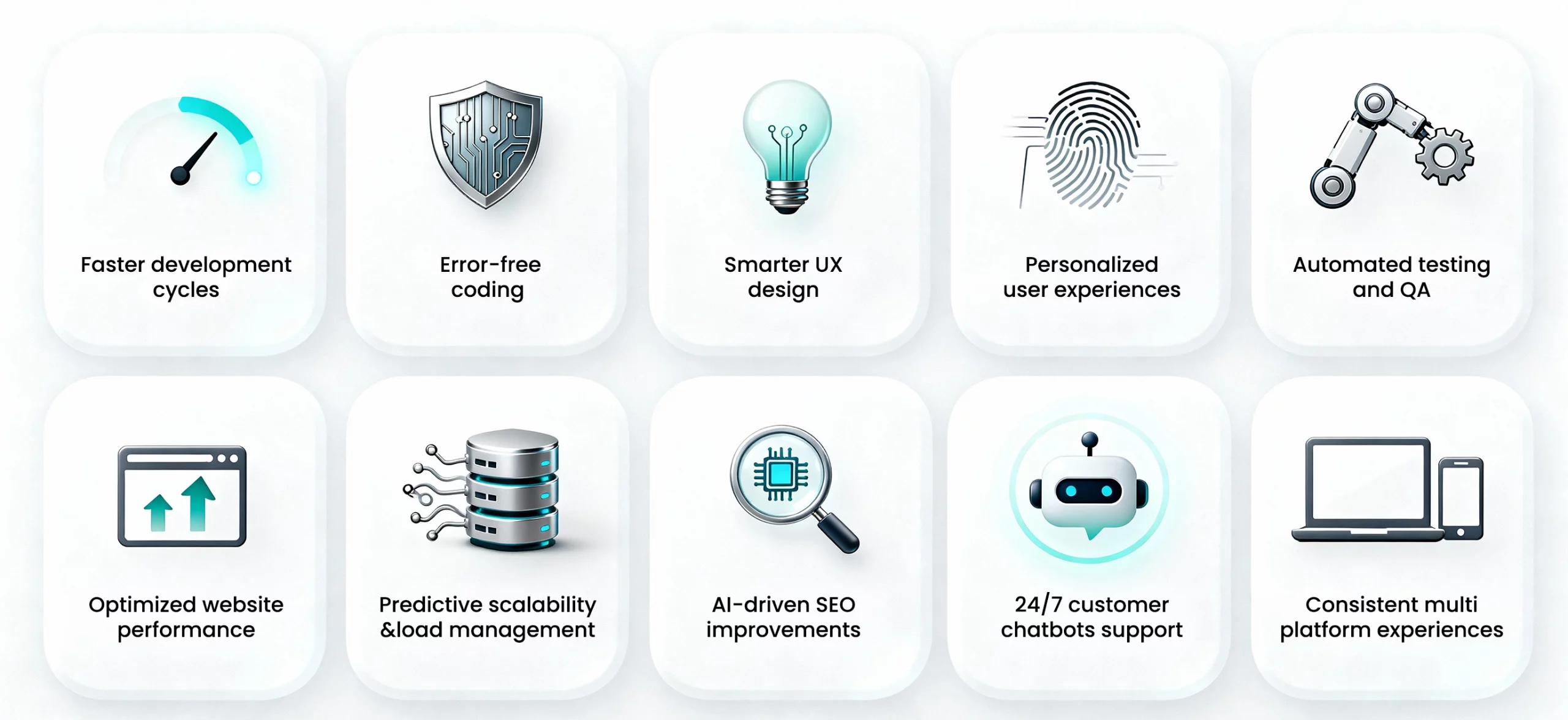
AI has become a driving force behind modern web development. Integration of AI in web development helps businesses build smarter and faster digital experiences. It reduces human effort, accelerates delivery, and enhances overall efficiency. From improving code accuracy to personalizing user journeys, AI ensures every aspect of development aligns with evolving user expectations and business goals.
How AI Transforms the Development Lifecycle
From ideation to deployment, AI integrates into multiple stages of the web development lifecycle:
- Planning and research: During the initial planning stage, AI analyzes competitors, market trends, and user behavior to guide website strategy.
- Design: AI-powered tools generate layouts, color palettes, and responsive designs.
- Development: Predictive coding assistants accelerate front-end and backend development.
- Testing: AI predicts bugs and automates quality assurance processes.
- Optimization: AI enhances performance, scalability, and user experience.
By leveraging AI throughout the development lifecycle, businesses can streamline complex workflows and deliver smarter, more efficient websites. From generating data-driven strategies during planning to automating testing and optimizing performance, AI ensures every stage is faster and more precise. Moreover, businesses should also be aware of top AI trends and work with industry experts who know how to increasingly incorporate these AI-driven processes to create integrated web solutions. Leading web development companies help you to develop solutions that are not only user-centric but also scalable, secure, and highly engaging.
AI in Front-End Development: Faster, Smarter, Adaptive
Front-end developers have the required knowledge & expertise about AI web development tools to streamline everything from layout rendering to component generation.
Predictive UI Components
AI can suggest reusable UI components based on previous projects or current design patterns. This ensures design consistency and speeds up project timelines.
Frameworks like Uizard and Figma AI make it easier to turn sketches into working prototypes within minutes.
Accessibility and Responsiveness
AI-driven systems automatically test a website’s accessibility, ensuring compliance with ADA and WCAG standards. They adjust contrast, detect missing alt text, and optimize mobile responsiveness across multiple devices. Even leading website design and development company uses AI-driven systems to save time, but also to broaden user reach and inclusivity.
The Role of AI in Backend Development
Behind every seamless interface lies a robust backend, and AI is making it smarter than ever.
Automated Database Management
AI helps dedicated web developers optimize databases by predicting storage needs, identifying redundant queries, and improving performance. For example, AI can auto-scale resources on cloud platforms. Thus, ensuring high availability during traffic spikes and cost savings during low demand.
Intelligent Security Monitoring
AI-driven systems detect anomalies in real time. Not only this, AI also helps in blocking suspicious activities before they escalate into breaches. From fraud detection to vulnerability patching, web development and AI combine to provide enterprises with proactive cybersecurity solutions.
AI and Content Management: From Static to Smart
Content management systems are evolving into intelligent ecosystems powered by AI. Traditional CMS platforms like WordPress and Drupal are integrating the latest technologies, such as machine learning, to automate SEO, curation, and optimization.
AI-Powered SEO
AI tools like SurferSEO and Clearscope analyze SERP data, competitor content, and keyword density to suggest the best structure for higher rankings. Businesses using these tools see measurable improvements in visibility and traffic quality.
Automated Content Creation and Curation
AI can write product descriptions, meta tags, and blog outlines instantly. For marketing teams, this means faster campaign rollouts and more time for strategy and creativity rather than repetitive content writing.
AI Testing: Quality Assurance at Machine Speed
Testing used to be the most time-consuming part of web development. However, not anymore. AI-based testing tools can now analyze, detect, and fix bugs automatically.
Predictive Testing and Bug Detection
AI algorithms simulate thousands of real-world interactions to predict where failures might occur. Several advanced tools, like Testim and Functionize, reduce manual test cases. Therefore, cutting QA time by up to 70%.
Continuous Learning and Optimization
Every test makes the system smarter. Over time, AI learns from past bugs and test results. That’s why it improves future predictions and performance accuracy. For businesses, that means fewer post-launch issues and a smoother user experience from day one.
AI in Performance Optimization
Website performance is a make-or-break factor for digital success. Even a 1-second delay can reduce conversions by 7%. AI ensures that your site stays lightning fast and efficient.
Predictive Load Balancing
AI systems predict traffic spikes and auto-optimize server loads before users feel any lag. This ensures consistent uptime, no matter how high the demand. No doubt, it’s an essential feature for ecommerce and SaaS businesses.
Automated Code and Asset Optimization
AI compresses images, minimizes code, and lazy-loads assets intelligently. These optimizations not only improve loading times but also enhance SEO performance.
For a top-rated AI app development company, integrating these advanced features can drastically improve app and web performance simultaneously.
Conversational Interfaces and AI Web Applications
Chatbots and voice assistants are now core features of AI web application development. They create seamless, human-like interactions that elevate the user journey.
Smart Chatbots
AI-powered chatbots handle support queries, sales assistance, and onboarding 24/7.
With natural language processing (NLP), they understand user intent, deliver relevant responses, and even escalate complex issues to humans when needed.
Voice-Activated Web Interfaces
Voice search is changing how users interact with websites. Integrating artificial intelligence in web applications enables voice navigation, faster accessibility, and hands-free browsing. Therefore, ideal for multitasking users and accessibility support.
AI Tools for Web Development
AI is transforming the way websites are designed, developed, and optimized. A wide range of AI tools now supports every stage of the development lifecycle, from predictive coding and automated testing to design prototyping and SEO optimization. Leveraging these tools helps businesses build smarter, faster, and more user-centric websites while reducing manual effort and improving overall efficiency. Here is the tabular presentation of the top AI tools for web development, along with their purpose.
| AI Tool | Purpose | Stage in Development Lifecycle |
| GitHub Copilot / Tabnine | Predictive coding & automation | Development |
| Wix ADI / Bookmark | Automatic layout & design generation | Design |
| Figma AI / Uizard | UI/UX prototyping & design | Design |
| Testim / Functionize | Automated testing & bug prediction | Testing |
| SurferSEO / Clearscope | SEO optimization & content suggestions | Optimization |
| Hotjar / Crazy Egg | User behavior tracking & heatmaps | Planning / UX |
| Chatbots & Voice Assistants | Conversational interfaces & support | User Interaction |
| Framer AI | Website prototyping & full-page generation | Design / Development |
Read More: Latest Full Stack Web Development Technologies To Pick For Your Web Project
Real-World Use Cases of AI in Web Development
Now, let’s look at how industry leaders are using web development AI to drive performance and user engagement.
1. Amazon – Personalized Shopping Experience
Amazon’s website uses AI to analyze browsing patterns, previous purchases, and wishlist data to recommend products with precision. This predictive personalization has contributed to its record-breaking conversion rates.
2. Airbnb – Image Recognition for Listings
Airbnb uses AI to categorize and enhance property photos automatically. It improves the search experience by displaying the most visually appealing listings to users. Thus, driving both trust and engagement.
Read More: Guide To Building Apps Like Airbnb: Business Model, Features, & Cost
3. Netflix – Dynamic UI Optimization
Netflix’s AI-driven layout changes based on what the user watches. From thumbnails to content recommendations, every element is tuned for maximum user retention.
How Businesses Can Leverage AI in Web Development
Whether you’re a startup or enterprise, the path to AI web development starts with strategy and the right partnerships.
1. Partner with an AI-Driven Agency
Collaborating with an experienced website design and development company that seamlessly integrates AI ensures your business stays ahead of the curve. These agencies provide scalable, data-backed solutions that evolve with your user base.
2. Hire Web App Developers Skilled in AI Integration
Mobile and web experiences now overlap. You can hire web app developers who understand AI ecosystems to ensure cohesive user journeys across all devices.
They can sync app intelligence with web functionality for a unified experience.
3. Adopt AI-Powered Tools Gradually
Businesses can start small by implementing chatbots, predictive analytics, or smart SEO. Gradual adoption allows smoother integration without overwhelming teams or budgets. This approach works especially well in web development for startups, where balancing innovation with cost-efficiency is key to sustainable growth.
The Future of AI and Web Development
The future won’t be about AI replacing humans but collaborating with them.
Experienced AI web developers will act as digital co-pilots and handle repetitive work while humans focus on creativity, empathy, and strategy.
In the next decade:
- Websites will build themselves based on natural language prompts.
- Testing and optimization will be fully autonomous.
- UX will become adaptive, responding in real-time to user mood and context.
Businesses that adapt early will own the competitive advantage. Therefore, you must invest in professional IT consulting services to identify the right AI tools, streamline integration, and ensure your web development strategy stays ahead of the curve.
Wrapping Up
AI in web development isn’t a passing trend, but it’s the new standard for creating faster, smarter, and more meaningful digital experiences. From intelligent coding assistants and automated testing tools to personalized user journeys and predictive analytics, AI is transforming every layer of how websites are built, optimized, and maintained.
For startups, this means accelerated go-to-market timelines and reduced operational costs. For enterprises, it means scalable, data-driven systems that deliver consistent performance across platforms. And for users, it means websites that feel intuitive, responsive, and personal with every interaction. Moreover, as AI-powered tools continue to evolve, the question is no longer whether to adopt AI, but how fast you can integrate it into your web development strategy. Therefore, partnering with a leading full stack development company can help you stay ahead of the curve. They can help you to build not just websites, but intelligent digital ecosystems that grow with your users.
So, are you ready to take the next step? It’s time to make your website smarter, faster, and future-ready with AI.

FAQs
Q1. Why should businesses adopt AI for web development?
AI-driven web development ensures faster launch times, smarter automation, and better scalability. Adopting AI today helps businesses stay competitive, deliver personalized digital experiences, and future-proof their online presence.
Q2. How to integrate AI in web development?
AI can be integrated into web development by using AI-powered tools and APIs for specific tasks such as design automation, chatbots, predictive analytics, or SEO optimization. Developers often use frameworks like TensorFlow.js or third-party AI APIs to embed intelligent features into websites seamlessly.
Q3. How does AI improve user experience on websites?
AI personalizes each user’s journey by analyzing behavior, preferences, and interactions. It recommends content, adjusts layouts, and provides real-time support through chatbots or voice assistants. Thus, making every visit feel intuitive and relevant.
Q4. What are the challenges of AI integration in web development?
Some challenges include data privacy, ethical use of AI models, integration complexity, and the cost of advanced AI tools. Partnering with an experienced product development company helps overcome these hurdles efficiently.
Q5. How does AI help in website testing and maintenance?
AI-powered testing tools like Testim and Functionize detect bugs, predict errors, and run regression tests automatically. This reduces manual QA time, ensures higher accuracy, and keeps websites running smoothly post-deployment.

SHARE
WRITTEN BY

Prankur Haldiya
Chief Technical Officer
A tech innovator and engineering leader, Prankur Haldiya drives RipenApps’ product development strategy and oversees cutting-edge solutions in mobility, AI, and cloud ecosystems. He is passionate about building high-performance teams and helping brands launch secure, scalable, and user-centric digital products.
View All Articles