

Did you know that startups that fail to scale their websites lose 40 percent or more of potential customers due to slow load times, poor mobile experience, or outdated features? By 2025, web development for startups will no longer be limited to coding a site. It is about building a feature-rich platform that drives growth, handles spikes in traffic, and adapts to emerging technologies like PWAs, AI personalization, and headless CMS. The right website transforms from a simple launch tool into a business engine that supports marketing, sales, and product expansion.
Every business decision, from tech stack to design, directly impacts conversions, retention, and long-term scalability. This means that founders, CTOs, and early-stage investors must rethink web strategy. So, if you are planning to build a website for your startup, this blog will help you explore actionable strategies to move from an MVP to a growth-ready website that keeps pace with evolving markets and user expectations. Now, let’s get started.
Table of Contents
Why Startups Need Future-Proof Web Development
Every startup owner needs to understand that their website is often the first touchpoint with customers, investors, or partners. A one-size-fits-all template does not meet startup needs in 2025. Therefore, they need to design a future-ready website according to their specific requirements to provide an ultimate experience to their target users.
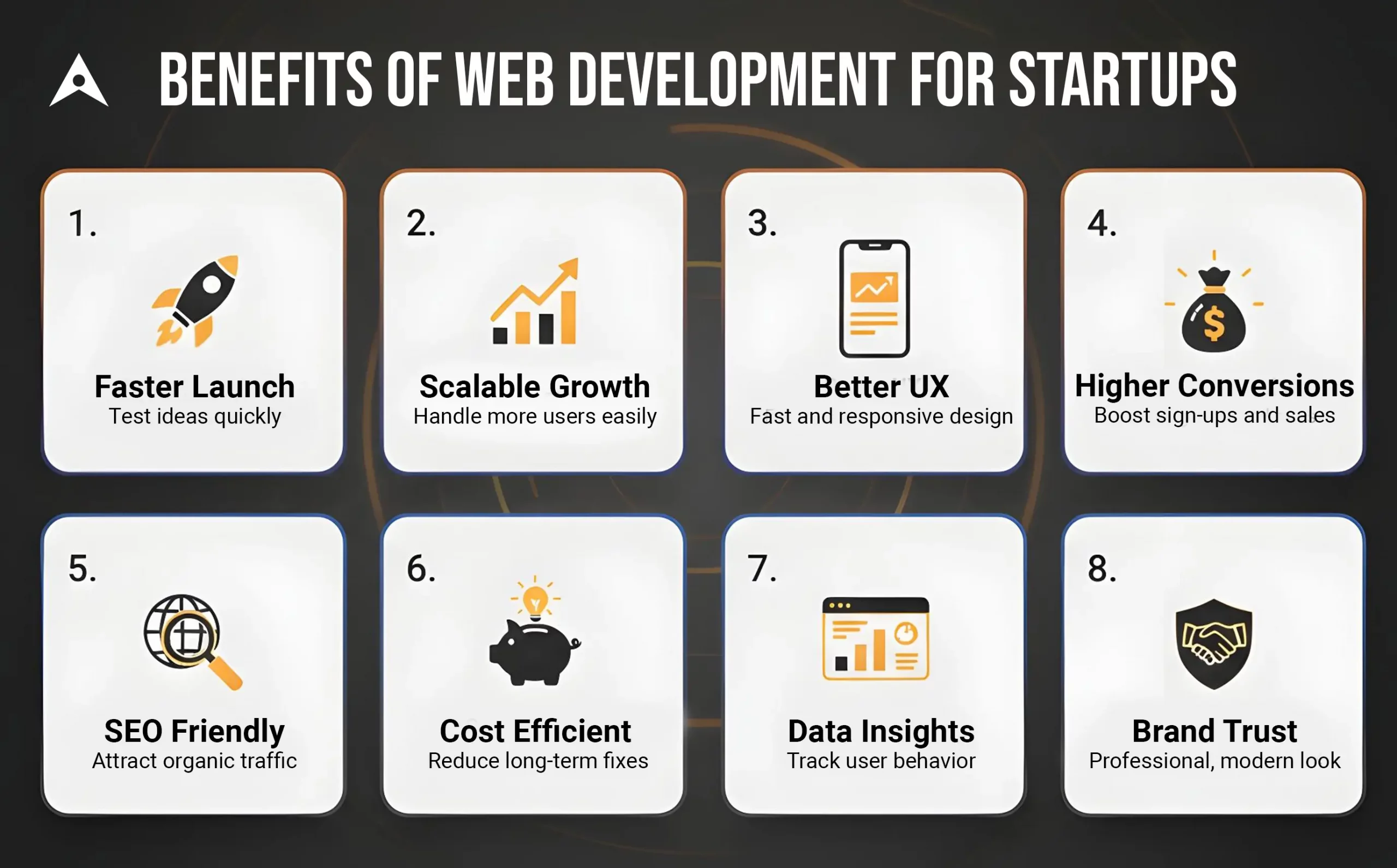
Future-proof web development means building websites that:
- Scale without breaking performance.
- Deliver a consistent user experience across devices.
- Adapt quickly to new technologies.
- Support marketing, sales, and product goals.
Startup website development is no longer limited to design. Moreover, it is about connecting product vision, customer engagement, and long-term scalability. To get a complete roadmap, you can reach out to a globally recognized web development company.
The Shift From MVP to Growth-Ready Platforms
Business growth slows when the MVP website cannot handle more users or advanced, complex features. That’s why many startups begin their project with leading MVP development companies to launch fast. This approach works to test ideas, but the problem comes after.
The new approach in 2025 is clear:
- Start with MVP, but design with scalability in mind.
- Use modular development and headless architecture.
- Partner with a top-notch website development company that balances speed with structure.
A strong MVP does not stop at launch. It prepares the foundation for growth.
Web Development Trends 2025 Every Startup Should Know
To stay ahead of your competitors, startups need to track the latest web development trends in 2025. Here are the most impactful shifts that every entrepreneur should be aware of:
- Progressive Web Apps (PWAs): PWAs combine the best of web and mobile apps. Not only this, but it also gives you offline access, fast load speeds, and app-like engagement without forcing users to download.
- Headless CMS: Headless systems separate the backend from the frontend. Therefore, it allows startups to scale content faster while keeping design flexible.
- AI-Powered Personalization: Integrating AI into your web platform has become mandatory. From chatbots to product recommendations, AI in web development is no longer optional. An experienced AI development company can embed these intelligent features seamlessly. Thus, making your platform smarter while significantly driving conversions and retention.
- Low-Code and No-Code Tools: Early-stage startups use these platforms for fast iterations and reduced costs while saving engineering resources.
- Accessibility and Inclusive Design: You need to know that compliance with accessibility standards improves usability, SEO, and customer trust.
- SEO-First Architecture: Startup owners need to pay attention to the SEO-first architecture of their web platform. With search competition higher than ever, websites built with structured data, optimized speed, and responsive design outperform.
By seamlessly integrating these emerging web development technologies & trends, startups reduce technical debt and position themselves for sustainable growth. All they need to do is discuss their project with a top-notch web development company to integrate the right tech-stack into their web-based platform.
Read More: Progressive Web App vs Website: Which One Suits Your Business Needs?
The Challenges Startups Face in Website Development
Web development for startups often faces three recurring problems:
- Budget Constraints: Limited funding makes startups look for affordable web development services for startups, but cheap fixes often lead to higher long-term costs.
- Choosing the Right Tech Stack: With numerous frameworks and tools available, founders struggle to strike a balance between flexibility and speed.
- Scaling Performance: What works for 1,000 users may fail at 100,000. Without scalable design, startups hit performance walls.
Working with the right web design and development company helps mitigate these issues early.

Actionable Strategies for Building Future-Proof Startup Websites
Startups need strategies that focus on growth, not just launch. A website or a web platform should not feel like a short-term project; it should evolve with your users and business goals. You can think of it as the foundation of your digital brand, and if built strongly, it will save you countless hours and costs in the long run. So, here are some practical steps:
1. Think Beyond Templates
Templates limit scalability. Go for custom website development for startups to align with your business model. Work with a website development firm that understands startup goals.
2. Build Mobile-First
With mobile traffic dominating, website development for startups must prioritize responsive design. A top-notch web development company for startups ensures a consistent experience across screens.
3. Start With Performance
Fast-loading pages mean better SEO and higher conversions. Therefore, it’s advisable to optimize code, images, and hosting from day one.
4. Use Scalable Architecture
Adopt modular frameworks and headless CMS. This allows you to add new features without breaking the core system.
5. Integrate Growth Tools Early
Your website should support email marketing, analytics, CRM, and even social media feeds on website from the start. Growth-driven websites support both product and marketing teams.
6. Plan for Security
Secure coding, SSL, and data protection are essential for building user trust. Partner with a web design & development company that prioritizes security audits.
From MVP to Scalable Growth: The Startup Playbook
No doubt that every startup dreams of fast launches, but the real challenge comes after the MVP phase. Many founders realize too late that their first version was built only to test an idea, not to handle growth. Therefore, following the steps below helps to ensure your MVP doesn’t turn into a roadblock but becomes the stepping stone to scalability. Here is a roadmap startups can follow:
Stage 1: MVP Launch
Partner with a top-notch MVP development company to validate your idea fast. It is advisable to keep it lean, but set a strong technical foundation.
Stage 2: Market Validation
You can add analytics, marketing integrations, and responsive design to your web-based platform. Remember, user feedback here should shape your next iterations.
Stage 3: Growth Scaling
Upgrade to headless CMS, AI personalization, and PWA features with help from a web development agency for startups. This stage transforms your website from “functional” to “growth-ready.”
Stage 4: Expansion
You need to focus on global accessibility, multi-language support, and advanced SEO to expand reach. Think about partnerships and integrations that open new revenue streams. Along with that, you must be aware of the best real-life examples of successful MVP development for startups.
The above steps are not about rushing through stages but about making each one count. The startups that win in 2025 are those that treat their website as a product, not a project.
Future-Proofing Your Startup Website in 2025
To stay ahead in the competitive industry, startups must treat websites as their living assets. That’s why future-proofing requires:
- Continuous updates with emerging web development technologies.
- Regular performance audits.
- Scalability planning in every sprint.
- A long-term partnership with a trusted web design and web development company.
Startups that invest in strategic website design and development services now are better positioned to convert leads, attract investors, and achieve growth.
Final Thoughts
Building a website for your startup in 2025 is not about having an online presence. It is about creating a platform that grows with your business, adapts to new technologies, and supports your goals at every stage. From MVP launch to global scalability, every choice you make, such as design, tech stack, and integrations, directly shapes how users experience your brand and how fast you can grow.
The good news is you don’t have to figure this out alone. You can partner with the right website design and development company that gives you speed, scalability, and a website that works as hard as you do. So, if you are ready to move beyond a simple MVP and build a website that drives real growth, now is the time to act. Your users expect seamless experiences, and your startup deserves a platform built for long-term success.

FAQs
Q1. What is the difference between an MVP website and a scalable website?
An MVP website tests your idea fast with basic or core features. Whereas a scalable website builds on that foundation, ready to handle more users, features, and integrations as your startup grows.
Q2. Which web development trends in 2025 should startups watch?
Trends including Progressive Web Apps, headless CMS, AI-driven personalization, and low-code tools are shaping how startups build fast, user-friendly, and flexible websites.
Q3. How much does web development for startups usually cost?
The overall costs vary based on several factors such as scope, features, and tech stack. Startups should focus on MVP-first development with clear roadmaps for scaling and to keep their project budgets predictable.
Q4. What features should a startup website include from day one?
Several features, such as fast loading, mobile-first design, SEO optimization, analytics, and essential integrations like CRM or payment systems, should always be part of the first release.
Q5. How do I find the right web developer for my startup?
Always look for a web design and development company or developer with experience in startups, flexible tech stacks, and a track record of scaling MVPs into full products. You can also contact the RipenApps team to build your next future-ready web-based platform.

SHARE
WRITTEN BY

Vaibhav Sharma
Business Head
Vaibhav Sharma bridges product vision with real-world execution. He shares consultation with startups and enterprises to shape digital strategies, refine user journeys, and create app experiences that feel intuitive from day one. His strength lies in transforming early concepts into clear development roadmaps that set products up for long-term success.
View All Articles