

Imagine a world where AI predicts customer behavior before browsing your website, supply chains operate with minimum human intervention, and businesses make data-driven decisions within seconds. It’s not the near future; it’s already happening as entrepreneurs leverage the latest AI trends to develop AI-driven apps.
Did you know? The global AI market is expected to reach USD 3,497,258.8 million by 2033 at an annual growth rate of 30.6%. These statistics highlight that AI adoption in various industries is increasing at a rapid pace.
Business leaders who are updated with the latest advancements in AI and are leveraging AI-powered solutions are seeing a 40% boost in operational efficiency and a 25% increase in revenue generation. This helps them leave their competitors behind.
But the challenge is that the latest advancements in artificial intelligence are emerging faster than most businesses can adapt. Entrepreneurs who fail to embrace the new AI trends are at risk of falling behind. The main reason for adopting these trends is that the latest AI developments, automation, machine learning, and AI-driven decision-making will define industry leaders.
So, if you are an entrepreneur or a business owner planning to expand your business, you need to understand the current AI trends. This blog will cover what’s next for the latest AI trends 2026, which trends will shape the future of business, and how you can stay ahead of the competition. So, dive into the latest AI breakthroughs to future-proof your business and thrive in this tech-driven era.
Table of Contents
Artificial Intelligence Market Statistics 2026
Before exploring the new trends in AI, it’s essential to understand the latest data driving this transformation. AI is one of the most exciting and growing technologies in the 21st century. Many businesses are using this emerging technology to automate their processes and stand out in the competitive industry. If you are also looking to take advantage of this emerging technology, examining the latest AI breakthroughs and statistics is necessary. Here are some important industry insights:
- The global AI market size is projected to reach USD 3,497,258.8 million by 2033, growing at a CAGR of 30.6% from 2026 to 2033. (Source: Grand View Research)
- The AI industry is expected to grow nearly 4–5x between 2024 and 2030, driven by enterprise AI adoption and generative AI expansion.
- By 2026, it is estimated that over 120 million professionals globally will be working in AI-related roles. (Source: World Economic Forum)
- Around 83% of companies worldwide consider AI a strategic priority for their business growth and digital transformation. (Source: IBM Global AI Adoption Index)
- Netflix generates over USD 1 billion annually from AI-powered recommendation systems that personalize user experiences.
- As per the latest reports of the ITP net and Process Excellence Network, the global AI software market is projected to reach approximately $452 billion in 2026.
- According to Hostinger, 35% of companies are already using artificial intelligence trends in business to address labor shortages.
These are the major AI industry statistics that businesses should consider before understanding the latest AI trends 2026 and entering the AI market. They highlight the heavy use of artificial intelligence in different industries. Overall, these stats inspire businesses to choose AI to achieve growth.
Top AI Trends 2026
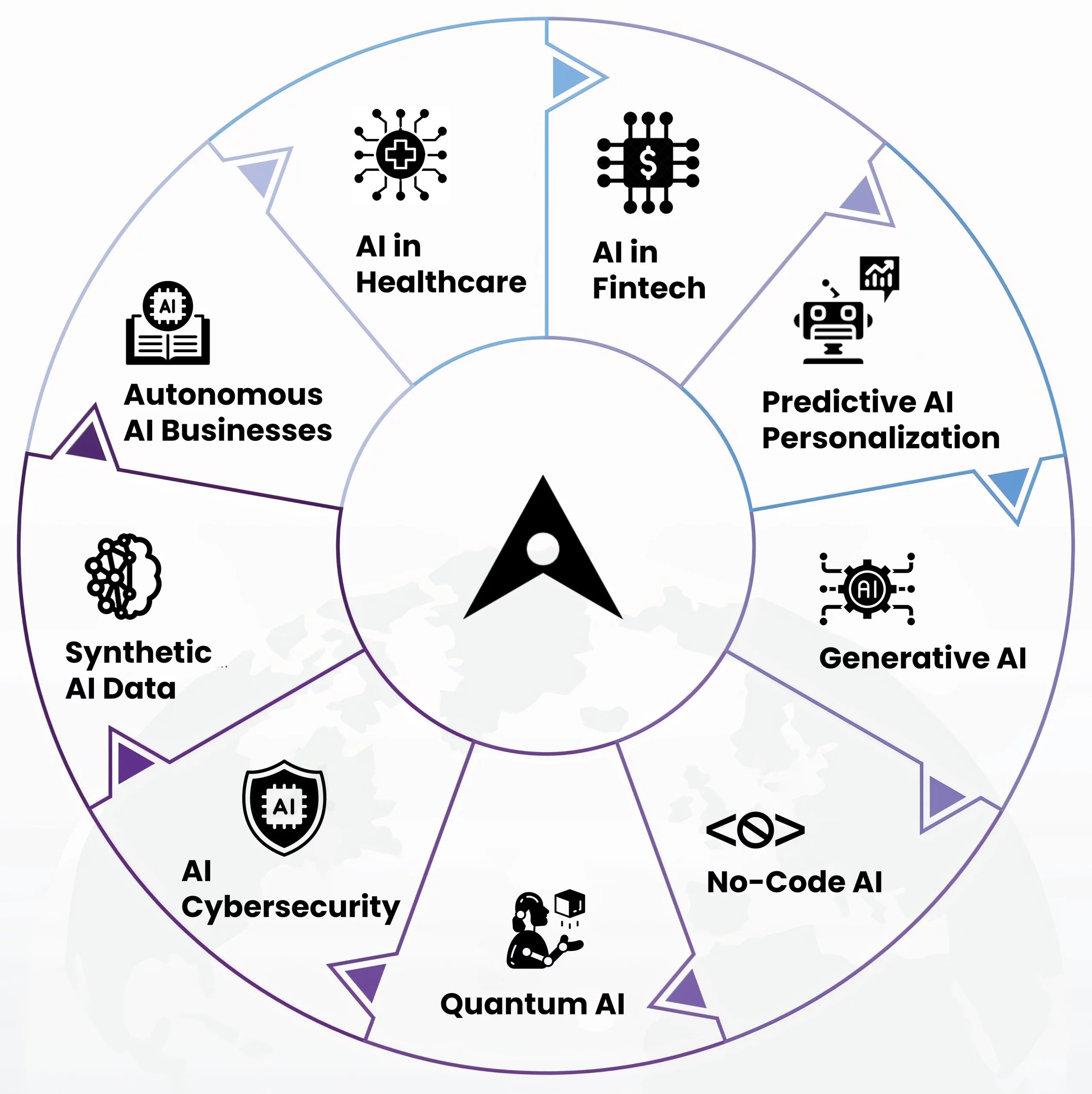
1. Predictive AI Goes Hyper-Personalized
Entrepreneurs rely on predictive analysis to make more informed decisions. However, the latest artificial intelligence trends 2026 suggest that business owners will move beyond general predictive analytics to offer hyper-personalized forecasting in the upcoming year. Emerging technologies such as Artificial Intelligence use real-time data from multiple touchpoints, social media activity, IoT devices, and neural patterns. This will help you to make more precise recommendations before users even realize what they need. It’s one of the most advanced and new developments in artificial intelligence that businesses can use to unleash the AI industry impact. To leverage this shift, many startups are availing mobile application development services in USA to embed predictive AI directly into user-facing applications.
Example: Imagine you are using an AI-driven app that predicts when your customers are about to churn. Not only this, but it also offers your users a tailored discount right before they think of leaving your app.
2. AI Becomes Your Autonomous Business Consultant
When you think of generative AI, tools like ChatGPT, Claude, and Gemini likely come to mind. Adoption has scaled massively, with hundreds of millions of weekly active users globally. But in 2026, the shift is no longer about chat interfaces, but it’s about Agentic AI. AI is evolving from answering questions to executing real business tasks through autonomous AI agents.
As part of the current trends in artificial intelligence 2026, businesses are implementing AI Agentic Workflows, where systems can analyze data, trigger actions, manage operations, and complete multi-step objectives independently. For example, instead of simply suggesting marketing improvements, an AI agent can launch campaigns, optimize budgets in real time, generate reports, and adjust strategy based on performance. This is the era of Autonomous AI Agents, not just conversational bots.
Forward-thinking enterprises are partnering with a leading chatbot development company to integrate intelligent AI agents into their products, CRMs, and internal systems. The goal is no longer just customer support automation; it’s AI-powered decision intelligence.
Example: Instead of hiring a traditional consultant, your AI business agent can analyze competitors, evaluate customer behavior, track industry trends, optimize operations, and generate step-by-step execution plans, while continuously learning and improving from new data.
3. AI-Generated Code & No-Code AI Development
In 2026, AI-generated code has evolved far beyond simple code suggestions. It’s no longer just about GitHub Copilot; we are now seeing the rise of autonomous AI software engineers like Devin and OpenHands that can plan features, write full modules, debug issues, and even execute development tasks independently. This shift is transforming how digital products are built.
The role of developers is evolving from “writing code line by line” to reviewing AI-generated architectures, validating system design, ensuring security compliance, and optimizing performance. AI accelerates development cycles, but human expertise ensures scalability, reliability, and business alignment.
For entrepreneurs, this means faster MVP launches and reduced development time. However, complex AI integrations, data security, and enterprise-grade applications still require expert oversight. To fully leverage the top AI trends 2026, businesses should hire mobile app developers who understand AI-driven development workflows and can strategically manage, refine, and scale AI-generated systems.
Example: AI agents that can build backend APIs, generate UI components, and run automated tests, while human developers focus on architecture strategy and product innovation.
4. AI in Quantum Computing
With the help of quantum AI algorithms, you can process huge data at a speed impossible for classical computers. Because of the top AI trends 2026 Quantum computing, various industries such as drug discovery, climate modeling, and financial risk assessment will witness game-changing advancements. In 2026, AI-powered quantum computing will solve various problems within a few minutes. If you don’t have expertise in AI quantum and algorithmic optimization, then you can also seek help from professional experts. The latest AI advancements have opened several opportunities through quantum computing. However, both these concepts are new, but the excessive use of artificial intelligence latest developments can make them a necessary part of daily lives, just like popular chatbots. Businesses looking to turn such complex AI-driven systems into scalable products often partner with a top-notch custom app development company to bring these advanced solutions into real-world applications.
Example: AI-powered quantum algorithms are transforming drug discovery, allowing pharma companies to simulate complex molecules with unprecedented accuracy.
5. AI-Driven Cybersecurity
With cyber threats becoming more sophisticated, traditional security measures are no longer enough. AI-driven cybersecurity in 2026 will leverage AI and machine learning trends, behavioral analytics, and real-time threat detection to easily detect cyberattacks before they happen. Businesses will rely on AI for fraud detection, automated security frameworks, AI-powered threat intelligence, and self-learning algorithms to identify and prevent breaches.
Example: AI-driven threat detection systems can predict cyberattacks before they happen. Therefore, helping financial institutions prevent fraud in real time.
6. AI-powered Synthetic Data Generation
One of the current trends in artificial intelligence is synthetic data generation. AI models need vast amounts of data for training. On the other hand, real-world data is often biased or may be expensive. Businesses can use AI-powered synthetic data generation to solve various challenges by having realistic data for machine learning models. The demand for synthetic data will accelerate AI model development across industries like healthcare, finance, and robotics. Thus, reducing privacy concerns and regulatory challenges. You can stay ahead of the competitive industry by investing in new developments in AI powered synthetic data tools to develop robust, unbiased synthetic datasets.
Example: Companies like Tesla use AI-generated synthetic data to train autonomous vehicles. It shows that 2026 AI trends reduce the need for costly real-world testing.
7. AI-Driven Autonomous Businesses
The concept of an AI-driven autonomous business has become a reality in 2026. In every industry, business leaders can operate with minimal human intervention. With emerging trends in AI-driven business solutions, companies are now embracing intelligent systems capable of running core operations independently. From self-managing supply chains and automated financial operations to AI-powered customer service bots, AI will automate several business processes. Therefore, investment in AI app development services will be worth it for business owners.
Businesses will operate with minimal human intervention. emerging AI trends will power systems to analyze market trends, make real-time strategic decisions, and even develop new business models. While automation will drive efficiency, entrepreneurs must collaborate with AI engineers to build, optimize, and fine-tune autonomous workflows, ensuring they align with business goals and customer needs. For instance, understanding what are current trends in AI-powered site management can help companies adopt smarter automation tools that support end-to-end business autonomy.
Example: Amazon’s AI-powered fulfillment centers automate inventory management, helping reduce overall operational costs and improve efficiency. When evaluating similar innovations, understanding the AI app development cost is also essential for businesses aiming to implement scalable and cost-effective automation solutions.
8. AI-Powered Healthcare Predictions & Biohacking
Technologies such as Artificial Intelligence are bringing a huge change in the healthcare industry as well. With the integration of AI in healthcare apps, doctors can easily detect diseases before any symptoms appear. Thus, it will revolutionize preventive healthcare. Biohacking AI will also emerge shortly which will help individuals to optimize their health and mental performance using AI-driven recommendations.
Example: Patients have started using AI wearables that predict potential heart attacks before they happen. Thus, AI-powered apps and devices ensure early interventions.
9. AI in Fintech For More Efficient Financial Services
AI is transforming the FinTech industry by enhancing fraud detection, automating risk assessment, and personalizing financial services. Fintech industries are making the best use of the latest AI trends, such as Predictive AI and machine learning trends to improve credit scoring, while AI-driven chatbots are enhancing customer support. Not only this, AI in Fintech is also streamlining financial reporting and investment strategies. It will help financial companies to provide more faster and secure services. However, regulatory compliance and ethical AI implementation remain key challenges. That’s why, you will need the help of an expert AI developer.
Example: Robo-advisors like Betterment and Wealthfront leverage AI to create personalized investment strategies. After the emergence of AI development trends, several fintech apps have emerged and helped individuals manage their finances.
Read Also: 8 Ways AI and ML Transforming the Finance Industry
10. Emotionally Intelligent AI Systems
Humans expect more than just logic from technology today. Emotionally intelligent AI systems recognise subtle cues in voice, facial expression, or text, and adapt their responses accordingly. This helps brands create deeper connections with customers, from virtual assistants that sense frustration and escalate help, to marketing tools that tailor tone and content based on user mood. Entrepreneurs leveraging these latest AI trends turn tools into trusted companions, not just services.
Example: Customer support platforms now use AI that detects anger or confusion in a user’s tone and automatically connects them to a human agent. This reduces frustration and improves satisfaction. Thus, making AI interactions feel more human.
11. Edge AI and On-Device Intelligence
As data volumes explode and privacy concerns grow, businesses are shifting from cloud-only AI to processing data directly on devices. Edge AI means models run locally on phones, tablets, or IoT devices—reducing latency, saving bandwidth, and ensuring data stays in the hands of the user. Leveraging cross platform app development services allows businesses to implement these AI-driven features seamlessly across multiple devices and operating systems, delivering real-time analytics and ultra-responsive experiences.
Example: Smart home cameras now process video locally to detect unusual activity instantly, without sending sensitive footage to the cloud. This allows immediate alerts while keeping user data private and secure.
Read Also: IoT Smart Home App Development: Everything You Need To Know
AI Trends Across Industries
Artificial Intelligence isn’t a buzzword anymore; it’s driving real change in every sector. With the latest developments in artificial intelligence and AI trends in business automation this year, many industries have entered a new era of efficiency and innovation. Here are some of the most important trends you should know:
Healthcare
AI recent developments have started transforming the healthcare industry. This emerging technology has made healthcare services more accessible and budget-friendly. Here’s how AI transformed healthcare:
- Predictive Analytics: AI models can forecast disease risks and patient deterioration, helping doctors act earlier.
- Medical Imaging: Computer vision algorithms detect cancers, fractures, and other issues faster than humans alone.
- Virtual Health Assistants: Chatbots and AI-powered apps are part of the top developments in artificial intelligence. They answer patient questions, manage appointments, and improve access to care.
- Drug Discovery: AI speeds up the process of identifying promising compounds, saving years of research time.
Finance & Banking
The finance industry has become fintech after the inclusion of technology in the financial industry. AI market trends 2026 have introduced a new revolution in the fintech industry, and it is used for:
- Fraud Detection: Machine learning trends are used by businesses to monitor transactions in real time to spot suspicious activity.
- Personalized Financial Services: The newest AI technology recommends products, investments, and budget tools based on individual behavior.
- Algorithmic Trading: Businesses use the latest AI technology to build AI-powered trading platforms that analyze market data to make faster and data-based decisions.
- Risk Assessment: AI latest developments allow lenders to evaluate creditworthiness more accurately and fairly.
Retail & E-Commerce
The top AI use cases 2026 in the retail and e-commerce industry are:
- Recommendation Engines: AI suggests products based on browsing and purchase history.
- Inventory Management: Artificial intelligence current trends enable the use of predictive tools to help retailers optimize stock levels and reduce waste.
- Customer Service Automation: Chatbots handle common queries, returns, and complaints 24/7.
- Dynamic Pricing: The latest developments in AI allow algorithms to adjust prices in real time to match demand and competitor pricing.
Supply Chain & Logistics
The logistics and supply chain industry has seen tremendous growth with the use of emerging trends in artificial intelligence. The different uses of AI latest trends in supply chain and logistics are:
- Route Optimization: AI calculates the fastest, most efficient delivery routes.
- Demand Forecasting: Predictive models anticipate fluctuations in demand to improve planning.
- Warehouse Automation: Robots and the latest AI technologies manage storage, picking, and packing.
- Quality Control: AI technology trends use computer vision to check products for defects automatically.
Read Also: Role of Technology in Supply Chain: How Technology is Revolutionizing the Logistics Industry
Real Estate
The use of AI in Real Estate opened a new door of opportunities for the real estate industry. Here are the different use cases of artificial intelligence trends:
- Property Valuation: AI models estimate property prices with high accuracy.
- Smart Buildings: AI controls heating, lighting, and security systems for better energy efficiency.
- Tenant Screening: AI technology advancements analyze applications to help property managers find reliable tenants.
- Virtual Tours: With the use of the latest advances in artificial intelligence, real estate can enable 3D tours to make property viewing easy and realistic.
Education
The education industry has seen a new transformation during the pandemic era. Businesses launched their e-learning apps to connect students with teachers remotely and make learning available at their fingertips. Artificial Intelligence development trends have automated the industry and helped businesses achieve success. Here are the top uses of AI in education:
- Personalized Learning: AI tailors content to each student’s strengths and weaknesses.
- Automated Grading: Machine learning can grade essays and assignments quickly.
- Virtual Tours: AI-powered bots help students with homework and revision.
- Predictive Analysis: Schools use the latest AI technologies and models to spot students at risk of falling behind.
Real-World AI Applications Shaping 2026
Understanding AI trends is powerful. Seeing them applied in the real world is transformational. Here are three practical examples that show how Artificial Intelligence is driving measurable business impact in 2026.
1. AI-Powered Personalization: Netflix
Netflix continues to set the benchmark for AI-driven personalization. Its recommendation engine analyzes viewing behavior, watch time, device usage, and interaction patterns to suggest hyper-relevant content in real time. This AI strategy contributes over $1 billion annually in retained revenue and improved engagement.
Key Takeaway: Personalized AI experiences directly increase user retention, satisfaction, and lifetime value.
2. AI in Customer Experience Automation: Amazon
Amazon leverages AI across its ecosystem, from predictive product recommendations to automated warehousing and demand forecasting. AI models analyze millions of transactions to optimize delivery routes, pricing, and inventory planning.
Key Takeaway: AI reduces operational costs while enhancing speed, accuracy, and customer satisfaction.
3. Generative AI & Enterprise Productivity: Microsoft
Microsoft has integrated generative AI across its enterprise tools, enabling AI copilots for document creation, data analysis, and workflow automation. Businesses using AI copilots report significant productivity improvements and faster decision-making.
Key Takeaway: AI is evolving from a support tool to a business productivity engine that accelerates innovation.
How Entrepreneurs Can Leverage These Latest Trends in AI?
The above-mentioned AI industry trends are great opportunities that can help you to set your business apart. By staying ahead of current trends in AI, entrepreneurs can have an edge over their competitors and position themselves for exponential growth. To make you understand in a better way, here are some ways that how you can integrate these artificial intelligence trends into your business:
- Invest in Predictive AI – You can use hyper-personalized forecasting to predict customer behavior and optimize marketing efforts.
- Leverage Generative AI – Entrepreneurs can automate content creation, marketing, and product recommendations to scale faster.
- Adopt AI-Driven Decision Making – Deploy AI-powered CFOs and marketing strategists to automate key business operations. You can partner with a globally recognized AI app development company to build an AI-driven app according to your business needs.
- Utilize AI for Customer Insights – Implement emotionally intelligent AI to understand your audience better than ever before. With the help of AI-powered mobile apps, you can easily get useful insights.
- Explore No-Code AI Platforms – Hire dedicated mobile app developers to build AI-powered apps and automation tools without coding expertise.
Read Also: 15 Future-Ready AI App Ideas for 2026 That Entrepreneurs Can’t Miss
Conclusion
The top AI trends 2026 are no longer centered around experimentation, but they are focused on execution, autonomy, and measurable ROI. From Agentic AI and autonomous AI agents to AI-generated architectures and enterprise-grade automation, Artificial Intelligence is becoming a core business infrastructure. It is not just enhancing efficiency; it is redefining how companies innovate, compete, and scale in a digital-first economy.
Entrepreneurs who embrace AI strategically will unlock new revenue models, smarter operations, and hyper-personalized customer experiences. The real competitive edge lies in how effectively you implement these advancements. At RipenApps, we help businesses transform AI opportunities into scalable, real-world solutions, from intelligent apps to AI-powered platforms. The future is being built with AI. So, connect with experts today and get ready to lead the competitive industry.
Frequently Asked Questions
Q1. How is AI transforming businesses in 2026?
AI is enhancing automation, and improving decision-making with predictive analytics. Moreover, current trends in AI are transforming customer experiences through personalized AI-driven interactions.
Q2. What is the difference between a Chatbot and an AI Agent?
A chatbot typically responds to user queries based on predefined rules or trained conversational models, mainly handling specific interactions like customer support. Whereas an AI agent can autonomously make decisions, perform multi-step tasks, learn from context, and interact with other systems. Thus, acting more like a digital assistant than just a conversational tool.
Q3. How can entrepreneurs leverage AI for business growth?
Entrepreneurs can use AI to automate workflows, enhance customer experience, improve security, optimize marketing strategies, and streamline operations.
Q4. Do businesses need AI developers to implement AI trends in 2026?
Yes, despite advancements in no-code AI tools, hiring AI app developers is essential for integrating complex AI solutions. They ensure you optimize models, and ensure scalability.
Q5. Why is AI in cybersecurity crucial for businesses in 2026?
AI-powered cybersecurity helps detect threats in real time, prevent fraud, and enhance data protection to safeguard businesses from evolving cyber risks.
SHARE
WRITTEN BY

Prankur Haldiya
Chief Technical Officer
A tech innovator and engineering leader, Prankur Haldiya drives RipenApps’ product development strategy and oversees cutting-edge solutions in mobility, AI, and cloud ecosystems. He is passionate about building high-performance teams and helping brands launch secure, scalable, and user-centric digital products.
View All Articles