

lThe mantra of “move fast and break things” has officially been replaced by a more disciplined doctrine: Capital Efficiency. For modern entrepreneurs, the goal is no longer just to launch quickly, but to build smart.
With the average monthly burn rate for seed-stage startups reaching $150,000 (Growth List), there is no room for vanity features or aimless coding. Investors are funding validated systems that prove high returns with minimal waste.
Despite the abundance of advanced tools, the problem remains stark: 90% of global startups eventually fail (Digital Silk). Interestingly, this downfall rarely stems from poor programming or “bad code.” Instead, most founders fall victim to the Discovery Gap, a critical disconnect between the product built and the actual needs of the market.
In fact, roughly 42% of startups fail simply because there is no market need for their service (Revli). They spend months perfecting an app development process only to realize they’ve built a solution for a problem that doesn’t exist.
This guide is your promise of a different path. It is a strategic framework designed for the modern founder. We will dive into an app’s development philosophy that prioritizes technical debt management and rigorous market validation. By the end of this journey, you will have a draft that minimizes wasted effort and maximizes your market fit, ensuring your app development process for entrepreneurs is geared for one thing: sustainable, investor-ready success.
Table of Contents
Phase 1: Discovery and Validation
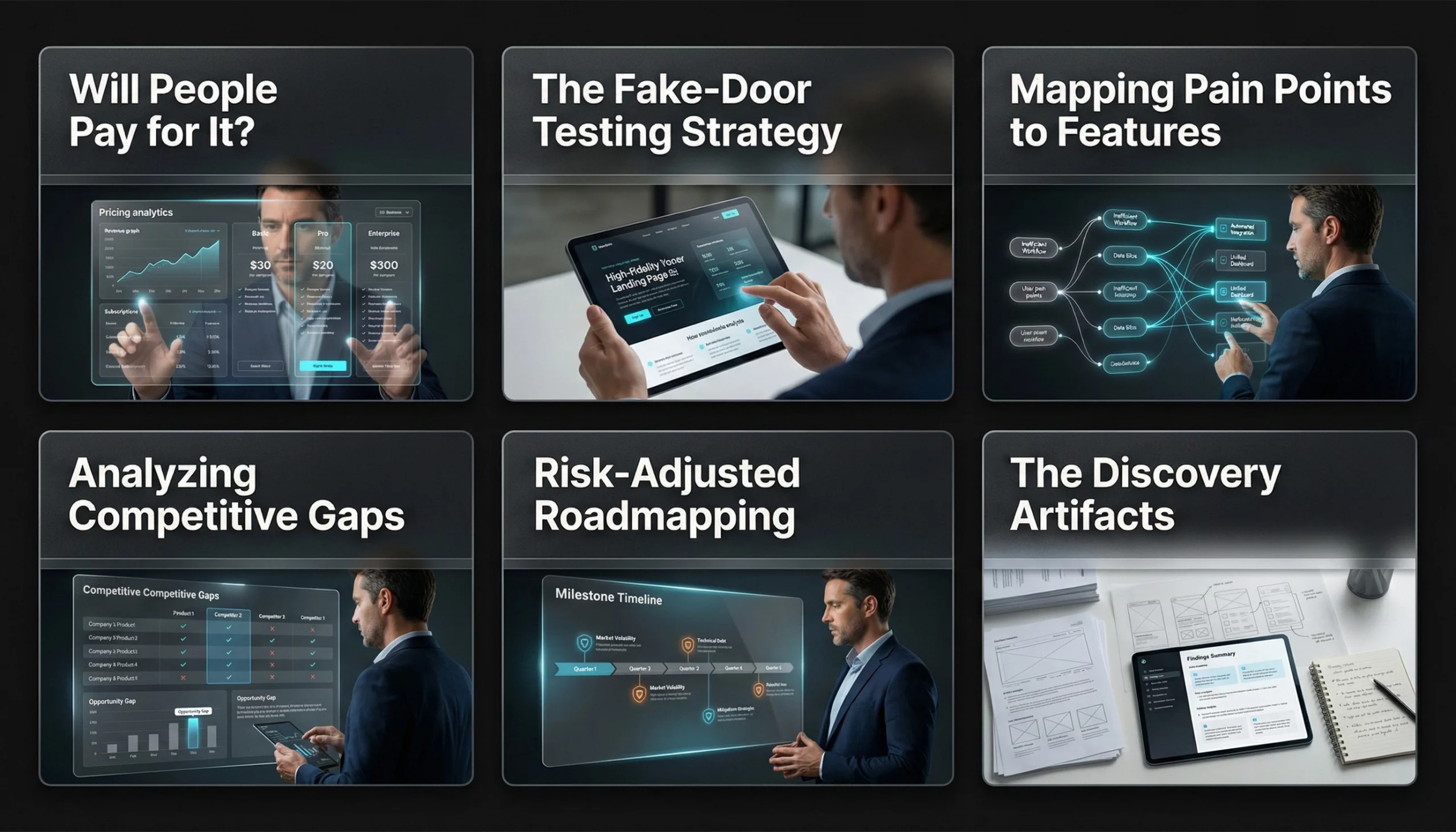
Many founders rush into the app dev process, thinking that a great idea is enough. However, the most successful steps to develop an app start long before the first line of code is written. The first phase is about closing the discovery gap by moving from assumptions to an evidence-based strategy.
1. The Real Question: Will People Pay for It?
Traditional market research often asks, “Would you use this?” to which most people politely say, “Yes.” In a high-stakes app development environment, you need to ask a harder question: “Will you pay for it?”
Successful app development tips focus on identifying Early Evangelists (users whose problems are so painful that they are already trying to solve them with clunky workarounds). If you find users spending money or significant time on a “broken” solution, you have found a market worth entering.
2. The Fake-Door Testing Strategy: Validate Demand Before You Build
One of the most efficient tips for developing an app is the “Fake-Door” or “Smoke Test.” Instead of fully creating an app, you build a high-converting landing page that describes your amazing application and its core value proposition.
- How it works: You place a “Sign Up” or “Get Early Access” Button on the page.
- The Goal: When a user clicks, they are told the feature is “coming soon” and asked for their email.
- The Result: This gives you a clear Conversion Rate. This behavioral data is infinitely more valuable than a survey, proving there is actual demand before you invest in the full app development procedure.
3. Identifying the “Problem-Solution Fit”: Mapping Pain Points to Core Features
To prevent feature bloat, where an app becomes too complex and expensive, you must achieve Problem-Solution Fit (PSF). This involves a rigorous step by step creating an app:
- List every user pain point discovered during interviews
- Map one specific feature to each pain point
- Kill any feature that doesn’t solve a high-priority problem.
This ensures your app development strategy stays lean, focused, and capital-efficient.
4. Analyzing Competitive Gaps: The 5-Step Framework
To outperform competitors, you shouldn’t just copy them; you should find where they are failing. Use this app development procedure for competitive analysis:
- Identify Top 5 Competitors: Look for direct and indirect players.
- Mine 1-Star Reviews: Look for recurring complaints (too slow, bad customer support, etc.)
- Audit the Onboarding: Is it too long? Can you make it 3 clicks instead of 10?
- Feature Heatmap: Create a grid of features. Find the “white space” where no one is offering a specific high-value solution.
- Innovation Velocity: How fast do they ship updates? If they are slow, that’s your window of opportunity.
5. Risk-Adjusted Roadmapping: Feasibility vs. Market Timing
When you design your roadmap, you should treat it as a risk management tool. You must evaluate every feature based on:
- Technical Feasibility: Can our team build this in 3 months?
- Market Timing: Is the market ready for this, or are we too early/late?
- Cost-to-Value Ratio: Does this feature provide enough value to justify its “burn rate”? By prioritizing low-risk, high-value features first, you ensure your app dev process delivers a Quick Qin that can attract further investment.
6. The Discovery Artifacts: Creating a PRD that Developers Actually Understand
The final step of this phase is the Product Requirement Document (PRD). To ensure a smooth app development process, your PRD must be a living document that translates business goals into technical specs. A developer-friendly PRD includes:
- The Why: The specific user problem being solved.
- User Stories: As a user, I want to [Action] so that [Benefit].”
- Acceptance Criteria: A checklist of exactly how the feature should behave.
- Non-Functional Requirements: Standards for speed, security, and scalability.
Creating a PRD that developers actually understand is a key deliverable. To see a full list of documentation and strategic outcomes you should expect, explore our specialized guide on mobile app product design & discovery phase.
Phase 2: Design Strategy – MVP vs. MLP (Minimum Lovable Product)
The modern app dev process has undergone a seismic shift. For years, entrepreneurs were told to build a minimum viable product (MVP), the bare-bones version of an idea. But in a saturated market where users have dozens of alternatives for every task, viable often feels like mediocre. To truly stand out, successful founders are now pivoting to the Minimum Lovable Product (MLP).
1. Why MVPs Fail in 2026: The Shift From Viable to Lovable
The traditional MVP focuses on functionality: Does it work? An MLP focuses on delight: Do they love it? If you are entering a competitive space, like fintech or social media, a product that only “works” will be ignored.
Users in 2026 have high standards for aesthetics and ease of use. An MLP ensures that, even with a small feature set, the experience is so polished that users become instant advocates. This is a critical step by step app development shift to secure early traction and brand loyalty.
2. Reducing Cognitive Load
The first 30 seconds are the “make or break” moment for any amazing application. To keep users from deleting your app, you must master Cognitive Load Theory. This means reducing the mental effort required to use your interface.
- Intrinsic Load: Keep tasks simple (one action per screen).
- Extraneous Load: Eliminate “noise” such as unnecessary buttons, long text, or distracting animations.
- Germane Load: Use familiar patterns (like a “plus” icon for adding items) so users can rely on existing habits rather than learning new ones. By minimizing the “thinking” required, your app development process for entrepreneurs ensures a frictionless path to the app’s core value.
3. Rapid Prototyping Loops: Low-Fi to High-Fi
Iterative design also plays a major role in the app development process. You don’t jump straight into coding; you build prototypes.
- Low-Fidelity Wireframes: Simple black-and-white sketches to map out the flow.
- Interactive Prototype: Clickable versions that mimic the final app.
- High-Fidelity Mockups: Pixel-perfect designs with final colors, fonts, and images. These tips for developing an app allow you to test user flows and fix usability issues before spending a single dollar on app coding.
4. Beyond Polite Feedback: Finding the Truth
During the MVP testing process, you’ll get a lot of feedback. The danger is “polite feedback.” Your friends will be telling you it’s nice because they like you. To get honest market data, watch what they do, not what they say. Use tools like heatmaps or session recordings to see where users get stuck. If a user says an app is “easy” but takes three minutes to find the checkout button, the data tells the real story.
5. Accessibility as a Growth Lever
Designing for inclusivity is no longer just a legal checkbox; it’s a massive growth opportunity. By following WCAG 2.2 standards (ensuring high color contrast, screen recorder compatibility, and large touch targets), you open your app to millions of additional users, including the elderly and those with visual impairments. This is a vital app development procedure for capturing the widest possible U.S. audience.
Phase 3: The Architecture Choice
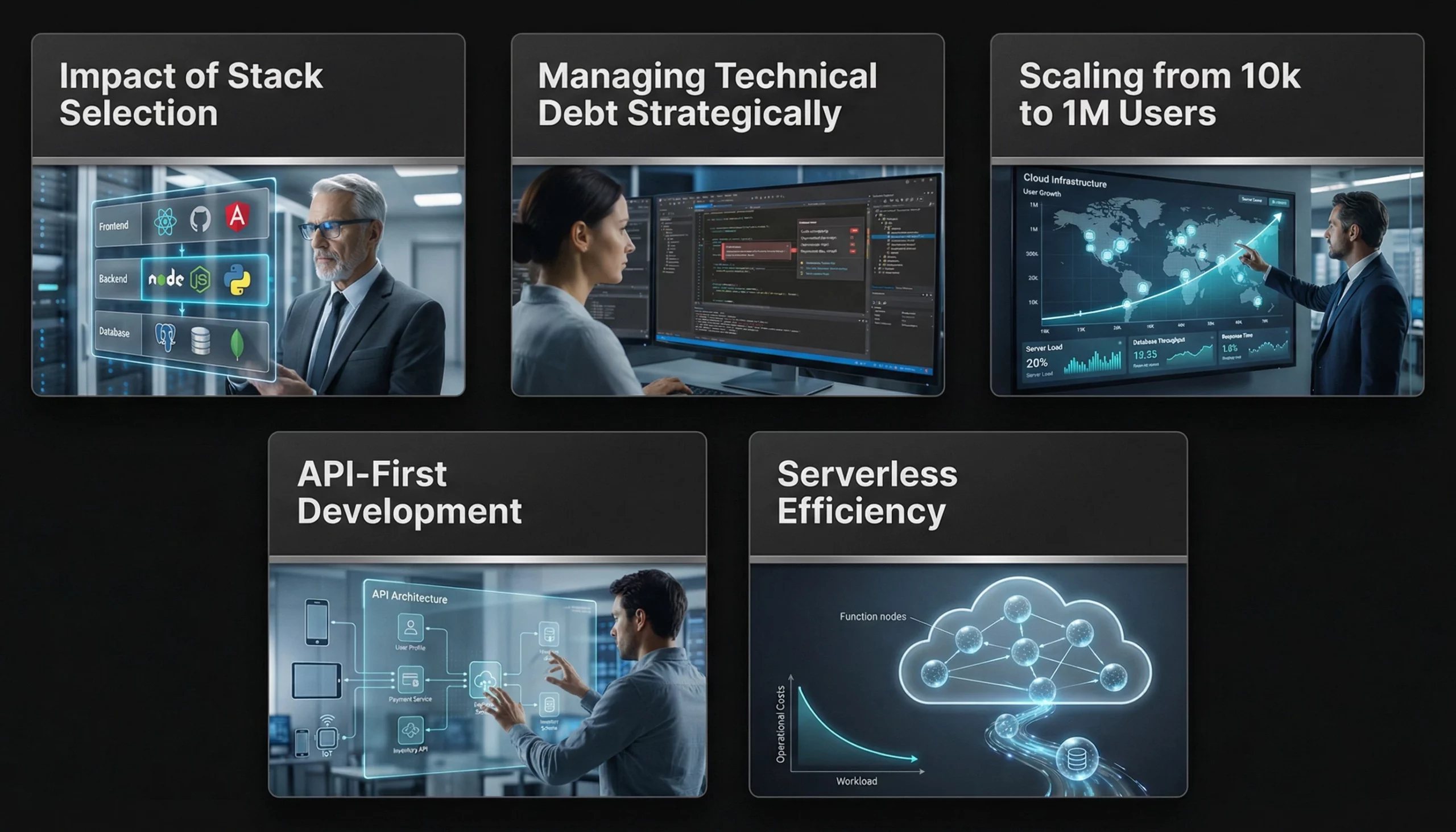
Choosing your tech stack is a critical business strategy. In the app development process for entrepreneurs, the architecture you choose today dictates your burn rate tomorrow. This phase is where you balance the need for speed with the necessity of a stable, scalable foundation.
1. The Business Impact of Stack Selection
One of the most frequent questions in app development is whether to go Native or Cross-platform.
- Cross-Platform: Best for speed-to-market. It allows you to use a single codebase for both iOS and Android, which can reduce your initial app development costs by up to 40%. Cross-platform app development is the go-to choice for founders who need to validate their amazing application quickly.
- Native: Best for high performance. If your app requires heavy processing (like video editing or complex animations) or needs deep integration with phone hardware, Native is the gold standard. While it involves a more complex app development procedure, it offers the best long-term user experience.
Read Also : Android vs. iOS User Behavior: Which Platform is Best for Your App?
2. Managing Technical Debt Strategically
Technical debt is a trade-off: you take a shortcut now to ship faster, knowing you’ll have to “repay” it by refactoring the code later.
- When to take debt: If a shortcut helps you hit a critical investor deadline or a market window.
- How to manage it: Keep a “debt ledger.” Document every shortcut taken during the app dev process, so your team can plan for repayment once you have secured your next funding round.
3. Scaling from 10k to 1M Users
Your backend structure determines how well you handle a “viral” moment.
- Monolith: A single, unified codebase. It’s easier and cheaper for step by step app development in the early stages.
- Microservices: The app is broken into small, independent pieces. While more complex, this is how you scale to millions of users. If your Payment service crashes, your User Profile service stays online.
4. API-First Development: Building a Connected Ecosystem
The modern app development process requires emphasis on the API-First approach. By building your app as a series of connected services, you ensure it can easily “talk” to other platforms. Whether it’s connecting to Stripe for payments or ChatGPT for AI features, an API-first strategy ensures your app remains a flexible, connected part of the digital ecosystem.
5. Serverless Efficiency: Pay Only for What You Use
For a startup, “idle” servers are wasted money. Serverless architectures (like AWS Lambda or Google Cloud Functions) allow your code to run only when triggered by a user action. The benefit of using a serverless architecture is that if no one uses your app at 3 AM, you pay $0). If 10,000 people log in at once, it scales instantly. This is one of the most effective tips for developing an app to keep your operational overhead low. To know more about this architecture, you can check out our mobile app architecture guide.
Phase 4: Agile & AI-Assisted Development
In 2026, the app dev process has evolved beyond simple sticky notes and basic Kanban boards. We have entered the era of Agile 2.0, where artificial intelligence acts as a co-pilot for the entire team. This modern approach ensures that the app development process is not just fast, but also predictable and highly stable.
1. Treat AI as Your Co-Pilot
The biggest challenge in the app development process for entrepreneurs is Sprint Overcommitment. Agile 2.0 solves this problem using AI tools like Jira AI or Monday.dev Copilot to analyze your team’s historical performance.
- Predictive Velocity: Instead of guessing, AI predicts how many story points your team can actually finish based on past data and current team capacity.
- Bottleneck Detection: AI monitors the workflow in real-time, flagging “stuck” tasks before they derail the entire sprint. This data-driven approach is one of the most effective app development tips for keeping your project on track and within budget.
To minimize your money-consumption, you can explore the latest AI app development costs. It is helpful for businesses planning to go the AI way to skyrocket their business.
2. Continuous Integration/Deployment (CI/CD)
If you want to build your app for 24/7 reliability, the answer is CI/CD. This setup creates “Automated Rails” that automatically build, test, and deploy your code every time a change is made.
- Continuous Integration (CI): Merges all developer code into a central stream multiple times a day, preventing the Integration Nightmare at the end of the month.
- Continuous Deployment (CD): Automatically pushes code to your staging or production environment. This ensures your application stays updated without manual intervention, significantly speeding up your time-to-market.
3. Catching Bugs with 99% Precision
Gone are the days of manual click-testing every single button. Modern app development uses AI-driven quality gates. Tools like Mabl or Testim use machine learning to:
- Self-Heal Scripts: If you change a button’s color or position, the AI automatically updates the test script instead of breaking.
- Visual Regression: AI compares screens pixel-by-pixel to ensure that a change in one area didn’t accidentally break the design in another. This automated QA is one of the best things to ensure you launch a quality app with a bug-free experience.
4. Using DevOps For Your App’s Uptime
For a founder, DevOps is a business strategy to achieve success in the modern app development era. It’s the bridge between writing the code and keeping the app running for your users. The DevOps model is one of the popular SDLC models, trusted by many companies.
- Stability: DevOps ensures your server scales automatically when 10,000 users suddenly sign up.
- Recovery: It provides “one-click rollbacks,” so if a new update has a critical error, you can revert to the previous working version in seconds. Understanding this app development procedure is what separates professional-grade apps from amateur ones.
Phase 5: The Security, Privacy & Legal Moat
Security is no longer a feature; it is a foundational business requirement. A single data breach can lead to a 20% drop in company valuation overnight. This phase of the app development process is where you build the app that protects your users, your data, and your intellectual property.
1. Embed Security From the Start
One of the most valuable steps is adopting a security-by-design philosophy. Instead of bolting on security at the end of the app dev process, you must embed it into the very frame of your software from day one. As a custom mobile app development company, we also embed security from the start by following:
- Principle of Least Privilege (PoLP): Ensure that every user and system process has only the absolute minimum access required to function.
- Defense in Depth: Implement multiple layers of security (like MFA, encryption, and firewalls) so that if one layer fails, others are there to catch the threat.
- Zero Trust Architecture: The standard is to never trust, always verify every interaction, even within your own network.
2. Compliance Requirements for U.S. Apps
Depending on your industry, your app development must comply with specific federal and state laws. Navigating these early in the app development procedure saves you from massive legal penalties later:
- GDPR & CCPA: Even for U.S. startups, if you have European or Californian users, you must provide clear “One-Click Opt-Out” options and honor Global Privacy Control (GPC) signals.
- HIPAA: Essential for healthcare app development, requiring strict audit trails and encryption for protected health information (PHI).
- PCI-DSS Level 1: Non-negotiable for any application that processes credit card payments, ensuring high-standard financial data security.
3. Protect Your Data, Increase Your Valuation
Data sovereignty means that data is subject to the laws of the country where it is located. It has become a major factor in modern startup acquisitions. When a larger company looks to acquire your startup, they audit your data flows. If your data is “messy” or stored in non-compliant jurisdictions, it becomes a liability. By keeping data localized and clearly mapped, you turn your database into a clean, high-value asset that is ready for a smooth exit or IPO.
Read Also : A Detailed Guide on Mobile App Development Process
4. Secure Access with Advanced Biometrics
Simple passwords are a relic. To reach modern trust levels, your app development must integrate Biometric Cryptography:
- Physical Biometrics: Standard FaceID and TouchID for quick, secure entry.
- Behavioral Biometrics: This is a unique and fresh concept. It analyzes how a user interacts with the app using their typing rhythm, scroll speed, and the angle at which they hold their phone. If a hacker tries to use a stolen session, the app can detect the change in behavior and lock the account automatically.
5. Safeguard Your IP Before Development Starts
When you are hire mobile app development company in USA or any other region, legal protection should be your first step. Your contracts must include:
- Intellectual Property (IP) Assignment: A clause stating that all code, designs, and logic created during the project belong to you immediately upon payment.
- Work-for-Hire Provisions: Explicitly defining the developer’s work as a service for your company, ensuring they cannot claim ownership later.
- Strong NDAs: Protecting your unique business model and secret sauce from being leaked or pirated by competitors.
Phase 6: Launch Strategy & Post-Launch ROI
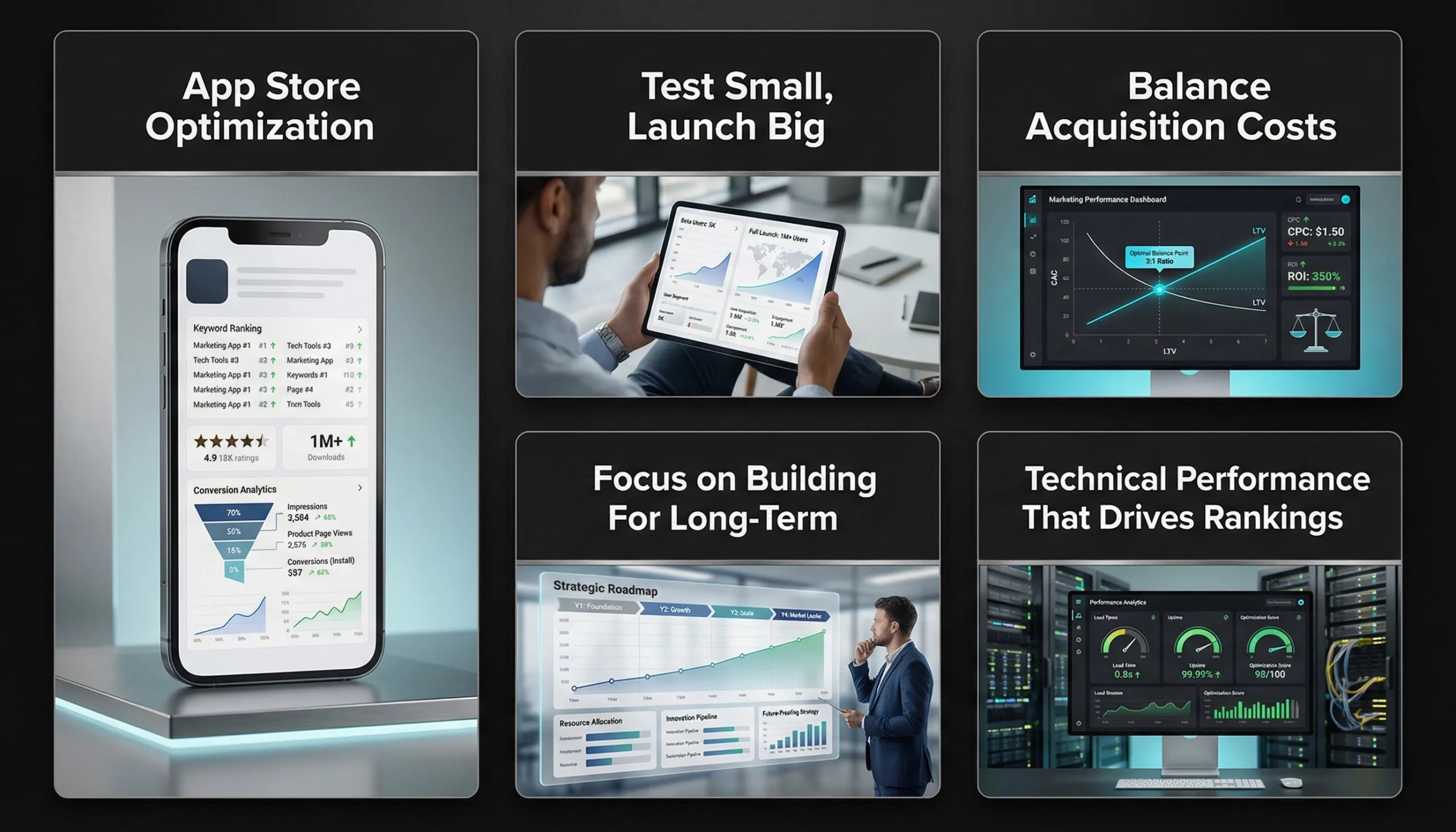
The app development process doesn’t end when you hit “Submit” on the app stores. In fact, the launch is simply the beginning of a high-stakes race where the goal is to convert your application into a sustainable business. To rank among the top 10% of startups, you must include a sophisticated post-launch roadmap focused on visibility, stability, and growth.
1. App Store Optimization for AI-Curated Discovery
Building an app that gets discovered has fundamentally changed. App stores are no longer keyword search engines; they are AI-curated discovery platforms.
- Semantic Search: Google and Apple app store submission guidelines mentioned that the stores use AI to understand user “intent” rather than keywords. Your metadata (title, descriptions) must sound natural and human.
- AI-Generated Summaries: App stores now aggregate your reviews into a single-sentence AI summary. If your reviews mention “crashes,” the AI will display that warning to every potential user.
- Custom Product Pages: You can now create up to 70 different store pages tailored to specific user segments, ensuring that a Finance user sees a different value proposition than a Lifestyle user.
2. Test Small, Launch Big
Avoid a Global Opening immediately. Instead, successful founders use a Soft Launch to “region-lock” their first 1,000 users in a lower-stakes market. Why should you do this? You catch technical bugs and UX friction points with a small audience before they can damage your global rating.
Small launch allows you to test your monetization and retention metrics in a live environment without burning your entire marketing budget. Once your Day 1 Retention and Crash Rate meet your targets, you move to the hard launch with a product that is proven to succeed.
3. Balance Acquisition Costs and Customer Value
During the app development process, many founders overspend on acquisition before fixing their leaky bucket (retention). Your Lifetime Value (LTC) of a customer must eventually be 3x higher than your Customer Acquisition Cost (CAC). Track exactly how much it costs to get one user to perform a “Core Action” (like making a purchase). If this cost is higher than your revenue, your app development model isn’t scalable yet.
4. Focus on Building For Long-Term
A common mistake businesses make is treating the app as a one-off project. You must shift to a Product Mindset to achieve success in 2026. Instead of major updates every six months, use a CD model to ship small improvements and bug fixes every week.
Focus on regular maintenance as it’s an investment in Retention. An app that is updated regularly stays compatible with new OS versions and maintains its ranking in the stores. Take apps like Snapchat or Instagram, for example, they introduce new features every week/month to keep users retained.
5. Technical Performance That Drives Rankings
To establish a strong foothold in this growing market, you should treat technical excellence as a primary priority during app development. Your server should respond in under 800ms. Anything slower causes users to bounce before the app even loads. Users in 2026 expect an app to be interactive within 2.5 seconds. On the Play Store, if your “application not responding” (ANR) rate exceeds 0.47%, your visibility will be severely penalized.
Conclusion
The transition from a visionary idea to a market-leading product is a high-stakes journey where moving fast must be balanced with building smart. In an era defined by Capital Efficiency, your app development process is more than just a sequence of coding sprints; it is a rigorous business strategy designed to eliminate the Discovery Gap and preserve your startup’s burn rate.
Navigating the complexities of app development requires a partner who understands the high-stakes reality of the startup ecosystem. At RipenApps, we don’t just build code, we build businesses. As a leading custom mobile app development company, we successfully bridge the gap between technical excellence and market success.
Our authority in the app development industry is backed by a portfolio of high-growth projects (Al Muzaini, Cilio, Volt, etc) that have dominated their respective markets. Whether you are looking for tips for developing an app or a full-scale engineering team to execute your vision, RipenApps provides the top-quality consulting and technical muscle needed to turn your concept into a market-leading reality.

FAQs
Q1. What are the first steps an entrepreneur should take before starting app development?
The journey begins with Market Discovery. Instead of coding, founders should focus on defining a specific “Problem-Solution Fit.” This involves identifying a high-friction pain point, researching the competitive landscape to find “white space,” and documenting a clear Unique Value Proposition (UVP) that explains why your app deserves to exist.
Q2. How do entrepreneurs validate an app idea before investing in development?
The most effective method is Behavioral Validation. Use “Fake-Door Testing” by creating a high-converting landing page with a Join Waitlist or Pre-Order button. If users are willing to provide their data or commit to a purchase before the app is built, you have proven market demand.
Q3. Why is choosing the right app development team important for startups?
For a startup, your development team is your Strategic Engine, not just a vendor. The right team manages your burn rate by suggesting cost-effective architectures (like Cross-platform vs. Native) and prevents Technical Debt.
Q4. What common mistakes should entrepreneurs avoid during the app development process?
The #1 mistake is Feature Bloat; trying to build a Swiss Army Knife” app that does too much, which leads to high costs and user confusion. Other critical errors include neglecting the Discovery Phase, ignoring user feedback loops, and underestimating the budget.
Q5. How can entrepreneurs ensure their app is scalable and future-ready?
Scalability is built at the Architecture Level. Founders should insist on an API-First approach and Microservices, which allow individual parts of the app to scale as traffic grows.

SHARE
WRITTEN BY

Ishan Gupta
CEO & Founder
Ishan Gupta is a seasoned entrepreneur and CEO with extensive 8+ years of experience in business and mobile app development landscape. He believes that the right digital product allows companies to focus on what they do best, while technology handles the rest. With deep exposure to global markets, he understands what makes an app succeed. His approach translates business needs into clear product strategies, ensuring that every feature contributes to measurable ROI.
View All Articles