

Most mobile apps don’t fail because the idea was weak. They fail because the product couldn’t grow without breaking. That failure almost always traces back to mobile app architecture, even though it’s rarely discussed outside engineering rooms. For business leaders, architecture is not a technical preference. It is a decision that quietly shapes cost, speed, risk, and long-term value from day one.
Think of architecture as the structural skeleton of a digital business. Features are the muscles. Marketing is the fuel. But if the skeleton is fragile, adding more muscle only increases strain. Early shortcuts may help an app launch faster, but they often create hidden weaknesses that surface when users scale, integrations increase, or compliance requirements tighten.
Poor architectural decisions show up in predictable ways. Teams struggle to release features without regressions. Maintenance costs rise, performance dips, and these issues turn into technical debt, slowing the product and forcing expensive rewrites. Weak foundations lower confidence and valuation. This is why mobile architecture should be treated as a business risk and asset decision, not just an implementation detail.
This guide explains mobile app architecture in business terms. You will learn how different architectural approaches affect cost, scalability, speed to market, and ROI, and how to align technical decisions with growth goals. The goal is not to overwhelm you with jargon, but to help you make informed choices that support long-term business success.
Table of Contents
What Mobile App Architecture Really Means?
When businesses hear the term “mobile app architecture,” it’s often mistaken for frameworks, programming languages, or the aesthetic appeal of the code. That confusion is common and costly. Architecture is not about how something is built at the code level. It’s about how the system is designed to behave as the business grows.
To explain it in simple language. Implementation is what your developers write today, architecture is what limits or enables you tomorrow.
Implementation decisions can change relatively easily. Architecture decisions cannot. Once an app is live and users, data, and integrations start piling up, architectural choices become expensive to reverse.
How Architecture Shapes Core Business Capabilities?
Here’s how architecture shapes core business capabilities:
- Architecture defines where responsibilities start and end. Clear boundaries allow teams to work in parallel, release features independently, and avoid breaking unrelated parts of the app.
- Architecture determines where data lives, how it flows, and who can access it. Poor data separation increases security risk, complicates compliance, and limits future analytics or AI use cases.
- Good architecture absorbs that pressure. This directly affects how quickly you can respond to market demands or customer feedback.
Business owners shouldn’t think like they can ‘fix architecture later once the product succeeds.’ Reworking architecture under active users is far more expensive than doing it right early. Architecture is not about choosing the most complex option.
It’s about choosing the right level of structure for your current stage, while leaving room for future evolution. Understanding architecture this way helps businesses move from reactive fixes to intentional, growth-ready decisions.
The Core Architectural Layers of Mobile App Architecture
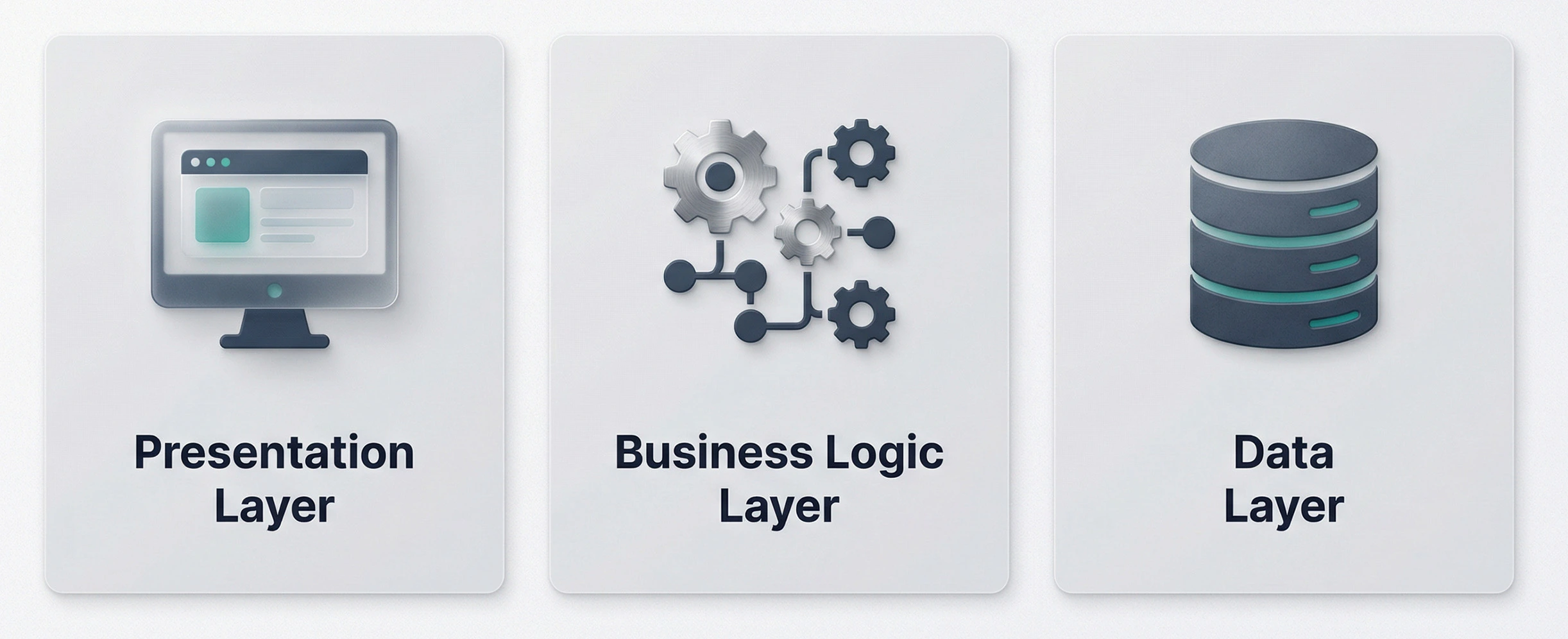
Mobile app development comprises different layers that are connected to the development process. These layers are not technical theory. They directly affect user experience, scalability, cost, and long-term stability.
Presentation Layer: The User Experience & Conversion Layer
The presentation layer of mobile app architecture is what users interact with. Screens, layouts, animations, navigation, and responsiveness all live here. When people ask what is a mobile application, this is the part they actually visualize. From a business perspective, this layer controls:
- First impressions
- Engagement and session length
- Conversion rates and churn
If the presentation layer is slow, inconsistent, or confusing, users leave. Even the best backend cannot compensate for poor UI performance. This is why frontend architecture decisions are as important as backend ones.
In Android apps, the architecture of Android app UI components must handle multiple screen sizes, device capabilities, and lifecycles. Poor structuring of Android app architecture leads to frequent crashes, UI freezes, and negative app store reviews.
Business Logic Layer: The Operational Intelligence Layer
This layer sits between what users see and how data is processed. It handles workflows, rules, validations, calculations, and decision-making logic. From a business lens, the business logic layer defines:
- How fast can features be released
- How complex workflows are handled
- How easily can rules change without breaking the app
When logic is tightly coupled to UI or scattered across the app, teams slow down. Every small change takes longer, testing becomes harder, and bugs increase. This is where poor application architecture silently increases operational costs. Businesses should focus on clean separation in this layer to support different app development models and allow businesses to adapt as requirements evolve.
Data Layer: The Data Ownership & Scalability Layer
The data layer manages databases, APIs, cloud services, and third-party integrations. It defines how data is stored, retrieved, synced, and secured. For businesses, this layer impacts:
- App uptime and performance
- Scalability during traffic spikes
- Compliance and data protection
- Long-term analytics and reporting
In most mobile app architecture diagrams, this layer connects frontend and backend deployment types, including cloud servers, microservices, or serverless functions. Weak data architecture leads to downtime, data inconsistency, and security risks.
Why This Layered Architecture Matters?
Every mobile application architecture diagram may look similar on paper, but the real difference lies in how well these layers are defined and separated. Strong app architecture allows businesses to scale features, users, and integrations without constant rewrites. In short, architecture is not about complexity. It’s about building a structure that supports growth, reduces risk, and keeps the product adaptable as the business evolves.
Types of Mobile App Architectures: Choosing Based on Growth Stage
Not all mobile apps are built for the same purpose. A simple MVP, a consumer-facing app, and an enterprise platform all fall under different types of mobile applications, and each one demands a different mobile app architecture. This is why understanding when and why to use a specific architecture matters more than just knowing the names.
In simple terms, app architecture defines how your mobile application is structured, how the frontend and backend communicate, and how the system behaves as users, features, and data grow. Choosing the wrong architecture early can slow growth and increase costs later. Below are the most common types of mobile application architecture, explained from a business point of view.
1. Monolithic Architecture
A monolithic architecture means the entire mobile application is built as a single unit. The frontend, backend logic, and data handling are tightly connected.
Best suited for
- MVPs and early-stage products
- Startups validating an idea quickly
- Limited budget and small teams
Business advantage
- Faster development and launch
- Simple custom app development model
- Lower initial cost
Hidden risk
As the app grows, changes become harder. Scaling specific features independently is difficult, and long-term maintenance costs increase. Many businesses using monolithic mobile app architecture face a high cost of ownership for a custom mobile app once user traffic grows. This approach works well when speed matters more than long-term flexibility.
2. Modular Monolithic Architecture
A modular monolith keeps everything in one codebase but separates features into well-defined modules. It improves structure without adding too much complexity.
Best suited for
- Growing products with steady user adoption
- Businesses planning feature expansion
- Teams preparing for scale
Business advantage
- Better maintainability than a pure monolith
- Clear separation of responsibilities
- Easier transition to advanced architectures later
This approach provides a balanced mobile application architecture for businesses that are past validation but not ready for complex systems.
3. Microservices Architecture
Microservices break the application into independent services that communicate through APIs. Each service can be developed, deployed, and scaled separately.
Best suited for
- Enterprise apps
- High-traffic platforms
- Large teams with DevOps support
Business reality
Microservices improve scalability and system resilience, but they also increase upfront cost. This architecture requires strong backend development, monitoring, and infrastructure management. This mobile architecture can make enterprise mobile app development faster.
4. Serverless Architecture
Serverless architecture uses cloud-managed functions to run backend logic without managing servers. Businesses need to focus on cloud migration & data security checklist to understand this mobile app architecture.
Best suited for
- Event-driven applications
- Apps with unpredictable traffic
- Businesses focused on cost optimization
Business trade-off
Serverless reduces infrastructure management and follows a pay-as-you-use model. However, it increases dependency on cloud providers and may limit customization.
How To Choose The Right Architecture?
Every mobile application architecture looks similar on paper, but the right choice depends on your business stage, traffic expectations, and team readiness. The goal is not to pick the most advanced architecture, but the one that supports growth without creating unnecessary complexity. Understanding what is app architecture from this perspective helps businesses build products that scale smoothly instead of becoming technical liabilities.
Mobile App Architectures For Different Platforms
When businesses plan a mobile product, one of the first questions is where will this app run? Android, iOS, or both. This choice directly affects mobile app architecture, development cost, delivery speed, and long-term maintenance.
At its core, app architecture changes slightly depending on the platform because each platform handles UI, system resources, and application lifecycle differently. Understanding these differences helps business owners choose the right app development model instead of reacting to problems later.
1. Android App Architecture
Android supports a wide range of devices, screen sizes, and hardware configurations. This flexibility is powerful, but it also introduces complexity in the architecture of Android app systems.
From a business point of view, Android app architecture must handle:
- Frequent lifecycle changes
- Multiple device configurations
- Varying OS versions across users
If the mobile application architecture is not well-structured, Android apps can suffer from crashes, memory leaks, and inconsistent performance. These issues increase support costs and hurt app ratings.
Having strong architecture on Android ensures:
- Better performance across devices
- Faster bug fixing
- Easier feature expansion
For consumer-facing apps with a broad audience, Android architecture decisions directly impact reach and reliability, shaping the future of Android and helping businesses stand out.
2. iOS App Architecture
iOS operates in a more controlled and predictable environment. Fewer device variations and consistent OS adoption simplify some aspects of mobile architecture.
For businesses, this means:
- More stable performance across users
- Easier testing and quality control
- Faster optimization for new OS features
However, poor mobile application architecture on iOS still creates problems. If logic is tightly coupled to UI or data handling is unclear, future updates become risky. That’s when you need expert iOS app development services to get everything done quickly.
An expert firm can provide a clean iOS architecture to improve:
- Maintainability
- Developer onboarding speed
- Long-term product stability
This is especially important for premium apps where user experience directly affects revenue.
Read Also : An Exclusive Cross Platform App Development Guide For Businesses
3. Hybrid vs Cross-Platform Architecture
This is where many businesses get confused:
Hybrid architecture usually relies on web technologies wrapped inside a mobile shell. It’s quick to build but often compromises performance and user experience.
Cross-platform architecture, using modern mobile application technology like Flutter or React Native, is different. It uses a shared codebase while still delivering near-native performance.
From a business perspective:
- Cross-platform architecture reduces development cost
- It speeds up time-to-market
- It simplifies frontend and backend deployment types
For businesses planning to invest in eCommerce, SaaS, internal tools, and fintech app development services, cross-platform mobile app architecture provides the best balance between cost, speed, and performance.
Critical Factors That Define a Scalable Mobile App Architecture
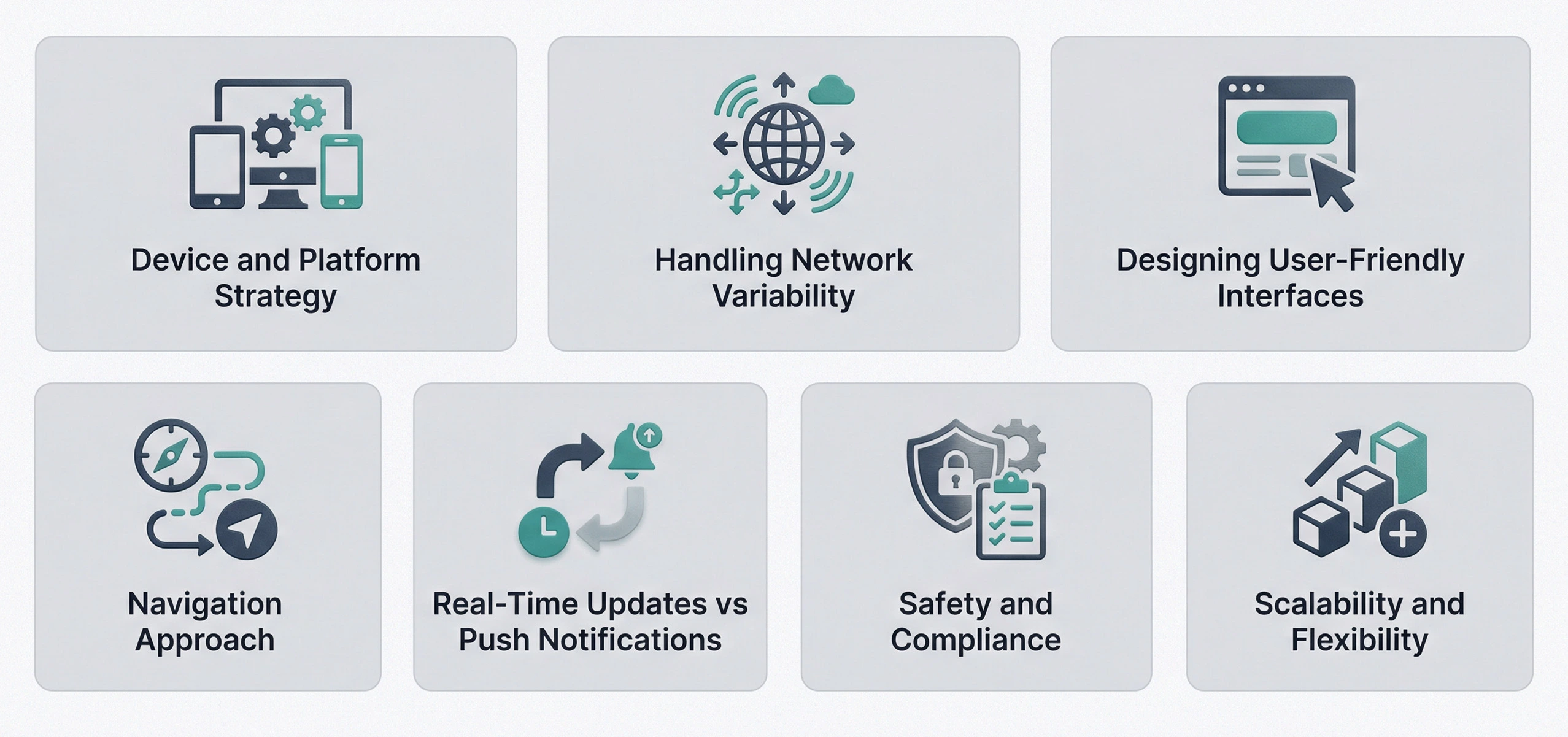
A robust mobile application architecture is necessary to ensure your app stands out. You need to consider scalability, performance, and security while developing a customized architecture. But there are several other factors that you shouldn’t ignore. Here are these key factors:
1. Device and Platform Strategy
Start by considering the device type. You should study the screen size, resolution, CPU characteristics, memory, and storage space, including the availability of the development tool environment. Once you have the details of the devices, you can decide on must-have app features as they depend on the software or hardware of your desired platform.
2. Handling Network Variability and Performance
Your application will face several events where internet connectivity will disappear. That’s why your mobile app architecture needs to be built considering the worst network conditions. It’s crucial to design the data access mechanism, caching, and state management, keeping the worst-case scenario in mind.
3. Designing Interfaces Users Actually Adopt
UI and UX design have an important role within an application. Your app’s UI should keep the users engaged and provide a smooth experience, which can be a crucial aspect of your mobile app infrastructure. This improves user satisfaction and impacts retention and conversion rates. Having a unique UI/UX can make your app stand out in the competitive market, resulting in overall success and usability.
4. Navigation That Reduces Friction and Drop-Off
While the primary focus is on designing the mobile app architecture, front-end and back-end development is essential. Once you understand your customers and their requirements, you can decide which navigation style would be best. You can choose one from:
- Stacked navigation bar
- Single view
- Scroll views
- Tab controller
- Model controller
- Search based
- Gesture driven
When you consider building a mobile app backend architecture, align these navigation styles with a powerful backend that supports smooth data flow and user interactions.
5. Choosing Between Real-Time Updates and Notifications
When you make informed decisions about the mobile app architecture diagram, consider providing your users real-time updates or push notifications. If you are looking to keep your users engaged with timely alerts and updates, then you should include push notifications in your app.
They provide a budget-friendly alternative to real-time updates, which demand continuous active connections. Choosing push notifications instead of real-time updates ensures your app stays relevant, increases user engagement, and improves retention. Apart from real-time updates, investing in chatbot development services is also a great choice to increase your user engagement and retention.
6. Security and Compliance as Business Safeguards
One important factor of mobile app architecture that cannot be compromised is security. Your architecture should include strong security features like encryption, protected APIs, and frequent security upgrades.
You should adhere to the applicable laws, like GDPR or HIPAA, to preserve confidence and safeguard user data. You can learn about the best practices to enhance the security of your Android and iOS app to identify and mitigate possible threats. Implementing multi-factor authentication and other mechanisms safeguards sensitive information, making your app reliable.
7. Designing for Growth and Peak Load
Your app’s architecture needs to be able to handle growth. It should support scaling up without compromising speed as the number of users increases. Include appropriate databases, cloud solutions, and backend services to make your app grow seamlessly with the user base.
Implementing load balancing and optimizing resource allocation are necessary to maintain high-quality performance under heavy load. When you plan for the future while being in the present, you save time and expense that can occur after launching the application.
How to Choose the Right Mobile App Architecture for Your Business?
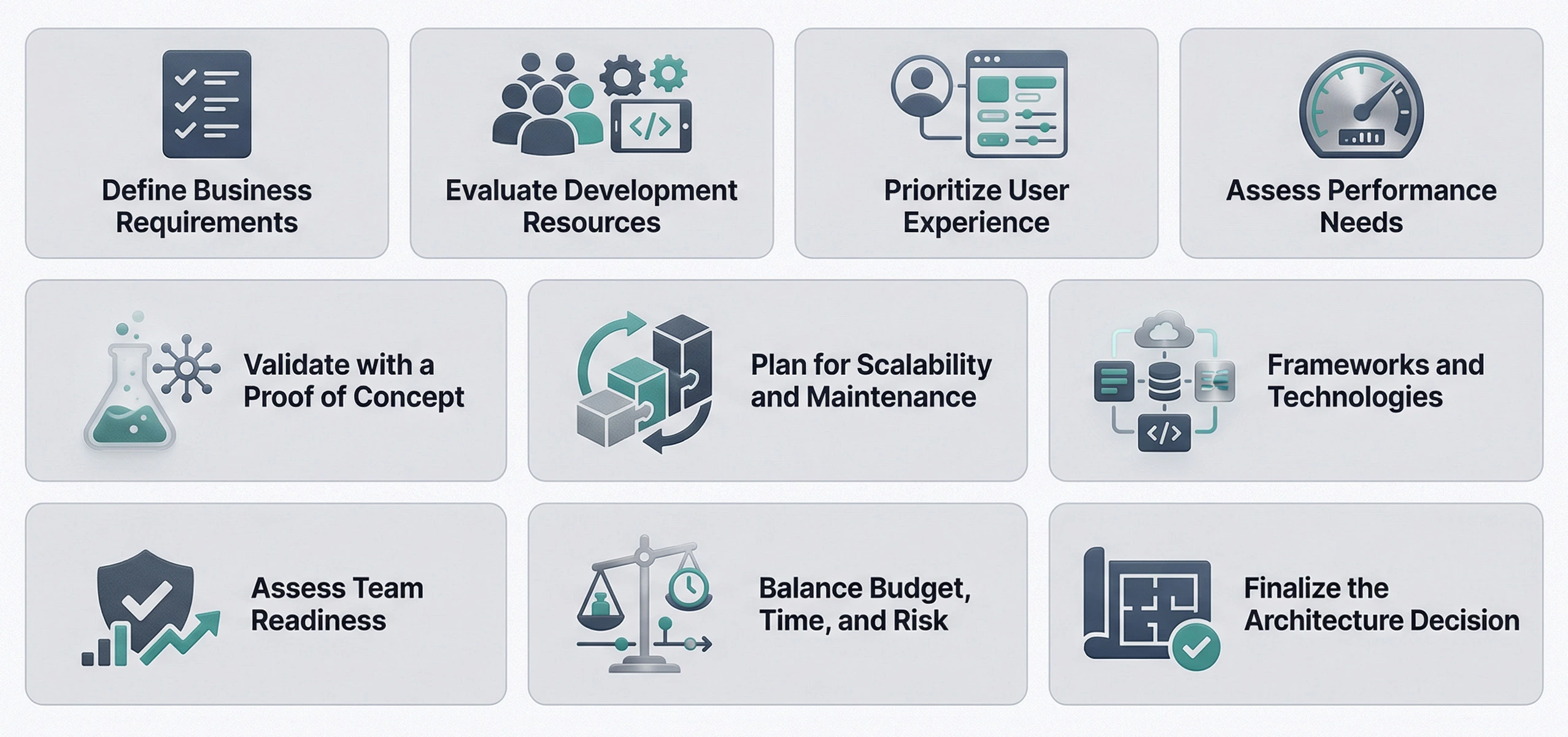
The process of choosing the right mobile app architecture should start by understanding your app’s requirements and the capabilities of your development team. Here are the important steps you need to take to choose the right architecture:
1. Define Your Business and Product Requirements
Start the process by writing down your app’s functional and non-functional needs. You need to keep some factors in mind, such as target audience, preferred platform, performance requirements, offline access, and third-party service integration. Focus on the app’s functionality and special features as well. Once you have a list of these requirements, you can select the best architecture.
2. Evaluate Available Development Resources
Analyze the skills and proficiency you need to have in your development team. Your architecture decisions can be smarter if you choose a team skilled in languages or frameworks like JavaScript, React Native, Flutter, Swift, or Kotlin.
Your developers should be able to use outside resources like plugins, libraries, and user assistance. Having a skilled and experienced development team boosts the speed and ensures your project’s success.
3. Prioritize User Experience and Adoption
Decide the level of user experience you aim to deliver. Native apps provide better performance and smoother user interfaces, but cross-platform and hybrid applications offer consistency across several devices. Keep particular user interactions and UI components in consideration, as this will enable you to select the best architecture that supports your desired user experience.
4. Assess Performance and Reliability Needs
Native development provides high-performance applications with intuitive visuals or interactions. Choosing the native mobile app architecture can be the best option when you want to use device-specific features.
Consider factors like battery use, rendering speed, and response time. You can test the performance to find an architecture based on your app’s performance needs.
5. Validate Assumptions with a Proof of Concept
Build a test app utilizing important styles from MVC, MVVM, and Clean Architecture to handle the needs of your app. This test application evaluates important aspects, including scalability, code maintainability, and simplicity.
Include app functionalities like data retrieval, user sign-in, and user interface navigation to recreate real-world scenarios and check the performance of each architecture in different scenarios.

6. Plan for Future Scalability and Maintainability
Build your app considering long-term growth and maintenance. Choose a mobile app architecture that provides scalability, feature additions, and updates easily. Evaluate how each architecture adapts to new platform updates, technologies, and required updates.
The available tools and resources should support the architecture to ensure you can scale and maintain your app to compete in the long run. This should be the top priority for businesses planning to invest in highly growing industries.
7. Select the Right Frameworks and Technologies
The choice of frameworks and tools matters as much as the design itself. Not every framework suits every type of mobile app. You should focus on tools that:
- Have clarity. well-maintained documentation
- Are easy for teams to adopt and work with
- Offer strong community and ecosystem support
Frameworks with active communities and regular updates reduce development friction and lower long-term risk. They make it easier to solve problems, onboard new developers, and keep your mobile application architecture up to date.
8. Assess Your Development Team’s Readiness
Even the best app architecture can fail due to the team’s less expertise and experience. Before finalizing an architecture, evaluate whether your development team has the skills and experience required.
Key areas to assess include:
- Familiarity with the chosen architecture pattern
- Experience with the selected frameworks and tools
- Ability to adapt to new technologies and workflows
If gaps exist, plan for training or external support early. Preparing your team in advance reduces implementation delays, improves code quality, and ensures the chosen mobile application architecture delivers its intended business value.
9. Balance Budget, Timeline, and Risk
Time and budget play a major role in shaping your mobile app architecture. Different app development models come with different cost structures, and understanding these trade-offs early helps avoid overspending later.
Cross-platform and hybrid approaches allow businesses to manage a single codebase across platforms, reducing development and maintenance costs. This can speed up delivery and make budgets more predictable. However, it’s important to factor in the initial effort required to adopt new frameworks, tools, or workflows.
10. Make an Informed Architecture Decision
By the time you reach this stage, you should have a clear view of your requirements, team readiness, performance needs, and future growth plans. Use these insights to select the app architecture that best aligns with your business objectives.
Consider your app’s complexity, the need for platform-specific functionality, and expected scalability. The right mobile application architecture should be practical today and flexible enough to evolve as your business grows.
An informed decision balances cost, speed, and long-term value, ensuring your mobile app architecture supports the app you are building now and the product you want it to become in the future.
Final Thoughts
The success of any mobile app heavily relies on the mobile app architecture. Some architecture prioritizes speed. Others prioritize scalability. The key is alignment. When app architecture aligns with business goals, growth becomes predictable instead of painful. Early clarity around mobile architecture prevents expensive rewrites, protects ROI, and turns the app into a long-term business asset rather than a technical liability.
RipenApps has been providing tailored custom app development services across various industries for more than a decade. We have gained extensive experience after working with growth-focused brands like Cilio (Management App), QuitSure (Quit Smoking App), and AL Muzaini (Money Transfer App).
Our designers and developers help our clients decide the best mobile app architecture pattern and then design, develop, and implement the same in their mobile app. You can plan your app development with RipenApps, a reliable mobile app development company, to select the perfect mobile app architecture.

FAQs
Q1. What is mobile app architecture?
Mobile app architecture is the structural design of a mobile application that defines how the frontend, backend, and data layers interact. It determines how the app is built, how components communicate, and how the system scales as users and features grow.
Q2. Why is mobile app architecture important?
Mobile app architecture is important because it directly affects performance, scalability, security, and maintenance cost. A well-planned mobile application architecture helps businesses avoid technical debt, reduce long-term expenses, and support growth without frequent rewrites.
Q3. What are the main layers of mobile app architecture?
Most mobile app architecture designs include three main layers:
- Presentation layer for the user interface and experience
- Business logic layer for rules and workflows
- Data layer for storage, APIs, and integrations
These layers are commonly shown in a mobile application architecture diagram.
Q4. How do I choose the right architecture for my app?
To select an appropriate app architecture, you have to analyze the app requirements, users, budget, timeline, and scalability. Different types of mobile applications need different architectures based on growth stage, traffic expectations, and team readiness.
Q5. How long does it take to build mobile app architecture?
Typically, building app design and architecture requires several days to several weeks. The time required is dependent on app complexity and technologies. However, spending time on design and architecture helps prevent app development delays and costly changes down the line.
Q6. What are some key principles of mobile app architecture?
The key principles of mobile architecture include separation of concerns, scalability, security, maintainability, and performance. By understanding and implementing these key principles, you should be able to create a flexible, stable, and scalable mobile application architecture.

SHARE
WRITTEN BY

Prankur Haldiya
Chief Technical Officer
A tech innovator and engineering leader, Prankur Haldiya drives RipenApps’ product development strategy and oversees cutting-edge solutions in mobility, AI, and cloud ecosystems. He is passionate about building high-performance teams and helping brands launch secure, scalable, and user-centric digital products.
View All Articles