

Building a custom mobile app is no longer a side initiative. For many companies, it’s a core driver of revenue, customer engagement, and operational efficiency. Yet most CEOs and business leaders still underestimate the total cost of ownership (TCO) that comes when you complete the custom app development process.
Research from Gartner shows that nearly 60% of digital initiatives exceed their budget because long-term expenses such as maintenance, infrastructure, integrations, scalability, and security are not planned up front. McKinsey also reports that organizations with a clear understanding of lifecycle costs improve delivery efficiency by up to 45%.
This gap between expectation and reality often leads to stalled releases, rising technical debt, and unpredictable burn rates. The initial build may feel straightforward, but the real investment comes from keeping the product stable, secure, and adaptable to market demands. That’s why understanding TCO is a strategic decision that shapes product velocity, team planning, and long-term ROI.
In this guide, we’ll break down every component that contributes to the true cost of owning a custom mobile app. This blog will help you budget confidently, reduce blind spots, and make decisions backed by data.
Table of Contents
What is Total Cost of Ownership (TCO)?
To define the total cost of ownership, the real cost of custom app development shows up over the months and years you continue to run, maintain, and improve it. That full picture is called the Total Cost of Ownership. It helps you understand how much your app will actually cost from day one to year three or five. This gives you a realistic view of your budget, avoids surprises, and helps you plan your product roadmap with confidence. To calculate the total cost of ownership in custom app development, you need to look at a few areas:
- Development – the cost of designing, building, testing, and launching the first version.
- Infrastructure – servers, cloud services, storage, and everything needed to keep the app running.
- Maintenance – bug fixes, updates, improvements, and support after launch.
- Security & Compliance – keeping your app safe, preventing breaches, and meeting industry standards.
- Team Costs – the people involved in building and managing the app, whether in-house or outsourced.
Once you combine these core areas, you get a clearer idea of how much it takes to not just create an app, but to keep it healthy, secure, and ready for growth.
Why Businesses Should Prioritize TCO Analysis?
Ignoring the total cost of ownership can lead to misjudging what a system truly costs. Things like integration fees, staff training, downtime, upgrades, hardware changes, and contract renewals can add up quickly. Many tools need extra subscriptions for features like loyalty, marketing, or analytics. By the time these costs show up, it’s often too late to plan for them.
A solid TCO review helps you understand the full picture before you invest. It helps you with:
- Predictable budgeting: Understand the full cost of using the tool over time.
- Fair comparisons: Compare vendors based on long-term value, not just starting price.
- Better planning: Pick tools that support your goals and future growth.
- Higher long-term value: Choose software that stays cost-effective as you scale, instead of tools that start cheap but get expensive through contracts or add-ons.
When you do it right, a TCO analysis shows what you will spend and how well the technology will serve your business over the years.
Understanding Your Costs: Before, During, and After Custom App Development
When most people think about custom app development, they focus only on the price to build the first version. But the total cost of ownership is much more than that. To plan your budget properly, you need to know what you’ll spend before development starts, while the app is being built, and after it goes live. Explore a simple breakdown to understand your real investment and improve your ROI from day one.
1. Before Development: Planning and Preparation
Every strong product starts with planning. This early phase may feel slow, but it helps you save money over time. Here’s what you pay for during the planning and preparation phase:
- Product discovery
- User flows and UX planning
- Technical architecture
- Choosing the right platforms and features
This stage prevents rework because you are not guessing what to build. It also helps you estimate your app development cost accurately. Every mobile app development guide starts with planning for a reason because this small process is the most important part of the puzzle. Having a clear plan provides long-term stability, strengthens your ROI calculation by allowing you to invest in the right features.
2. During Custom App Development: The Actual Build
This is where you start building your custom app. This phase includes development costs for:
- Features
- Complexity
- Integrations
- Platforms (iOS, Android, or both)
- Tech stack your app developer uses
- Testing and QA
Your decisions at this stage impact both short-term app development cost and long-term TCO (total cost ownership). For example, a poor tech stack may look cheaper today, but performance issues or rewrites can make it a lot more expensive in the future.
Read Also : Custom App Development: A Smart Investment for US SMBs
3. After Launch: The Long-Term Costs That Most Teams Miss
Once your app goes live, the costs don’t stop. In fact, post-launch spending usually makes up the largest part of your TCO cost. After launching the app, you need to budget for:
- Maintenance and updates
- New features based on user feedback
- Hosting and cloud services
- Performance improvements
- Security patches
- Monitoring and analytics
This is where many business owners underestimate expenses and end up affecting product quality. Choosing the right custom application development company keeps these costs predictable and manageable. Once you gain knowledge about every cost across the full lifecycle, your ROI calculation becomes far more accurate.
Simple Breakdown of Costs Involved in Custom App Development
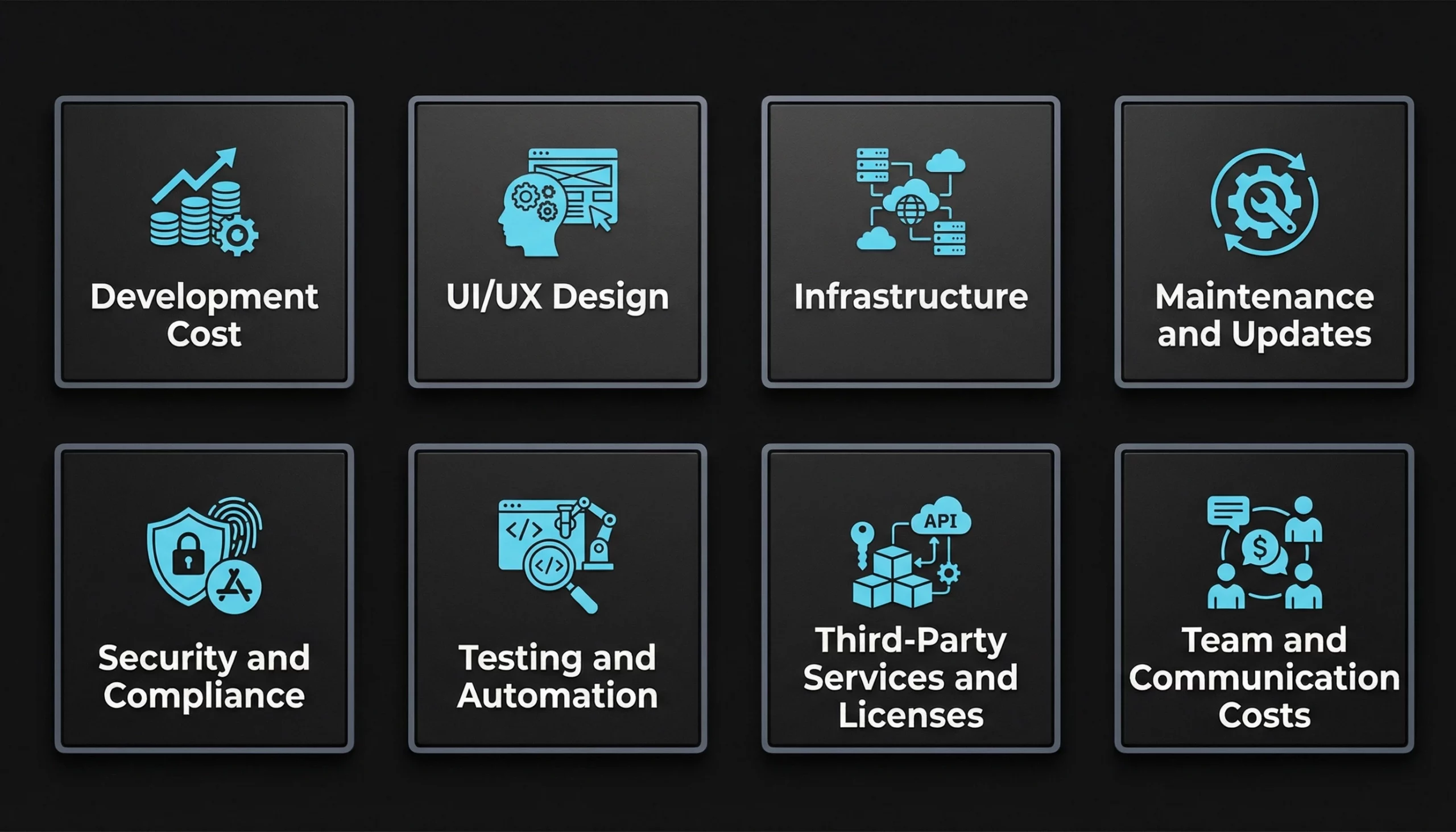
When people talk about the total cost of ownership, they usually think only about the development bill. But in reality, a custom app has multiple cost layers that show up at different stages of its lifecycle. Understanding these layers helps you plan better, avoid surprises, and improve your ROI from the start.
Here’s a clear and simple breakdown of the main costs that shape your custom app development budget.
1. Development Cost
This is the first major expense and usually the most visible one. Your app development cost gets influenced by features, app complexity, number of screens, integrations, and platform selection.
2. UI/UX Design
Good design shapes the user experience and reduces support costs later. Even if you know how to build an application technically, a clean UI still requires planning, prototyping, and testing. UI and UX design impacts development speed, user onboarding, retention, conversion, and long-term app development budgeting for business.
3. Infrastructure (Cloud, Hosting, Storage)
Many founders underestimate this part, and they end up spending a lot of money. Your app needs servers, storage, CDN, logs, and other cloud resources to operate. You should know which cloud solution works best for your business to make an informed decision. The main factors that play an important part in infrastructure are traffic volume, data usage, media storage, and API requests. These ongoing charges play a major role in mobile app total cost analysis.
4. Maintenance and Updates
This is where the largest chunk of your long-term budget sits. Maintenance includes fixing bugs, updating libraries, adjusting to iOS/Android updates, adding new features, and improving performance. If you’re planning for long-term mobile app maintenance costs, this becomes essential.
5. Security and Compliance
Every modern app needs strong protection because secure apps get loyalty as a special reward. You can check the iOS and Android application security best practices to make an informed decision. Security costs include security audits, data encryption, compliance with industry laws, and regular penetration testing. Ignoring security costs can lead to more money and abandonment.
6. Testing and Automation
Every app needs thorough testing before launch to meet user expectations. This process includes functional testing, device testing, performance testing, and automation scripts. Testing ensures your product stays reliable and reduces future repair costs.
7. Third-Party Services and Licenses
Many apps use third-party tools such as:
- Payment gateways
- Analytics platforms
- Push notification services
- Maps and location APIs
These tools can have free tiers initially, but paid plans add up over time and affect your TCO cost.
8. Team and Communication Costs
Whether you invest in reliable mobile app development services in USA, India, UAE, or have an in-house development team, there are costs associated with hiring, coordination, meetings, project management, and code reviews. Choosing cheaper regions can help you save money, but they will still play a major role in your long-term budget. Also, don’t choose cheap custom app development services for the sake of saving money because it can negatively impact your app.
Why This Cost Breakdown Matters?
Understanding each factor early helps you:
- Improve ROI calculation
- Budget realistically
- Plan for scaling
- Choose the right custom mobile app development partner
- Avoid underestimating long-term expenses
Knowing your full cost structure makes the entire development journey seamless and business-friendly.

Step-by-Step Method: How to Calculate TCO for Your App
To plan your budget properly, you need a simpler way to understand the total cost of ownership. Here’s a step-by-step method to help you make better decisions throughout your custom app development journey.
Step 1: Identify all Upfront Costs
These are the expenses you incur before the first version of your app reaches users. They form the foundation of your investment.
What to Include:
- Discovery and planning: Workshops, requirement gathering, business analysis, and user flow creation.
- UI/UX Design: Wireframes, visual design, prototyping, and user testing.
- Development: Frontend, backend, database, admin panel, dashboards, and third-party integrations.
- Testing and QA: Manual testing, automated tests, performance checks, device testing.
- Initial licensing or setup fees: Third-party SDKs, premium libraries, DevOps setup, CI/CD pipelines.
These costs determine your initial budget and timeline. Missing items here lead to cost overruns later.
Step 2: List your Operating Costs
These expenses start once your app is live and continue throughout its lifetime. They are recurring and often underestimated.
What to include:
- Server hosting and cloud services: AWS, GCP, Azure, or managed hosting fees.
- API usage fees: Maps, SMS OTP, payment gateways, analytics tools, or AI-powered APIs.
- App Store and Play Store fees: Annual developer accounts, percentage-based transaction fees.
- Support and monitoring: Customer support agents, monitoring tools like Datadog or Firebase, and uptime alerts.
- Team salaries or outsourcing: Developers, QA, DevOps, or support personnel required for ongoing operations.
These are the costs you’ll pay every month or year, so they affect your long-term financial planning.
Step 3: Add Maintenance and Update Costs
Maintenance keeps your app stable, secure, and compatible. It’s not optional; platforms and user expectations change constantly.
What to include:
- Bug fixes: Continuous fixing of bugs that are reported by users.
- Security patches: Authentication updates, encryption strengthening, vulnerability fixes.
- OS and device updates: iOS and Android release major updates every year, affecting compatibility.
- Feature enhancements: new features, UI improvements, and user-requested changes.
- Tech debt cleanup: Refactoring and optimization, restructuring code.
A large portion of the overall app cost is spent after launch. Maintenance is where long-term TCO becomes clearer.
Step 4: Consider Scaling and Performance Costs
Growth is good, but it increases expenses. As more users join, your infrastructure and processes must scale.
What to include:
- Higher server capacity: More CPU, RAM, bandwidth, and load balancers.
- Database scaling: Sharding, backups, replication, storage expansion.
- Spikes in API usage: More OTP counts, more map loads, more analytics events.
- Team expansion: Additional developers or support staff as the app grows.
- Performance optimization: Caching layers, setting up CDN, and architectural improvement.
Scaling costs can multiply as your user base grows. Planning for them early avoids sudden budget pressure.
Step 5: Add Hidden and Indirect Costs
These are not monthly expenses, but they influence your budget and operational planning.
What to include:
- Employee Training: Learning new tools, onboarding development teams.
- Downtime or Outages: Loss of Revenue, Damage to Reputation, Emergency Fixes
- Data migration: Moving systems, consolidating platforms, and changing vendors.
- Compliances and audits: GDPR, PCI-DSS for payments, and HIPAA for health.
- Legal and Documentation: contracts, privacy policy, data handling agreements.
These costs may come out of the blue. Adding them provides a more realistic TCO.
Best Practices To Reduce Total Cost of Ownership

1. Start With a Small Version
You should build a minimum viable product (MVP) to keep things focused. It helps you launch faster, learn from real users, and avoid paying for features that don’t bring value.
2. Reuse What You Can
Reusable components are one of the best things to save both time and money. Avoid rewriting the same elements for different parts of your app, which improves your delivery speed and reduces development hours. This plays a major role in lowering your mobile app total cost analysis over the long run.
3. Use Automation
Automated testing reduces manual effort and catches issues before they reach users. This leads to fewer bugs, faster updates, and similar maintenance bills in the long run.
4. Plan Your Infrastructure the Smart Way
Good infrastructure planning is necessary to avoid paying for resources you don’t need. It also gives you space to scale when your user base grows. This leaves a direct impact on app development budgeting for businesses, especially when dealing with fluctuating traffic.
5. Monitor Continuously Instead of Fixing Later
Tracking performance, errors, and crashes in real time allows your team to respond early. This prevents bigger failures, which are far more expensive to fix. It also keeps your long-term mobile app development maintenance cost under control.
Wrapping Up
Planning the full cost of an app isn’t easy. You have development, infrastructure, updates, security, and years of maintenance to think about. When these pieces aren’t managed well, the app becomes expensive to run and even harder to grow.
RipenApps helps remove that uncertainty with reliable Android and iOS app development services. Our team builds products with a long-term view, so your costs stay predictable, and your app remains stable as your user base grows. We start with clear discovery and architecture planning to help you avoid rework and surprise expenses. Our experts set up clean code, documentation, and automated testing to keep maintenance smooth and affordable.
Our projects, like eGurukul (E-Learning App), Hungama (Entertainment App), Cilio (Product Management Platform), and Vedic Meet (Astrology App), grew because they were built with a strong foundation, reliable architecture, and cost-efficient development. Each of these products scaled without unnecessary rewriting, showing how our experts work with thoughtful planning to lower long-term ownership costs.

FAQs
Q1. What is the Total Cost of Ownership (TCO) for a custom mobile app?
The Total Cost of Ownership, in other words, is the total responsibility you take for a mobile app throughout its life cycle. It not only covers the development, design, cloud hosting, updates, security, and long-term improvements, but also helps in planning and avoiding unplanned expenses.
Q2. Why is TCO important for CEOs and business leaders?
TCO is necessary since it reveals the real monetary effect of the app. CEOs and decision-makers rely on it to foresee the future of their investments, mitigate risks, and get the most out of their capital. Not knowing the TCO can lead to underestimating long-term budgets, scaling issues, or rebuilding parts of the product. TCO is the key to smarter investments, better planning, and the financial health of the app.
Q3. What factors affect the Total Cost of Ownership of an app?
The total cost of a mobile app is shaped by several elements, such as:
- Functionality and overall complexity
- Platforms (iOS, Android, or both)
- Choice of cloud services and infrastructure
- Update frequency and scope of maintenance
- Security and compliance issues
- Third-party integrations
- Team model (in-house, outsourced, or a custom mobile app development company
Each of these determines your spending during and post-development of the custom app.
Q4. How much does it cost to maintain a custom mobile app?
It is hard to tell actual maintenance costs as they vary, but the majority of companies are spending about 15%-25% of their original app development cost every year. Included in this range are the updates for new OS versions, security fixes, performance improvements, bug resolutions, new features, and any other ongoing work.

SHARE
WRITTEN BY

Ishan Gupta
CEO & Founder
Ishan Gupta is a seasoned entrepreneur and CEO with extensive 8+ years of experience in business and mobile app development landscape. He believes that the right digital product allows companies to focus on what they do best, while technology handles the rest. With deep exposure to global markets, he understands what makes an app succeed. His approach translates business needs into clear product strategies, ensuring that every feature contributes to measurable ROI.
View All Articles