

Imagine a mobile app that can translate text offline in seconds, verify a payment instantly, recognize speech or objects quickly, provide real-time health insights, even without using any cloud server. That’s the promise of Edge AI, a next-gen technology that is built on core foundational technologies: Edge Computing and On-Device AI.
One of the two foundations, edge computing, provides the infrastructure that allows apps to collect and process data locally without using any remote cloud server. On the other hand, on-device AI acts as an intelligent layer and enables apps to analyze data, images, and thus make predictions based on the edge devices’ fetched data.
Unlike a traditional cloud-based AI approach, this model approach eliminates the heavy usage of cloud servers. Some businesses have even reported that they have seen a strategic reduction in their operational costs by up to 90%, utilizing edge AI compared to cloud-only AI.
The edge AI solution is not just cost-efficient, but also reshapes what mobile apps can achieve by delivering improved privacy, minimized cloud reliance, and real-time intelligence. This blog provides a brief overview of edge AI, how edge computing and on-device AI work together, key benefits, and a detailed guide to building an Edge AI-Powered app.
Table of Contents
Understanding Edge AI: Edge Computing and On-Device AI Explained
Edge AI, commonly known as “AI on the edge,” refers to the powerful integration of edge computing and artificial intelligence. This combination allows real-time data processing and analytics without the need to send data to the cloud and utilize cloud infrastructures.
The real-time data processing is executed by performing machine learning (ML) tasks and directly running AI models for analysis on local or edge devices. This means that, instead of sending all the data to the cloud, you can process the data with the help of a smartphone, camera, sensor, or any IoT device.
Edge artificial intelligence is made possible due to the following advanced technologies:
- Edge Computing: This technology provides the infrastructure and enables you to decentralize data computation by processing data closer to the source. By enabling local data processing, it decreases the latency and offers advanced capabilities like working in situations that have limited or no stable internet connection.
- On-Device AI: This is a key part of edge AI for real-time analytics, which helps you to embed and directly run machine learning models on local devices. It leads to enhancing the app’s privacy and helping you make real-time decisions.
- ML Frameworks: Lightweight ML frameworks allow your development teams to train and deploy AI models so that they work efficiently and in an optimized way on the particular edge device. Some of the top machine learning frameworks are Core ML, PyTorch Mobile, TensorFlow Lite, etc.
In short, leveraging this edge AI solution and modern mobile app development services in USA helps you build a next-gen mobile app. This way, you can ensure that your users have access to an app that offers improved app privacy and comes with almost no external cloud dependencies.
How Edge Computing and On-Device AI Work Hand in Hand
Have you ever wondered about the fact that your phone unlocks instantly with the scanning of your biometrics, even in situations where you have no internet connection?
This is possible because of the core edge AI technology, a combination of on-device AI technology and edge computing. These are two different technologies working together and laying the foundation of the edge AI implementations. By combining these two technologies, you can have access to edge AI computing or, simply, AI at the edge.
To be precise, on-device AI acts as the intelligence layer and edge computing as the infrastructure layer. In fact, Gartner estimated that by 2025, around 75% of enterprise data is expected to be processed at the edge, which means outside the data center.
Together, this combination is becoming essential, and you can collaborate with an IoT app development company to utilize this in your next-gen, customized applications.
The Practical Workflow of Edge AI in Modern Mobile Applications
Whether it’s healthcare, education, or the FinTech sector, businesses, especially those working with a FinTech app development company, are adopting Artificial Intelligence at the edge, or edge AI computing. This is because it reduces the overall latency and improves your app’s responsiveness. It does this by quickly responding to user inputs, signals, or sensor data, without relying much on cloud infrastructure or servers.
Before looking at the actual workflow of edge AI implementations, let’s explore some of the Industry Use Cases of the same:
- FinTech: Fraud detection and prevention systems or transaction verifications
- Healthcare: Patient health monitoring systems
- Education: AI offline learning assistance or E-tutors
- Retail: recommendations or In-store analytics
- Logistics: AI-driven route optimization
In each of these industries mentioned above, edge AI solutions, when integrated within mobile apps, ensure a consistent and basic workflow. The basic workflow includes the following steps:
- The first step involves gathering raw data from the edge devices, such as IoT, smartphones, wearables, etc.
- After the data collection at the edge, the data is cleaned and categorized, and instantly fed into an on-device AI model.
- With lightweight ML models, the on-device AI model analyzes the preprocessed data and performs real-time inference, which means understanding patterns or detecting any anomalies.
- After generating the useful insights, the app will respond based on the insights. Notifications like alerts and recommendations can be sent quickly.
- If there is any selective information that is required to ensure continuous optimization in the long run, you can send it to the cloud and store it. (Optional Step)
Read Also: Leveraging AI for Fraud Detection and Prevention in FinTech Apps
Market Stats and Key Business Benefits of Edge AI in Custom Apps
The importance of edge AI becomes evident after seeing the rapid rise of the global edge AI market. According to a Grand View Research report, in 2024, the edge AI market size was valued at $20.78 billion. Now, it is projected to reach $66.47 billion by the end of 2030, growing at a CAGR of 21.7% from 2025 to 2030.
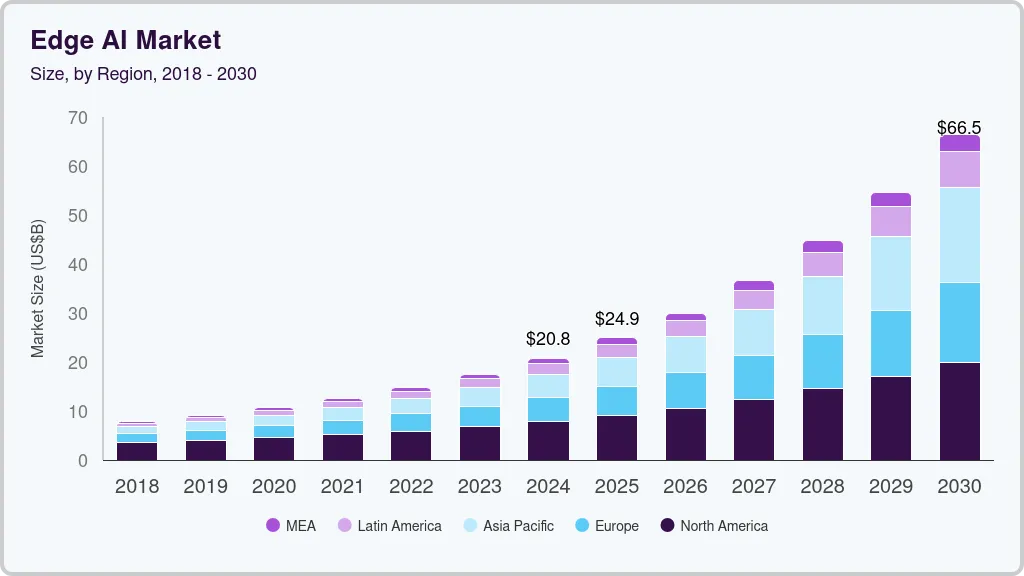
This significant growth is due to the increasing demand for edge AI for real-time analytics and data processing and smarter mobile applications across the custom mobile app development industry.
Now, explore the practical benefits of edge AI computing and understand the reason behind the booming edge AI market:
Top Benefits of Utilizing Edge AI Within Mobile Apps
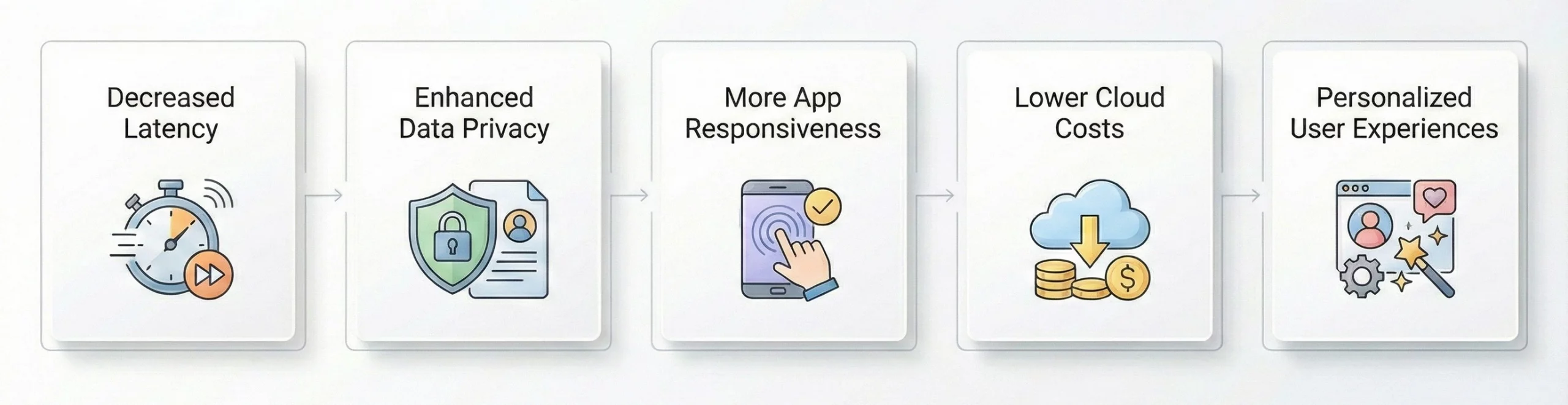
1. Decreased Latency
By utilizing edge AI solutions, you can provide your end user base with a rapid response with no delays, as the data is not traveling to distant data centers. By partnering with an AI app development company and running AI models, you can provide instant and critical decisions and support real-time use cases such as route optimization or fraud detection.
2. Enhanced Data Privacy
With edge AI solutions, you can reduce the risk of mishandling data as it processes information locally on the device, without transferring it over to any cloud network or server. The data is collected and processed near the edge devices, which leads to better data security and enhanced privacy.
3. More App Responsiveness
This technology enables your users to have access to an app that offers enhanced responsiveness. A traditional cloud computing strategy follows the following process: the device collects data, sends it to the cloud server, processes it, and then sends back the necessary information. This cloud computing approach is time-consuming and results in delays, whereas edge AI computing processes data locally, resulting in quick responses to the end users.
4. Lower Cloud Costs
It limits the need to utilize cloud servers, which helps you reduce the total bandwidth and cloud server costs. This is because it processes and analyzes the data on-device or edge AI devices, instead of a cloud server. With edge AI, you can utilize AI models that are considered cost-efficient, and you can avoid expensive cloud infrastructure usage.
5. Personalized User Experiences
It enables real-time analysis by predicting the user behavior directly through the AI at the edge device. This way, by integrating edge AI solutions within your mobile app, you can offer your end user base instant and tailored personalization and dynamic content. It leads to improved app user experience without compromising on the app’s performance and privacy.
Edge AI vs Cloud AI: A Detailed Feature Comparison Table
Many businesses often face challenges in choosing between the two essential technologies that provide users with personalized and smart insights. These are: Edge AI and Cloud AI. Both are types of AI deployment approaches that have recently become a critical feature to have within most modern applications.
Now, let’s look at the detailed comparison between Edge AI and Cloud AI based on the core features:
| Feature | Edge AI | Cloud AI |
| Latency & Performance | Reduced latency, as it processes data locally | Increased latency, as it relies on remote cloud servers and data centers |
| Bandwidth Usage | Low bandwidth, due to the fact that it has real inference capabilities | High bandwidth, as it requires a network of servers for data transmission |
| Security & Privacy | More secure, due to its capability of gathering and processing the data on the device itself | Involves a potential transmission risk due to exposure to unauthorized parties |
| Cost-Efficient | Yes, as it comes with lower operational costs because of no continuous cloud usage | Depends on the cloud computing and storage usage, usually higher operational costs |
| Internet Dependency | Works fine offline and even in less network situations | Requires a stable connection throughout the data processing and analysis process |
| Computing Power | Lower computing capability, as it relies only on the power of edge AI devices | Higher computational power, as it has power from virtual compute resources |
| Best Use Case | Real-time object detection & speech recognition | Big data analytics & training large, complex AI models |
If you are still unsure about which approach is better for your business goals, consider partnering with a custom app development company. They can help you choose between Edge AI and Cloud AI by evaluating your end users’ pain points and your business requirements.
A Step-by-Step Guide to Building an Edge AI-Powered App
One of the major differences between the two, Edge AI and traditional Cloud AI approaches, is that the former enables businesses to smartly and quickly deliver real-time insights. Unlike cloud AI, Edge AI comes with enhanced app privacy and reduced internet dependence for its end users.
This is why most of the businesses nowadays are integrating edge AI capabilities within their apps. But building an edge AI-powered app can be a little challenging and can lead to a higher AI app development cost. So, to build a cost-efficient Edge AI app solution, you should explore and understand the following steps:
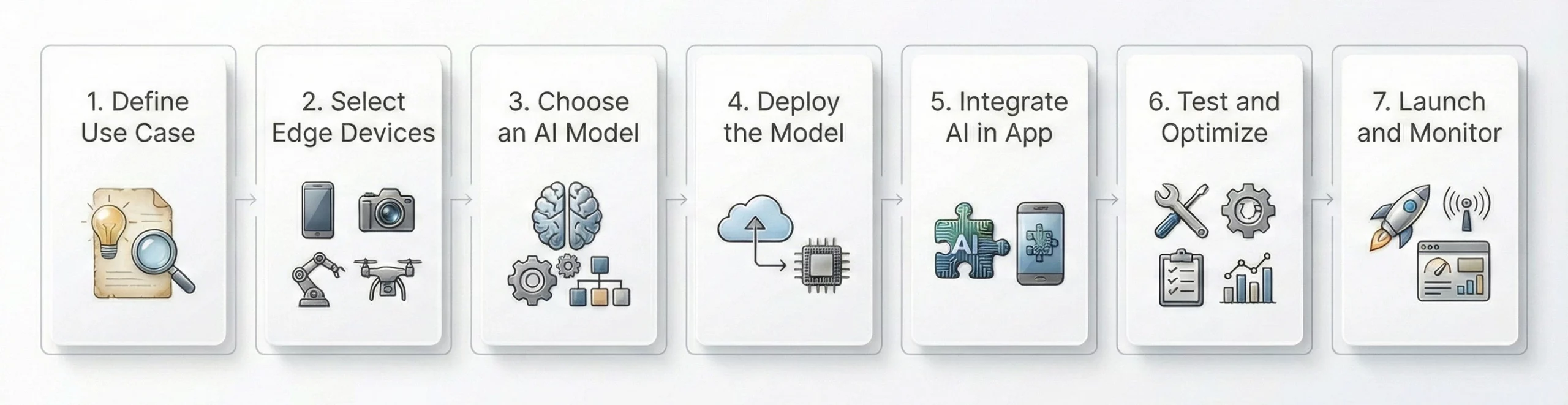
1. Define Use Case
The first step involves the process of defining and identifying the audience’s pain points and what your app’s major core functionalities will be. You need to determine how AI will help you and what capabilities you wish to add from the following:
- Object or Speech Recognition
- Data Collection & Processing
- Anomaly Detection
2. Select Edge Devices
After defining the particular app’s requirements, you need to choose the edge device that will help you in sensing, collecting data, and processing it locally. For choosing the correct edge device, remember to check constraints such as their computational power, processing and storage memory, and battery life.
This is a crucial aspect as these will directly influence your app design. Additionally, partnering with a UI/UX design agency can help you run resource-intensive AI tasks while keeping the app’s user experience smooth and intuitive.
3. Choose an AI Model
This step involves the selection of the AI model that completely resonates with your defined AI functionalities and the app’s major use case. Here, you also need to choose lightweight AI/ML architectures such as MobileNet or TinyYOLO, which have limited compute power and are designed specifically for edge devices.
4. Deploy the AI Model
Once you have chosen the particular AI model, you need to conduct an extensive training process and then deploy the AI model to your edge device. To do so, you may need to convert the AI model to an edge-compatible format so that it becomes a mobile-friendly model.
Moreover, to reduce latency and improve the model’s performance, you can partner with an AI software development company to leverage and apply techniques like quantization and pruning. These techniques help you lower down the latency and also boosts the AI model performance.
5. Integrate AI in App
After successful AI model deployment, it’s time to integrate it within your mobile app. This step involves building the app interface by utilizing essential mobile app features in such a way that it ensures a smooth user experience. This leads to building an app that offers a loyal audience with enhanced real-time inference capabilities.
With a proper integration, your app will respond quickly to the generated insights by the on-device AI model. Thus, it will also result in seamless user interactions and enable them to make real-time decisions.
6. Test and Optimize
Testing is another major step that ensures that your app meets user expectations in terms of performance and speed. In this step, you need to conduct testing phases such as functional testing for validating the accuracy, performance testing for latency, and battery consumption.
After completion of these testing phases, you can optimize and improve the AI model and app’s codebase, using the results and parameters that you have gained.
7. Launch and Monitor
After conducting an extensive testing phase, your app is optimized and ready to deliver real-time AI insights to your specific user base. However, post-launch monitoring is a crucial thing as it helps you continuously track the performance of the AI model and its accuracy levels.
For performing continuous monitoring, you need to check factors such as latency, AI drift, accuracy levels, and simultaneously improve based on the evolving user needs.
Final Thoughts
Edge AI has been emerging as a strategic necessity and a technological backbone of edge device or IoT app development. Embracing and integrating edge AI will help organisations to deliver an application that is faster, safer, smarter, and more efficient. By adopting this approach and an edge computing and on-device AI combination, you can build future-ready apps that have the least reliance on cloud servers or any data centers.
However, to minimize latency, increase privacy, and have enhanced real-time decision-making capability, you should leverage the right cloud application development services. This will help you build a powerful ecosystem that is scalable and resilient, thus gaining a competitive edge in this modern mobile app industry.
FAQs
1. What is the role of edge computing in modern mobile apps?
Edge computing is a foundational part of Edge AI that helps you collect and process data near the source, which is the edge device. It enables faster insights, responses, reduced latency, and enhanced app privacy, as it doesn’t rely much on cloud servers or remote data centers.
2. How does on-device AI improve mobile app performance?
On-device AI performs real-time analysis by directly fetching data from edge devices such as smartphones, IoT devices, etc. It delivers instant predictions or monitors users’ health, and helps you to cater to the modern-day users’ expectations.
3. Why are companies adopting edge computing and AI in custom apps?
Businesses that adopt edge computing AI within their specific mobile apps can reduce the need to rely on a remote-based cloud server. By utilizing edge computing and AI app development, you can also have access to enhanced user privacy, lower infrastructure costs, and deliver real-time intelligence.
4. What types of apps benefit most from edge computing and on-device AI?
Some of the industry-specific app examples that can benefit the most are as follows:
- FinTech App
- Healthcare App
- Education App
- Logistics App
- Retail App
Additionally, to build an app efficiently and for proper implementation and enhanced scalability, you can consider leveraging IT consulting services.
5. How will edge computing shape the future of custom mobile app development?
The future of custom mobile app development is very promising with the integration of edge AI and edge computing technologies. These help you build an app that provides smarter and faster insights, even without or with minimal cloud dependence.

SHARE
WRITTEN BY

Prankur Haldiya
Chief Technical Officer
A tech innovator and engineering leader, Prankur Haldiya drives RipenApps’ product development strategy and oversees cutting-edge solutions in mobility, AI, and cloud ecosystems. He is passionate about building high-performance teams and helping brands launch secure, scalable, and user-centric digital products.
View All Articles