

In today’s tech-driven era, mobile apps no longer sit on the sidelines of business growth. They shape how customers interact, how teams operate, and how brands scale in competitive markets. In 2026, users expect apps to respond instantly, adapt to behavior, and feel purpose-built. Generic solutions struggle in this environment. Businesses need applications developed around their workflows, audiences, and growth goals, not around limitations of ready-made templates.
Custom applications are built from scratch or deeply tailored to fit specific business requirements. Every feature, flow, and integration serves a defined purpose. Unlike off-the-shelf apps, custom solutions evolve with your product strategy, support advanced security needs, and allow full ownership of data and performance. For businesses aiming to stand out, customization is the foundation of long-term digital value.
Technology in 2026 pushes this need even further. Pre-built apps cannot keep pace with dynamic demands. Custom apps bridge the gap between innovation and execution. So, if you are an entrepreneur planning to build an app, this guide will help you know how custom business application development works and how businesses can build products that stay relevant, scalable, and trusted. So, stay tuned for some useful insights :
Table of Contents
Why Businesses Should Go With Custom App Development?
You might feel astonished to know that there are now 8.9 million mobile apps in the world. On average, 1,828 new apps are released on Google Play Store. This huge market certainly offers great lucrative opportunities to businesses and organizations. However, as the number of apps has increased, the need for quality and innovative enterprise custom app solutions has also acquired pace.
Despite there being plenty of apps available in the market for customers, still, many apps still struggle to gain traction and acquire userbase. This is due to most mobile apps fail to satisfy user’s evolving needs. As technology is ever-changing, mobile applications require timely updation and customization to make them consistent with market performance.
Mobile apps that have lagged behind in quickly adopting emerging trends, couldn’t obtain significant business results. Therefore, custom app development plays an influential role when it comes to build user-centric and market-ready apps.
Benefits of Developing Custom Mobile Apps For Business Growth
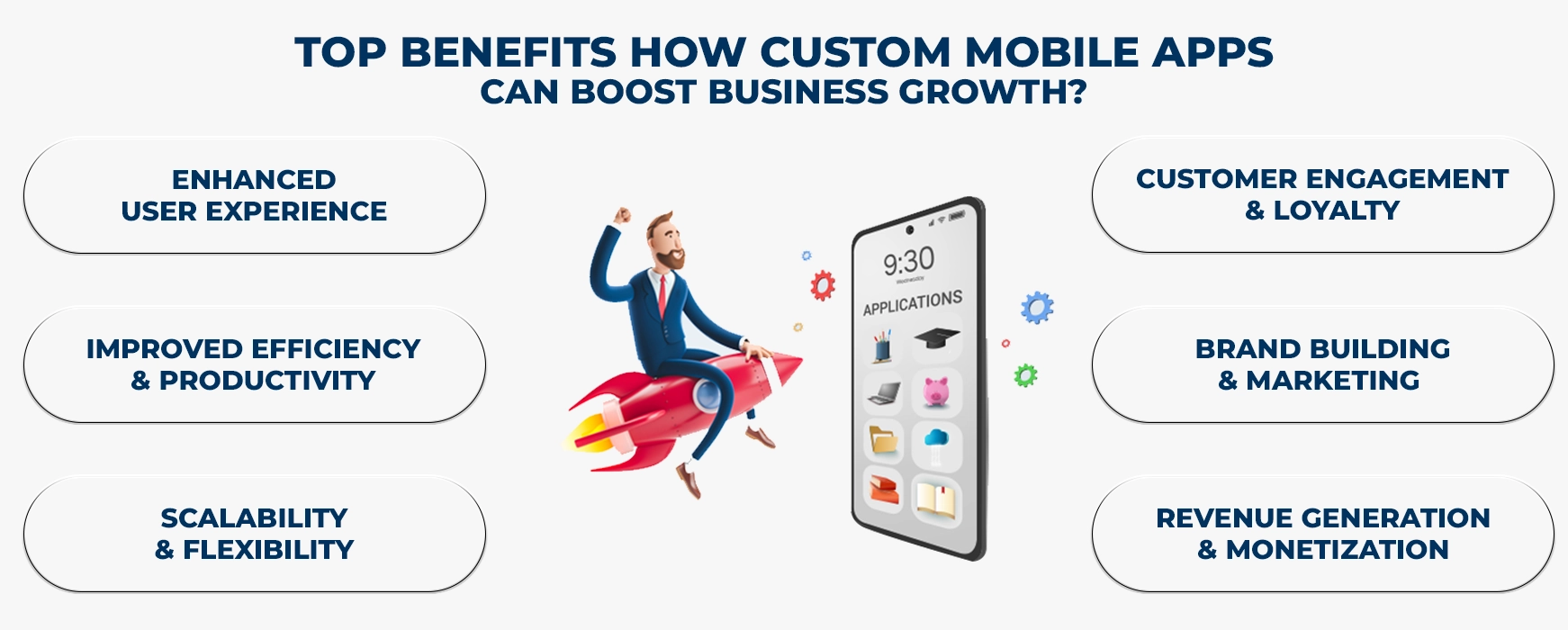
One of the major benefits of custom app development for startups is that you can offer effective solutions tailored to customers’ needs. Custom apps are like personalized tools that can help boost your business. They’re built to fit, grow, and make your customers happy, making your business stand out in a crowded market. This not only allows you to satisfy user expectations but also gives you a competitive advantage.
According to Grand View Research, the global custom software development market is expected to reach $146.18 Billion by 2030 at a CAGR of 22.4% by 2030. There are several factors that have worked in propelling the growth of the custom business application development market like AI Chatbots, AR/VR. AI & ML, and other emerging tech trends.
As a result, the role of custom mobile apps in digital transformation has also been enhanced. If we dive deeper here are the top benefits of custom app development that compel businesses to go with this option.
1. Tailored Solutions
Custom apps are like made-to-order tools designed exclusively for your business needs. They fit perfectly because they’re built to address your unique challenges and workflows. The result stays focused. No extra features. No functional gaps. This approach reflects how a custom mobile app development company designs solutions around business logic, user behavior, and long-term growth goals. Each app stays aligned with purpose, performance, and scalability from day one.
2. Enhanced User Experience
Imagine your app as a personalized space for your customers. Custom apps are carefully crafted to ensure your users feel comfortable and confident while using it. It’s like creating a shop or an experience that’s uniquely designed to match what your customers like and expect, making it easier and more enjoyable for them to interact with your business.
3. Flexibility and Scalability
Custom apps grow with your business. They’re not rigid; they’re like elastic, stretching and adapting as your business evolves. You can easily add new features or make changes to keep up with the changing needs of your business, just like how your wardrobe might change over time to fit your lifestyle. Many businesses also focus on ways to accelerate custom mobile app development to save time & cost. Thus, ensuring scalability does not slow down innovation or increase long-term expenses.
4. Increased Security
Security is super important, and with custom apps, you get to be the boss of it. You can add extra layers of protection to keep your business data safe from any cyber baddies. It’s like having a top-notch security system for your shop or office—it keeps everything safe and secure.
5. Competitive Advantage
Having an app that’s all about your business sets you apart from the crowd. It shows your customers that you care about giving them the best experience possible. Just like how a unique shop with exclusive offerings attracts more visitors, a custom app can draw more customers to your business.
Read Also : How Custom App Development Can Boost Your Business?
6. Efficiency and Streamlining
Custom apps are like super assistants for your business. They automate tasks, cut down on the time-consuming stuff, and help everything run smoother. They’re like having an extra set of hands to make things easier.
7. Cost-Effectiveness in the Long Run
Custom app creation might seem a bit pricier at first, it’s like investing in something that pays off in the long term. It saves money in the long run by eliminating the need for multiple tools or licenses that might not fully fit your business needs.
8. Easy Integration
Custom apps play well with others. They can easily connect and work with your other systems and software without any hassle. It’s like having puzzle pieces that fit together perfectly, ensuring everything works harmoniously.
9. Customer Engagement and Loyalty
A customized app creates smoother, more meaningful experiences for users. When interactions feel simple and relevant, customers spend more time in the app and return more often. Consistent value builds trust and long-term loyalty. Businesses that apply proven strategies to enhance user engagement focus on personalization, timely interactions, and friction-free journeys, which strengthen retention and deepen customer relationships.
10. Ownership and Control
With a custom app, you’re the boss. You have complete control and ownership over it. You’re not tied down by someone else’s rules or limitations. It’s like having your own business; you get to make all the decisions that best suit your goals and needs.
Comparison Table: Custom Mobile Apps vs Ready-Made Apps
Many businesses and startups often choose ready-made or white-label mobile app solutions over custom application development. This is because ready-made apps come with commonly used features and are already designed as per normal standards. They are ready to go anytime and also available at low costs. However, market and consumer behavior are ever-changing. Ready-made apps might not fit current market needs. The cost of ownership for a custom mobile app might be slightly high, but it can give better returns to fit the user’s needs.
Therefore, there is always confusion or debate about choosing between custom apps and ready-made app options. To give you a clear picture, here we have given a table that highlights the key differences between tailor-made mobile applications and ready-made apps across various aspects such as customization, flexibility, user experience, cost, security, and control.
| Features | Custom Mobile Apps | Ready-made Apps |
| Tailored Solutions | Built specifically for unique needs, fit like a glove | Generic, not personalized to specific needs |
| Flexibility | Highly flexible, adaptable, and scalable | Limited flexibility, may lack scalability |
| User Experience | Personalized user experience, matches brand look and feel | Standard interface, may not align with brand |
| Integration | Easily integrates with existing systems and software | May have integration limitations |
| Development Time | Longer development time due to customization | Quick deployment, ready to use immediately |
| Cost | Higher initial cost, potential long-term savings | Lower initial cost but might require add-ons |
| Security | Greater control over security measures | Security features dependent on provider |
| Updates and Maintenance | Easily updated and maintained to meet evolving needs | Updates and maintenance controlled by provider |
| Competitive Advantage | Sets business apart from competitors | Common features used by various businesses |
| Ownership and Control | Complete ownership and control over the app | Limited control and ownership |
Steps To Build A Successful Custom Mobile App
The custom application development process requires lots of planning, research, iteration, and coding. Since you are creating a mobile app from scratch, you have to define everything from the very beginning. You need to invest in reliable mobile app development services to understand the complete roadmap to create a feature-rich mobile app.
So, here we have explained the key steps for custom mobile app development. By following these steps and continuously refining the app based on user feedback, you can create a successful custom mobile app that meets user needs and stands out in the market.
1. Planning and Research
First, brainstorm ideas about what your app should do. Look around to see what problems people face that your app could solve, like how Airbnb saw a way for people to rent out their homes. Then, figure out who will use your app. Think about what they need and how your app can help them.
2. Defining Features
Decide What Your App Will Do: Choose the main things your app will help users with, like giving rides (like Uber) or teaching languages (like Duolingo). You will also need to Think About User Needs. For this, you can Make a list of all the things your app needs to do to make it helpful and easy to use for people.
3. App Design
Focus on creating a simpler yet engaging app design that looks and works well. Decide where buttons will go, what colors to use, and how people will move around in the app. Try to make a user-friendly mobile app design. Think about how to make it easy for people to use without getting confused.
4. Choosing Tech Stack for Custom App Development
Selecting the right application development tools & technology is a very important part of the mobile app development process. What frameworks, SDKs, or languages you incorporate will directly affect the future performance of your app? Therefore, you should wisely decide the tech stack for custom app development. Depending on the type of app, there is a dedicated set of technologies for building custom mobile apps.
Front-end Development:
- Programming Languages: HTML, CSS, JavaScript, Java, Kotlin, Swift
- Frameworks/Libraries: React Native, Flutter, Android Studio, Xcode
Back-end Development:
- Programming Languages: JavaScript, PHP, Python, Java
- Frameworks: Node.js, Express.js, ASP.NET
- Databases: MySQL, PostgreSQL, MongoDB, Firebase, SQL Server
Cloud Platforms:
- AWS (Amazon Web Services), Azure, Google Cloud Platform
Testing Frameworks:
- Jest, Mocha, Jasmine (for JavaScript), PyTest (for Python)
DevOps Tools:
- Automation/CI-CD: Jenkins, Travis CI, CircleCI
- Containerization: Docker, Kubernetes
5. Finding an Expert Partner for Custom App Development
You need an expert team to build a custom mobile app. You can either hire dedicated app developers who possess relevant skills as per your project requirements or outsource your project to an industry expert. They specialize in providing business-oriented custom app development solutions. You can find these companies on various B2B listing platforms like Clutch, GoodFirms, etc.
6. QA & Testing
Test your app to find any problems or mistakes. Make sure that your mobile app works well as you planned in the beginning. Stay in communication with the QA team to ensure your app is free from all bugs and errors. To be 100% assured about how your app works, conduct a survey about the app. Pay attention to what people say about your app. Use their feedback to make your app better.
7. Launch & Monitoring
Once your app is developed and validated by the QA team, you can launch your app on the app stores. While you may feel exhilarated after launching the app, the task is not finished yet. You will need to monitor the performance of your app constantly. Check whether your app is working well as it was tested and users feel engaged using your app.
How Much Does It Cost To Build A Custom Mobile App?
The cost of custom app development varies depending on several factors. The more an app is complex, the more time and resources will it take. Consequently, it will increase the app development cost. Moreover, it also depends on what industry your app serves. To cater to the industry-specific needs, you will need to integrate the required features & functionalities in your app. Hence, the best way to estimate the cost of building custom mobile app would be to consult a mobile app development firm. However, to give you a rough estimation, here we have shared the cost of custom mobile apps for different industries.
| Industry | Complexity | Approximate Cost Range |
| E-commerce | Moderate | $20,000 – $100,000+ |
| Healthcare | High | $50,000 – $300,000+ |
| Finance | High | $50,000 – $300,000+ |
| Real Estate | Moderate | $20,000 – $100,000+ |
| Education | Moderate | $20,000 – $100,000+ |
| Entertainment | Low to Moderate | $10,000 – $50,000+ |
| Travel and Tourism | Moderate | $20,000 – $100,000+ |
| Food and Beverage | Low to Moderate | $10,000 – $50,000+ |
| Transportation | High | $50,000 – $300,000+ |
| Manufacturing | Moderate | $20,000 – $100,000+ |
Best Practices And Tips For Custom App Development
1. Clear Planning
Before diving into development, outline your app’s goals, functionalities, and target audience. A detailed plan ensures everyone involved understands the app’s purpose and helps avoid confusion during development.
2. User-Centric Design
Design the app with users in mind. Prioritize simplicity and intuitive navigation to ensure users can easily understand and use the app without confusion. This approach boosts user satisfaction and engagement.
3. Agile Development
Break down the app development into smaller, manageable parts called sprints. This iterative approach allows for continuous improvement and adaptability, responding to changes efficiently throughout the development process.
4. Security First
Implement robust security measures from the beginning. Protect user data and the app’s integrity against potential threats by following best security practices and regularly updating security protocols.
5. Start Simple
Begin with core features and functionalities that align with your app’s primary purpose. This approach helps in faster development and ensures a more focused user experience.
6. Listen to Users
Gather feedback from users and adapt the app accordingly. Their insights help identify areas for improvement, ensuring the app meets user expectations and remains relevant.
7. Regular Updates
Continuously improve the app by releasing updates based on user feedback and technological advancements. Regular updates keep users engaged and demonstrate your commitment to enhancing their experience.
8. Collaborate
Maintain open communication and collaboration within the development team. Encourage sharing ideas, feedback, and concerns to ensure everyone is aligned and working towards a common goal.
9. Test Across Devices
Test the app on various devices and platforms to ensure compatibility and consistent performance across different screen sizes and operating systems. This step helps avoid potential issues and ensures a wider user reach.
Wrapping Up
As the mobile app market continues to evolve, businesses need to update and customize their app to keep up pace with emerging trends. While there are plenty of apps already available for customers, apps that solve ongoing needs have a better chance of succeeding in the market. Therefore, investing in custom app development offers future-proof business outcomes.
The above guide highlights the crucial things that would assist you in making a high-quality and result-driven custom app. However, since custom app development requires proven expertise, you should seek professional assistance for building your app. RipenApps stands out as the best partner for businesses that want to build a custom mobile app from scratch tailored to specific needs.

FAQs
Q1. What is custom app development and why does it matter?
Custom app development is the process of building mobile apps tailored specifically to a business’s needs and users. It matters because it delivers personalized experiences, stronger security, and features designed for your exact goals, unlike generic, ready-made apps.
Q2. How does custom app development differ from ready-made app solutions?
Custom apps are built from scratch to align with your business model. Thus, they offer flexibility, scalability, and complete control. Ready-made solutions are generic, cheaper initially, but often lack personalization and long-term adaptability.
Q3. What are the key steps in building a successful custom mobile app?
Successful custom apps start with research and planning, followed by feature definition, intuitive design, tech stack selection, QA testing, launch, and ongoing monitoring to refine based on user feedback.
Q4. How much does it cost to develop a custom mobile app in 2026?
App costs vary widely based on complexity, features, and industry requirements. Simple apps may start in the lower range, while high-complexity apps like fintech or healthcare can cost more due to advanced integrations and security.
Q5. Which industries benefit most from custom app development?
Industries that value personalization, security, and continuous improvement, like healthcare, finance, e-commerce, education, and logistics, gain the most from custom mobile apps tailored to specific user and business needs.

SHARE
WRITTEN BY

Ishan Gupta
CEO & Founder
Ishan Gupta is a seasoned entrepreneur and CEO with extensive 8+ years of experience in business and mobile app development landscape. He believes that the right digital product allows companies to focus on what they do best, while technology handles the rest. With deep exposure to global markets, he understands what makes an app succeed. His approach translates business needs into clear product strategies, ensuring that every feature contributes to measurable ROI.
View All Articles