

Launching a new product idea is thrilling, but the reality is harsh. You’ve got the idea, the vision, and maybe even the early sketches of what could be the next big thing. But here’s the truth: almost 90% of startups fail because they build too much before knowing what users truly want.
Investors and users don’t care about perfection. They’re looking for proof. Proof that your product solves a real problem, fits into real lives, and delivers real value. That’s exactly where the concept of Minimum Viable Product (MVP) becomes the smartest path forward.
An MVP isn’t a half-built product, but it’s a smart validation tool. Building an MVP is a data-driven launch strategy that helps you test your vision in the market, gather authentic feedback, and earn early trust from both users and investors.
This guide explores how to build a Minimum Viable Product that wins both users and investors, using practical steps, business insights, and proven frameworks used by successful founders. So, let’s get started :
Table of Contents
What Is a Minimum Viable Product (MVP)?
A Minimum Viable Product or MVP is the simplest version of your product that delivers the core value proposition to early adopters. It’s not about doing less, but it’s about doing what matters first.
The MVP concept was introduced by Frank Robinson in 2001 and popularized by Eric Ries in The Lean Startup. It encourages entrepreneurs & startups to launch quickly, test early, and learn continuously. Thus, it reduces overall time, cost, and risk before committing to full-scale development.
Building an MVP helps you :
- Validate your product hypothesis with real users
- Reduce wasted resources on untested ideas.
- Collect actionable feedback to guide future development.
- Attract early investors with measurable traction.
The goal isn’t to build something perfect, but it’s to make something that proves potential.
Why MVPs Matter More Than Ever For Businesses
In today’s competitive tech ecosystem, speed and insight are everything. Building an MVP gives you both. According to CB Insights, 42% of startups fail due to a lack of market need. MVPs prevent this by validating the problem-solution fit before you invest your huge capital.
Whether you’re developing a consumer app, a SaaS tool, or an enterprise platform, an MVP acts as your initial PDLC step for iteration, investor pitches, and early user engagement.
Key business advantages include:
- Faster market entry: Launch within months, not years
- Budget control: Spend smartly with defined MVP budgeting
- Data-driven growth: Base decisions on analytics, not assumptions
- Investor appeal: Demonstrate traction before full investment
For startups, building an MVP is not optional, but it’s essential for survival.
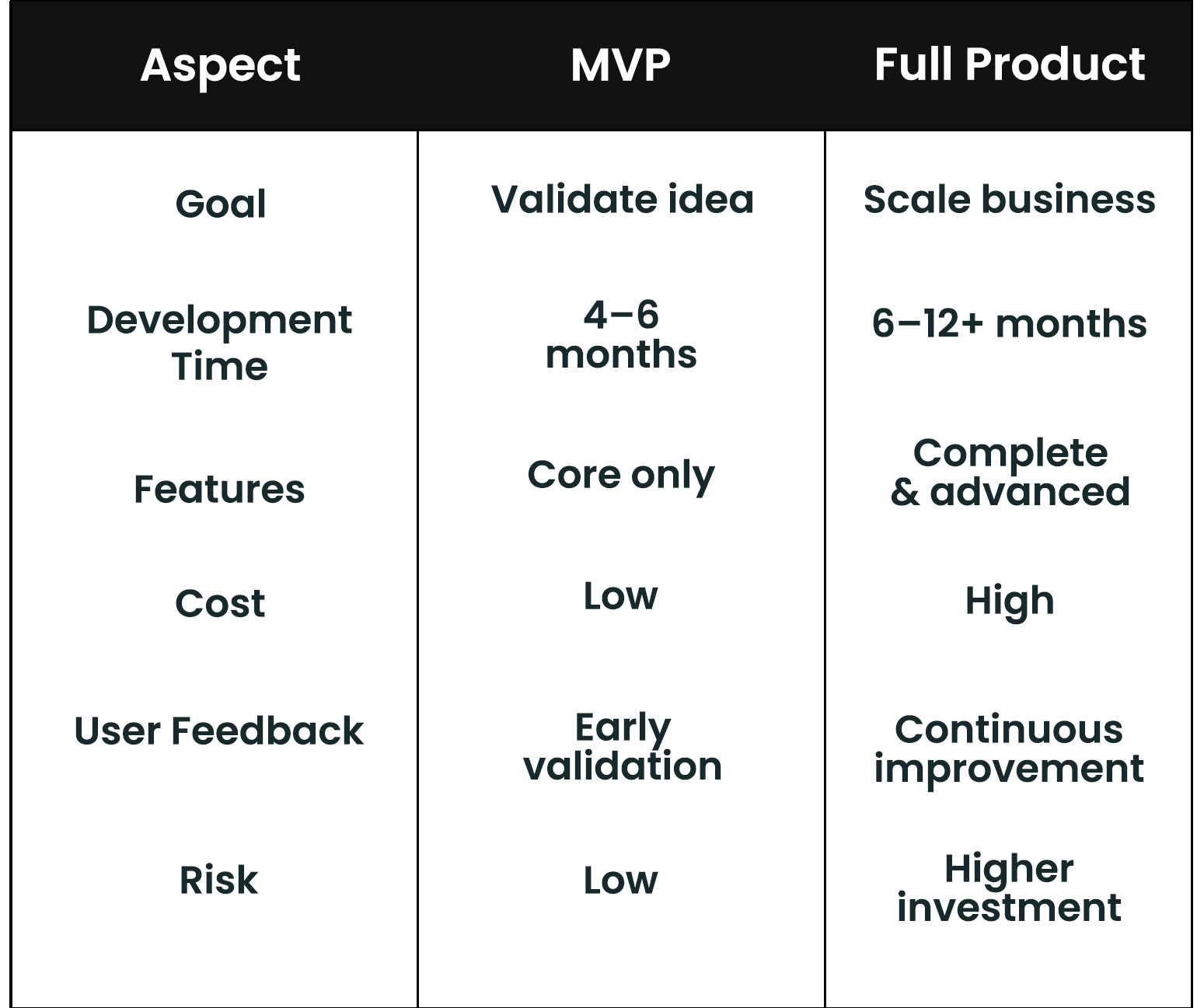
MVP vs Full Product: What’s the Difference?
How to Build an MVP: The Complete Step-by-Step Process
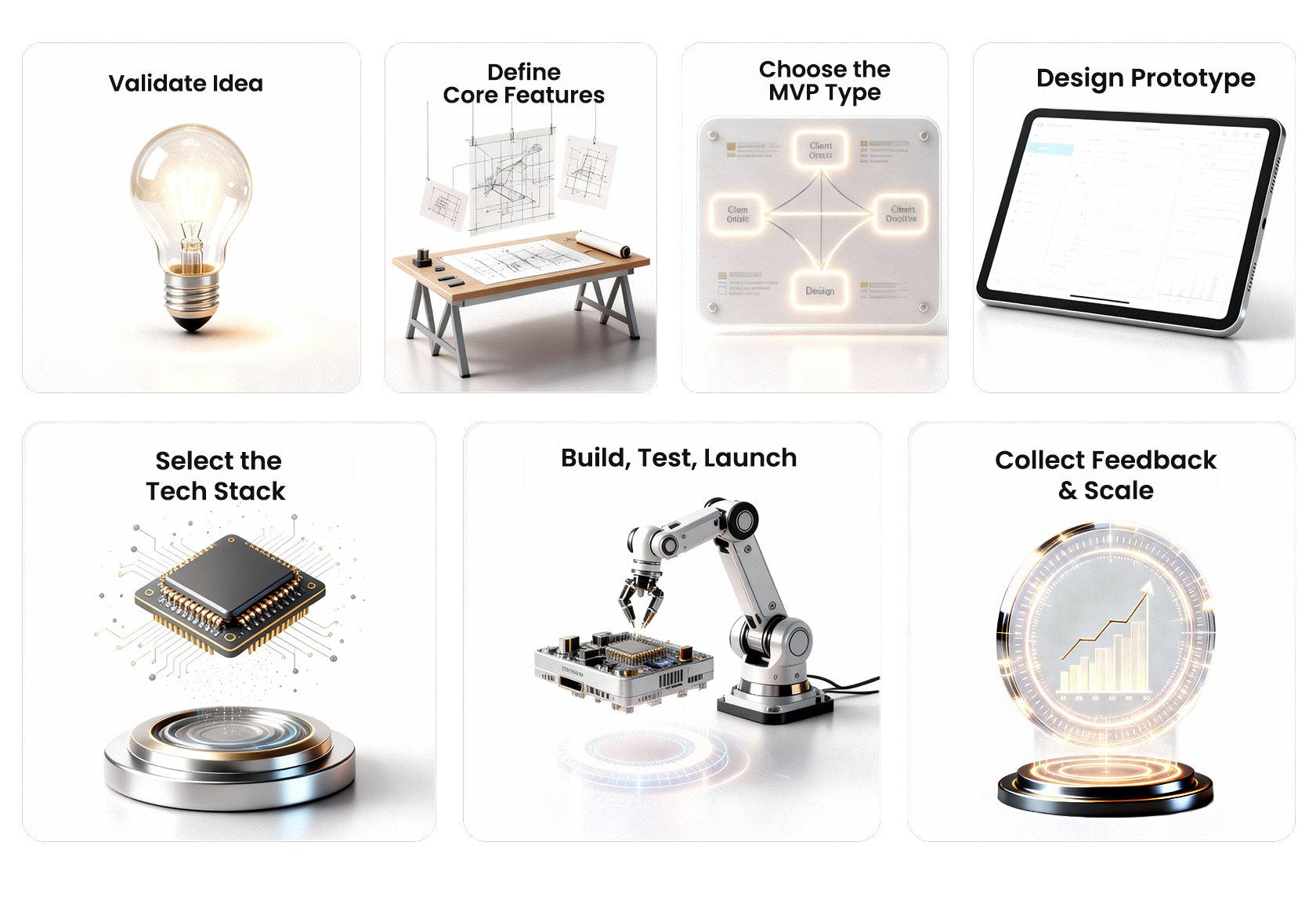
Creating a Minimum Viable Product is not about coding first; it’s about thinking strategically. Here’s how to build an MVP app or digital product that’s both scalable and fundable.
Step 1: Validate the Problem Before the Product
Every successful MVP starts with a clear, validated problem. You need to think about who you are helping. What’s your user’s pain point? And how can your app solve it today? It’s advisable to start by conducting market research and user interviews to uncover real user behavior, not assumptions. Always use surveys, competitor analysis, and keyword trends to identify demand patterns.
Pro Tip: Use tools like Google Trends, Typeform, or Reddit communities to validate audience needs before spending a dollar on development. This early validation lays the foundation for the idea to MVP success.
Step 2: Define Your Core Value Proposition
Before you start building, define what success looks like. Your MVP must deliver one strong promise—the reason users should care. For instance, if you’re building a wellness app, don’t aim to “improve lifestyle.” Instead, focus on one measurable goal such as “help users track their hydration and daily mood.” This clarity helps in building an MVP that communicates value instantly.
It’s advisable to write down your:
- Target audience
- Core problem statement
- The primary feature that solves the problem
- Expected outcome
Once you’ve defined this, your MVP roadmap becomes clear and targeted.
Step 3: Choose the Right MVP Type
Not all MVPs are built the same. Depending on your business stage and complexity, choose the format that fits best. Here is the tabular presentation of MVP types along with their purposes :
MVP Type |
Purpose |
| Landing Page MVP | Test demand before building |
| Concierge MVP | Offer the service manually before automating |
| Wizard of Oz MVP | Simulate full functionality with a hidden manual backend |
| Single Feature MVP | Test one key function to validate the core utility |
| Pre-order MVP | Measure user commitment through advanced sign-ups |
You can invest in professional MVP development services to select the right model. This ensures efficient MVP application development while keeping costs low and learning high.
Step 4: Design an Experience, Not Just an Interface
Even a minimal product should feel delightful. Your MVP’s UX design determines whether users stay long enough to give feedback.
At this stage, focus on:
- User flows over fancy UI
- Clarity of action (each screen should serve a clear purpose)
- Fast feedback loops (built-in surveys, contact buttons)
If you’re developing digital platforms, consider to hire app developers having experience in MVP website design to create prototypes that represent functionality and intent clearly. You need to remember, design is communication. It shapes perception, trust, and conversion.
Step 5: Select the Right Tech Stack and Team
Your tech stack defines how fast and scalable your MVP will be.
- Frontend: React, Flutter for MVP, or SwiftUI
- Backend: Node.js, Django, or Firebase
- Database: PostgreSQL, MongoDB
- Analytics: Mixpanel, Google Analytics
If you plan to develop an MVP for both iOS and Android, availing professional cross platform app development services saves cost and time while ensuring a uniform experience.
Step 6: Build, Test, Launch — But Keep It Lean
Once you’ve finalized your design and the tech stack, start the build. The secret key here is: “Build what you can measure.”
Focus only on:
- The core feature set
- Smooth onboarding
- Reliable performance
Avoid overbuilding. The objective is to launch a minimum viable launch consumer app, not a feature-rich platform. You can run quick user tests. Observe how people interact. Iterate fast. MVP success depends on how efficiently you learn, not how much you build. However, you should work with a skilled team that understands agile principles and MVP flexibility. Choose a top-rated custom software development company that specializes in successful product launches.
Step 7: Gather Feedback and Iterate
After launching an MVP, your real learning begins. Engage your first 100 users personally. Collect feedback, measure retention, and identify patterns in behavior.
You need to critically analyze:
- What users love
- What frustrates them
- Which features do they ignore?
This insight defines your next sprint and overall MVP product development roadmap. Businesses can also avail top-notch mobile app development services, as the experts know how to use analytics tools, in-app surveys, and A/B testing to drive informed updates. Each iteration brings you closer to product-market fit.
Avoid These Common MVP Mistakes
Even with the right process, many teams derail their MVP strategy. Therefore, it’s recommended to avoid the following pitfalls:
- Building too many features too early
- Ignoring pre-launch user validation
- Overanalyzing feedback instead of prioritizing
- Skipping monetization strategy
- Neglecting data privacy and compliance
A successful MVP is minimal, measurable, and meaningful. So, try to keep your scope tight and your learning cycle fast.
MVP Budgeting: What to Expect
The MVP development cost depends on multiple factors such as complexity, design, tech stack, and the location of your development team. However, on average, a functional MVP can range between $15,000 $100,000, depending on features and integrations.
Budget wisely:
- Prioritize must-have features only
- Opt for cross-platform frameworks to reduce cost.
- Consider outsourcing to a recognized MVP development agency for efficiency.
- Keep 20% of your budget aside for iteration post-launch
Working with experienced partners offering product development services ensures smoother execution and predictable timelines.
MVP Funding: How to Attract Investors Early
Investors don’t invest in ideas, but they do invest in traction. That’s why an MVP becomes your most powerful fundraising tool. It shifts the conversation from “what you plan to do” to “what you’ve already achieved.” With tangible proof of concept, early user engagement, and measurable growth, you can walk into investor meetings with data instead of promises. However, when pitching your MVP to investors, focus on what matters most:
1. Track user activity and growth patterns
You can show your investors that people are not only signing up but also returning and engaging with your product regularly. Consistent usage speaks louder than projections.
2. Present customer validation and feedback
Include testimonials, survey results, or usage insights that prove your product solves a real problem. Investors love seeing evidence of demand and satisfaction.
3. Highlight your unit economics and retention rate.
Even at an early stage, basic financial indicators like customer acquisition cost (CAC) and lifetime value (LTV) demonstrate that you understand scalability.
4. Use your MVP as a story, not just a demo.
Tell the story of why you built it, who it’s helping, and how it’s evolving with user needs. Authentic storytelling backed by data builds emotional and financial buy-in.
The moment investors see real-world proof, such as people using, liking, and paying for your product, your funding journey becomes much smoother. Also, remember, an MVP isn’t just a product for users; it’s your credibility engine for investors. It proves your vision has market demand, operational discipline, and growth potential, and these are all the things investors look for in a winning startup.
Read Also: 5 Best Real-Life Examples of Successful MVP Development For Startups
Scaling from MVP to Full Product
Once your MVP gains traction, it’s time to scale. This phase requires refining your tech architecture, enhancing UI/UX, and expanding your feature set.
Here, we have mentioned some key steps to transition:
- Consolidate user feedback
- Prioritize the next features using analytics.
- Strengthen security and performance layers.
- Align roadmap with investor expectations.
This stage often involves working with an MVP app development company experienced in scaling products from early prototypes to full-scale launches. Moreover, if you’re planning for a larger rollout, partnering with teams offering IT consulting and services ensures scalability, compliance, and cost-efficiency.
Final Thoughts
Building an MVP isn’t about launching a half-done product; it’s about launching your digital products smartly. Developing an MVP is your way of proving demand before scaling, learning before spending, and connecting with real users before making big bets. You can hire full-stack developers for MVP development to build a well-planned MVP with core features. It gives you the clarity to refine your idea, prioritize the right features, and align your team around real data instead of assumptions.
Whether you’re a startup founder or part of an established business, think of your MVP as both a test and a launchpad. When you focus on solving a real problem, track what matters, and listen to user feedback, you build something investors can believe in and customers can’t ignore. In today’s competitive landscape, winning both starts with one simple truth: launch less, learn fast, and grow with purpose.
FAQs
1. Why is building an MVP important for startups?
Building an MVP helps startups validate their idea early, attract investors with data-backed proof. Not only this, but it also helps you to avoid wasting time and money on features users don’t need.
2. What’s the difference between an MVP and a prototype?
A prototype is a visual model used to test design and flow, while an MVP is a functional version of the product that users can interact with to validate market demand. In the context of POC vs MVP vs Prototype for your mobile application, a prototype focuses on design, an MVP validates usability and demand, and a POC tests the technical feasibility of your app idea.
3. How long does it take to build an MVP?
On average, MVP development takes 4 to 6 months. It totally depends on the app’s complexity, features, and technology stack. A reliable MVP development company can help speed up the process.
4. How much does MVP development cost?
MVP development cost varies based on design, functionality, and platform. It typically ranges between $10,000 and $80,000 for a functional MVP that’s ready for launch and user testing. However, discuss your project with an industry expert to get an accurate estimate.
5. How can an MVP attract investors?
An MVP demonstrates user interest and market potential. Thus, it gives investors confidence that your product solves a real problem and has a viable business model worth funding.
SHARE
WRITTEN BY

Prankur Haldiya
Chief Technical Officer
A tech innovator and engineering leader, Prankur Haldiya drives RipenApps’ product development strategy and oversees cutting-edge solutions in mobility, AI, and cloud ecosystems. He is passionate about building high-performance teams and helping brands launch secure, scalable, and user-centric digital products.
View All Articles