

If we ask you why you develop an MVP, your answer would be because it requires less time and cost, wouldn’t it? But what if we tell you that by hiring full stack developers, you can save even more time and cost while building your MVP? MVP stands as the top option for startups and businesses that want to quickly launch their product or mobile app at reduced cost. This approach is widely adopted because it is both budget-friendly and development-efficient.
However, when it comes to building an MVP, startup owners and businesses have to put in significant effort, hiring multiple developers searching for reliable MVP development services, and then managing different resources to form the right development team. As a result, for startups and new businesses, launching an MVP in a timely and cost-efficient manner can become quite challenging with this approach.
On the other hand, when you hire full stack developers, you not only streamline the development process but also save considerable time, cost, and resources. But the main question is: how do full-stack developers enable businesses to achieve faster and more efficient product launches?
If you are planning to develop an MVP-based mobile app or any digital product, this blog explains why hiring full stack developers is a better choice for MVP development. This guide breaks down exactly how they add value. So, let’s get started:
Table of Contents
Understanding the Role of Full Stack Developers
The term “full-stack” refers to the complete technology stack or the entire set of technologies used to build a fully functional software or application. So, full-stack developers are versatile professionals who possess expertise in both frontend and backend technologies. They work on various parts of web, software, or mobile app development.
They can seamlessly bridge the gap between what users see (front end) and the underlying server infrastructure (back end). Nowadays, full stack developers are not just experts who work on both frontend and backend. But they’re also end-to-end product engineers capable of building, launching, and iterating digital products.
Modern-day full stack developers can also handle critical development components such as serverless mobile app architecture, database design and optimisation, 3rd-party API integrations, security best practices, and more. This is why hiring full-stack developers is a valuable decision while building an MVP.
Popular Types of Full Stack Development Approaches
The full-stack development process has completely evolved as per the current market demands. Most of the businesses now prioritise development approaches that enhance future scalability and enable faster deployment cycles and lower app development costs. As a result, the most popular full-stack development approaches combine modern frameworks and cloud-ready architectures.
Below are the commonly used full-stack development approaches with their frameworks and technologies included in each stack:
| Full-Stack Development Approach | Frameworks & Technologies Included |
| MEAN Stack | MongoDB, Express.js, Angular, Node.js |
| MERN Stack | MongoDB, Express.js, React, Node.js |
| MEVN Stack | MongoDB, Express.js, Vue.js, Node.js |
| Django Stack | Python, Django, JavaScript, MySQL |
| Ruby on Rails Stack | Ruby, Rails, JavaScript, PostgreSQL |
| LAMP Stack | Linux, Apache, MySQL, PHP |
| LEMP Stack | Linux, Nginx, MySQL, and PHP |
| Jamstack | React, Headless CMS, APIs |
| Serverless Stack | Node.js, AWS Lambda, API Gateway, DynamoDB |
Choosing Between Full Stack and Specialised Developers
When you hire developers to build mobile apps or any other digital products, there are mainly two types of developers. Specialised and full-stack developers. Both kinds of developers work in the same field of application development. However, they are different from each other.
For businesses that are looking to hire MVP developers for their projects, it is crucial to understand the difference between the two. This will help them to determine which developers suit their project. Especially in the case that you are a startup working on MVP development and speed, flexibility, and cost control are critical factors, it would allow you to set up a good dev team for the project.
Full Stack Developers
Full stack developers possess a broad range of skills in full-stack web development in both front-end and back-end development. They can work on all aspects of application development, from user-side (front-end) to server-side (back-end). In addition to this, modern full stack developers are also familiar with cloud deployment models, API integrations, and DevOps workflows. Understanding and implementing one of these concepts is increasingly important in MVP development.
Full-stack developers are versatile and can handle the entire development process. As a result, it makes them highly valuable assets in agile development environments. They are especially important in scenarios where rapid iterations and frequent changes are involved.
Specialized Developers
Specialised developers, on the other hand, focus on a specific area of product development. They may specialise in one particular area. For example, front-end development, back-end development, database management, or any other specific aspect of the digital product development process. Specialised developers have in-depth knowledge and specialisation in their chosen fields. Thus, it allows them to excel in complex and specialised projects.
Why MVP Development is Important for Startups and Businesses
A Minimum Viable Product (MVP) is a strategic approach in application and product development. It is the development of a simplified version of a digital product with just enough features to satisfy early adopters.
Building a Minimum Viable Product (MVP) before a fully functional application is very useful, as it helps you to validate the application’s idea. MVP development allows you to test, learn, and adapt in a dynamic market environment.
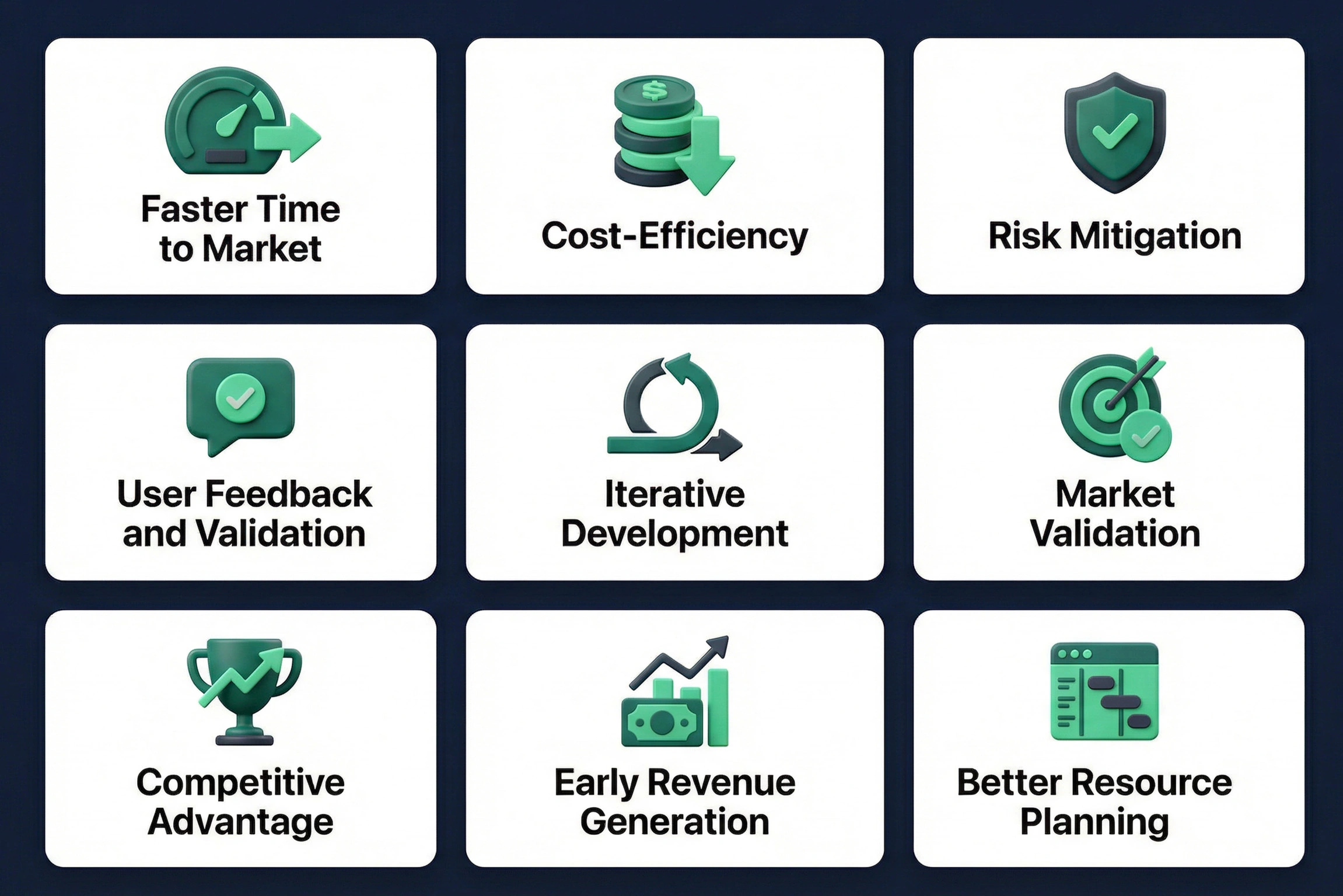
Here are the key advantages of developing MVPs for businesses.
1. Faster Time to Market
MVPs prioritise the quickest route to market by focusing on essential features. This rapid deployment allows you to gain an early market presence, seize opportunities, and stay ahead of competitors. This development process is especially important to utilise where the app development market is fast-moving and innovation-driven.
2. Cost-Efficiency
Developing a full-featured product can be expensive. However, MVPs optimise costs by concentrating on core functionalities. Hence, it enables you to test concepts, validate assumptions, and gather user feedback without unnecessary expenditures. This makes MVP app development an ideal process for startups and early-stage businesses with limited budgets.
Read Also: MVP Development Cost: Affecting Factors, Estimations, Optimisation Tips
3. Risk Mitigation
By releasing a minimalistic yet functional version of the product, you can reduce the risk of investing extensively in a concept that may not resonate with the target audience. With a well-defined and structured MVP app development cycle, you can get early feedback from users. This helps you to identify potential issues and allows for necessary adjustments before committing to a large-scale development investment.
4. User Feedback and Validation
MVPs support direct interaction with early adopters. It provides valuable insights into user preferences, needs, and pain points. This feedback loop informs subsequent development stages. As a result, it ensures that the final product aligns more closely with user expectations, which is based on real usage data rather than assumptions.
5. Iterative Development
The MVP development approach follows an iterative development process. With continuous MVP testing and refinement, you can evolve the product based on real-world user experiences. Consequently, it results in a more robust and user-centric final product. This allows you to adapt and change the application’s core functionalities to market demands.
6. Market Validation
By launching an MVP, you can quickly gauge market interest and demand. Positive responses help you validate your innovative product or mobile app ideas. At the same time, negative feedback allows for timely adjustments before investing in extensive resources. This helps you to avoid costly failures and achieve sustainable business success.
7. Competitive Advantage
Being the first to introduce a unique product to the market, even in a limited form, provides a competitive advantage. It allows you to establish your business presence, build brand awareness, and ultimately capture market share before competitors catch up. This will continuously help you improve the application based on user feedback.
8. Early Revenue Generation
Launching an MVP can generate initial revenue, helping to offset development costs and sustain further product enhancements. This revenue stream can be crucial for startups and businesses operating on limited budgets. In addition to this, early revenue helps you to validate app monetisation strategies and pricing models. It also improves investor confidence by having a real user demand at an early stage.
9. Better Resource Planning
MVP development helps you clearly identify which features, technologies and resources are truly essential for the product’s success. By focusing only on validated requirements, you can plan development efforts more effectively and avoid unnecessary workload or technical complexity. This clarity improves team alignment, streamlines decision-making, and ensures that time, budget, and technical resources are invested where they deliver the highest impact.
Top Reasons To Hire Full Stack Developers for Building MVPs
1. Optimised Budget Allocation
Hiring full-stack developers for MVP development brings notable cost efficiency. Since they are skilled in both frontend and backend technologies, it eliminates the need for separate specialists. As a result, it reduces the overall development costs. By consolidating tasks under a single developer or a small team, businesses can optimise their budgetary allocations.
Therefore, hiring full-stack developers stands as an economical choice for MVP projects. This financial advantage is particularly beneficial for startups and small enterprises. It is because they always look to maximise the impact of their limited resources without compromising the quality of their MVP.
2. Faster Development Time
When you hire full stack developers, it helps you accelerate the development process. Being experts in both frontend and backend domains, they can seamlessly integrate all the essential components.
This streamlined process allows quick iterations and a faster time-to-market for the MVP. Thus, it gives the flexibility to refine their product based on user feedback rapidly. This speed advantage is crucial for companies that want to leverage custom MVP app development services and quickly validate their concepts, make necessary adjustments, and gain a competitive advantage.
3. Flexibility and Adaptability
Full-stack developers offer unmatched flexibility and adaptability in the MVP development landscape. Their proficiency in a wide array of technologies empowers them to select the most suitable tools for specific project requirements.
Whether it is frontend or backend, full stack developers can swiftly switch their roles. This adaptability plays a pivotal role, especially in the early stages when requirements may undergo frequent changes.
4. Detailed Expertise
Since they bring complete expertise to MVP development, it allows them to make informed decisions that align with the entire development stack. From creating an interactive user interface to designing robust backend architecture, full stack developers excel in end-to-end implementation.
Their mastery of the entire development lifecycle ensures that every aspect of the MVP, including databases, servers, and APIs, is flawlessly interconnected. Thus, it not only enhances the quality of the MVP but also simplifies decision-making processes.
5. Efficient Communication
Efficient communication is one of the top reasons why you should hire full-stack developers for MVP. When you outsource your project to an agency or set up a large team of different developers, it requires a time-consuming process of communication. You have to monitor and control various tasks from various developers. However, with full-stack developers, communication becomes easier. You only need to discuss all the aspects with a single person.
Hence, it allows seamless and straightforward communication, which reduces the chances of misunderstandings and errors. It ensures seamless collaboration within a single developer or a small team. This efficiency in communication not only expedites the development process but also contributes to the overall success of the MVP.
6. Rapid Prototyping
Faster prototyping plays a crucial role in the MVP development process. With rapid prototyping, startups or businesses can save valuable time and cost in validating their concept. It allows stakeholders to visualise and interact with the product quickly. In addition to this, product owners can gather feedback and make necessary adjustments in the early stage.
And when you have full-stack developers, the speed of prototyping gets enhanced. They have extensive knowledge, so they implement features more quickly. As a result, development remains agile and responsive to evolving project requirements.
7. Simplified Maintenance
Having full-stack developers makes it easier to maintain the product or application. As these developers possess all the required expertise, you only need to hire fewer developers as compared to a large team. They can efficiently address updates, enhancements, and bug fixes.
Apart from this, full stack developers can quickly implement changes and ensure compatibility between different aspects of development. This simplified maintenance process not only saves time and effort but also contributes to the long-term sustainability of the minimum viable product.
Read Also: 5 Best Real-Life Examples of Successful MVP Development For Startups
Things to Consider While Hiring Full Stack Developers
It may appear highly beneficial to hire full stack developers. However, there are many challenges and difficulties associated with this. While it is true that with full-stack developers, you don’t need many developers for your MVP project. But when it comes to hiring developers with full-stack development expertise, it is not easy. The market is mostly full of specialised developers who are well-versed in a particular technology.
Finding a full-stack developer who possesses expertise in all aspects of MVP development is challenging. There are fewer full stack developers compared to specialised developers, so you have to be prepared in advance while searching for a skilled full-stack developer. Besides this, there are also many other challenges that you may encounter while hiring full stack developers.
- Depth of Expertise: Full-stack developers are expected to have proficiency in both frontend and backend technologies. However, finding candidates with deep expertise in all required areas can be challenging.
- Experience and Specialisation: They may not possess the same level of specialisation as dedicated frontend or backend developers. Hence, this may potentially impact the depth of expertise in specific areas.
- Technological Diversity: Staying updated with a wide range of tools and frameworks due to the fast-paced evolution and emerging, advanced technologies can be demanding for full-stack developers.
- Project Scale: Full stack developers are generally preferable and better suited for smaller to medium-sized projects. Also, their versatility might not be sufficient for very large and complex projects.
- Quality vs. Quantity: Balancing the breadth and depth of skills in full-stack developers can sometimes lead to compromises in providing an expert solution in specific domains.
- Market Demand and Competition: The high demand for full stack developers has resulted in increased competition for hiring them. So, this makes it challenging for cross platform mobile application development companies to attract and retain top talent.
Comparison Between Hiring Full Stack Developers vs Hiring Specialised Developers
Here is a quick comparison table that will give you an idea of when it is beneficial to hire full stack developers for MVP development.
| Aspect | Hire Full Stack Developers | Hire Specialised Developers |
| Flexibility and Adaptability | Versatile to work on both frontend and backend tasks. | -Specialised expertise in a specific area (frontend or backend). |
| Cost-Efficiency | Potential cost savings as fewer developers may be needed | May require a larger team to cover both frontend and backend aspects. |
| Wide Range of Skills | Can handle various aspects of the development stack. | May lack skills in areas outside their specialisation. |
| Up-to-Date Tech Knowledge | Typically stays updated with a broad range of technologies. | May require additional effort to adapt to new technologies. |
| Project Scale | Suitable for startups and small to medium-sized projects. | Ideal for large-scale projects with complex requirements. |
| Quality of Work | Balances depth and breadth of skills. | May lack a holistic view of the entire project. |
| Time to Market | Quick iterations and rapid prototyping. | More time for coordination between frontend and backend teams. |
| Cost of Hiring | Potentially lower overall MVP development costs. | It may require multiple specialists and higher costs. |
| Scalability | Well-suited for projects with moderate scalability requirements. | Better suited for projects with specific, large-scale needs. |
Final Thoughts
Minimum Viable Product or MVP development has emerged as a strategic and practical approach for businesses that are looking to validate their product app ideas quickly in the targeted app development industry. However, due to limited resources, developing an MVP with cost-efficiency becomes a significant challenge. This is why you should hire full-stack developers who enable you to build MVPs faster and thus reduce development costs.
For businesses aiming to overcome this challenge, partnering with a dedicated MVP app development company like RipenApps is the right approach. RipenApps stands out as a trusted destination where startups and enterprises can hire experienced full-stack developers with proven expertise in building successful MVPs. With a strong focus on quality, scalability, and performance, RipenApps helps businesses transform ideas into market-ready digital products efficiently and effectively.
FAQs
1. Why should startups hire full stack developers for MVP app development?
Startups benefit from hiring full stack developers because they can handle both frontend and backend development, reducing the need for multiple specialists. This results in faster development cycles, lower costs, and smoother iterations—ideal for MVPs where speed and flexibility matter most.
2. Are full stack developers suitable for complex MVP projects?
Full stack developers are best suited for small to medium-complexity MVPs. They efficiently manage end-to-end development during early stages. However, as the product scales or becomes more complex, specialised developers can be added to support advanced requirements.
3. How do full stack developers help reduce MVP development costs?
By combining multiple skill sets into one role, full stack developers minimise hiring overhead, coordination costs, and communication gaps. This streamlined approach significantly reduces overall MVP development expenses without compromising core functionality.
4. What technologies should a full stack developer know for MVP development?
A strong MVP-focused full stack developer should be proficient in frontend frameworks (React, Angular, Vue), backend technologies (Node.js, Django, Ruby on Rails), databases (MongoDB, PostgreSQL), cloud platforms, APIs, and basic DevOps practices.
5. When should a business choose specialised developers over full stack developers?
Specialised developers are a better choice when the project involves large-scale architecture, advanced performance optimisation, or domain-specific complexity. For early-stage MVPs, however, full stack developers offer better speed, flexibility, and cost control.

SHARE
WRITTEN BY

Ishan Gupta
CEO & Founder
Ishan Gupta is a seasoned entrepreneur and CEO with extensive 8+ years of experience in business and mobile app development landscape. He believes that the right digital product allows companies to focus on what they do best, while technology handles the rest. With deep exposure to global markets, he understands what makes an app succeed. His approach translates business needs into clear product strategies, ensuring that every feature contributes to measurable ROI.
View All Articles