

Many founders ask: “How much does an MVP Development cost?” But that is rarely the question that actually needs answering. The real question is: how much will it cost if you build it wrong? This question is more crucial as the first version of a product is rarely the most expensive. The rebuild usually is.
This means that the real financial risk of MVP development is not overspending in the beginning. Instead, it is spending in the wrong direction. This is why budgeting an MVP and allocating capital intelligently is important.
Without a structured MVP budgeting approach, businesses invest in features before validating the problem, choose tech stacks that do not scale, or even underestimate the operational costs that follow launch. What appears to be a faster or cheaper path in the early stages often becomes the source of technical debt, delayed timelines, and expensive refactoring later.
For CTOs and startup founders, the goal is not just to estimate spend, but to design a capital-efficient validation strategy that protects runway while maximising learning. Without this mindset, development turns into execution without evidence.
This guide breaks down the real cost drivers of MVP development in 2026. It explores discovery, architecture trade-offs, resourcing models, platform decisions, post-launch obligations, and cost optimisation strategies to help you invest in validation without creating costly mistakes.
Key Takeaways
- MVP cost depends more on strategic decisions than development hours, and wrong choices often create expensive technical debt.
- Investing early in a structured discovery phase prevents major budget overruns and builds products on validated assumptions.
- Choosing the right team structure and location can reduce costs significantly while accelerating overall time to market.
- Building only the core differentiator and integrating third-party tools reduces development time, risk, and early expenses.
- Post-launch costs like marketing, compliance, maintenance, and iteration can add 30 to 50% to budgets.
Table of Contents
Why Should You Plan Your MVP Development Budget?
Before understanding why minimum viable product budgeting matters, you need to first know why the MVP of a final product even exists. Many startup founders and CTOs often relate MVP to a cheaper version of the final product.
No, currently, it is not a cost-friendly or cheaper version; instead, it works as a learning system that is designed to convert assumptions into validated knowledge as fast as possible.
This validation of a new idea is critical, as every new digital product begins with questions:
- Whether users will adopt it and be willing to pay
- Whether the acquisition or revenue strategies will work
- Whether the utilised technology stack and mobile app development trends can scale
This means that budget clarity is the difference between a controlled experiment and a costly mistake. An MVP turns your idea into reality, but only if the investment behind it is planned. Without a defined cost framework, you risk converting capital into unnecessary expenses, thus resulting in no positive measurables.
Planning your MVP development budget helps you:
- Set realistic expectations so every dollar strategically maps to a decision, not guesswork.
- Stay financially sustainable, especially critical for startups scaling on a limited runway.
- Track spend in real time so you know exactly where your budgeting is accumulating.
Before Starting the MVP Budgeting Process: Critical Phases
1. The MVP Discovery Phase
Many CTOs start the MVP development phase quickly, without investing first in a structured and well-planned MVP discovery phase. This results in MVPs going over the budget before even the codebases are written.
The discovery phase is now more important when the app development market is evolving at a much faster pace. It is the process that involves user research, architecture-related decisions, risk identification, feature scoping, etc., before you commit to building the MVP app or the product idea.
At this discovery stage, the main objective you should carry out is to define the problem with 100% precision. What exact users’ problems are we solving? For whom is this MVP app? Under what context is it a winning MVP?
If you are able to answer these questions, then you should invest in a proper discovery phase, costing between $5,000 and $15,000, and the delivery timeline range is between 3 to 6 weeks.
2. MVP vs. MMP vs. MLP
You need to know and be clear on what stage of the product you are building. Whether it is a minimum viable product (MVP), minimum marketable product (MMP), or minimum lovable product (MLP).
Each stage represents a different objective, success metrics, feature scope, etc. Look into the detailed table given below to know the actual differences that matter to your business:
| Aspect | MVP (Minimum Viable Product) | MMP (Minimum Marketable Product) | MLP (Minimum Lovable Product) |
| Primary Goal | Validate assumptions and detect product–market signals | Achieve market readiness and revenue generation | Build emotional engagement and strong user retention |
| Focus Area | Core functionality and learning | Stability, scalability, and monetisation | Experience, user delight, and differentiation |
| Success Metrics | Activation and early adoption | Conversion, revenue, and churn reduction | Retention, engagement and brand liking |
| Feature Scope | Strictly essential features only | Essential, onboarding, and payment-related features | UX refinement, personalisation, and advanced features |
| Infrastructure Type | Basic and lean infrastructure | Production-ready infrastructure | Scalable and optimised ecosystem |
| Engineering Priority | Speed and validation | Performance, security, and scalability | Optimisation, polish, and advanced capabilities |
| Design Investment | Functional usability | Conversion-focused UX | High-quality and delightful UX/UI |
| Budget Stage | Lowest investment stage | Moderate investment stage | Higher strategic investment stage |
| Typical Outcome | Evidence and learning | Revenue and market traction | Brand loyalty and long-term growth |
Confusing these three is one of the most common reasons behind the budget spiralling out of control. When leadership knows whether they are funding validation, market readiness, or user loyalty, capital can be allocated with precision and engineering efforts remain focused on the right objectives.
3. API-First Design and Microservices vs. Monolith
The architecture decisions made during discovery have an outsized impact on your long-term cost.
API First Design means building your product so that every feature is accessible via an API from day one. This makes your MVP app or product easier to integrate, scale, and extend without rebuilding core infrastructure.
Microservices vs. Monolith is a core decision that defines how your codebase is structured. A monolithic architecture keeps everything in one codebase, simpler and faster to build initially. But it is harder to scale independently.
Whereas a microservices architecture breaks the product into independent, deployable features, more complex upfront. This architecture ensures scalability and maintainability as the product grows.
For most early-stage MVPs, a well-structured monolith is the right call. For products expecting rapid scale or multiple independent feature teams, microservices are worth the upfront investment. Getting this wrong in discovery means paying to rebuild it later.
Now, deep dive into the next section and look at the real factors that influence the total MVP development cost:
Factors Driving MVP Development Costs With Cost Estimations
When planning the budget for your MVP, there are several factors affecting estimates. And knowing them can help you make informed decisions.
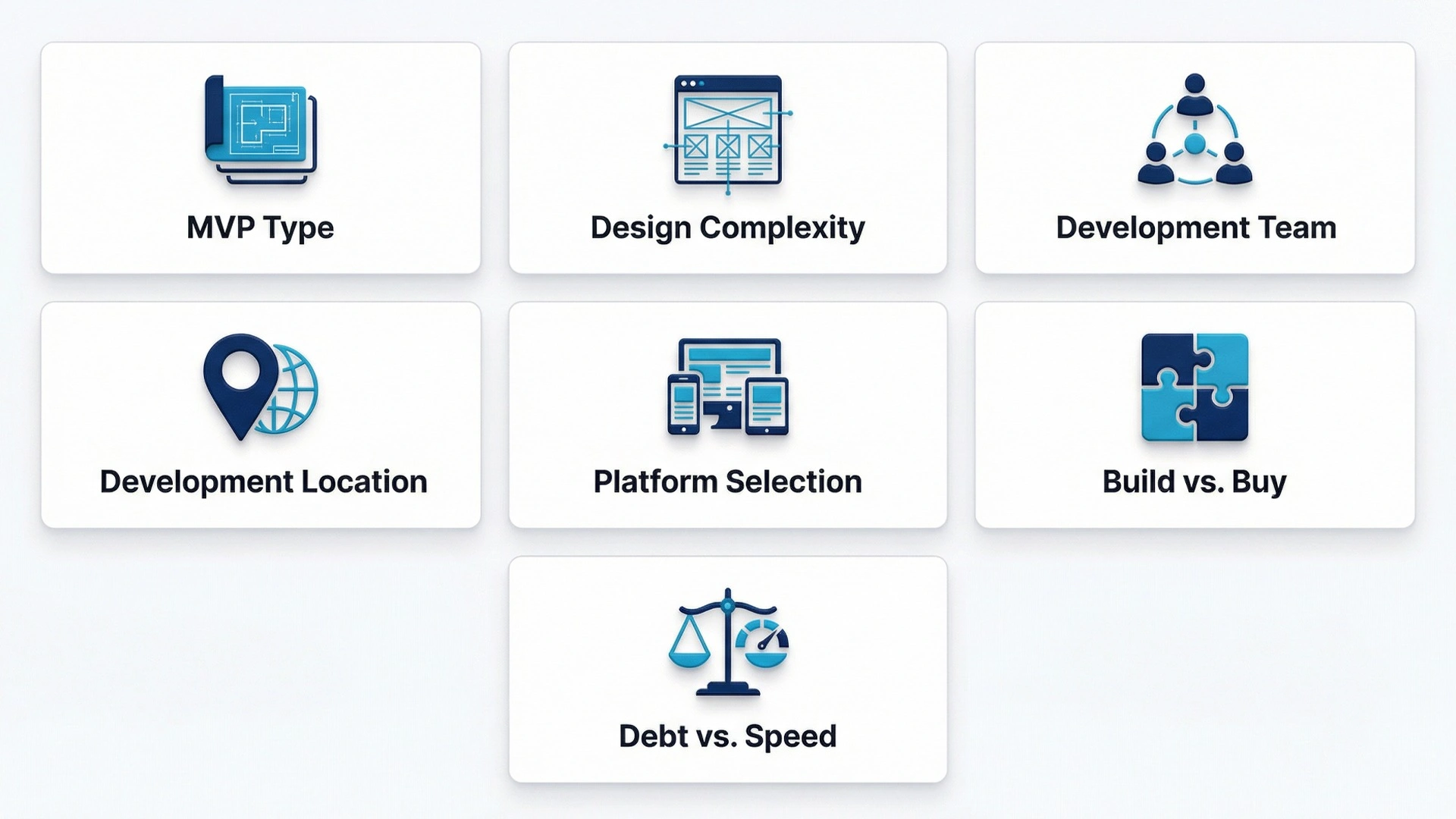
1. The MVP Type Impact
MVPs have several types. For example, the cost of low-fidelity MVP types might be lower compared to high-fidelity MVPs. It is because low-fidelity MVPs target basic complexities and have the primary goal of finding a suitable solution for the target audience. Whereas high-fidelity MVPs are aimed at understanding whether customers will pay for their solutions or not.
Here are rough cost estimates for different MVP types:
- Landing Page MVP: $1,000 to $5,000
- Single-feature MVP: $5,000 to $25,000
- Multi-feature MVP: $25,000 to $100,000, or more
2. The Design Complexity Impact
Design directly affects both cost and user validation quality. A poorly designed MVP generates misleading feedback. Users reject it because of the experience, not because of the idea. A well-designed MVP generates a clean signal.
On average, a designer charges between $50 and $100 per hour, depending on experience and location. Design complexity ranges from basic wireframes and a functional UI to a fully polished, brand-consistent interface. For most MVPs, aim for functional and clear rather than beautiful. Polish is for the MLP stage.
3. The Development Team Structure Impact
How you staff your MVP development has a larger impact on cost than most founders expect. You have to keep a good amount of budget aside while planning this phase. Here are the four primary development approaches available with their cost estimates:
In-House Development Team
Many businesses choose to build their MVP ideas by reaching out to an in-house development team. This development team approach provides you with greater control, retention, and full alignment with your product vision level.
The true cost of an in-house development team is not just the developers’ salaries, but also includes compliance, onboarding, and overhead costs. Here is the cost estimation for hiring an in-house development team for your MVP project:
| Variable | Estimated Cost (In USD) |
| Average Cost per Hire (Monthly) | $3,000 to $6,000 |
| Combined Team Salary (6 to 8 Months) | $100,000 to $200,000 |
| Recruitment and Hiring Costs | $5,000 to $15,000 |
| IT Infrastructure and Equipment | $2,000 to $5,000 |
| Software Licenses and Tools | $1,500 to $4,000 |
| Training and Onboarding | $1,000 to $3,000 |
| Total Estimated Cost | $120,000 to $250,000 |
Read More: Why You Should Hire Full Stack Developers For MVP Development?
Nearshore or Onshore Development Team
Some businesses prefer building a locally based team, which can be a nearshore or onshore development team. This development approach prioritises easier collaboration, time-zone alignment, and direct communication across product, design, and engineering teams.
While this reduces coordination complexity, it significantly increases development costs due to higher hourly rates in mature markets. However, working with a leading MVP development company that is in a similar time zone reduces coordination overhead and accelerates decision-making during the MVP phase.
Look at the table below to know the complete estimated cost of hiring a local MVP development team:
| Variable | Estimated Cost (In USD) |
| Average Hourly Rate | $150 to $200 per hour |
| Team Size | 5 to 6 specialists |
| Estimated Development Duration | 6 to 8 months |
| Average Monthly Development Cost | $22,000 to $28,000 |
| Total Estimated Cost | $170,000 to $190,000 |
Outsourcing Development Team
Outsourcing to a specialised MVP development company is one of the most cost-efficient and scalable approaches for early-stage product development. This model provides access to a ready-made cross-functional team, proven delivery processes, and faster time-to-market without long-term hiring commitments.
| Variable | Estimated Cost (In USD) |
| Average Monthly Cost | $5,000 to $8,000 |
| Team Composition | PM, Designers, Developers, QA |
| Estimated Development Duration | 4 to 6 Months |
| Project Management & Delivery Overhead | Included |
| Total Estimated Cost | $25,000 to $40,000 |
Offshore Development Team
Choosing an offshore or global development partner is primarily a location-driven cost optimisation strategy. Instead of hiring locally in high-cost markets, businesses collaborate with teams in regions where operational and salary benchmarks are significantly lower while maintaining engineering quality.
This model is widely adopted by startups aiming to extend their runway without compromising delivery standards.
| Variable | Estimated Cost (In USD) |
| Average Hourly Cost | $25 to $60 per hour |
| Team Size | 4 to 6 Specialists |
| Estimated Development Duration | 4 to 6 Months |
| Average Monthly Cost | $6,000 to $12,000 |
| Total Estimated Cost | $20,000 to $70,000 |
4. The Development Partner Location Impact
Location is one of the most significant cost levers available to you. Regardless of whether you hire freelancers or outsource to a top software development company, geographic location influences the overall app development cost.
For example, development costs in India can be 2 to 3x lower than in the United States or Western Europe. This cost difference is primarily driven by infrastructure, operational expenses, and market salary benchmarks. Here is the current market rate breakdown by region:
| Country | Average Hourly Rate (In USD) |
| USA and Canada | $100 to $180 |
| Western Europe | $80 to $150 |
| Eastern Europe | $45 to $80 |
| India | $25 to $55 |
5. The Platform Selection Impact
The platform you build on determines both your initial development cost and your long-term infrastructure expenses.
- Native iOS and Android have the highest build cost and high scalability. Best for performance-critical apps.
- Cross-platform app development frameworks like Flutter and React Native have a medium cost and high scalability. They are best for most MVPs targeting both platforms.
- Web apps have the lowest cost and high scalability. Best for B2B tools and SaaS.
Serverless architecture is worth considering for any web or mobile MVP. Rather than provisioning and managing dedicated servers, serverless platforms like AWS Lambda or Google Cloud Functions run code on demand and charge only for actual usage. For an early-stage MVP with unpredictable traffic, this eliminates the cost of idle infrastructure and reduces DevOps overhead significantly.
6. The Build vs Buy Analysis
One of the most overlooked cost optimisation decisions in MVP development is knowing which components to build from scratch and which to buy or integrate.
In 2026, the ecosystem of third-party tools, APIs, and SaaS integrations means that a significant portion of what startups used to build custom is now available off the shelf. Authentication, payments, notifications, analytics, CRM integration, and even top-notch AI trends can be wired together in days rather than built over weeks.
The rule of thumb is to buy anything that is not your core differentiator and build only what is unique to your value proposition.
Building a custom payment system when Stripe exists is not a competitive advantage. It is a budget drain. The same applies to CI/CD pipelines. Buying pre-configured pipelines through platforms like GitHub Actions or CircleCI saves weeks of DevOps setup time and reduces early costs while delivering a more reliable deployment process than most in-house setups.
7. Technical Debt vs Speed
Speed is the goal of every MVP, but speed pursued without discipline creates technical debt, and technical debt is one of the most expensive hidden costs in product development.
Technical debt accumulates when shortcuts taken during the MVP stage become load-bearing walls in a growing product. Fixing it later requires rewriting systems that are already in production, which costs significantly more than building them correctly the first time.
The decisions that generate the most technical debt are architecture choices made under time pressure. Choosing a monolith when your product needed microservices, skipping CI/CD pipelines to save setup time, or building without a proper API layer are all decisions that feel cheap in week one and become expensive by month six.
The practical balance is to move fast on features but not on mobile app architecture. The structure of your codebase is not a feature. It is the foundation that determines how expensive every future feature becomes.
Post-Development Factors Affecting The MVP Development Cost
Most MVP budgets stop at deployment. Most MVP failures start there. The costs that follow launch are predictable but consistently underplanned.
- The marketing cost of your MVP is roughly estimated at around $10,000.
- Sales team cost, whose rough estimation is also around $10,000
- Security and compliance, including legal regulations like HIPAA, GDPR, and SOC2, can cost $20,000 to $40,000.
- Maintenance of your MVP, since you might need iterations on the basis of user feedback. Generally, it is estimated at 20% of the total cost.
- Localisation of your app or internationalisation of the app might affect your overall cost.
Tips For MVP Development Cost Optimisation
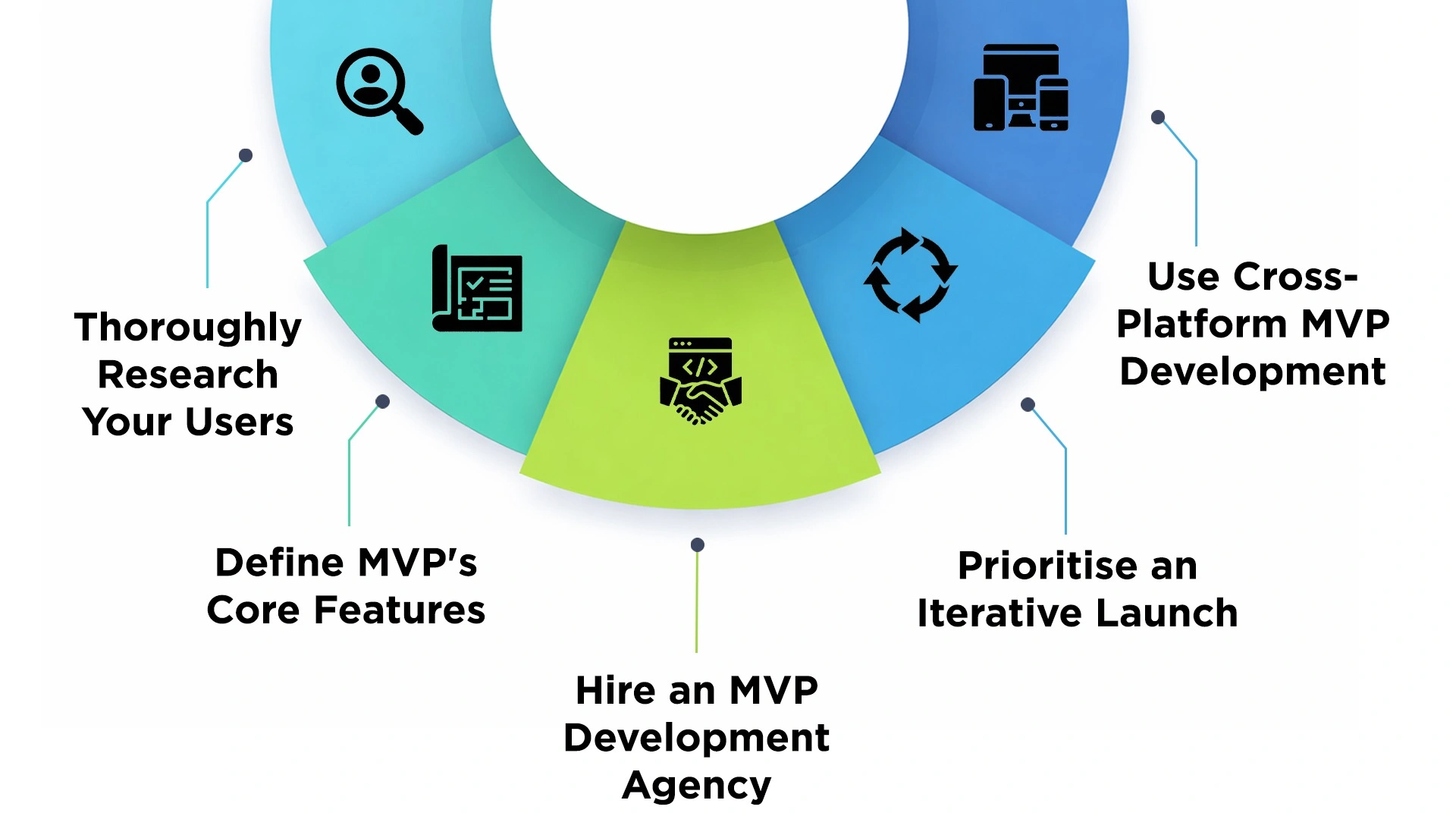
Here are the tips for MVP development cost optimisation:
Thoroughly Research Your End Users
Why do we build products? OfCourse to solve problems for users. Until and unless you have a clear understanding of your end users, you cannot plan the optimisation of your costs. A thorough user research will not only help you understand your users but also how to invest in them in the most cost-effective manner. Use surveys, questionnaires, feedback forms, and every other method to better understand your users.
Define Your MVP’s Core Features Clearly
You need to have a strong understanding of the difference between the minimum viable product and the full product. You have to define the core features that you need in your MVP, or else you might end up adding so many features just like the full product. Focus on applying the key features that really define your idea so that you can test if users will like it or not.
Hire an MVP App Development Agency
If you opt for building the team yourself or even hiring freelancers, the overall cost can be higher in the long run. Whereas top mobile app development companies have the complete infrastructure required for your MVP to get developed. This development approach is also viable for the long run when you want iterations according to user feedback.
Prioritise an Iterative Launch & Feedback Cycle
Instead of trying to perfect the product before launch, release early and improve based on real user feedback. Continuous iteration helps you avoid investing heavily in features that users may not need. By testing small updates, measuring engagement, and refining the product step-by-step, you significantly reduce wasted development costs while improving product-market fit faster.
Go For Cross-Platform MVP Development
If you are clear about targeting both iOS and Android markets, look no further than an elite cross-platform app development company. Through cross-platform technologies, developers can reuse the code, reducing the effort and turnaround time of your product, ultimately leading to cost optimisation.
Read More: How Much Does It Cost to Develop an App? A Detailed Guide
Wrapping Up
Currently, the total MVP development cost is defined by the team’s clarity, not by how many development hours they have put into the process. Clarity is required in architecture and the development team structure. Clarity in what to build versus what to integrate. Whether you are validating your first idea or scaling an existing product into new markets, the decisions you make will determine whether your investment compounds into a scalable asset or drains into technical debt.
At RipenApps, we have helped startups and enterprises move from idea to validated product with budgets that stay intact and timelines that hold. If you are ready to build your MVP the right way, let us start with the discovery phase and build everything else from there.
FAQs
Q1. Can I build an MVP for under $10,000 in 2026?
Yes, with no code or low-code platforms like Bubble, Webflow, or Glide. These tools support genuine product validation at minimal cost. The trade-off is scalability. No code hits technical limits as complexity grows. Use it to validate, then rebuild on a custom stack once the idea is proven.
Q2. How much does MVP app development cost?
Custom MVP development typically ranges from $25,000 to $100,000, depending on feature complexity, platform choice, and team location. No-code MVPs can be built for $1,000 to $10,000. AI-assisted development is actively bringing custom MVP costs down in 2026.
Q3. How long does it take to develop a Minimum Viable Product?
A standard custom MVP takes 4 to 6 months with an agency. No-code MVPs can be ready in 2 to 6 weeks. AI-assisted development workflows are compressing custom timelines by 20 to 30% compared to 18 months ago.
Q4. What is the average hourly rate for MVP developers in India vs USA?
Senior developers in the USA charge $120 to $180 per hour. Equivalent senior developers in India charge $35 to $55 per hour. For a typical MVP build, this difference represents $150,000 to $250,000 in savings with no compromise in output quality from an established agency.
Q5. Why do most MVPs go over budget?
The four most common reasons are skipping the discovery phase, scope creep from confusing an MVP with an MMP or MLP, underestimating post-launch runway costs, and failing to account for compliance requirements like SOC 2 and GDPR. Each of these is preventable with upfront planning.
Q6. How do I choose an MVP development company?
Evaluate portfolio depth, client testimonials, technical capability across your required stack, and whether their developers actively use AI-assisted tooling. Ask specifically about their discovery process. An agency with no structured discovery phase will almost certainly deliver cost surprises mid-build.

SHARE
WRITTEN BY

Mohit Singh

Mohit is a writer who makes technology easy to understand. He uses clear and simple words to explain technology for techy and non techy people who may not know much about tech. Mohit wants everyone to get how technology works without it being confusing. He's really good at turning complicated ideas into simple articles that anyone can read and enjoy. Mohit's goal is to help people see that tech isn't so hard to understand – it's for everyone!
View All Articles