

Mobile apps no longer compete on features alone. They compete on how intelligently they respond to user behavior, how seamlessly they fit into daily routines, and how quickly they adapt to rising expectations. As digital experiences become denser and attention windows shrink, users expect apps to think ahead, load faster, stay secure, and feel effortless across devices. This seismic shift is redefining mobile application development trends and forcing businesses to move beyond familiar patterns toward experience-driven innovation.
The real challenge is not a lack of innovation. It is decision overload. The app ecosystem is crowded with mobile app trends that claim impact but deliver limited value. For entrepreneurs or app owners, selecting the wrong mobile development trends adds friction, slows user adoption, and weakens retention. This blog cuts through the noise by focusing only on mobile app development trends shaping measurable outcomes in 2026. These trends influence how apps are built, how users engage, and how businesses prepare for the future of mobile app development.
Table of Contents
Mobile App Industry Growth Statistics
The mobile app industry continues to expand at a rapid pace as businesses across sectors integrate mobile experiences into core operations. From customer engagement to internal workflows, mobile apps now shape how brands interact, scale, and retain users. This widespread adoption fuels sustained growth across the app ecosystem and pushes mobile application development trends toward smarter, faster, and more experience-driven solutions.
To meet rising expectations, mobile app development companies rely on advanced technologies and modern frameworks to build apps aligned with current usage patterns. As a result, mobile development trends are reshaping the app market at scale. Industry data reflects this momentum.
According to the latest industry reports, the global mobile app market is projected to reach USD 777.4 billion by 2032. Users now spend an average of 4 hours and 39 minutes daily on mobile apps, which raises the bar for performance and experience. For app owners, partnering with the right custom app development company is one of the best strategies to lead the competitive industry. Moreover, long-term relevance depends on aligning product decisions with forward-looking mobile app development trends built for 2026 and beyond.
Top Mobile App Development Trends for 2026
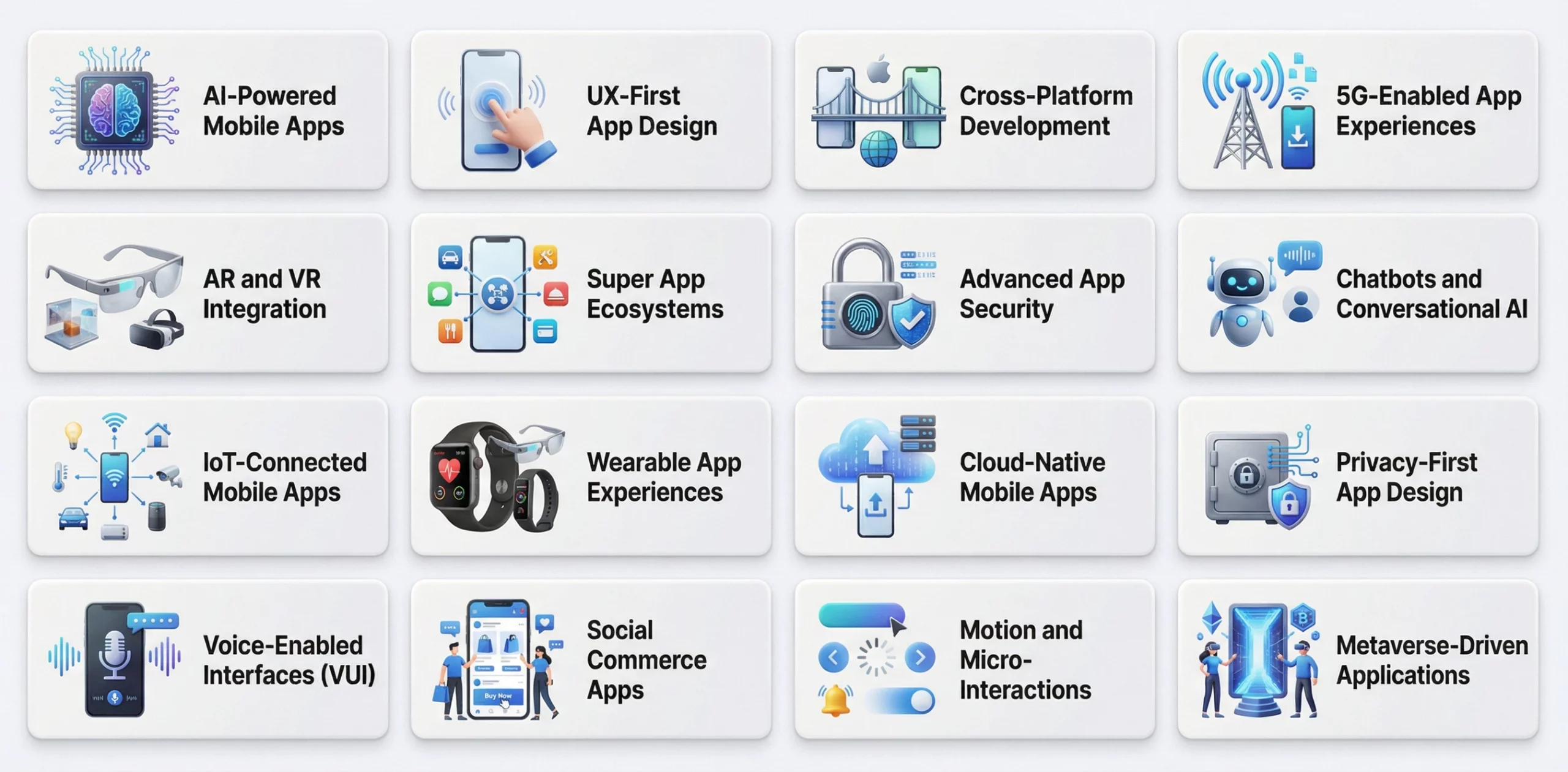
Mobile apps are dynamic and scalable digital products. The market is always equipped with new innovations and advancements in mobile app technologies. Therefore, when new mobile development trends start evolving, it becomes crucial to recognize them in their emergence stage. Below are the top mobile app development trends that are expected to transform industries in various aspects. So, let’s have a look at them.
1. AI-Powered Mobile Apps
Artificial intelligence has moved beyond automation and entered the core of mobile app experiences. What began as basic machine learning models has evolved into AI-powered mobile apps that respond, predict, and personalize at scale. The rise of generative AI accelerated this shift. Thus, pushing businesses to rethink how apps understand user intent, behavior, and context. In 2026, AI personalization engines sit at the center of mobile app marketing trends. That’s why allowing apps to adapt interfaces, content, and user journeys in real time based on individual usage patterns.
Developers now integrate AI in mobile app development to deliver smarter workflows and self-optimizing experiences that reduce user effort and operational overhead. These capabilities improve efficiency while supporting long-term scalability. AI-powered mobile apps handle advanced functions such as image and speech recognition, sentiment analysis, predictive maintenance, and intelligent customer support. As mobile app technology trends continue to evolve, AI personalization engines will define how apps engage users, retain attention, and prepare for the future of mobile app development beyond 2026.
2. UX-First App Design
User experience now defines app success more than feature volume. Apps with weak usability struggle to retain users, no matter how advanced the technology behind them is. In 2026, UX-first app design prioritizes clarity, speed, and reduced effort across every interaction. Voice user interfaces, gesture-based navigation, dark mode optimization, and adaptive layouts shape modern design systems. The goal is simple. Fewer taps. Faster actions. Higher satisfaction. Modern teams rely on advanced UI/ UX design tool ecosystems to prototype, test, and refine interfaces that feel natural across devices and screen formats.
UX decisions now extend beyond visuals into trust and data protection. Privacy-by-Design Architecture embeds security and data control directly into the user journey rather than adding compliance layers later. Clear consent flows, transparent data usage, and intuitive privacy settings strengthen user confidence without disrupting the experience. As mobile application design evolves, UX-first strategies paired with privacy-driven thinking will remain central to mobile app development trends shaping adoption, retention, and long-term product relevance.
3. Rise of Cross-Platform Development
As consumers are increasingly adopting mobile apps, the market continues to become more competitive. Startups & businesses look for cost-efficient mobile app development solutions that give the same performance as native apps. Therefore, cross-platform app development has become one of the popular mobile app development trends. Cross-platform mobile apps are built with a single codebase and run across all mobile OS platforms.
It means developers don’t have to create apps separately for Android and iOS. A cross-platform mobile app is meant to perform on Android and iOS. This multi-platform ability allows businesses to save huge costs and achieve the same results as native apps.
4. 5G-Enabled App Experiences
5G connectivity now plays a defining role in mobile app development trends as networks mature and adoption scales globally. What began as a speed upgrade has evolved into a foundation for real-time, high-performance mobile experiences. With ultra-low latency and high data throughput, 5G reshapes how apps process data, stream content, and respond to user actions. Industry forecasts project strong growth for 5G services, reinforcing its position among the most influential mobile app technology trends shaping the next phase of app innovation.
For app owners and developers, 5G expands what apps deliver without performance trade-offs. Use cases such as AR-driven experiences, VR gaming, immersive live streaming, and cloud-powered mobile workflows benefit directly from faster response cycles. Especially when executed by a leading mobile app development company in California, building performance-driven products for global audiences. Moreover, these capabilities redefine mobile app marketing trends by removing technical constraints that once limited experience design. As businesses plan for the future of mobile app development, 5G-driven app development trends will remain central to building responsive, scalable, and experience-led mobile applications.
5. Transformation Through AR and VR
While VR redefines the world, AR is the icing on the cake. Over the most recent few years, we saw positive gaming trends, for example, Pokemon Go, Incell, Dino Trek, and many more.
According to Precedence Research, the global augmented and virtual reality market size is expected to increase at a CAGR of 24.87% from 2026 to 2035.
Amazon Go already demonstrates how advanced technologies reshape in-store retail experiences. To extend this momentum, both Apple and Google now rely on AR platforms to embed augmented reality capabilities directly into their mobile apps. This shift reflects a broader app industry trend. Integrating AR/VR in mobile apps increases engagement, shortens decision cycles, and creates more immersive user journeys across retail and beyond.
There are numerous applications like “Ikea” that utilize the technology to elevate the user experience. Various such apps are en route to be a piece of this progressive change. Hence, in the upcoming years, the AR combination will be a fundamental advance for the mobile app development industry.
6. Super Apps will Dominate in 2026
Super applications continue to gain momentum as users prefer fewer apps that handle more daily tasks. Inspired by platforms like WeChat, many brands now focus on building all-in-one digital ecosystems that combine communication, payments, content, and services within a single interface. This shift reflects a growing application trend where convenience and consolidation drive user adoption.
A strong example is the evolution of a messaging app like WhatsApp, which now extends beyond simple communication. From instant messaging and payments to channel-based updates and business interactions, users manage multiple activities without leaving the app. As mobile application trends evolve, super app experiences position messaging platforms as central hubs in the future of mobile app development.
Read Also: Super App Development: Everything You Need To Know
7. Upgraded Mobile App Security
Malware attacks designed to harm mobile devices increased by 54%. In addition, more than 60% of fraud originates from mobile devices. Of that figure, 80% comes from mobile apps. Hence, digital security is a massive part of application development and will continue commanding every single technological headway.
The move by Apple to its coding language Swift and Objective-C ought to be a crucial suggestion to developers and designers to coordinate more security efforts in the initial phases of the app development process.
Enterprises will likewise investigate deception technologies to capture the tech mutants that have compromised the organization’s network. Also, the BYOD (Bring Your Own Device) trend has likewise expanded the danger of mobile enterprise apps being attacked. It requires the mobile app developers to take a shot at the application security without any preparation with an alternative methodology.
In addition, numerous apps include a payment or money transfer feature that calls for a high-security system. Therefore, the experts need to implement security measures such as code encryption, a verified backend, API, trusted payment gateways, and other fundamental steps to guarantee user safety over the app.
8. The Rise of Chatbots and Conversational AI
Chatbots aren’t a new trend in the mobile app market. Google Assistant, Siri, and Alexa are popular chatbot apps that have been used for a long time. But the potential of chatbots could be realized more when ChatGPT came into the market. This sensational Chatbot, powered by artificial intelligence, showed how AI-based chatbots can solve complex things in no time.
It proves that chatbots have diverse capabilities to solve users’ problems and help them in many different ways. Therefore, the trend of chatbot apps is emerging substantially these days. And driving higher demand for every leading chatbot development company to innovate smarter, more human-like conversational solutions.
Many companies and other brands would introduce their own AI chatbots that would be equipped with high-end problem-solving features. Hence, the rise of chatbots will acquire a fast pace as consumers and businesses both are showing great interest in using chatbots for many purposes.
9. IoT-Connected Mobile Apps
The Internet of Things continues to reshape how users interact with everyday products through mobile applications. From smart homes to connected healthcare and industrial systems, IoT-powered mobile apps give users real-time control, visibility, and automation through a single interface. This shift has turned convenience into an expectation. Thus, it pushes mobile application development trends toward deeper IoT compatibility and seamless device integration. Apps no longer support IoT as an add-on. They act as the primary control layer for connected ecosystems.
Industry projections reinforce this momentum. The number of connected IoT devices continues to rise sharply, with billions of devices expected to operate globally over the coming years. Organizations adopting IoT-driven mobile solutions report measurable efficiency gains and stronger operational control. As mobile development trends evolve, IoT-enabled apps play a central role in scalability, data-driven decision-making, and long-term value creation. For businesses planning future-ready products, IoT integration remains one of the most impactful app development trends shaping 2026 and beyond.
10. Wearable App Experiences
Wearable devices now form a core layer of mobile-first experiences rather than a supporting feature. Smartwatches, fitness trackers, and smart rings continue to gain adoption as users prioritize real-time health insights, activity tracking, and contextual alerts. This seismic shift accelerated awareness around preventive healthcare and continuous monitoring. Thus, pushing wearable app experiences into the mainstream. As a result, mobile application trends increasingly revolve around seamless synchronization between wearables and smartphones.
Growth across the wearable ecosystem reinforces its long-term impact on mobile app development trends. Leading consumer brands continue expanding their wearable portfolios, while market projections show strong momentum through the next decade. Every wearable depends on a mobile app to manage data, personalize insights, and deliver value across platforms such as Apple Watch and Android-based devices. Emerging application trends indicate stronger independence from smartphones, deeper health analytics, and expanded fitness tracking capabilities, positioning wearable app experiences as a critical focus area for the future of app development.
Read Also: How is Wearable Technology Shaping the Future of Healthcare Industry?
11. Cloud-Native Mobile Apps
Adjusting to cloud technologies is an absolute necessity for app development to make your app work consistently over various platforms. To achieve this, you must work closely with the best cloud application development company to get a complete road map. Out of the numerous benefits, cloud technology shares a portion of the standard methods that include streamlined operations, reduction in hosting, lower equipment costs, enhancement in storage capacity of apps, & Increased collaboration and productivity.
Cloud computing integrations encourage mobile apps to store data effectively and perform complex tasks. However, the more significant part of the mobile apps with a more fabulous database is utilizing AWS (Amazon Web Services) as their cloud-computing backup.
It also helps expand the unwavering quality, speed, processing power, and security of the apps and empowers them to manage a lot of data.
Read Also: AWS vs Azure vs Google Cloud Platform (GCP): Which is best for your business?
12. Privacy-First App Design
User trust has become a deciding factor in app adoption and retention. As data-driven experiences expand, users expect transparency, control, and accountability at every touchpoint, especially in apps handling sensitive financial data built by leading fintech app development companies. Privacy-first app design shifts data protection from a compliance task to a core product principle. Mobile application development trends now emphasize minimal data collection, clear consent flows, and user-controlled permissions built directly into the experience.
For businesses, privacy-first thinking strengthens long-term engagement without adding friction. Apps designed with secure data handling, transparent policies, and intuitive privacy settings reduce risk while improving user confidence. As mobile app technology trends keep changing, privacy-first design aligns closely with regulatory expectations and user behavior patterns. It stands as one of the most critical app development trends shaping sustainable growth in 2026 and the future of mobile app development.
13. Voice-Enabled Interfaces (VUI)
Voice user interfaces continue to gain traction as hands-free interaction becomes part of everyday mobile behavior. What started with virtual assistants now extends across search, navigation, commerce, and in-app actions. Users rely on voice to complete tasks faster, especially in multitasking and on-the-go scenarios. This shift places VUI among the most relevant mobile application development trends, as apps adapt to conversational inputs and context-aware responses.
Market indicators reinforce this momentum. Voice-enabled experiences continue expanding across devices and platforms, including smartphones, wearables, and smart home ecosystems. The growth of voice-driven commerce and search reshapes how users discover and interact with mobile apps. In the upcoming years, as mobile app technology trends mature, VUI integration remains a critical app development trend influencing accessibility, engagement, and the future of app development beyond 2026.
14. Social Commerce Apps Will Boom
Social commerce has shifted from experimentation to a primary revenue channel. Live shopping events, creator-led product discovery, and in-app checkout experiences now drive purchasing decisions at scale. A well-built social commerce app in eCommerce helps you enhance growth by reducing friction between discovery and purchase within a single mobile flow. What began with high-impact livestream sales has matured into a continuous commerce model embedded directly into social platforms. This shift reflects a major app industry trend, where discovery, validation, and purchase happen within the same mobile experience.
Read Also: 9 Unique And New Social Media App Ideas For Entrepreneurs
15. Motion and Micro-Interactions
Motion design has moved beyond visual appeal and become a functional layer of mobile experiences. By 2026, users expect subtle animations, responsive transitions, and micro-interactions that guide actions and confirm system responses. Static screens feel rigid in comparison, while motion-driven feedback improves clarity, usability, and emotional connection. This shift places motion design among the most influential mobile application trends shaping modern app interfaces.
Micro-interactions now serve a purpose beyond aesthetics. Animated cues signal progress, reduce perceived wait time, and help users understand complex flows without added instructions. Moreover, businesses adopting purposeful motion design improve engagement and retention without overwhelming users. For brands planning future-ready apps, motion and micro-interactions stand as essential elements in the future of mobile app development beyond 2026.
16. The Evolution of Metaverse-Driven Applications
Metaverse-driven applications continue to evolve beyond early experimentation into structured digital ecosystems. Rather than replacing existing mobile experiences, metaverse apps extend them by enabling immersive, 3D environments layered over traditional interactions. These applications support activities such as social engagement, virtual collaboration, digital commerce, and interactive entertainment, all accessible through mobile-first platforms. As mobile application development trends mature, metaverse integration focuses more on utility, scalability, and user experience than hype.
Businesses now approach metaverse apps with clearer use cases across gaming, virtual events, social platforms, and digital asset interaction. Leading platforms have already demonstrated strong engagement and monetization potential, encouraging broader adoption. Additionally, metaverse-driven applications are becoming more accessible, performance-optimized, and integrated with existing mobile ecosystems. This positions the metaverse as a long-term application trend shaping how users interact, transact, and engage in the future of mobile app development beyond 2026.
Wrapping Up
Mobile app development continues to shift toward smarter experiences, stronger trust, and lower user effort. Trends such as AI-powered personalization, UX-first design, 5G-driven performance, IoT integration, wearable experiences, privacy-first architecture, motion design, voice interfaces, social commerce, and metaverse-driven applications all point to one direction. Apps built for the future prioritize intelligence, speed, and relevance over feature volume. Adopting the right mobile application development trends helps businesses reduce friction, improve engagement, and stay aligned with evolving user behavior.
Adapting to these changes does not require chasing every trend. It requires clear strategy, technical expertise, and execution discipline. With the right mobile app development company, businesses translate app trends into scalable, user-focused products. At RipenApps, teams help brands apply future-ready app development trends with precision. Thus, ensuring apps remain competitive, adaptable, and built for long-term growth in 2026 and beyond.
FAQs
Q1. How is AI transforming mobile app development in 2026?
AI now shapes how apps think, adapt, and personalize experiences. From real-time recommendations to predictive workflows, AI reduces user effort and improves engagement. It also supports automation, smarter customer support, and scalable performance across complex app ecosystems.
Q2. Why does mobile app development remain critical for business growth?
Mobile apps sit at the center of customer interaction, retention, and brand loyalty. Businesses rely on apps to deliver faster services, collect insights, and stay present in daily user routines. In 2026, mobile-first strategies directly influence revenue and long-term relevance.
Q3. Why are cross-platform app development frameworks trending in 2026?
Cross-platform frameworks help businesses launch faster while maintaining consistent experiences across devices. They reduce development cost, simplify maintenance, and support quicker updates. With the changing mobile development trends, scalability and speed drive the adoption of cross-platform solutions.
Q4. How does privacy-first app design impact user adoption?
Users expect transparency and control over their data. Privacy-first design builds trust by embedding security and consent into the user journey. Apps following this approach see stronger retention and align better with regulatory expectations.
Q5. Which mobile app development trends should businesses prioritize in 2026?
Businesses should focus on AI-powered personalization, UX-first design, 5G-driven performance, privacy-first architecture, and scalable cross-platform development. These trends address real user needs and prepare apps for long-term growth.

SHARE
WRITTEN BY

Prankur Haldiya
Chief Technical Officer
A tech innovator and engineering leader, Prankur Haldiya drives RipenApps’ product development strategy and oversees cutting-edge solutions in mobility, AI, and cloud ecosystems. He is passionate about building high-performance teams and helping brands launch secure, scalable, and user-centric digital products.
View All Articles