

Social commerce strategy in ecommerce has started a new revolution. In the current internet and smartphone-driven era, where 5 billion people (roughly 58% of the population) spend 2.5 hours every day on social media, social commerce is evolving as a powerful tool that takes online shopping to the next level.
Today, customers have become more conscious and curious about their purchases. Before they buy anything online, they like to explore products on social media and consider feedback & reviews. In 2026, they also rely heavily on influencer recommendations through social media platforms like Instagram.
Therefore, social commerce strategy in ecommerce or social ecommerce is emerging as one of the top ecommerce trends in the industry. Customers are highly interested in using this social shopping feature since it removes friction from the entire buying process and gives them a more engaging buying experience.
If you are planning to build an ecommerce app or currently have an ecommerce platform, you must think of integrating social commerce features into your ecommerce application. In this blog, we will explain how the integration of social commerce in ecommerce app development benefits your business. Also, you will get to know the strategic process of developing a modern and next-gen social commerce application.
Table of Contents
What is Social Commerce & A Social Commerce App?
Social commerce is the integration of social media and ecommerce platforms and has emerged as one of the top eCommerce trends. It creates a seamless shopping experience within social networking sites or apps. eCommerce apps that are powered with these features are called as social commerce apps. This is because social commerce apps utilise social media channels such as Facebook, Instagram, Pinterest, and others to facilitate online shopping and drive sales.
This social shopping concept offers a more immersive and convenient way of online shopping. By leveraging a social commerce app, customers can discover, explore, and purchase products while staying connected with their social networks. So, social media integration in ecommerce bridges the gap between social media and online shopping.
How Does a Social Commerce App Work in eCommerce?
A social commerce app in ecommerce leverages the power of social media platforms to enhance product discovery, engagement, and conversion. It focuses on creating a more interactive and personalised shopping experience for customers while driving consistent business growth for e-commerce brands.
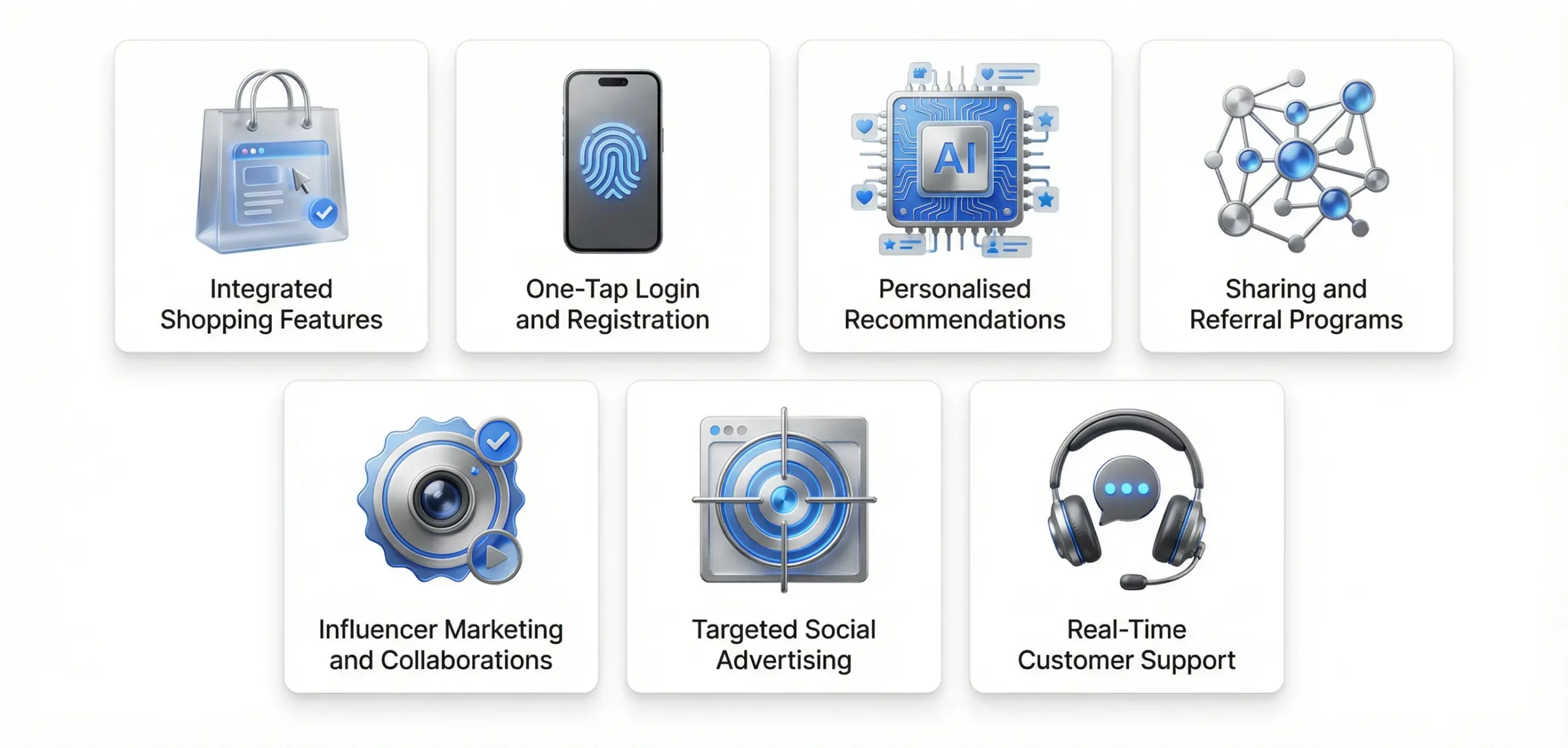
Here are some of the key ways in which social ecommerce elevates the ecommerce journey:
1. Integrated Shopping Features
Social commerce integration in 2026 works in various ways. Ecommerce platforms can integrate these social features directly into their mobile ecommerce solutions to make shopping feel more interactive and community-driven. Some of these social features include user profiles, likes, comments, product tagging, and more. You can consider leveraging modern eCommerce development services to ensure secure implementation and consistent user experiences across various devices.
2. One-Tap Login and Registration
Customers can log in or register for an account using their social media accounts, such as Google, Facebook, or Instagram and the saved credentials. This process makes the signup process faster and more convenient. It also enables ecommerce apps to access useful user data from social networks.
3. Personalised Recommendations
Social ecommerce apps can utilise social proof and personalised recommendations in ecommerce apps & platforms to build trust and reliability. You can use ratings, reviews, peer interactions, and other such ways, thus making purchase decisions more confidently.
4. Sharing and Referral Programs
These social ecommerce apps in eCommerce encourage customers to share their recent purchases, wishlists, or favourite products with their social networks. This also leads to helping brands expand their reach organically and achieve sustainable growth.
5. Influencer Marketing and Collaborations
Social ecommerce allows brands to collaborate with influencers and content creators on social media to promote their products to a larger audience. It involves sponsored posts, product reviews, unboxing videos, and other forms of branded content.
6. Targeted Social Advertising
Social commerce platforms invest in social media advertising like Facebook ads, Instagram ads, and so on. This results in driving shoppers toward product pages or in-app storefronts based on their interests.
7. Real-Time Customer Support
Through social commerce strategy, ecommerce brands provide customer support and assistance through social media channels. They respond to inquiries, resolve issues, and engage with customers in real-time.
The Growing Market Opportunity for Social Commerce
Today, many ecommerce brands and retailers utilise social commerce apps in their ecommerce businesses to enhance the buying experience and improve conversion rates. The market of social ecommerce is growing drastically. If you look at recent market social media app development trends & statistics, the social commerce industry is expanding at a fast pace.
According to Grand View Research, the global social market size is projected to reach $17.83 trillion by 2033, growing at a CAGR of 36.4% from 2025 to 2033.
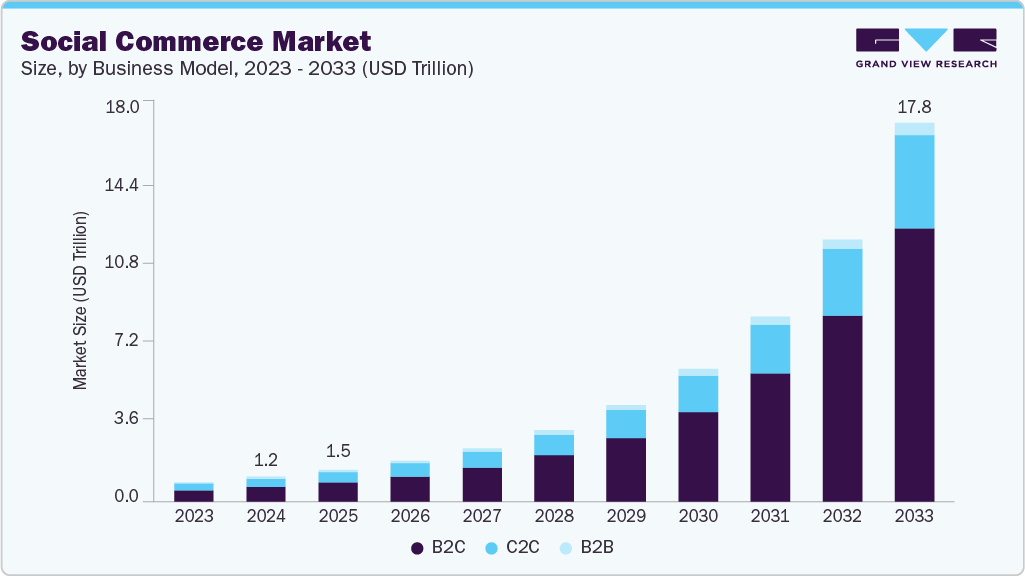
Some other key market trends related to the social commerce industry are as follows:
- Asia Pacific social commerce dominated the global market with the largest revenue share of 71.6% in 2024.
- The social commerce industry in the US is expected to grow significantly over the forecast period.
- By business model, B2C led the market and held the largest revenue share of 58.8% in 2024.
- By product type, the personal & beauty care segment held the dominant position in the market and accounted for the largest revenue share in 2024.
- By platform or sales channel, the social network-led commerce segment is expected to grow at the fastest CAGR from 2025 to 2033.
Benefits of Integrating Social Commerce Apps in eCommerce Business
With social commerce strategy reshaping how customers behave, discover, and purchase products, integrating this feature into your existing eCommerce app unlocks multiple advantages. So let us explore these benefits of eCommerce app development using social commerce functionality. This way, you can also understand why eCommerce businesses should integrate a social commerce strategy in their eCommerce app development:
1. Increased Brand Awareness and Customer Reach
Who doesn’t want to have access to billions of potential customers? Social media platforms like Facebook, Instagram, and TikTok are teeming with active customers. These apps are now working as social ecommerce platforms. When you implement social commerce features in your ecommerce app, you can showcase your brand and products to a massive audience.
This organic reach, coupled with targeted advertising options, allows you to place your brand right in front of your ideal customers. As a result, you can significantly boost your brand awareness and drive them toward your ecommerce app.
2. Enhanced User Engagement
Social commerce strategy goes beyond just displaying products. It’s about creating an interactive experience that keeps customers engaged. Features like user reviews, social sharing buttons, and live shopping events spark conversations, encourage user-generated content, and answer questions in real-time. This two-way communication fosters a sense of connection and excitement around your brand. So, it makes the shopping experience more enjoyable and memorable for customers.
3. Social Community Building
Traditional ecommerce lacks the ability to provide community-building features. Most customers must go on social media platforms to get people’s feedback to make a well-informed decision. So, through the integration of social commerce strategy in ecommerce app development, you can create a space where customers can connect with your brand and each other.
User reviews, discussions about products, and brand advocacy through social sharing all contribute to a sense of belonging. And this loyal community becomes a powerful asset. It helps you promote your brand organically and drive sustainable growth.
4. Streamlined Shopping Experience
Friction in the buying journey is a conversion killer. It is one of the major challenges that ecommerce businesses face. Social ecommerce platforms tackle this problem by streamlining the shopping experience. It enables e-commerce businesses to deliver a frictionless buying experience to customers.
Through in-app purchase options, social logins, and other social shopping features, eliminate the need to switch between platforms and fill out lengthy forms. Hence, this smooth and convenient purchasing journey removes barriers and encourages customers to complete their purchases.
5. Higher Conversion Rate
Social commerce strategy helps you create a powerful recipe for boosting conversions by providing a streamlined shopping experience and combining convenience with trust.
Your ecommerce app is equipped with social proof elements like user reviews and influencer recommendations. So you can build trust and confidence in potential buyers. In addition to this, you can also add augmented and virtual reality features in social commerce to engage customers and increase conversion ratio in your ecommerce app.
6. Valuable Customer Insights
Social media platforms are treasure troves of customer data. When you integrate social ecommerce in your ecommerce app, you gain access to valuable insights into user behaviour and preferences. This social media analytics lets you track user engagement with your shoppable posts, influencer marketing campaigns, and live streams.
You can see what kind of content resonates most, which products generate the most buzz, and even identify potential pain points in the buying journey. Hence, with such a goldmine of information, ecommerce and retail businesses can strategise their ecommerce app development & marketing strategies.
7. Targeted Marketing
Gone are the days of traditional marketing campaigns. Social commerce strategy allows you to leverage customer insights for hyper-targeted marketing strategies. The data gathered from social media platforms allows you to segment your audience based on demographics, interests, and buying habits.
It further enables you to craft personalised marketing messages, product recommendations, and promotions that resonate deeply with specific customer groups. Through a targeted approach, you increase the effectiveness of your marketing efforts and maximise your return on investment.
8. Influencer Marketing Opportunities
Social media is the natural habitat of influencers! Social commerce integration in ecommerce opens doors to powerful influencer marketing collaborations. It lets you partner with social media influencers who align with your brand values and target audience.
You can leverage their credibility and reach to promote your products in a genuine and engaging way. Influencer endorsements can significantly boost brand awareness, build trust among potential customers, and drive traffic to your ecommerce app.
9. Social Proof and Trust Building
In today’s digital world, social proof works as the best convincing force. User reviews, ratings, and recommendations displayed on your ecommerce or social shopping platforms
hold immense power to influence your customers’ decisions. Social commerce lets you leverage social proof, like positive reviews, to build trust and confidence in potential buyers. It acts as a virtual testimonial for your products.
Apart from this, user-generated content, such as photos and videos showcasing your products in real-world settings, further strengthens social proof. So, in this way, social commerce strategy helps you in convincing customers to take a chance on your brand and ultimately convert them into loyal customers.
10. Improved Personalisation
It is one of the top reasons why ecommerce businesses should integrate social commerce in ecommerce application development. Social commerce strategy empowers you to personalise the shopping experience for each customer. It lets you leverage data on past purchases, browsing behaviour, and social media interactions. You can even recommend products that are most relevant to individual user preferences.
Suppose a user who frequently interacts with posts featuring activewear on your social media page. Your ecommerce app can use this information to showcase targeted promotions or offer a personalised online shopping experience.
Read Also: How Digital Asset Management Drives Efficiency and Revenue in eCommerce
How To Integrate a Social Commerce App In Your Ecommerce Business?
Integrating social commerce features into ecommerce app development requires a strategic approach. There are two options. Either you can go with the integration of social commerce features into the existing eCommerce platforms or build a new eCommerce app with this core functionality.
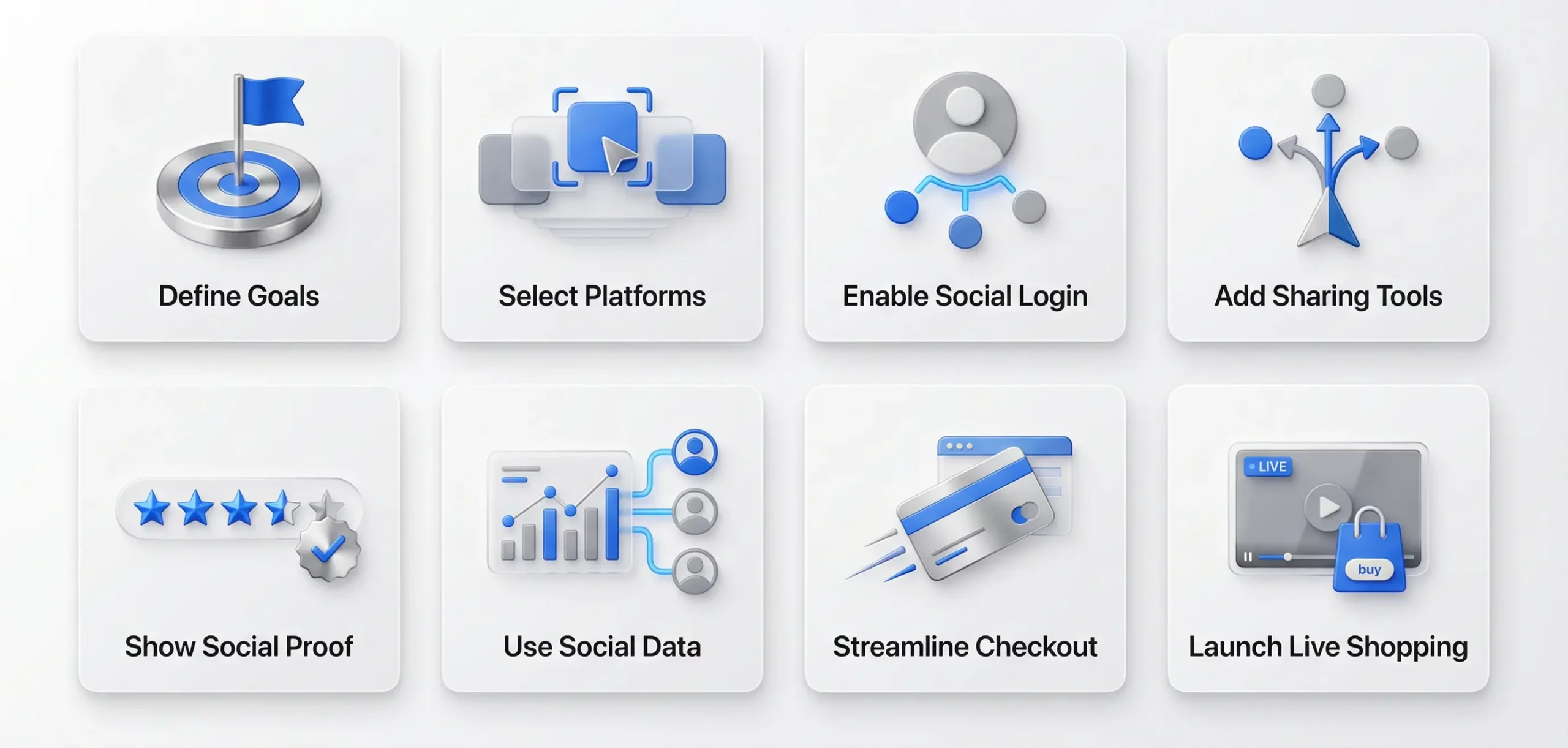
When it comes to integrating social commerce in ecommerce, you need to follow the proper steps. Below, we have shared the step-by-step guide on how to integrate social commerce into ecommerce app development:
1. Define Social Commerce Goals
Start by defining your social commerce goals and objectives. Determine what you want to achieve through social integration. Whether it’s increasing sales, enhancing engagement, building brand awareness, or improving customer satisfaction. Moreover, you can also consult a custom software development company to align these goals with the right technologies and core capabilities.
2. Choose Social Media Platforms
It is an important step. Here, you need to identify the social media platforms that are most relevant to your target audience and industry. You can consider platforms like Facebook, Instagram, Snapchat, and other social media platforms according to suitability for your products or services.
3. Implement Social Login and Registration
Enable your customers to log in or register using their social media accounts. For this, your ecommerce application development company or dev team may integrate OAuth or dedicated social login SDKs provided by respective social media platforms.
This will streamline the authentication process and access user data. Moreover, you can consider consulting a cross platform mobile application development company to create a social media-friendly user interface that ensures smooth navigation & app journey.
4. Enable Social Sharing
Now, you should implement social media sharing functionality in your social commerce app. It will allow customers to share products, wishlists, or purchases with their social networks. Here, your ecommerce app development team will need to integrate social sharing APIs to enable these features.
5. Integrate Social Proof Elements
Incorporate social proof elements such as customer reviews, ratings, and testimonials into your ecommerce app. Your ecommerce app should display user-generated content and social endorsements to build trust and credibility in your brand and products.
6. Utilise Social Data for Personalisation
It is also an important part of integrating social commerce in ecommerce. Your app must have the ability to utilise social data to personalise the shopping experience for customers. Your social commerce app should have data analytics to analyse customers’ social profiles, interactions, and preferences. Additionally, you can consider leveraging expert IT consulting services to ensure these capabilities are implemented securely.
7. Optimise for In-app Checkout
Don’t forget to make the checkout process seamless, resulting in having access to frictionless payments. You can streamline the checkout process by enabling in-app checkout options and integrating with payment gateways. To ensure a frictionless and secure checkout method, some of the one-tap payment options that you can integrate are as follows:
- Apple Pay
- Google Pay
- Meta Pay
- UPI
You can also utilise an omnichannel commerce strategy for your ecommerce to ensure a seamless buying journey experience and improve conversion rates.
8. Implement Live Streaming Shopping Feature
Live streaming is one of the most sought-after features in the current e-commerce industry. People highly rely on watching live product demonstrations and real-time feedback on products. Therefore, your ecommerce app must have these social commerce features. Many leading brands like Amazon, Sephora, and other e-commerce brands have implemented this feature in their apps and witnessed great outcomes.
Read Also: Top 10+ Profitable eCommerce Business Ideas to Start and Scale in the USA Market
Leading Brands Using Social Commerce in 2026
The concept of social commerce has already been running in the market for many years. However, after the adoption of social media in various ecommerce strategies, its adoption has increased significantly. Many ecommerce brands and companies implemented a social commerce strategy in their ecommerce apps, and they achieved impressive results.

Here are some of the top real-world examples:
Wayfair
A leading home store retailer, Wayfair, is successfully using the power of social media in the retail industry. Their app utilises Pinterest Product Pins, previously known as Pinterest Buyable Pins. These allow customers to purchase furniture and homeware directly from inspiring Pinterest boards.
They also run interactive polls on Instagram Stories to understand customer preferences and curate product recommendations. Wayfair has also begun tapping into the TikTok Shop strategy to reach younger shoppers.
Shein
This fast-fashion giant thrives on social media engagement. They leverage TikTok for trendy product hauls and challenges. This company partners with micro-influencers for authentic product reviews and encourages UGC through hashtag campaigns. So, in this way, Shein leverages the power of the social shopping community in their business.
Starbucks
Starbucks uses social media to create a personalised and engaging experience. They offer mobile ordering and payment options through their app, integrated with social media platforms. They also run social media contests and promotions, and thus encourage user interaction and brand loyalty.
While Starbucks doesn’t rely on traditional shoppable feeds, its app is heavily promoted through social media channels and loyalty-driven promotions.
Sephora
It is a well-known beauty brand. Sephora seamlessly integrates social commerce throughout its customer journey. They leverage Instagram Shopping for shoppable posts, TikTok Shop strategy for direct checkouts, and partner with beauty influencers for product reviews and tutorials.
Nykaa
This leading Indian beauty retailer has mastered social commerce. They run interactive polls and quizzes on Instagram Stories to gauge customer preferences. They also utilise user-generated content (UGC) featuring customer makeup looks, and host live shopping events with beauty experts on Instagram and Facebook. In 2026, Nykaa also engages creators across YouTube Live and has built an influencer-driven community.

Wrapping Up
Social commerce apps empower ecommerce businesses to make the most of social media. It enables brands and retailers to create more engaging and proven content that builds trust in customers. Integrating social commerce in ecommerce enables you to engage customers more effectively and thus drive better ecommerce sales.
By merging social interaction with seamless in-app buying, social commerce empowers brands to meet customers where they already spend their time, that is, browsing social media platforms.
Whether you’re enhancing an existing ecommerce platform or planning a new build, partnering with RipenApps will help you stay relevant, competitive, and connected to shifting shopper expectations. From live shopping and creator-led campaigns to personalised recommendations powered by social data, the potential to drive engagement and maximise conversions has never been greater.

FAQs
Q1. What is the difference between Social Commerce and eCommerce in 2026?
eCommerce is a traditional online buying model where customers visit a website or app to browse and purchase products. Social commerce, on the other hand, allows customers to discover, evaluate, and buy products directly within social media platforms such as Instagram, TikTok, YouTube, and Facebook, without switching apps.
Q2. How do I optimise my products for Social Search?
To improve visibility on social platforms:
- Use platform-specific keywords in captions, titles, and product tags
- Upload short-form video content demonstrating product usage
- Encourage and repost UGC (creator and customer content)
- Include hashtags that match search intent
- Ensure product visuals are high-quality and mobile-first
Q3. Is social commerce safe for payments?
Yes. Social commerce platforms support secure, encrypted payment options such as Apple Pay, Google Pay, Meta Pay, UPI, and verified payment gateways.
Most platforms also offer:
- Fraud monitoring
- Seller verification
- Secure checkout APIs
- Protection policies for buyers
As long as you work with trusted payment providers and verified platform features, transactions are safe.
Q4. Which platform has the highest social commerce ROI in 2026?
ROI can vary based on brand and audience, but current trends show:
- TikTok Shop strategy leads for fast conversions through UGC and live selling
- Instagram Shopping performs well for visual products like beauty, fashion, and lifestyle
- YouTube offers long-tail ROI through evergreen shoppable video content
- Meesho, Flipkart, and Myntra Creators are strong ROI drivers for social-led discovery and sales.
Q5. Do I need influencers to succeed in social commerce?
Not necessarily. While influencers and creators accelerate visibility, brands can still grow without them by:
- Sharing product demo videos
- Leveraging customer reviews and UGC
- Running live shopping events internally
- Encouraging referrals and loyal customer shout-outs

SHARE
WRITTEN BY

Ishan Gupta
CEO & Founder
Ishan Gupta is a seasoned entrepreneur and CEO with extensive 8+ years of experience in business and mobile app development landscape. He believes that the right digital product allows companies to focus on what they do best, while technology handles the rest. With deep exposure to global markets, he understands what makes an app succeed. His approach translates business needs into clear product strategies, ensuring that every feature contributes to measurable ROI.
View All Articles