

In the modern era, building software is cheap. But building the wrong product is not. Software became cheap because execution is done with leveraging AI-assisted development and mature platforms that make speed widely accessible. However, once a product enters the delivery stage, deciding strategies begins to harden.
With the roadmap being solidified, architectures locked in, and your organisation shifting from learning to actual execution, the cost of change escalates, and nearly 70% of digital products fail to reach product-market fit. And thus, assumptions are turned into long-term technical debt. This is where software product discovery earns its place.
The product discovery process needs to be reframed not as a UX exercise, but designed as a financial and strategic control layer to “de-risking” the investment before the delivery cost piles up and also the complexity. By utilising AI-augmented discovery, assumption mapping, and early Riskiest Assumption Tests (RATs), your organisation can validate business value, usability, feasibility and business viability before the actual capital is invested.
For startup leaders, choosing a continuous discovery outperforms blind execution and ensures that speed becomes their foremost competitive advantage rather than a liability. So, if these considerations align with your actual needs, this blog shows how software product discovery de-risks growth and execution.
Table of Contents
Key Takeaways
- Product discovery functions as a de-risking layer, with organisations that validate assumptions early reducing product rework by 30 to 40% and preventing delivery-stage cost overruns.
- Around 70% of digital products fail due to poor discovery, not execution, primarily from untested assumptions about user behaviour, value, and feasibility.
- Riskiest Assumption Tests (RATs) outperform traditional MVPs, enabling teams to answer critical viability questions at lower cost and weeks faster than full-feature builds.
- Continuous, AI-augmented discovery improves long-term ROI, with discovery-led teams achieving faster time-to-market and significantly lower technical debt as products scale.
Understanding the Product Discovery Phase
Before defining and understanding the term “product discovery”, it is worth looking at a widely cited failure, that is, Quibi, a short-form streaming app. Looking at this, you will gain knowledge regarding why discovery is not optional.
Why Quibi was shut down
Launched in 2020, Quibi raised approximately 1.75 billion in USD from top-tier investors, and suddenly, after 6 months of launch, it was shut down, with a return of less than 10% to all the investors and shareholders. This failure was not due to technology: the app worked, and the content delivery method was new and attractive enough to target younger youth.
It failed because of one core fundamental issue: assumptions around user behaviour and usage context were vague and never actually validated in any form. It failed at the discovery phase, not the delivery one, which shows the difference between discovery and delivery.
We will be highlighting this misunderstood distinction in the section below:
Discovery vs. Delivery: The Actual Difference That Changes ROI
Discovery and delivery phases serve fundamentally different purposes. Yes, most businesses confuse the two concepts, resulting in inflated app development costs and product timelines. Let’s look at their definition’s brief distinction, and know why it matters:
- The discovery phase helps you test assumptions, reduce uncertainties, and prove outcomes before any type of capital or engineering effort is invested. In short, it focuses on learning and validation.
- The delivery phase focuses on the execution and scaling part. It assumes that the decisions made are already validated and focuses on shipping solutions efficiently and reliably.
Now you must be wondering why this distinction matters. This is because when you separate these phases, you stop viewing engineering as a “cost centre” driver and look at the bigger picture and start viewing it as a “value driver”. If your engineering team is spending 30% of their time refactoring features that users did not actually want, your ROI isn’t being hit by slow coding or deployment timeline. But it’s actually being hit by poor discovery.
Defining Product Discovery: Pivot or Persevere
After looking at the difference between the two phases: delivery vs discovery, product discovery can be defined as the phase where your organisation need to decide whether to pivot or persevere, before delivery costs are incurred.
Product Discovery is essential for every product where product owners closely analyse users’ problems and their unmet needs. These insights are not collected only for documentation purposes; instead, they are then validated to determine how a product can solve the identified real problems and create a measurable value. Users remain central to this process, with feedback, behaviour signals, and evidence informing every decision.
At its core, this product discovery process exists to prevent your organisation from building first and persuading later. This means that, with this phase, you can introduce products that resonate fully with the proven market demand and users’ demand. When the discovery phase signals out misaligned propositions and high user friction, the correct outcome that the organisation need to implement is to pivot.
But if the assumptions are validated before de-risking the investment, this discovery phase provides the confidence to stick to the original plan, that is, to persevere. In both these cases, your main aim should be to ensure that the execution effort is spent only on ideas that are justified and are okay to put investment in.
The Strategic Framework for Product Discovery: A Risk-Mitigation System
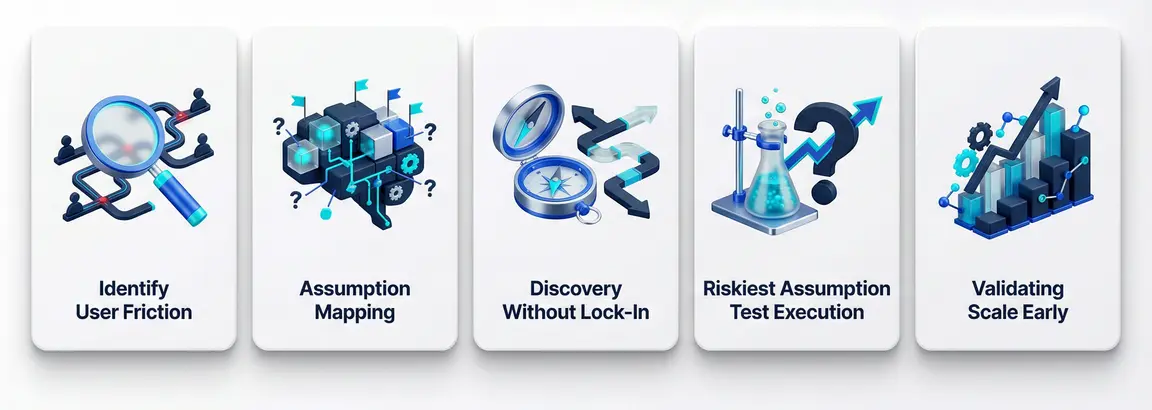
Discovery is the “De-risking” phase of your investment. By following the double diamond design process, you can ensure that your engineering resources are focused on high-leverage problems before the product code development starts.
Identify User Friction
Instead of accepting a “clear brief” at face value, your organisation should focus on uncovering where assumptions about users may be wrong. You must utilise the Jobs-to-be-Done (JTBD) framework to move beyond feature requests and focus on unmet needs.
You must ensure that your team is not building a solution for problems that don’t matter. This way, you address the root cause of why 60% of shipped mobile app features deliver zero business value.
Assumption Mapping
Once the problem space is clearly defined, your organisation must shift from exploration to prioritisation by tackling Marty Cagan’s four big risks through structured assumption mapping. You must filter every concept based on the following 4 critical lenses:
- Value: Will the customer actually choose or buy this product?
- Usability: Can the user navigate the solution intuitively?
- Feasibility: Do we have the tech stack, data, and talent to build it?
- Business Viability: Does this align with our legal, financial, and ethical standards?
Ensuring these critical factors are validated early allows your organisation to focus on discovery efforts, thus protecting both capital and long-term ROI.
Discovery Without Lock-In
The biggest killer of ROI is “Premature Convergence”, that is, locking into an architecture before the solution is validated. This leads to massive technical debt and high total cost of ownership (TCO). During this phase, your organisation need to explore these two solutions and choose between one of these:
- AI-augmented Discovery: This solution path uses synthetic users or AI-generated users that can simulate real user interactions and stress-test the product logic at 10x speed.
- Low-fi vs. High-fi Prototyping: This solution path, if taken, helps you validate workflows and user behaviour through interactive mockups, without the backend investment.
Exploring these solution paths before committing to delivery reduces the rework efforts and ensures that your organisation commits with evidence, rather than assumptions.
Riskiest Assumption Test (RAT) Execution
In high-velocity environments, even building a traditional Minimum Viable Product (MVP) is too expensive or too slow a process for an initial test. Instead, you must run a Riskiest Assumption Test (RAT) as these are low-cost experiments designed to answer the one critical question that could break the project.
By testing only what matters most, you can gather the data required to choose between a pivot or a persevere decision before committing capital or engineering effort.
Validating Scale Early
The final step is translating validated ideas into an executable engineering reality. Through this step, service blueprinting maps the end-to-end journey, including the backend process and third-party integrations.
This step ensures that the transition from discovery to the delivery phase is seamless and that the product’s app architecture is sustainable and ethical. It prevents late-stage surprises and ensures that what works for users can also be sustained by the business.
How Product Discovery Creates Business Value
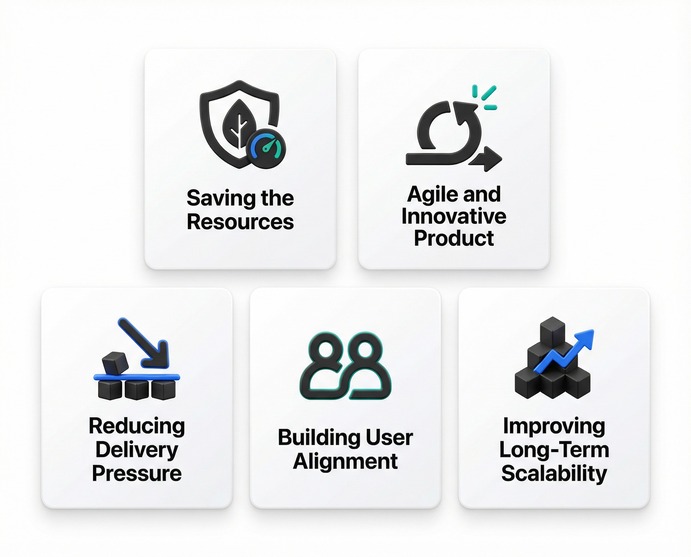
Product discovery brings several benefits to modern product development and acts as a de-risking layer for your overall product development. This is why modern product development services increasingly prioritise discovery-led approaches to validate ideas before committing engineering effort and capital. Here are the main benefits you gain from performing product discovery:
Saving the Resources
In product development, time and money are the most important resources for entrepreneurs. If you imagine designing and researching the product without the product discovery process, teams often end up spending excessive time and capital fixing the wrong problems later. With product discovery, your organisation gains early clarity directly from users, helping reduce user friction and thus improving capital efficiency and long-term cost control.
Agile and Innovative Product
Steps such as collecting problems, analysing them, and validating assumptions before delivery help you build products that are both innovative and adaptable. Product discovery ensures your team focuses on outcomes over outputs, allowing agility without chaos. This phase sharpens the idea before execution begins.
Reducing Delivery Pressure
If you have performed the product discovery phase, then you are reducing dependency on any mobile software development company by eliminating the cost of your software product discovery phase, which you take as a service from them. The final delivery of the Product takes less time to come up live.
Building Early User Alignment
Since the software product discovery process involves communication with users on a regular basis, your organisation builds early alignment and trust even before development begins. Even before your Product goes into the development stage, users in the market get awareness about your Product. And it can also act as publicity for your upcoming Product.
Improving Long-Term Scalability
By validating assumptions early and addressing user friction before delivery begins, software product discovery helps your organisation avoid costly rework, architectural churn, and technical debt. This ensures that as your product scales, it does so on a stable foundation, thus improving long-term ROI and enabling sustainable growth without recurring delivery inefficiencies.
Best Practices for Product Discovery
The software product discovery process is not as easy as you might think. There can be numerous challenges attached to the process. However, the best practices below can help you overcome most of the possible challenges while de-risking the investment and maintaining strategic focus.
Embrace Early Failure
You might have to revamp your idea multiple times. Otherwise, your custom MVP development will not address user problems efficiently or solve a real-life problem. So, do not be afraid of failing. Stay attached to your original idea and keep room for revamping your Product. The more failures you face, the closer you get to bringing a perfect product. Each iteration helps you move closer to the right pivot vs. persevere decision.
Don’t Rush Validation
Do not rush the product discovery process. A new problem or the inclusion of a new feature will take more time. And, if you do not give yourself proper time, you might lose in the upcoming phases of the product development process. Do not start the development process until and unless you are 100% sure about what you will build and what it will bring to the users.
Let Users Guide Decisions
Do not treat your users just as ordinary people. Your users are the key to making your product better and driving long-term growth. Focus on every detail of the data you collect from the users. Analyse user behaviour and user friction through frameworks like Jobs-to-be-Done (JTBD), thus strengthening evidence-based development and reducing adoption risk.
Evidence Over Assumptions
In the end, the goal of software product discovery is to reach the validation of your idea. Validate every detail you gain from users. Also, explore more ways to validate your idea. Create more assumptions and hypotheses and validate them with real-time research. Do not bring changes to your idea due to user suggestions or feedback. Validate inputs before incorporating them into the roadmap to ensure outcomes over outputs and protect ROI.
Continuous Discovery Matters
Even after your product goes live, software product discovery should not stop. There is always room to refine and improve products through new features and functionality. Continuous discovery helps prevent roadmap decay, supports scalability, and ensures your product evolves alongside changing user expectations and operational realities, uncovered through practices like service blueprinting.
Proven Techniques for Product Discovery
Now that we have introduced product discovery in detail, it is time to explore some effective techniques for software product discovery that support evidence-based development and help your organisation reduce discovery risk. Look at the most crucial techniques for software product discovery:
Customer Interviews
There can be nothing better than interviews for efficient product discovery. You must start by preparing a list of questions you want to ask your customers. Interview your customers with a fresh mind so that you can grasp their feedback in a raw format.
When you gain knowledge that is structured correctly, customer interviews help uncover user friction, validate assumptions, and support frameworks such as Jobs-to-be-Done (JTBD) by revealing what users are truly trying to achieve, not just what features they request.
Product Analytics
When we refer to Analytics, we always assume it is something that is performed after product development. However, it is a highly effective technique during software product discovery, especially when combined with AI in product development to achieve insights faster.
For example, you can analyse early signals from an MVP, prototype, or even a landing page experiment before releasing the final product. These insights help your organisation validate assumptions, test outcomes over outputs, and guide pivot vs. persevere decisions before delivery costs or engineering efforts increase.
Implementing the 5 Whys Technique
As the name suggests, the 5 Whys technique is a powerful method for identifying the root cause of a problem during the software product discovery phase. It is especially useful when combined with assumption mapping and Riskiest Assumption Tests (RATs).
For instance, if your organisation wants to understand why users are uninstalling an app, you can apply the 5 Whys as follows:
- Why are customers uninstalling our app?
- Why is our app not delivering the optimum experience?
- Why is our location feature not working?
- Why is our location feature not showing concise and accurate locations?
- Why is our app failing to estimate the street address?
Through this process, you may conclude that the core issue lies in inaccurate location estimation. Identifying such root causes early prevents your organisation from fixing surface-level symptoms and instead enables targeted improvements that reduce user friction and long-term rework.
Why These Techniques Matter:
When applied together, these techniques help your organisation validate assumptions early and reduce uncertainty. It also ensures that discovery efforts directly contribute to better product decisions, before delivery locks in cost, complexity, and technical debt.
Wrapping Up
Product discovery is no longer a preliminary phase or a design-led exercise. But it is a strategic investment discipline. In an era where software execution is fast and inexpensive, the real differentiator is not how quickly you build, but how confidently you decide what to build. Organisations that treat discovery as a risk-mitigation system are better positioned to control costs, scale sustainably, and adapt as markets evolve.
At RipenApps, a trusted product development company, we turn your product discovery into a measurable business advantage, not a theoretical exercise. By embedding discovery into your product lifecycle, RipenApps helps you reduce rework, control long-term costs, and move into delivery with confidence. Our discovery-led approach ensures that your engineering effort is invested only where it creates real, sustainable value.
FAQs
Q1 What is product discovery?
Product discovery is the process of identifying real user problems, validating assumptions, and determining whether a product idea is worth building before significant delivery costs are incurred. Its purpose is to reduce risk and improve decision quality.
Q2 Why is product discovery important?
Product discovery is important because it prevents organisations from investing in products that fail to achieve market adoption. By validating value, usability, feasibility, and business viability early, discovery protects capital and reduces long-term technical and operational debt.
Q3 What are the stages involved in the product discovery phase?
The product discovery phase typically includes identifying user problems and friction, prioritising assumptions, exploring solution options, and testing the riskiest assumptions before moving into delivery. The outcome is a clear pivot or persevere decision.
Q4 What are the principles to follow during the product discovery phase?
Key principles include embracing early failure, allowing adequate time for validation, treating user insights as evidence, validating every assumption, and maintaining continuous discovery even after launch.
Q5 What techniques should be used in the product discovery process?
Common techniques include customer interviews, product analytics, assumption mapping, Jobs-to-be-Done analysis, the 5 Whys technique, low-fidelity and high-fidelity prototyping, and Riskiest Assumption Tests (RATs). These techniques help organisations validate decisions before scaling delivery.

SHARE
WRITTEN BY

Ishan Gupta
CEO & Founder
Ishan Gupta is a seasoned entrepreneur and CEO with extensive 8+ years of experience in business and mobile app development landscape. He believes that the right digital product allows companies to focus on what they do best, while technology handles the rest. With deep exposure to global markets, he understands what makes an app succeed. His approach translates business needs into clear product strategies, ensuring that every feature contributes to measurable ROI.
View All Articles