
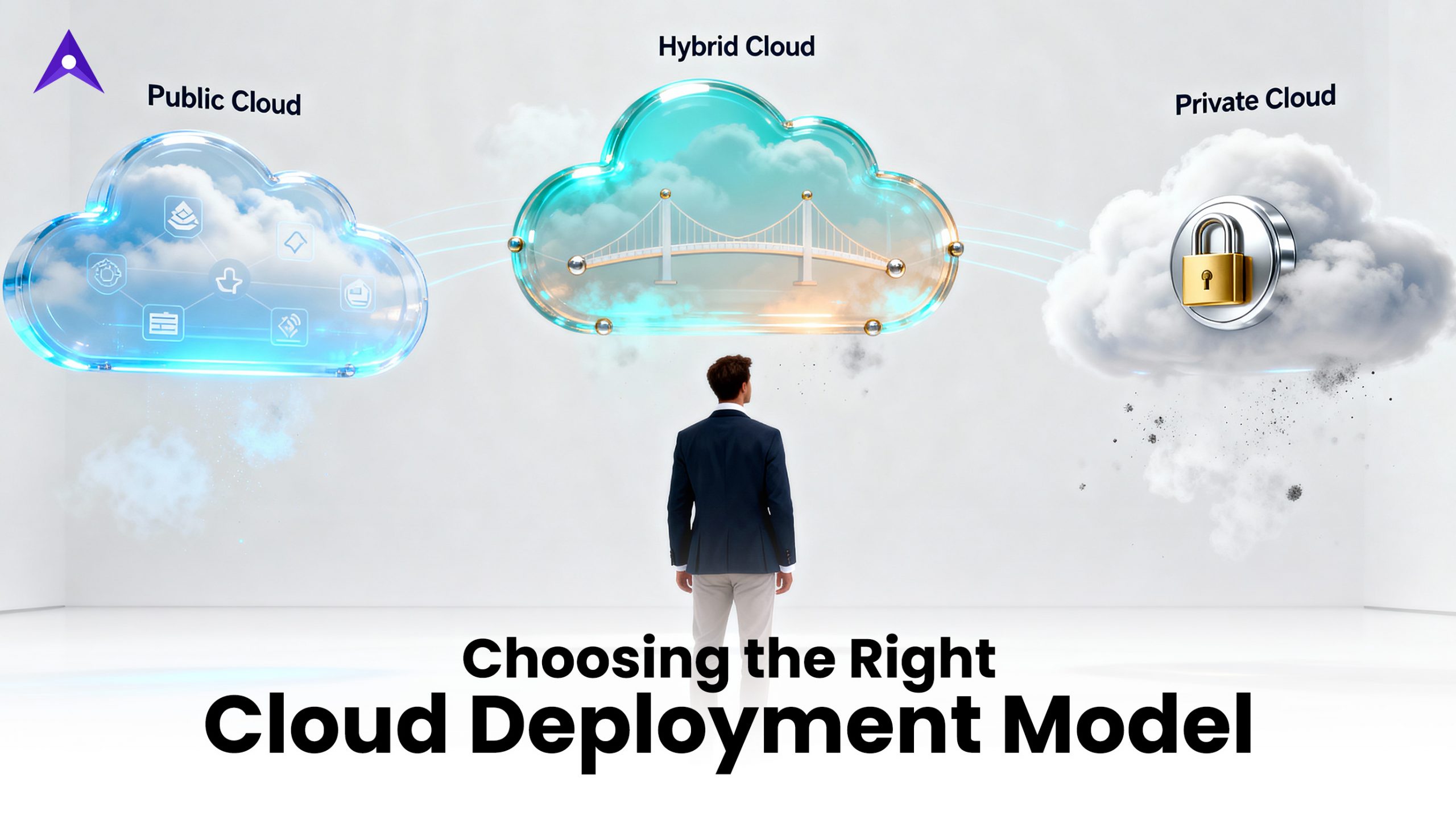

In today’s tech-driven era, cloud computing is the foundation of modern business. Nearly 94% of enterprises already use some form of cloud service. The reasons are clear: scalability, cost efficiency, and speed of innovation. But the challenge? Choosing the right type of cloud Model.
Every business today faces the same dilemma: should you stay flexible with public cloud, protect your data in a private cloud, balance both through a hybrid approach, or adopt a multi-cloud strategy? Your choice will define how you scale, innovate, and secure your future digital ecosystem.
This blog breaks down each cloud model and explains when to use it, what business benefits it brings, and how emerging trends like AI, hybrid architectures, and cloud-native security are reshaping enterprise decisions. If you are an entrepreneur or a startup owner, this guide will give you some useful insights, so stay tuned till the end :
Table of Contents
Understanding the Four Major Cloud Deployment Models
1. Public Cloud: Pay for What You Use
Public cloud is the most popular option; platforms like AWS, Azure, and Google Cloud dominate this space. In a public setup, computing resources are owned by third-party providers and shared across multiple tenants.
- Why businesses choose it: It’s cost-effective, scalable, and ideal for startups and SMEs looking to deploy quickly without heavy infrastructure investment.
- When it works best: For app development, testing, or any workload that doesn’t handle confidential data.
- Example: A fintech startup using AWS to run backend services for its MVP, scaling automatically during traffic spikes.
2. Private Cloud Model: Total Control, High Responsibility
A private cloud is a dedicated infrastructure used by a single organization. It can be on-premise or hosted by a third-party provider.
- Why businesses choose it: It offers maximum control, compliance, and customization. Thus, making it ideal for industries like healthcare or finance. Companies investing in custom mobile app development often prefer private cloud setups to ensure data privacy, secure integrations, and complete governance over their digital ecosystems.
- When it works best: For businesses dealing with sensitive customer data or requiring strict security and governance.
- Example: A financial institution storing confidential transaction data in a private cloud to meet PCI-DSS compliance standards.
3. Hybrid Cloud Model: The Best of Both Worlds
Now, the question arises: What is hybrid cloud? Hybrid cloud computing merges public and private environments, allowing data and applications to flow between them. It combines public scalability with private security.
- Why businesses choose it: One of the major reasons is flexibility. You can keep sensitive workloads on private infrastructure while using public resources for less critical operations.
- When it works best: When regulatory compliance and scalability both matter.
- Example: A healthcare app developed through cross platform mobile application development can store patient data securely in a private cloud, while using the public cloud for analytics and non-sensitive workloads. Thus, cloud computing in healthcare ensures data security, faster performance, and seamless accessibility across devices and platforms.
4. Multi-Cloud Model: A Cloud for Every Purpose
Multi-cloud means using multiple public clouds, like AWS for compute, Azure Cloud for AI, and Google Cloud for data analytics. This approach helps businesses avoid vendor lock-in and use the best tools from each provider.
- Why businesses choose it: Freedom, resilience, and performance optimization.
- When it works best: For global businesses running diverse workloads needing regional and functional flexibility.
- Example: A global eCommerce company hosts its frontend on AWS and customer analytics on Google Cloud to balance performance and cost. By integrating a reliable cloud storage service, the business ensures seamless data synchronization, secure backups, and faster access to customer insights across both platforms.
Read Also: Cloud Computing In E-commerce: Benefits, Use Cases, and Challenges
Comparing Cloud Deployment Models
| Criteria | Public Cloud | Private Cloud | Hybrid Cloud | Multi-Cloud |
| Cost | Low upfront, pay-as-you-go | High setup, long-term savings | Moderate | Variable depending on the mix |
| Scalability | High | Moderate | High | Very high |
| Security | Shared responsibility | Full control | Balanced | Depends on setup |
| Customization | Limited | High | High | High |
| Management | Easy | Complex | Moderate | Complex |
| Use Case | Startups, dev/test apps | Regulated industries | Enterprises with mixed workloads | Global companies with multi-region needs |
Each model serves a specific business maturity stage and operational goal. The challenge isn’t which is best but which fits your current needs and scales effectively as you grow. However, working with an experienced app development company can help you align your cloud strategy with app performance, user experience, and long-term business goals.
Hybrid Cloud vs Multi-Cloud — What’s the Real Difference?
Though often used interchangeably, they solve different business challenges.
- Hybrid cloud tech mixes public and private environments. It’s about data distribution between secure and scalable systems.
- Multi-cloud uses multiple public providers to optimize performance, redundancy, and vendor flexibility.
Businesses leveraging cloud computing in e-commerce can benefit from both models—hybrid for secure customer data management and multi-cloud for faster, globally distributed storefronts and analytics.
Key differences:
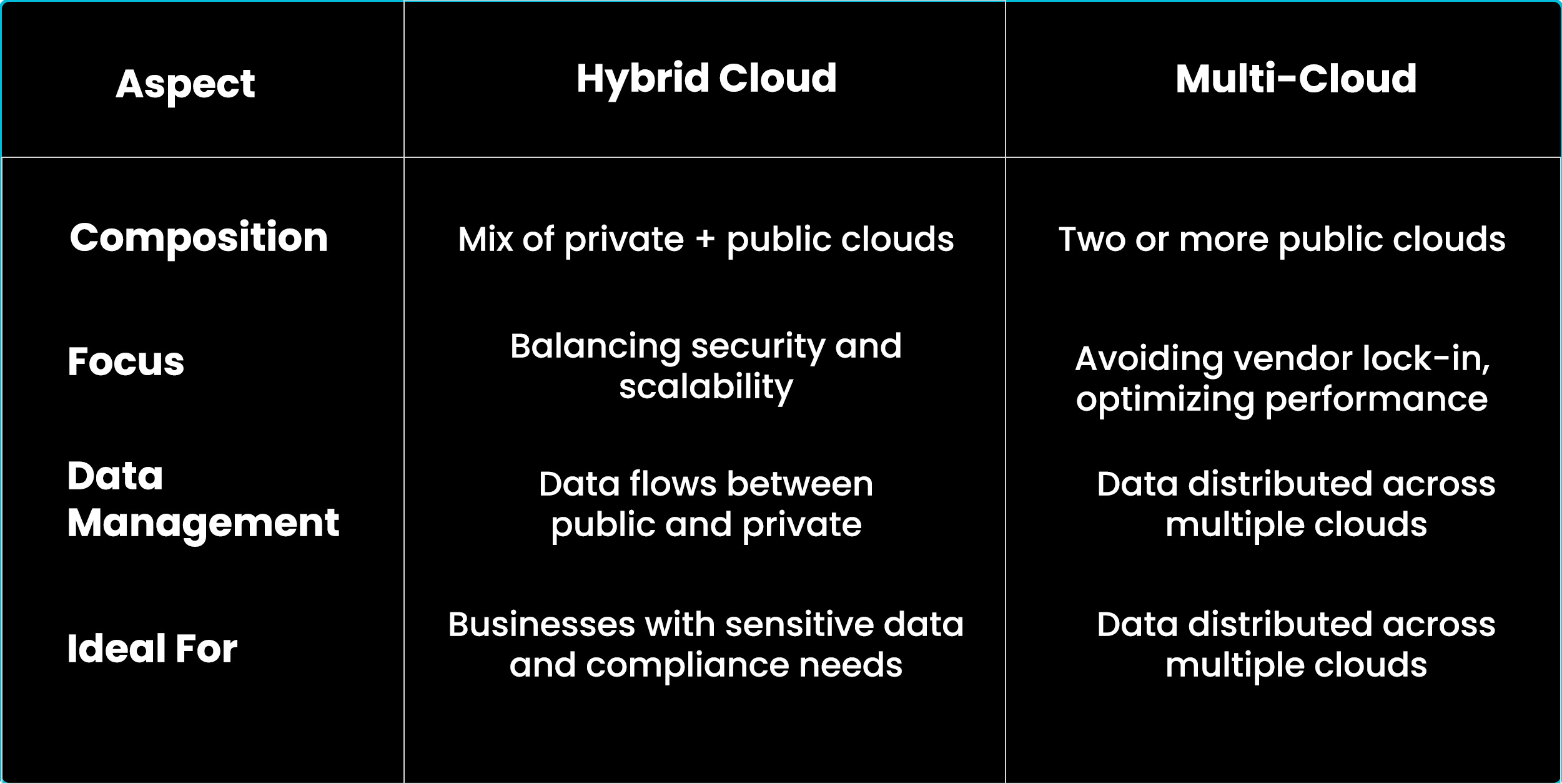
A hybrid model is often the bridge to a multi-cloud setup as businesses mature and diversify workloads. Companies leveraging professional MVP development services can use this model to test, deploy, and refine new digital products faster across multiple environments. It allows teams to validate performance, security, and scalability before moving to full-scale cloud deployment, ensuring smarter innovation with lower risk.
Factors to Consider Before Choosing Your Cloud Model
Every business has a unique cloud journey. Before choosing, evaluate these core factors:
1. Data Sensitivity & Compliance
If your app handles medical, financial, or personal data, you need strong governance and regional compliance. Private or hybrid models usually fit better for such needs.
2. Budget & Cost Flexibility
Startups or small businesses should start lean. Public cloud’s pay-as-you-go model avoids heavy CapEx. As you grow, hybrid or private clouds may make more economic sense long-term. Availing expert cloud app development services ensures you choose and manage the right mix of environments for maximum ROI and performance efficiency.
3. Workload Performance
High-performance computing, analytics, or AI workloads might benefit from multi-cloud setups, where specific providers offer specialized capabilities.
4. Scalability Demands
If you expect unpredictable traffic spikes, public or hybrid clouds deliver on-demand scalability without infrastructure limits.
5. IT Expertise
Private and hybrid environments require skilled cloud engineers. If your team lacks deep technical resources, a top-notch hybrid app development company can bridge the gap.
6. Vendor Lock-in Risks
Relying solely on one provider may limit flexibility and scalability over time. Cross-platform architectures or multi-cloud setups help reduce these risks. Moreover, when you hire mobile app developers with cloud expertise, they can design architectures that remain portable, ensuring your applications adapt easily across providers without disruption.
How Your Business Stage Influences the Cloud Model Choice
Choosing a cloud model isn’t a one-size-fits-all decision. Your business’s stage—whether you’re running a startup, scaling mid-market, or managing a large enterprise—dramatically affects which model delivers the most value. If you plan to develop a cloud storage app like Dropbox, your choice of cloud model will also impact scalability, data management, and user experience from the very first launch.
- If you’re a startup launching your first product, your priority is speed, cost-flexibility, and minimal infrastructure burden. A public cloud environment allows you to focus on cloud based application development rather than hardware.
- If you’re a mid-market company with legacy systems, you likely care about modernising while protecting assets and data. A hybrid approach gives you the ability to migrate selectively using cloud application migration services, letting you preserve older investments while innovating.
- If your enterprise operates globally with specialized workloads, regional compliance needs, and high availability demands, a multi-cloud or large-scale hybrid model is a smarter choice. You should focus not only on which cloud to use but also on how different clouds will work together and be managed efficiently.
Recognising your business stage and requirements helps you adopt the model that aligns with your immediate priorities and sets a roadmap for evolving.
Read Also: How Is Cloud Computing Technology Powering Up The Sports Industry?
Comparing Workloads: Which Model Fits Where
| Workload Type | Ideal Cloud Model | Why |
| MVP Launch | Public Cloud | Quick deployment and low cost |
| Customer Data Storage | Private Cloud | Maximum control and compliance |
| Marketing Campaigns | Hybrid Cloud | Use public for analytics, private for sensitive data |
| Global AI Processing | Multi-Cloud | Access diverse compute and regional strengths |
Governance, Talent & Process Challenges Behind the Scenes
Selecting the cloud model is only half the story. Real-world success depends on your ability to govern, operate, and scale the environment. Many startups and enterprises overlook these “people and process” factors.
- Talent and skills: Managing a multi-cloud setup demands staff who understand orchestration, cost monitoring, federation, and security across multiple vendors. Therefore, it’s recommended to work with top cloud app development companies that have years of expertise & knowledge.
- Governance frameworks: As you transition into hybrid or multi-cloud, you need clear policies around data placement, cloud endpoint security, identity management, and workload taxonomy. This can be considered a resource allocation challenge in hybrid cloud setups.
- Cost accountability: In a public or multi-cloud setup, uncontrolled sprawl can drive unexpected bills. Establish FinOps practices early: label workloads, track spend by business unit, optimise usage. If you are a non-tech founder, it’s better to avail professional It consulting services to get a complete roadmap.
- Integration and latency: Hybrid and multi-cloud models introduce latency and integration risk when data moves between clouds or between private and public. As noted, hybrid clouds face complexity in integration and governance.
- Security posture: You’ll need zero-trust, cross-cloud identity, and consistent logging to protect your infrastructure. Without these, your hybrid or multi-cloud setup can become a security liability rather than an advantage. Following cloud application security best practices ensures your environment remains secure, compliant, and resilient against potential threats.
This means when you pick a model, you should simultaneously build the operating model and talent strategy.
Edge, AI, and the Cloud Strategy of Tomorrow
Your cloud choice isn’t permanent. New technologies and cloud computing trends are constantly reshaping how businesses use and combine cloud environments.
Edge Computing
With connected devices growing fast, speed and low latency are now essential. Companies are moving computation closer to users and syncing it to the cloud. This makes hybrid and edge-based setups more common.
AI and ML Workloads
AI needs massive computing power and specialized hardware. Multi-cloud lets businesses choose the best providers for specific AI needs without being locked to one platform.
Cloud-Native Applications
Modern apps built on microservices, containers, and serverless technology need environments that support rapid deployment and easy scaling. This is where opting for cloud application development services plays a key role—helping businesses design, build, and manage applications that perform seamlessly across public or hybrid cloud environments for maximum agility and uptime.
Data Sovereignty and Compliance
Stricter global regulations now require businesses to store and process data within specific regions. Many organizations are turning to multi-cloud strategies to meet these local compliance standards effectively. Partnering with an experienced IT consulting company helps businesses design compliant, secure, and scalable cloud architectures tailored to evolving regulatory demands.
Your cloud strategy should serve current workloads—but also stay ready for the future of connected, intelligent, and compliant digital ecosystems.
Wrapping Up
Choosing between public, private, hybrid, or multi-cloud isn’t about picking the most popular option, but it’s about selecting what aligns with your business goals, security priorities, and growth plans. Each model serves a unique purpose: public cloud drives agility, private cloud strengthens control, hybrid cloud blends both, and multi-cloud empowers flexibility at scale. For startups, scalability and cost matter most. For enterprises, compliance, performance, and global reach take center stage. The smartest move is to build a cloud roadmap that evolves with your business with starting simple and growing strategically.
At RipenApps, we help businesses assess, plan, and deploy the right cloud model that maximizes ROI and accelerates innovation. Whether you aim to modernize your infrastructure, migrate your apps, or go hybrid at scale, our cloud experts ensure your digital foundation stays future-ready.
Your business goals are unique. Your cloud strategy should be, too. So, let’s build the one that fits—securely, efficiently, and intelligently.

FAQ
1. How does cloud model choice affect application development?
Your cloud model impacts speed, flexibility, and cost of app development. Public cloud enables rapid cloud app development and testing, while hybrid or multi-cloud setups support cloud-native application development with better control over sensitive data and compliance.
2. Which cloud model is best for startups?
Startups often benefit from public cloud due to its low upfront costs, easy scalability, and fast deployment. It allows rapid app development and testing without investing in hardware. As the business grows, moving to hybrid setups can help manage sensitive data while maintaining scalability.
3. When should an enterprise consider hybrid cloud?
Hybrid cloud is ideal for enterprises balancing data security, compliance, and scalability. Sensitive workloads can run on private infrastructure while less critical operations use public cloud resources. This approach enables cost optimization and faster innovation without compromising control.
4. How does multi-cloud help global businesses?
Multi-cloud allows businesses to leverage the strengths of different cloud providers across regions, improving performance, redundancy, and disaster recovery. It also helps avoid vendor lock-in and ensures compliance with regional regulations while distributing workloads efficiently.
5. Can hybrid and multi-cloud models be used together?
Yes. Many enterprises adopt a hybrid multi-cloud strategy, combining private infrastructure with multiple public cloud providers. This setup allows optimal workload placement, compliance, performance, and disaster recovery while maintaining centralized governance.
SHARE
WRITTEN BY

Ishan Gupta
CEO & Founder
Ishan Gupta is a seasoned entrepreneur and CEO with extensive 8+ years of experience in business and mobile app development landscape. He believes that the right digital product allows companies to focus on what they do best, while technology handles the rest. With deep exposure to global markets, he understands what makes an app succeed. His approach translates business needs into clear product strategies, ensuring that every feature contributes to measurable ROI.
View All Articles