

Did you know that over 85% of US enterprises already use mobile apps to streamline operations, engage customers, and drive growth? Yet, many organizations struggle to see measurable results. The gap is in applying the right strategies that connect technology to business outcomes. That’s where enterprise mobile app development becomes a game-changer.
Enterprises in the USA face unique challenges such as fragmented systems, rising customer expectations, compliance pressures, and the constant need to innovate faster than competitors.
However, without a clear mobile strategy, apps can become cost centers instead of profit drivers. Leaders invest heavily in development, only to battle low adoption rates, poor user engagement, and disappointing ROI.
But the reality is, enterprises can’t afford apps that simply ‘exist.’ They need applications that scale across departments, integrate seamlessly with enterprise systems, and deliver measurable value.
This blog explores proven strategies for enterprises in the USA that can transform mobile apps into growth engines and enhance user engagement. After learning about these strategies, you can transform challenges into opportunities and establish a strong foothold in the US market.
Table of Contents
Why Enterprises in the USA Need Mobile App Development?
The US enterprise mobility market is booming, with enterprise mobile app revenue projected to reach $294.40 billion by 2034 (Source: Precedence Research). This surge highlights how enterprise mobile app development has moved from being a tech investment to a mobile engagement strategy for growth, scalability, and customer engagement.
For enterprises, mobile apps are necessary because they are core to solving business challenges like fragmented communication, inefficient workflows, and limited customer touchpoints. A well-executed mobile app development for enterprise approach enables companies to:
- Boost Employee Productivity: Mobile enterprise applications streamline internal processes by connecting employees across departments in real-time. With the right enterprise mobile application platform, enterprises can automate workflows, reduce downtime, and enable teams to work smarter.
- Increase User Engagement & Retention: Poor retention is one of the biggest threats to enterprise mobile applications. Without a robust mobile app engagement strategy, businesses struggle to retain users. Through personalization, push notifications, and data-driven app engagement strategies, enterprises can increase active users, increase app retention, improve app engagement, and drive loyalty.
- Enhance Customer Experience: Customers expect speed, convenience, and personalization. By leveraging enterprise mobile apps development and mobile enterprise application platforms, enterprises can deliver experiences that increase mobile app user engagement while directly impacting revenue growth.
- Gain Competitive Edge: With US markets growing rapidly, companies that invest in enterprise mobile application development services position themselves as customer-first, data-driven, and innovation-ready.
Partnering with an experienced enterprise mobile app development company ensures your business not only builds scalable mobile enterprise applications but also implements strategies to increase mobile app engagement and optimize ROI.
Proven Strategies To Maximize User Engagement In Enterprise Mobile App Development
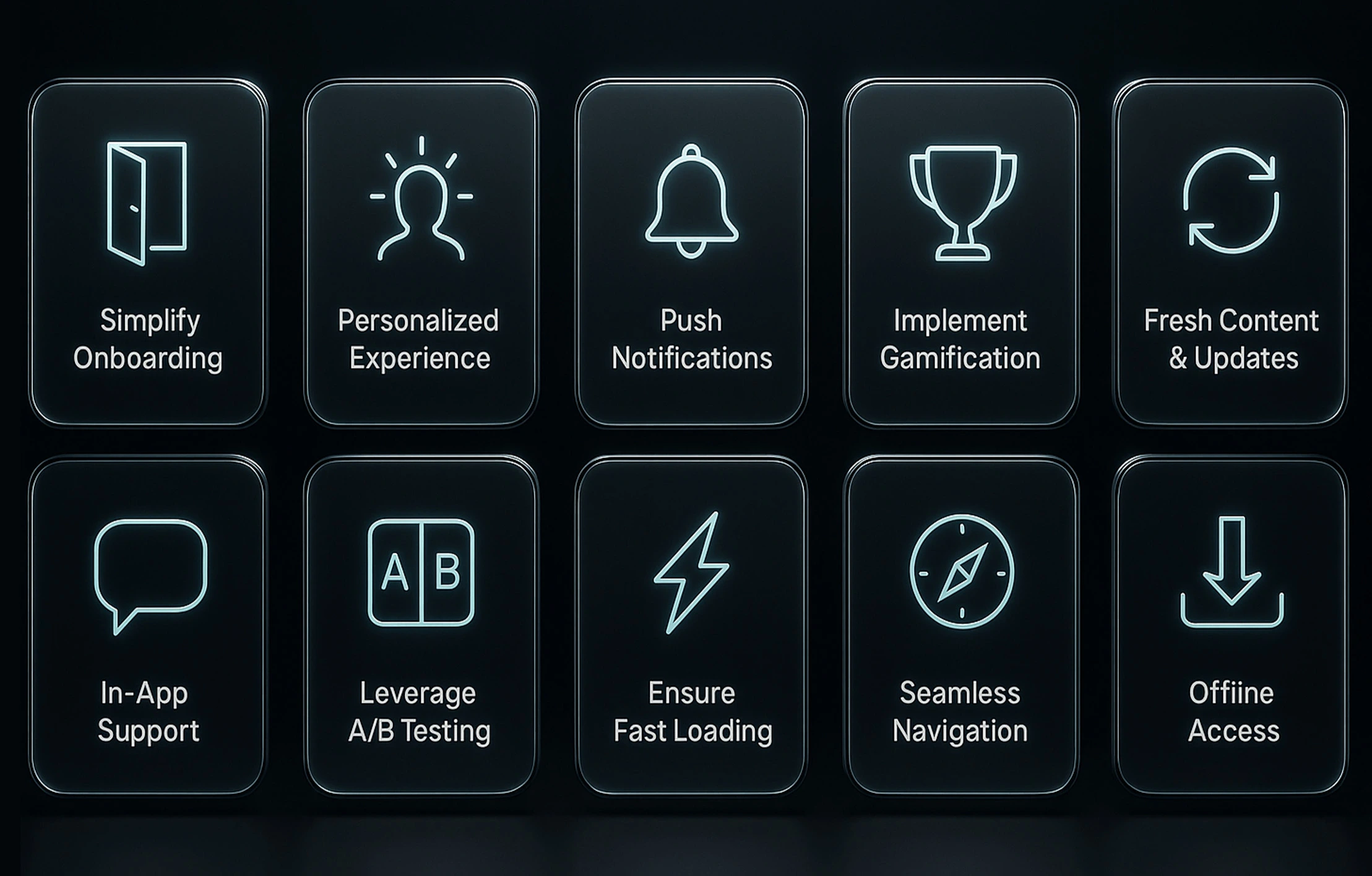
Unlock maximum user engagement for your enterprise mobile application with strategies like personalized user experiences, intelligent onboarding, multichannel communication, and AI-powered messaging. Combining timely push notifications, tailored in-app journeys, and interactive incentives ensures customers stay connected, satisfied, and loyal to your mobile enterprise app and brand. These strategies are:
1. Simplify Onboarding
App onboarding is users’ first experience when they start using your enterprise mobile app platform. You need to simplify this process to make it easy and quick for users to understand how the app works, so they can start using it without confusion.
To simplify your onboarding, you need to include clear signs and buttons. Some key considerations for app onboarding are:
- Keep It Simple: Avoid lengthy tutorials and including too much information.
- Highlight Benefits: Clearly mention the app’s benefits and how it can solve user problems.
- Make It Interactive: Allow users to interact with the app during onboarding through tutorials, tailored questions, or goal-setting exercises.
2. Personalize User Experience
Personalizing user experiences is like making the app completely personal for every user according to individual user preferences and behaviors. According to the report of Contentful, 69% of customers appreciate personalization.
When you go to your neighborhood store to buy something, the seller shows you items that suit your taste to make your shopping experience pleasant. Take Spotify, for example, the app successfully increases app engagement with customized playlists for users.
Hence, you need to invest in reliable mobile app development services to make the application personalized for the users. This decision can make your app popular among users, increasing your audience reach.
3. Push Notifications
Push notifications are messages sent directly to users’ mobile devices to aware them about updates, reminders, or promotions.
Using them cautiously means sending timely and relevant notifications to users, ensuring they provide value to the users instead of annoying them.
Tailored push notifications can increase response rates by 400% compared to a generic one. It’s important to make push notifications friendly for the users.
A well-timed push notification can remind users about something important, but constant nudges become annoying for them. And using push notifications can also increase app development costs.
4. Implement Gamification
Including the fun element during the mobile enterprise application development process makes the application more engaging and exciting. That’s when you need app gamification strategies because they make your app more enjoyable for the users, increasing user engagement and ROI. With gamification, you can include:
- Rewards and Badges: Award users with points, badges, or virtual rewards for completing tasks.
- Challenges and Competitions: Encouraging friendly competition among users can make them return quite often.
- Progress Tracking: Allowing users to track their progress and achievements motivates them to interact more with the app.
If you are wondering how to increase active users in your enterprise mobile app, then you should include these features to make the app enjoyable for the users.
5. Fresh Content and Regular Updates
No one likes an app that doesn’t keep up with the times. During enterprise mobile app development, you need to focus on keeping up with the trends to maintain relevancy among users.
Consistently adding new features, content, or improvements according to user feedback makes the app engaging and relevant. When user finds something that they need, they feel valued and stay loyal to those enterprise mobile apps.
For example, Snapchat keeps adding new features to its app, which has made the application even more popular among its target audience and increased its user engagement. That’s why many businesses have shifted towards building social media apps like snapchat.
6. Offer In-App Support
Every user requires support while using the application, as it’s impossible to train them to know everything about it, and complaints are bound to arise.
It makes in-app support critical to provide real-time support and updates directly within the app. Features like in-app support increase app engagement by offering immediate assistance and keeping them informed.
More than 51% of individuals prefer using chatbots over human agents for immediate assistance. So, you need to partner with a chatbot development company to integrate a chatbot during enterprise mobile app development.
Airbnb integrated in-app support to bridge the communication gap between hosts and guests. After including AI-powered chatbots, they saw a significant spike in their app engagement metrics.
7. Leverage A/B Testing
A/B testing is a process of creating two versions of an app element to see which performs better. Following this step right after enterprise mobile app development allows enterprises to identify what resonates most with users.
It is also one of the best ways for MVP testing for a successful app launch. In the past, A/B testing has happened on the streets, where retailers used to try different combinations of clothes to see which ones were getting more walk-ins. Doing this can help you engage viewers, increase app engagement, and leave the competitors behind.
8. Ensure Fast Loading
Imagine using an app that takes over a minute to open; you’d probably uninstall it right away. That’s why it’s crucial to optimize an app’s performance to reduce load times, as slow apps increase frustration and lead to abandonment.
You need to partner with an experienced enterprise mobile app development agency that can seamlessly do efficient coding, asset optimization, and regular performance testing to provide best-in-class enterprise mobile app development.
For example, Facebook Lite is a beta version of the Facebook app, designed for Android users with older phones. It takes limited data and works on a poor internet connection, providing a seamless user experience.
Read Also : Future of Mobile App Development in USA
9. Make Navigation Seamless
Designing an intuitive interface enables users to locate desired features or information seamlessly, improving the overall experience.
Having clear menus, logical layouts, and consistent design elements makes the app simple, reducing frustration and increasing user satisfaction.
When you have simple navigation, you can easily increase user engagement and ROI because users will keep using the application.
Google Maps is a prime example of simplified navigation because it offers a clean interface with intuitive controls.
10. Provide Offline Access
Providing offline access allows users to interact with an app’s core features without an internet connection. This feature increases usability, especially for users in areas with poor connectivity, increasing the user engagement metrics for apps. You can hire app developers with years of experience to include offline compatibility in your enterprise.
Spotify allows its premium users to stream songs and podcasts without using the internet, enhancing user satisfaction. Like this, they make the users feel valued and help them leave the competition behind.
Proven Strategies to Boost ROI in Enterprise Mobile App Development
Now that you know about proven strategies to maximize user engagement, it’s time to explore the strategies to maximize ROI. Partnering with an experienced enterprise mobile application development company ensures your app is designed to drive measurable business results. Here’s how enterprises can boost returns:
1. Cloud & Scalability
Enterprises operate at scale, and apps must evolve as user demand grows. Having a mobile enterprise application platform ensures your solution scales seamlessly across devices and regions. This scalability reduces downtime, increases productivity, and extends app lifecycle value. Looking at the cloud application development guide will help you find out the benefits of choosing this technology for your enterprise.
2. Integration With Existing Systems
True ROI comes when apps connect seamlessly with ERP, CRM, and APIs. An app development enterprise team can unify operations across systems with enterprise application integration, eliminating data silos. It enhances application engagement by providing employees and customers with a unified experience, reducing operational costs, and improving efficiency.
3. Advanced Analytics & App Engagement Strategy
ROI depends on retaining users. With the right app engagement strategy, businesses can track user engagement metrics for their apps and design campaigns to increase app usage and engagement.
Features like personalized recommendations, real-time notifications, and AI-driven insights help the enterprise understand how to increase active users and how to increase user engagement on the app effectively.
4. Security and Compliance
Without trust, there’s no ROI and user engagement. You need to invest in advanced-level enterprise mobile application security to protect sensitive customer data and business data.
By working with skilled enterprise mobile app developers, you can enforce encryption, role-based access, and compliance frameworks, ensuring apps meet regulatory standards in finance, healthcare, and other high-risk industries.
If you have a fintech enterprise, then you need to partner with one of the leading fintech app development companies to include best-in-class security in your mobile app. It will build trust among the users and make your app famous.
5. Custom Design & Improvements
Every enterprise has unique workflows. Investing in enterprise custom app design creates tailored experiences that boost satisfaction and efficiency. Doing continuous app improvement, based on analytics and feedback, ensures apps stay relevant and ROI keeps growing. However, you need to partner with a custom app development company to create a tailored design for your enterprise.
Read Also : Enterprise App Development Guide
Case Studies / Examples: How Mobile Apps Drive ROI and Maximum User Engagement
Let’s take a look at the US-based enterprises that transformed their operations and delivered measurable business value with enterprise mobile app development:
McDonald’s
McDonald’s is a prime example of a US enterprise that achieved significant engagement and ROI after launching a mobile app. By integrating a MyMcDonald’s Rewards loyalty program, offering exclusive vouchers, and utilizing features like a restaurant finder with location-based services, McDonald’s saw increased customer use, higher sales, and a positive return on investment for its mobile strategy.

Coca Cola
Coca-Cola already uses advanced technologies like artificial intelligence and machine learning to analyze data and understand consumer behavior. In 2018, they began their digital transformation to satisfy customer needs.
The launch of a mobile app for Android was part of their digital transformation campaign, and it allowed customers to redeem loyalty points and discounts on their drinks. After launching their app, Coca-Cola maximized user engagement and achieved better ROI. The company’s second-quarter revenue reached $10.13 billion.
Nike
Nike is a well-known sportswear brand that has become a global name by offering a complete health and fitness experience. The sports brand launched its fitness app in 2010 for iOS and in 2012 for Android, to offer guided workouts and increase the purchase of brand merchandise.
It was among the top future-ready fitness app ideas because the app has been doing great till now. After launching their app, Nike’s revenue jumped 96% from the lockdown-impacted quarter. This shows that the company achieved a significant amount of growth after going digital.
Conclusion: Mobile Apps Are The Future of Enterprise Growth
For US enterprises, mobile apps have become essential for growth, efficiency, and customer loyalty. The challenge isn’t building enterprise applications but ensuring they deliver lasting value. With the right enterprise mobile application development company by your side, your enterprise app can help you increase app engagement, user engagement, and maximize ROI. The global demand for mobile enterprise applications will grow in the future, and early movers have all the chances to gain the most. Partnering with RipenApps means you create future-proof solutions backed by innovation, security, and measurable business outcomes.

FAQs
Q1. What is enterprise mobile app development?
Enterprise mobile app development is a process of creating customized software applications to meet the specific needs of businesses. These apps focus on improving operational efficiency, streamlining internal processes, and enhancing communication within organizations.
Q2. How do enterprise apps improve ROI for businesses?
Enterprise mobile apps improve ROI by automating manual tasks, reducing operational costs, and enhancing productivity. By using an expense management app and other tailored solutions, businesses can optimize resource allocation and track expenditures more effectively.
Q3. How much does it cost to develop an enterprise app in the USA?
The cost of enterprise mobile app development in USA varies depending on the app’s complexity, features, and integration requirements. Typically, the development cost is $50,000 to $250,000 or more, depending on the crucial factors.
Q4. How can enterprises boost user engagement through mobile apps?
Enterprises can boost user engagement by implementing proven user engagement strategies such as personalized content, push notifications, gamification, etc. Regular updates, custom design, and responsive customer support will also increase app adoption and retention.
Q5. Can mobile apps improve employee engagement in enterprises too?
Yes, mobile enterprise app development enhances employee engagement by providing easy access to work resources, collaboration tools, and real-time communication platforms. Apps designed for internal use can be beneficial in task management, streamlining workflows, and performance tracking.

SHARE
WRITTEN BY

Vaibhav Sharma
Business Head
Vaibhav Sharma bridges product vision with real-world execution. He shares consultation with startups and enterprises to shape digital strategies, refine user journeys, and create app experiences that feel intuitive from day one. His strength lies in transforming early concepts into clear development roadmaps that set products up for long-term success.
View All Articles