

Cloud migration is a strategic shift to the cloud that promises to make your data workloads or applications secure, faster, and scalable. It has quickly become a top priority for organizations that are accelerating toward digital transformation. Yet, despite its high-impact business benefits like cost-efficiency, flexibility, and security, the cloud migration & data security process remains risk-prone and complex.
In fact, a Gartner Insight Summary explained that many organizations end up overspending on cloud migration services by up to 70% without deriving the expected business value from it. However, these risk and cost-related challenges can be overcome easily when organizations implement a detailed cloud migration roadmap.
This is where leveraging a structured and well-defined cloud migration checklist comes as a game-changer. It guides you in every step, from cloud migration assessment to utilizing a phased cloud migration strategy. It helps you transform your cloud migration journey from a risk-oriented operation to a secure and performance-optimized transition journey.
Whether you are a CTO redefining your migration blueprint or a cloud business leader responsible for evaluating the ROI, this guide will provide you with a comprehensive cloud migration checklist. You will understand the best cloud migration strategies, types, and benefits of cloud migration. So, let’s get started:
Table of Contents
What is a Cloud Migration & Data Security Checklist?
Cloud migration is the process of moving digital assets such as data, applications, or IT resources to the cloud environment. Before deep diving into what a cloud migration & data security checklist really means, let’s look at the definition of a cloud migration strategy.
A cloud migration solution is basically a structured process that combines various practices. It walks organizations through the overall cloud migration journey, which starts from assessing the existing infrastructure to ensuring full compliance in the new cloud environment.
Now, you must be wondering why businesses actually need to migrate to a new environment or a cloud center. The answer to this is that, by leveraging a cloud migration checklist, you can transfer data with the utmost level of data integrity.
A cloud migration checklist is a step-by-step strategic roadmap that helps you achieve a secure cloud data migration strategy, which will ultimately lead to strengthening your business value and ensuring compliance. Furthermore, it helps you execute the migration process at a reasonably managed cost. This means that you no longer have to spend millions on cloud migration projects, especially when you have complex infrastructures.
Key Benefits of Utilizing a Structured Cloud Migration Checklist
Many organizations want to have a cloud environment that is highly adaptable and helps them evolve with the modern business needs. By leveraging a strategic cloud migration & data security checklist, you can have access to the following key advantages, and gain support in enhancing organizations’ growth and agility:
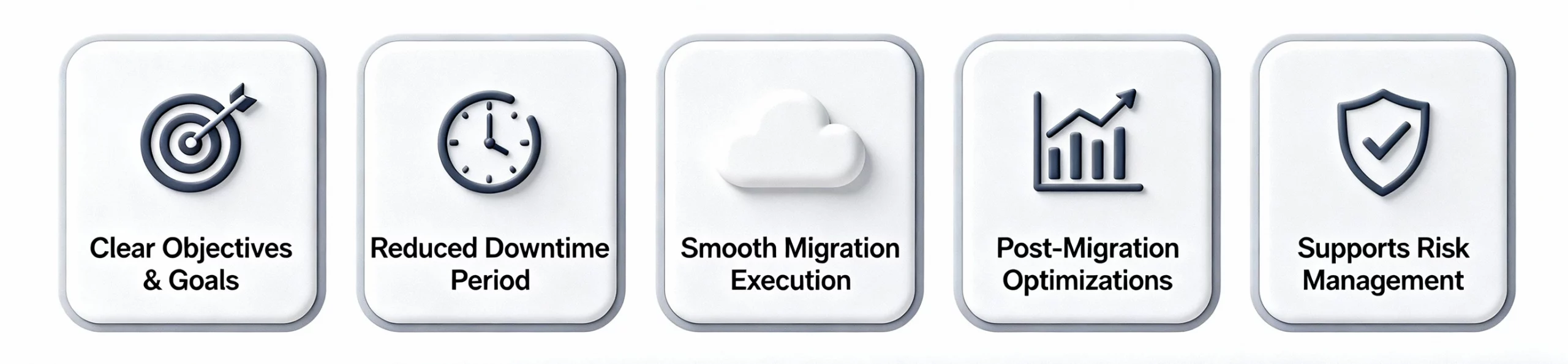
Clear discussions with CTOs and stakeholders
With a structured cloud migration & data security checklist, IT, business heads, and stakeholders can discuss, define various objectives and goals. This ensures full alignment throughout the cloud migration phase, while leveraging cloud migration services.
Minimizes Downtime and Disruptions
A checklist serves as a step-by-step roadmap and helps you by ensuring a smoother transition and identifying if there are any risks, and mitigating them proactively. This helps you to minimize the downtime and disruption time period, ultimately providing a good experience and transition for the end user base.
Smooth Cloud Migration Execution
Without implementing a structured cloud migration checklist, you can face problems such as unplanned downtime, prolonged interruptions, which can cause migration delays and also integration failures.
Post-Migration Optimizations
The right cloud migration checklist doesn’t end at the cloud deployment step. Instead, it includes post-migration optimization strategies such as continuous monitoring, compliance verification, and cost optimization once workloads go live and are transmitted to the new cloud environment.
Provides and Supports Risk Management
Cloud migration process is a crucial process and can be vulnerable to potential risks, like compliance gaps, data loss or corruption, security breaches, etc. However, with a clear cloud migration strategy and ensuring cloud application security, you can detect these risks and mitigate them in the early stages of the cloud transition process.
Types of Cloud Migration: A Detailed Comparison Table
Your chosen cloud migration solution and type should primarily depend on factors such as business needs, technical cloud migration challenges you are facing, and the end goal of this migration. However, to choose one of the types of cloud migration strategies, you should go through the detailed comparison table, which helps you understand your specific needs and business requirements. So, let’s get into this:
| Cloud Migration Type | Brief Overview | Best Use Case | Advantages | Disadvantages |
| Database Migration | This type carefully maps the data and transfers a database from one environment to another | Organizations wanting to upgrade database systems | Optimized performance and improved backups and disaster recovery | Requires structured planning and has downtime risk |
| Application Migration | This type focuses on moving the existing application from one on-prem infrastructure or cloud environment to another | Businesses looking to modernize legacy apps | Improved collaboration and better app scalability | Need to involve the refactoring, cloud migration strategy, and reconfiguration |
| Data Center Migration | This type involves the process of moving an entire on-premises infrastructure to the cloud environment | Large enterprises seeking full cloud adoption | Long-term cost savings and improved centralized management | High initial cost and complex process |
| Hybrid Migration | This is a hybrid migration approach and moves some data to the cloud while keeping others as it is on-prem | Organizations needing to adopt the cloud environment for local regulations | Reduced risk and enhanced app flexibility | Partial app optimization and monitoring challenges |
| Cloud-to-Cloud Migration | This type helps migrate data workloads or IT resources between various cloud migration service providers, AWS, Azure, and GCP | Enterprises looking to leverage new cloud features | Better pricing and access to the best cloud migration services | Cloud migration challenges and integration complexity |
If you are still unsure about which type of cloud migration & cloud data security you should implement, partnering with a teams that build tailored digital solutions can be beneficial. They can help you understand each type and plan a secure and cost-effective cloud data migration.
Common Risks to Mitigate in Cloud Migration: Pre, During, and Post-Migration Phases
Let’s look at the distinguished category of risk involved in the cloud migration process, from pre-migration and during the migration phase to the post-migration phase.
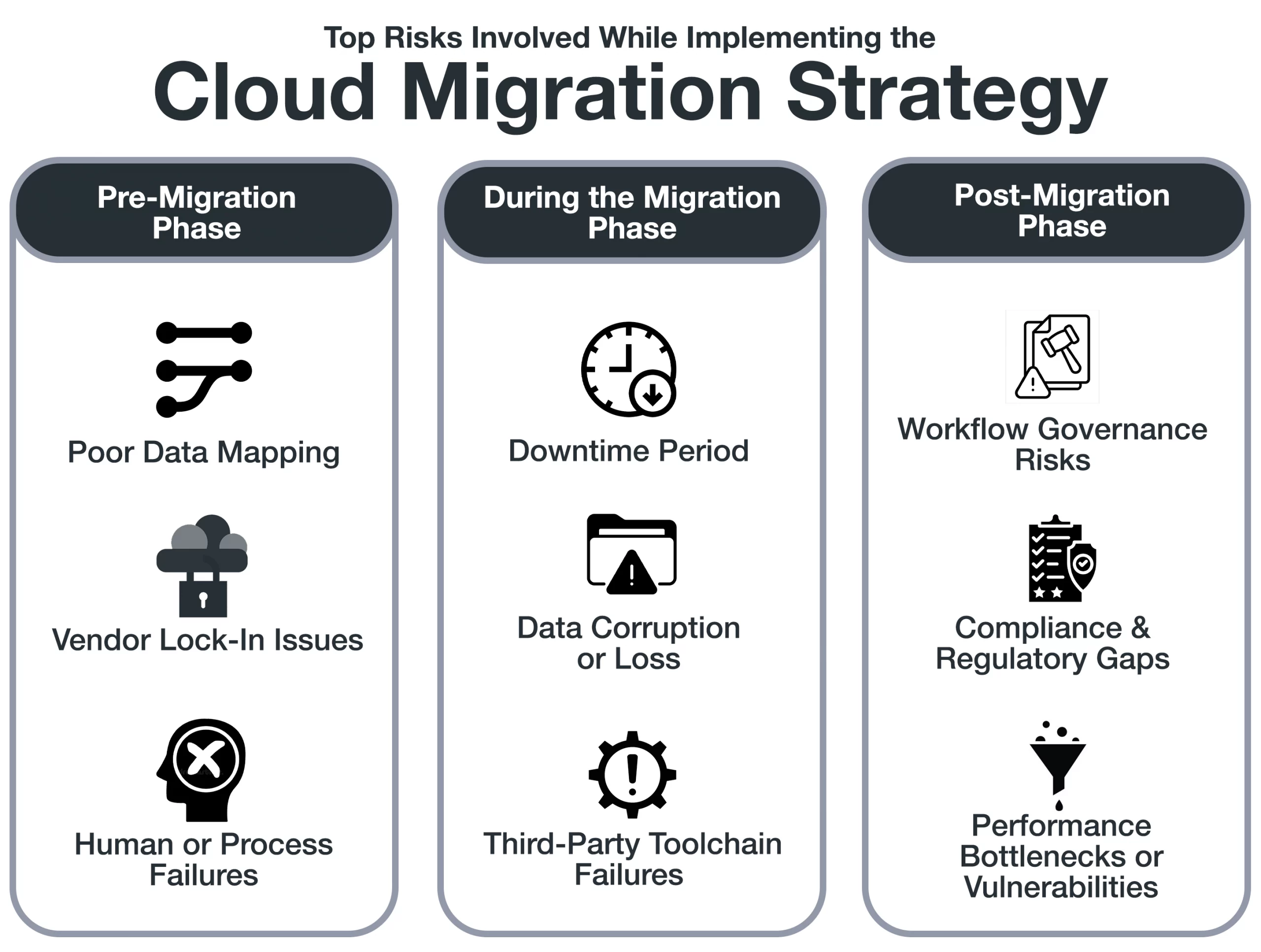
Pre-Migration Phase
Before actually starting the cloud migration process, the organization must plan to avoid major risks that include:
Poor data mapping while optimizing legacy apps
Risks such as mismatched schemas and outdated schemas are common when you try to implement application modernization trends and align legacy apps or systems with modern cloud platforms.
Impact: Silent corruption of data and also potential downtime, leading to failed migrations.
How to Mitigate: Update the old schemas while aligning them with the modern cloud standards, and also audit each legacy system.
Future vendor lock-in and scalability issues
Overlooking or not conducting a proper cloud migration assessment of the chosen cloud provider later can restrict any other migrations or have scalability limitations as well.
Impact: Potential growth limitations and reduced cloud flexibility level.
How to Mitigate: Consider multi-cloud or hybrid cloud migration types, as it helps you have multiple vendors.
Misconfigurations due to human or process failures
Lack of training, unclear leaders’ decisions, or the team’s fatigue are some of the top cloud security risks you can counter while planning the cloud migration checklist strategy.
Impact: Missed cloud migration steps, which also led to delayed cutovers.
How to Mitigate: Implement a structured cloud migration checklist and conduct proper team training sessions.
During the Migration Phase
Cloud migration challenges involved while transferring a combination of data, applications, and IT resources are as follows:
Downtime and poorly orchestrated cutovers
A well-planned SLA contract may overrun, especially when you counter workload spikes, unexpected delays, or disrupt the overall sequence.
Impact: Prolonged downtime, cutover failure, and poor user experience.
How to Mitigate: Review SLA (Service Level Agreement) contracts and liability clauses, and adopt a phased blue-green cutovers.
Structural drift due to data loss or corruption
Transferring high-volume data can be a little challenging if not utilizing a structured cloud migration checklist. This is why you should ensure that there are no incomplete syncs, mismatched fields, or encoding errors during the overall transition process.
Impact: Inconsistent data models and failed application logic may occur.
How to Mitigate: Leverage a checksum and hash verification and validate data before finalizing it.
Third-party toolchain risks and failures
Most of the enterprises completely rely on external cloud migration tools, consisting of ETL tools or 3rd-party cloud migration service providers. If a robust security validation method is not implemented, the errors can slip into the cloud migration process.
Impact: Corrupted datasets and increased cloud data migration time.
How to Mitigate: Perform stress testing of the cloud migration tools under real workloads and ensure version compatibility in advance.
Post-Migration Phase
Once the data transition process is completed, you can encounter the following cloud migration challenges while maintaining security, performance, and compliance of the complete ecosystem:
Orchestration and workflow governance risks
After the migration is completed, many overlook the need to re-establish workflow sequencing rules and automation policies, which can lead to non-compliance and silent failure.
Impact: Automation failures and increased operational overhead costs.
How to Mitigate: Re-validate orchestration & cloud migration tools, implement strong workflow governance policies, and enforce change management procedures.
Cloud-specific compliance and regulatory gaps
Certain cloud environments need to have a specific set of compliance and regulatory checks, logging standards, or advanced access controls. If these requirements are not met after the cloud migration process, the organization can have blurred boundaries, leading to unpatched gaps in logging or monitoring of systems.
Impact: Audit failures and increased regulatory violations.
How to Mitigate: Conduct a cloud-specific compliance audit and implement encryption policies.
Performance bottlenecks and ongoing security vulnerabilities
Many enterprises face problems, such as outdated Identity and Access Management (IAM) roles, unoptimized storage tiers, or scaling issues, when moving to the new cloud environment. This can expose systems to potential threats or security gaps.
Impact: Higher latency period, increased cloud migration costs, and slower applications.
How to Mitigate: Implement cloud-native security & cloud migration tools and continuous cloud optimization by regularly tracking essential KPIs such as network latency, error rates, and more.
Top Cloud Migration Strategies to Ensure a Smooth and Secure Transition
Before finalizing the cloud environment and starting the cloud migration process, it is very important for businesses to choose the right migration approach or cloud migration strategies. Out of multiple cloud migration strategies, the most utilized and trusted are the 6Rs of cloud migration. These six strategies, starting from Rehost, Replatform, Refactor, Repurchase, Retire, and lastly Retain, help you to determine which application or data workload should be moved.
By choosing the right strategy, you can streamline the migration roadmap and also ensure a cost-effective cloud adoption throughout the data transition process. Now, let’s look into these cloud migration strategies in brief and learn their best use cases and cloud migration benefits as well:
Rehost Strategy
It is commonly known as the Lift and Shift strategy and involves the process of migrating cloud applications to the cloud without updating them.
Best use case: This cloud migration strategy is ideal for modernizing legacy systems and immediately moving them to a cloud environment.
Key benefits of cloud migration: Faster cloud adoption and reduced cloud upfront costs.
Limitations: Increases the long-term overhead costs and may have performance issues.
Replatform Strategy
It is commonly known as Lift, Tinker, and Shift, and involves making small optimizations in the core application architecture and then moving it to the cloud environment.
Best use case: This cloud migration strategy is perfect for apps that require performance improvements and database modernization.
Key benefits of cloud migration: Lower team effort than refactoring strategy, and enhances performance by upgrading databases and autoscaling.
Limitations: Partial improvements and rely on the existing architecture only.
Refactor Strategy
It involves rebuilding the application to leverage modern cloud-native capabilities such as serverless computing and Kubernetes.
Best use case: This cloud migration strategy is an ideal choice for apps that face performance or any type of scalability issues.
Key benefits of cloud migration: Maximum flexibility, improved performance, and operational cost benefits.
Limitations: High level of effort needed and increased engineering costs.
Repurchase Strategy
It replaces the existing system with a SaaS product, such as moving from an on-premise CRM to using Salesforce.
Best use case: This cloud migration strategy is ideal for organizations wanting to eliminate maintenance cycles and cloud costs.
Key benefits of cloud migration: Lower operational costs and no infrastructure management required.
Limitations: Vendor lock-in possibilities and require user retraining for data migration.
Retire Strategy
It removes the applications and data workloads that are no longer necessary or that are not serving the business value anymore.
Best use case: This cloud migration strategy is perfect for organizations that need to eliminate old, unused, or redundant applications and workloads.
Key benefits of cloud migration: Reduces maintenance overhead and simplifies the overall architecture.
Limitations: Dependency issues and related risks.
Retain Strategy
It involves the process of keeping certain apps on-premises due to factors such as compliance, cost, or their complexity levels.
Best use case: This cloud migration strategy is useful for applications that are not cloud-ready or required to stay on-prem for some compliance reasons.
Key benefits of cloud migration: Avoids unnecessary migration risk and supports phased migration approaches.
Limitations: Increases the operational complexity and requires environmental support.

A Comprehensive Cloud Migration & Data Security Checklist
Now that we have learnt about the strategies to implement during the cloud migration process, let’s have a detailed understanding of how to design a structured cloud migration checklist. This cloud migration checklist should be designed in such a way that it simplifies your overall journey to choosing the new environment or a cloud center.
This cloud migration & data security checklist is an important aspect, as according to a Gartner report, 60% of organizations overspend on their initial cloud budgets during the cloud migration process. This statistic highlights the need to follow and implement a well-defined cloud migration roadmap. So, let’s explore this structured cloud migration & data security checklist:
Step 1: Analyse and Assess the Current Ecosystem
The first step includes a thorough cloud migration assessment of your existing IT infrastructure. You need to determine whether it requires migration or not, and which parts of the infrastructure will be migrated to the new cloud environment.
Also, you need to conduct in-depth research on the entire business structure, not just the IT framework. This way, you will have a deep understanding and can identify which applications, databases, or storage systems need to be migrated, optimized, modernized, or retired.
Step 2: Identify the Migration Goals & Cloud Costs
After analyzing the existing IT infrastructure, you need to identify the cloud migration goals and cloud costs, and keep track of these while data is being migrated. This is crucial as a successful cloud migration & data security checklist determines the expected outcomes and the financial boundaries as well.
To track business goals, define migration objectives, such as cost reduction, security modernization, and scalability. Also, to estimate cloud costs and plan a well-calculated cloud costing model, you should track factors like network costs, bandwidth costs, costs incurred while changing the license model, & upskilling the workforce costs.
Step 3: Choose the Right Cloud Deployment Architecture
Many businesses rely on the new environment to determine how their workloads will operate, both in technical and financial terms. This is why you should choose the appropriate cloud deployment model, from options like public cloud, private cloud, hybrid cloud, and multi-cloud deployment architecture.
While evaluating and choosing one of these cloud deployment model options, you should consider the following aspects:
- The size of your workforce
- The level of scalability of your cloud systems
- The security and compliance requirements
Step 4: Develop a Cloud Migration Strategy
This phase involves the process of defining and developing the final cloud migration strategy. Many businesses confuse the definition of the cloud migration & data security strategy with the implementation of cloud app development. But it focuses entirely on how the workloads will move from the existing IT environment to the new cloud environment.
Here, you need to select your migration approach, from 6Rs: Rehost, Replatform, Refactor, Repurchase, Retire, and Retain. You also need to chalk out a detailed cloud migration plan with your most suitable cloud provider partner.
Step 5: Design a Data Protection Plan
This step plays a crucial role in a successful and secure cloud migration process. You need to implement a comprehensive data protection strategy that ensures a higher level of security, integrity, and compliance throughout the data transition process. Establish a robust framework that includes classifying the datasets based on the sensitivity levels and utilizing encryption policies, both for data at rest and in transit.
Additionally, you should leverage checksum and hash verification and employ algorithms such as MD5 or SHA-256. These algorithms help you validate and confirm that there is no corruption or manipulation has happened during the data transfer, and data has enhanced integrity at all levels.
Step 6: Prepare the Cloud Environment
This step includes the process of preparing the target cloud environment. You need to ensure there is a correct and sound setup of accounts, networks, access, and security policies. Ensure that this new cloud environment is adhering to all the required compliance benchmarks, such as CIS, SOC2, or HIPAA. It is also essential to set up IAM policies, virtual networks (VPC, VNET), firewall rules, and network compute instances.
During this step, it is equally vital to ensure the new environment provides network connectivity and reliable bandwidth for the proper data transition process. Creation of sandbox environments, an isolated testing environment, helps you test configurations, validate workflows, and find possible network issues before actual workloads are in use.
Step 7: Execute a Phased Cloud Migration Strategy
For an effective cloud migration strategy, the business executives need to understand the major phases, expected timelines, and resource commitments required to sustain security throughout. Here is a phased timeline strategy that you should adopt:
- Pilot Phase: In this phase, pilot workloads or low-risk workloads are first migrated, allowing your team to test the overall performance and validate their assumptions.
Total timeline – 2 to 6 weeks
- Core Workloads: This phase starts with the migration of critical business systems such as ERP and CRM, while carefully monitoring of cutovers.
Total timeline – 6 to 12 weeks
- Scale-out Transitions: Here, you need to migrate the remaining applications, integrations, and cloud migration services without scaling out the cloud footprint.
Total timeline – 3 to 9 months (variable time)
Step 8: Optimize & Monitor Post-Migration Performance
Once the workloads are moved successfully, you should focus on refining the performance and operational efficiency of your cloud environment. It involves monitoring of Key Performance Indicators (KPIs), including:
- Network Latency
- CPU or Memory Usage
- Storage Patterns
- Error Rates
- Autoscalling Behavior
After monitoring these KPIs, you must also revisit IAM roles, optimize storage classes, and fine-tune compute resources for cost efficiency. Additionally, you can use automated threat detection tools and implement a security scanning and patching schedule. This will help you ensure a long-term cost optimization and high operational performance of your new cloud environment.
Utilizing this structured cloud migration and data security checklist empowers you to complete the data transition process with minimal risks and achieve long-term operational success. Additionally, you can leverage cloud application development services to modernize workloads and ensure your cloud environment is fully aligned with modern and evolving user needs.
Read Also: Green Cloud Sustainability in 2026: Market Stats, AI Innovations & Future Outlook
Closing Statement
Every organization’s cloud journey is unique, but the a need for a secure and structured cloud migration and data security checklist. It doesn’t just streamline the move to the new cloud environment but also reshapes how your organization adopts one of the 6Rs cloud migration strategies. If you need help in leveraging and following the cloud migration & data security checklist, you can partner with us and have expert guidance and seamless cloud transitions.
We bring deep expertise in all aspects of the cloud adoption journey and have delivered cloud migration services and data security in cloud computing services. With our team of cloud app development and migration experts, you can have guidance in selecting the right cloud migration strategy, tools, and execute a phased cloud migration approach. We have successfully helped enterprises in their cloud journey initiatives. Brands like VoltEnergy (CleanTech Software Solution), Cobone (Daily Deals Application), and Al Muzaini (Digital Remittance App) required an app solution that ensures secure, efficient, and scalable cloud journeys.

FAQs
Q1. What is a cloud migration and data security checklist?
A cloud migration and data security checklist is a roadmap that provides a strategic plan for moving to the new cloud architecture. By following a detailed cloud migration checklist, as discussed above, you can stay on track and ensure your cloud migration process is completely resonating with your specific business goals.
Q2. How does a cloud migration checklist ensure and support risk management?
A detailed and strategic cloud migration & data security checklist involves the process of implementing a robust data protection plan. This helps you strengthen your new cloud environment and architecture, and also identify the risks before they negatively impact the data transition process.
Q3. How do I ensure no data is lost or corrupted during the cloud migration phase?
Implementing post-migration optimization strategies, such as leveraging MD5 or SHA-256 algorithms, helps you validate the data workload post the migration has occurred. Moreover, having a comprehensive testing phase is critical before the migration process is completed.
Q4. What is the complete cloud migration timeline?
Cloud migration timeline depends on the complexity and what you are migrating (applications or services). However, it can take 3-4 weeks to 6+ months if a phased data transition approach is utilized.
Q5. How do I choose between a public, private, hybrid, and multi-cloud deployment model?
The type of cloud deployment model you want to choose should vary up on some critical factors. These are:
- Compliance Needs
- Type of Workload
- Scalability Requirements
- Your Cloud Cost Goals
- Migration Goals

SHARE
WRITTEN BY

Ishan Gupta
CEO & Founder
Ishan Gupta is a seasoned entrepreneur and CEO with extensive 8+ years of experience in business and mobile app development landscape. He believes that the right digital product allows companies to focus on what they do best, while technology handles the rest. With deep exposure to global markets, he understands what makes an app succeed. His approach translates business needs into clear product strategies, ensuring that every feature contributes to measurable ROI.
View All Articles