
Choosing the right framework: React vs Angular is one of the most critical decisions you’ll face when building a modern application. In the early stages of development, the focus is usually on shipping fast and delivering a functional product to users. The framework decision seems straightforward; however, as the application matures, the real impact of that choice begins to surface.
New features are introduced, teams grow, and performance requirements become stricter. What once felt like a flexible startup setup can start introducing limitations related to scalability or development efficiency. This is where the comparison between the React framework and Angular becomes highly relevant.
Both frameworks directly influence how smoothly a product can evolve. These are widely adopted and backed by strong ecosystems. React works as a component-driven UI ecosystem, whereas Angular is a structured framework built for large-scale apps. In 2026, with applications expected to support advanced capabilities such as cloud-native architectures and AI integrations, understanding these differences is a must.
For business and startup founders, the challenge is choosing the one that aligns with their scalability needs and provides long-term goals. So how do you decide between the two popular framework options for modern app development? This guide breaks down their core features, differences, benefits, and ideal use cases to help your business to make future-ready decisions.
Table of Contents
React VS Angular: What Exactly Are They?
Both frameworks have huge market popularity and carry various benefits that supports modern custom app development process and deliver scalable, high-performance solutions. We will discuss their adoption, market popularity, and benefits in the following sections.
Before that, let us first understand what these frameworks are and explore their core features:
React
React, or ReactJS, is a JavaScript library developed by Facebook (now Meta) that allows you to build UI components. It facilitates the creation of interactive and responsive UIs and also makes the code easier to understand, manage, and launch. It has now evolved beyond being just a UI library and supports modern capabilities.
Core Features of React
It provides the following core features:
- Component-based architecture for improving maintainability
- Virtual representation of the DOM to provide better performance
- One-way data binding for easier debugging
- Server-side rendering (SSR) to improve initial load time
- Server components for reducing client-side JavaScript
- Concurrent rendering to enable smoother user experiences
This is why the React framework is used by the top cross platform mobile application development service providers, especially suited for building scalable web and mobile applications.
Angular
Angular is a structural framework for developing dynamic web apps. It allows developers to use HTML as a template language and allows HTML’s syntax to express the application’s components briefly and clearly. It is a fully-featured JavaScript framework that helps develop dynamic, single-page web apps.
In 2026, it emphasises more on performance, scalability, and maintainability through features like Standalone Components, Signals, and improved server-side rendering, and it continues to support the MVC programming structure.
Core Features of Angular
It offers some of the following core features:
- Full-fledged framework with built-in tooling
- Two-way data binding for automatic synchronisation
- TypeScript-first development for better quality
- Dependency Injection for efficient modular design
- Standalone Components to reduce boilerplate
- Signals-based reactivity for faster state updates
React VS Angular: Current Market Overview
In 2026, modern web and mobile applications continue to define how users interact with digital products. With modern evolution, two dominant JavaScript technologies, React and Angular, have matured into powerful ecosystems.
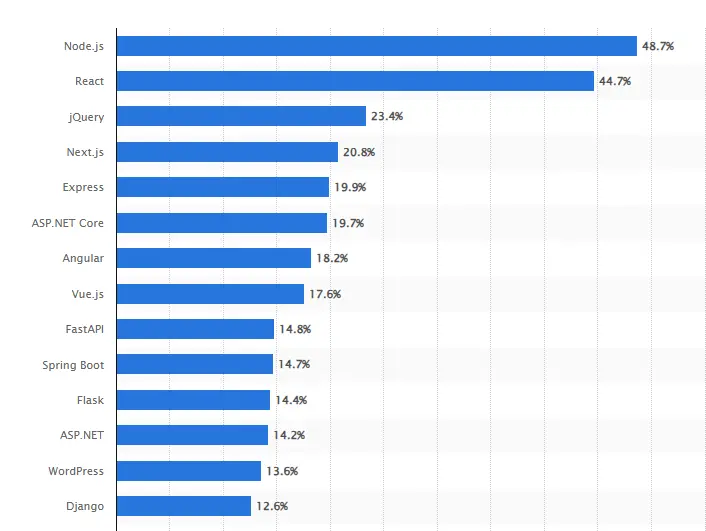
When comparing Angular vs React, in terms of adoption and popularity, React comes in second position under the category of mostly used web frameworks among developers worldwide in 2025. Over 44.7% of professional developers have used it for its flexibility and vast ecosystem. It is one of the most preferred choices for startups and rapidly scaling digital products.
In contrast, Angular has been used by 18.2% experienced developers and continues to be widely adopted by large organisations. Its comprehensive built-in tooling and TypeScript-first approach, Angular is an ideal choice for building complex and long-term applications
React VS Angular: Key Benefits Comparison
Both app development frameworks offer extensive benefits to businesses. However, the final choice between React and Angular often depends on specific business goals, project complexity, scalability requirements, and team expertise. Now let’s look at their key benefits:
Benefits of React
Interactive User Experience
React uses the Virtual DOM. This makes it simpler for you to make changes without disrupting the actual flow of the user interface. This approach enables the creation of highly dynamic and responsive user interfaces, resulting in an improved overall user experience.
Efficient Yet Less Time-Consuming
React is time-saving as it provides code reusability. It allows you to reuse the same code component wherever needed. Plus, the segments are separated from one another, and updates in one don’t influence the other, which makes it simpler to deal with the updates. This code reusability makes React the best choice, time-saving, and efficient. That’s why businesses should hire React developers to build fast and flexible applications.
Faster Development
React allows you to reuse existing code and leverage features like hot reloading. This significantly accelerates the development process by reducing the need to rewrite code and enabling faster iteration during development.
Quicker Testing
React integrates and uses state management libraries such as Redux, which simplifies state storage and management in large and complex applications. It assists you by adding the app state to a solitary object and engages each part of the app to get to the app state.
This can be done without including the child component or utilizing callback. It makes it simpler to test the app and log data changes, alongside the utilisation of hot reloading and other such tools.
Code Stability
ReactJS enables you to work directly with the components and utilise downward or one-way data binding. It ensures that changes in child components do not affect the parent component. This methodology makes the code stable and supports the possibility of scalability later on for future development opportunities.
Benefits of Angular
Platform Independent
Angular provides the benefit of developing across all platforms. You can learn one approach to build progressive web apps (PWAs) applications with Angular and reuse your code and capacities to build applications for any deployment target. React also supports cross-platform development by enabling code reuse and flexible component-based architecture for building web and mobile applications efficiently.
Faster Speed & Performance
Angular is designed to deliver high performance on modern web platforms. It supports advanced features such as Web Workers and server-side rendering, enabling applications to handle large data volumes and scale efficiently using reactive programming models like RxJS.
Powerful Tooling
This framework allows building features rapidly with straightforward, declarative templates. Extend the template language with your parts and use a wide exhibit of existing segments. Get prompt Angular-specific assistance and input with practically every IDE and proofreader. This meets up so you can zero in on building astounding applications instead of attempting to make the code work.
Trusted by Enterprises Worldwide
From early-stage prototypes to global-scale deployments, Angular delivers a scalable and efficient framework that supports some of Google’s largest enterprise applications. Its structured mobile app architecture makes it a preferred choice for large teams and long-term projects.
Built-in Security and Maintainability
Angular includes built-in security features such as protection against cross-site scripting (XSS) and strict template sanitisation. Combined with its TypeScript-first approach and well-defined architecture, Angular makes large codebases easier to maintain, refactor, and scale securely over time.
React vs Angular: A Side-by-Side Comparison Table
There are certain factors on which one can lay down the comparison of the two most popular app development frameworks: React Framework vs Angular. Understanding these factors makes it easier to evaluate how each framework performs in real-world scenarios and which one aligns better with your business and technical requirements.
In this section, we will compare React and Angular across multiple factors and provide you with useful insights to help you make an informed decision. Below is a React vs Angular comparison table that offers a clear side-by-side overview:
Factor |
React |
Angular |
|
Type |
JavaScript library focused on UI |
Structured front-end framework |
|
Architecture |
A component-based architecture that is ideal for building reusable UI elements |
A framework as an MVC model for clear separation of codebases |
|
Language |
JavaScript ES6 and JSX |
TypeScript and JavaScript |
|
Data Binding |
A one-way data flow: from parent to child components |
A two-way data binding system between the model and the view |
|
DOM Handling |
Virtual DOM |
Incremental DOM |
|
State Management |
External libraries such as Redux, MobX, and Context |
Built-in libraries and services |
|
Learning Curve |
Moderate and flexible |
Steeper but structured |
|
Cross-Platform Support |
React Native for mobile apps |
Ionic for mobile apps |
|
Scalablity |
Highly scalable with the right architecture |
Designed for enterprise |
|
Ideal Use Cases |
Trusted by many companies due to its flexibility and rich ecosystem |
Trusted by large organisations due to its robustness and longevity |
React VS Angular: Core Technical Comparison
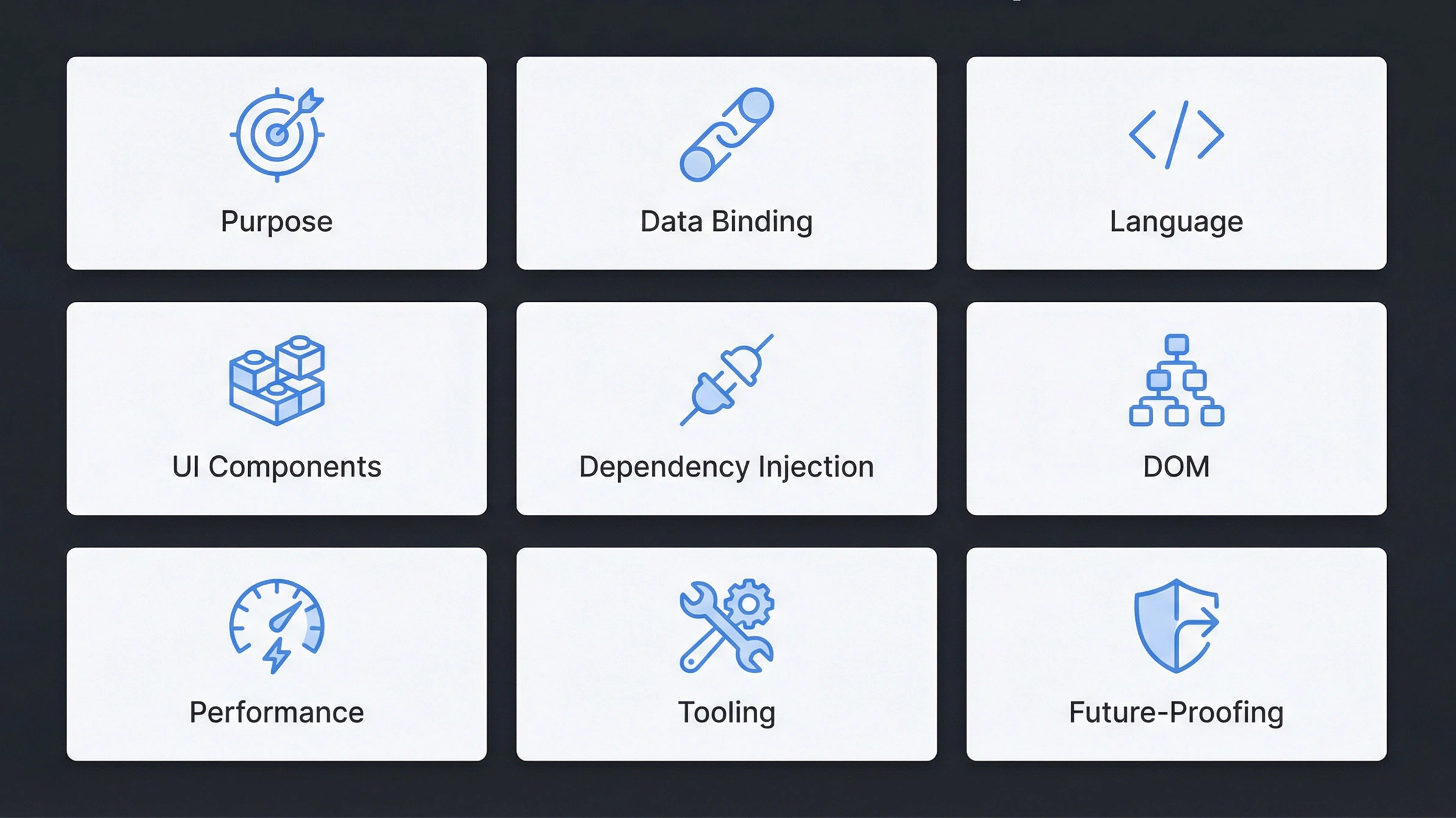
Let’s now look at this section, which highlights the key differences between React vs Angular:
1. Purpose
When comparing Angular vs React, Angular is a full-fledged Framework that provides you with a clear and opinionated structure for organising applications. It includes many built-in mobile app features and libraries that help you to build large, complex, and scalable applications with consistency.
ReactJS, on the other hand, is a JavaScript Library that primarily focuses on the View layer of the Model-View-Controller (MVC) architecture. It offers you greater flexibility as it relies on external libraries such as Flux or modern state management solutions. Using React as a library, you can manage application architecture and control how various components are structured within your application.
2. Data Binding
Choosing between the two most used mobile app development frameworks, that is, Angular vs React, also depends on how data binding is handled. This factor directly influences your application performance and maintenance level. Here. React follows one-way data binding. This means that your UI components cannot directly modify their state, thus you have to edit the state as well.
Whereas Angular traditionally supports two-way data binding, where changes in the UI automatically update the model and vice versa. In recent versions, Angular now also promotes unidirectional data flow using Signals for better performance and predictability.
3. Language
Angular uses TypeScript, a superset of JavaScript and a statically typed language. In TypeScript, mistakes are simpler to spot, and by and large, the code is simpler to explore. Therefore, it improves code readability and maintainability, especially in large projects.
React can be composed in JavaScript ES6+ joined with JSX script, which comprises an extension for syntax, making JavaScript code indistinguishable from HTML. It can also be written in TypeScript, and TypeScript usage with React is now very common in production environments, though it is not enforced by default.
4. UI Components
Angular provides Angular Material, which includes a wide range of pre-built Material Design components such as layouts, buttons, dialogs, and other form elements. This enables you to have a fast and consistent UI development phase.
When using React, you need to rely on third-party libraries such as Material UI, Ant Design, or custom component libraries. These UI components are open-source and community-driven, offering a large variety of reusable UI elements.
5. Dependency Injection
Dependency injection (DI) is a programming technique utilised when classes get references to different classes (dependencies), rather than creating them internally. Unlike React, Angular supports built-in dependency injection capability, which allows services to have distinct lifecycles. This improves the modularity and testability of the codebase.
React doesn’t provide native dependency injection capability. Instead, it relies on component composition, hooks, and context to manage dependencies and shared state, aligning well with functional programming principles.
6. DOM
When comparing React vs Angular, React uses a Virtual DOM, where changes are first applied to a virtual representation of the UI. It can then efficiently update only the parts of the real DOM that have changed.
Angular uses an Incremental DOM, which updates the real DOM directly by applying only the necessary changes during rendering. This approach helps you reduce memory usage and improve rendering efficiency.
7. Performance
React appears to have an edge over Angular in runtime performance because of the Virtual DOM trees, which are based on the server and exceptionally lightweight. It consequently does not load the program a lot. Further, with React, the data-binding process is unidirectional, implying that ties are not assigned watchers, and thus, the responsibility is diminished. This means that it reduces unnecessary re-rendering and thus boosts your mobile app performance.
Angular’s performance has significantly improved with the introduction of technologies like Ivy and Signals. While traditional two-way data binding could introduce overhead, modern Angular applications can now achieve high performance when following some recommended patterns and principles.
8. Tooling
React relies more on external libraries for routing, state management, and SEO handling. Tools such as Redux, React Router, and Helmet help streamline application state, routing, and metadata management.
Angular provides built-in tooling through Angular CLI, including project generation, routing, data binding, and testing support out of the box. Additionally, developers can integrate advanced state management solutions like NgRx and RxJS when needed.
9. Future-Proofing
Both React and Angular are future-ready frameworks backed by strong communities and enterprise support. React continues to evolve with innovations like Server Components, concurrent rendering, and improved performance optimisations. This makes it adaptable to modern UI and AI-driven experiences.
In contrast to this, Angular focuses more on long-term stability through regular updates, backward compatibility, and features like Signals and standalone components. This makes it a reliable choice for enterprises that are planning to build scalable and future-proof applications. Additionally, you can consider working with a reliable hybrid app development company to further enhance the future-readiness factor within your mobile apps.

React VS Angular: When To Choose What?
In this part, we will explore the scenarios where choosing React or Angular makes the most sense based on project requirements, scalability goals, and team expertise. So, let’s deep dive into this:
When to Choose React?
Choose React when:
- You are building single-page applications (SPAs) or cross-platform applications
- Your project requires fast development and quick iterations
- You want a lightweight and flexible framework with high customisation
- Your application needs dynamic, interactive user interfaces
- You are developing an MVP or startup product that needs to scale rapidly
When to Choose Angular?
Choose Angular when:
- You are developing an enterprise-level application like FinTech applications
- Your project demands a structured and opinionated architecture
- Long-term maintainability and scalability are critical
- You need built-in tooling for routing, testing, and state management
- Your application includes complex workflows or real-time features
Wrapping Up
As user expectations continue to rise in 2026, selecting the right framework plays a critical role in how an application performs, scales, and evolves over time. React and Angular both offer strong capabilities to meet these demands, but they serve different purposes.
React excels in flexibility and rapid innovation, while Angular provides a structured foundation for building large, enterprise-grade systems. Understanding the key differences between React and Angular and partnering with a leading software development company can help you to make confident, future-ready decisions.
At RipenApps, we help you in choosing and implementing the right framework based on your product goals and growth strategies. Over the decade, we have helped innovative brands such as Hanchens (Food Ordering App), eGurukul (Medical Entrance Exam App), and Swish (Child’s Activity Tracker App). Our team of experienced mobile app developers can enable you to create scalable applications that deliver higher engagement, improved retention, and sustainable long-term success.

FAQs
1. Which framework is better for startups: React or Angular?
React is often preferred for startups due to its flexibility, faster development cycles, and ease of scaling. It is well-suited for MVPs and rapidly evolving products. Whereas Angular is more suitable for large-scale or enterprise applications that require a structured and long-term maintainability rather than rapid early-stage iteration.
2. Is Angular still relevant in 2026?
Yes, Angular remains highly relevant, especially for enterprise-level applications. Its structured architecture, built-in tooling, and long-term stability make it ideal for complex and large-scale projects.
3. Can React and Angular both be used for cross-platform mobile app development?
Yes. React supports mobile app development through React Native, while Angular can be used with frameworks like Ionic and Capacitor to build cross-platform mobile applications.
4. Which framework is easier to learn for beginners?
React generally has a gentler learning curve for beginners. On the other hand, Angular has a steeper learning curve due to its comprehensive framework and TypeScript-first approach.
5. How do I decide between React and Angular for my project?
The decision depends on factors such as project size, scalability needs, team expertise, and long-term maintenance goals. React is ideal for flexibility and speed, while Angular is better suited for structured, enterprise-grade applications.

SHARE
WRITTEN BY

Prankur Haldiya
Chief Technical Officer
A tech innovator and engineering leader, Prankur Haldiya drives RipenApps’ product development strategy and oversees cutting-edge solutions in mobility, AI, and cloud ecosystems. He is passionate about building high-performance teams and helping brands launch secure, scalable, and user-centric digital products.
View All Articles