

Finance changed faster than anyone expected. Cash is disappearing. People transfer money from their phones. They open bank accounts online. They track investments in real time. Startups are launching financial products without physical branches. Users demand speed, transparency, and control. Trust moves where convenience lives.
Today, more than 65% of global users rely on mobile financial platforms daily. Funding in FinTech continues to rise because businesses want automation and accuracy. The fintech industry grows stronger each year due to rising digital-first behavior. If you plan to build a finance product, you need clarity about development, technology, risk, and growth strategy. A strong roadmap saves money and speeds launch. On the other hand, a weak one leads to expensive rebuilds and lost users.
So, if you are a startup owner, product manager, CTO, technology leader, or financial entrepreneurs who want real results, this blog is for you. This guide explains fintech app development, different types of FinTech apps, stages of development, key technology layers, and smart growth tactics for product scaling. Stay tuned till the end for some useful insights :
Table of Contents
What is a FinTech Application
A FinTech app is a software application that supports digital financial services. It helps users manage money, payments, savings, credit, investments, insurance, or business transactions using secure online systems. These apps improve financial access and reduce manual processes. They offer real-time actions, transparency, security, and faster decision-making. Several businesses partner with a globally-recognized custom app development company to create secure and scalable FinTech solutions tailored to user needs. Thus, FinTech is becoming one of the strongest segments within the global financial technology market.
Why Fintech Apps Matter Today
The demand for mobile solutions in finance has never been higher. Mobile banking app development allows users to manage money, make payments, and access financial services anytime, anywhere. Here are some valid points why fintech apps matter today :
- Users want financial control on their phones.
- Businesses want automation and reduced operational costs.
- Banks want secure and faster digital experiences.
- Investors reward scalable financial products with strong technology and compliance.
The FinTech industry continues to grow because speed and user experience win. Traditional institutions cannot rely on old systems. Financial technology solutions are leading the way to a great extent.
Key Types of FinTech Apps
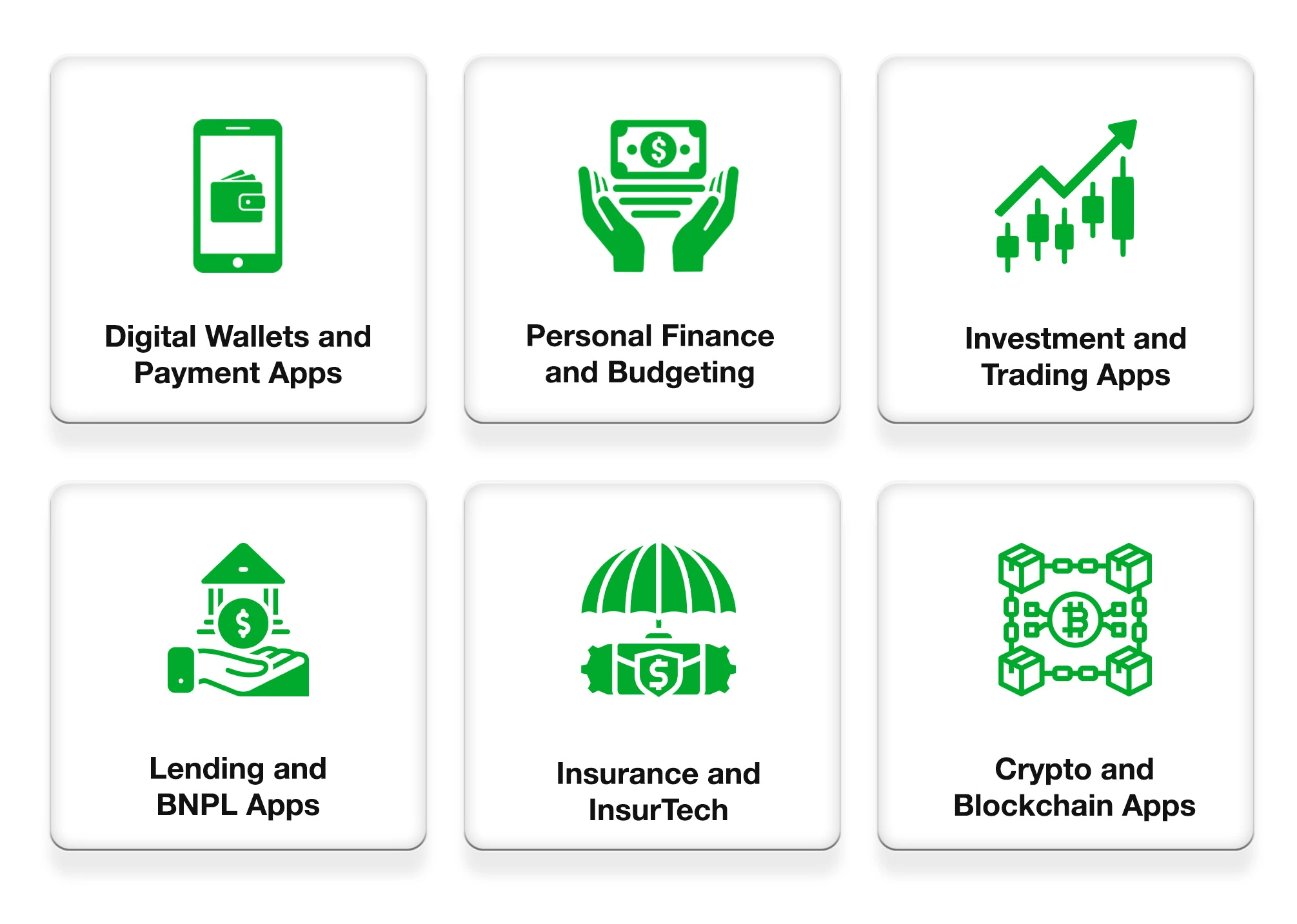
The FinTech market includes several product categories. Each category demands unique workflows, compliance requirements, and security standards. Here are some of the popular types of fintech apps recommended by every experienced IT services provider, that you can develop and lead the industry :
1. Digital Banking Apps
Digital banks operate without branches. Users open accounts online, manage funds, send transfers, check statements, apply for cards, pay bills, and track activity in real time. These apps focus on clean design and strong authentication.
Key features
• Instant KYC verification
• QR and UPI payments
• Spending analytics
• Biometric login
• 24×7 chat support
Digital-first banking continues to grow as more users switch from traditional banks to digital banking applications offering speed and transparency. Availing professional mobile app development services in USA can help you build a feature-rich digital banking app within a limited time & budget.
2. Mobile Payment and Digital Wallet Apps
Payments must be fast and reliable. Wallets allow users to send and receive money instantly. They also store cards, support P2P transfers, bill payments, merchant checkout, and contactless transactions. These applications lead modern finance tech adoption.
Key features
• Multi-layer encryption
• Real-time transfers
• Bill and merchant payments
• Cross-border payment options
• Rewards and cashback programs
These apps not only simplify everyday transactions but also enhance user trust and engagement. By seamlessly integrating AI-powered fraud detection and personalized spending insights, digital wallets provide a seamless and secure financial experience. Businesses benefit from faster transaction processing, higher customer retention, and the ability to expand into new markets with global payment options.
3. Personal Finance and Budgeting Apps
Users want control over spending. Personal finance tools provide budgeting, expense management, reminders, and progress tracking. These tools help users build financial discipline and planning habits.
Key features
• Automatic expense categorization
• Savings goals
• Subscription tracking
• Visual financial summaries
• Alerts and reminders
These apps turn financial planning into a simple and stress-free experience. Users view all expenses in one place, track spending patterns, and set goals with clarity. The combination of smart analytics and personalized insights supports better decisions and long-term financial stability. Businesses offering these tools to build fintech app have strong user loyalty because people rely on them for daily financial control.
4. Investment and Trading Apps
Investment platforms allow users to trade stocks, mutual funds, crypto assets, or bonds in real time. The apps handle complex data with high accuracy and secure compliance.
Key features
• Real-time market charts
• AI-driven advisory suggestions
• Risk assessment
• Portfolio tracking
• In-app education and alerts
These apps give users direct access to financial markets without relying on brokers or long processes. People manage portfolios, analyze trends, and make informed decisions with confidence. Advanced analytics and automated insights support smarter investments and reduce guesswork. The growing interest in wealth growth and digital assets makes these platforms essential for modern investors. That’s why top fintech app development companies focus on building secure, intuitive, and feature-rich solutions.
5. Lending and BNPL Apps
Lending apps allow users to apply for loans without paperwork. BNPL offers flexible payments at checkout. Automation reduces processing time and increases credit accessibility.
Key features
• Digital KYC
• Automated underwriting
• EMI planning
• Instant approval
• Credit tracking dashboard
These apps offer fast access to credit without long approval cycles or branch visits. Users view eligibility, compare options, and choose repayment plans with clarity. Businesses gain higher conversion rates because simple financing increases purchase confidence. The demand for flexible digital credit solutions continues to rise as users seek convenience and transparency in borrowing.
6. Insurance and InsurTech Apps
Insurance processes become simpler with automated onboarding, claim requests, and policy management.
Key features
• Claims automation
• Paperless policy buying
• Customer support chat
• Risk screening
• Secure document management
Insurance apps remove complexity from insurance decisions and give users full clarity over the process. People compare policies, submit claims, and track approvals without offline paperwork or long delays. Automation improves trust and efficiency. Thus, it helps insurers deliver faster support and better customer experiences. This shift strengthens loyalty because users feel confident managing coverage directly from their phones.
7. Crypto and Blockchain-Based Finance Apps
These tools support wallet security and blockchain transactions. They use cryptographic protocols to protect each transaction.
Key features
• Blockchain-backed authentication
• Multi-currency wallets
• NFT support
• Tracking and analytics
These apps help users manage digital assets with security and transparency. People send, store, and track crypto holdings without relying on intermediaries. Real-time insights and decentralized control give users confidence in handling transactions. The rapid adoption of digital currencies increases the need for reliable platforms that protect assets and support modern financial behavior.
Read Also: An Ultimate Guide to Fintech Software Development: Key Features, Benefits, And Cost
Stages of FinTech App Development
The development lifecycle shapes the reliability and scalability of the product. Structured execution prevents risk and delays.
1. Product Analysis and Strategy Planning
During the initial stage, you need to define business goals, user segments, features, compliance standards, and revenue plans.
2. Experience Planning and Design
The planning and designing phase includes wireframes, prototypes, and interface testing. Design clarity drives trust. Many teams partner with a top-rated UI UX design agency to build smooth journeys that reduce drop-offs.
3. MVP Development
Launching with must-have features shortens time to market. This path aligns with investing in professional MVP development services that validate the idea using real feedback.
4. Core Engineering and Integrations
This development stage includes backend architecture, security policies, payment APIs, KYC tools, and real-time analytics. At this phase, businesses often reach out to a top-rated fintech app development company to connect with strong engineering teams for advanced workflows.
5. Security, QA, and Compliance Validation
No doubt, security is the topmost priority. Investing in cybersecurity in fintech app development ensures that testing covers performance, automation, penetration checks, encryption validation, and regional compliance standards.
6. Deployment and Performance Scaling
After development and testing, the app moves to real users. Strong infrastructure ensures high availability and smooth performance during peak usage. Teams monitor load, optimize server capacity, and scale resources to maintain speed and security as the user base grows. Continuous performance tuning keeps the app reliable and ready for expansion.
7. Continuous Updates and Support
Last but not least, you need to critically analyze usage data. Add improvements. Build features based on real demand. However, businesses partner with an experienced app development company to handle technical and regulatory success using structured delivery.
Growth Strategies That Turn Fintech Apps Into Market Leaders

Growth in fintech industry is not luck. It is structure, precision, and user-first execution. Each stage below moves users smoothly through the adoption funnel and converts them into loyal advocates.
1. Smooth Onboarding
You might know that first impressions shape trust. A confusing onboarding experience causes users to drop in seconds. Whereas a clear, guided, and minimal-step journey helps new users feel in control from the beginning.
• Use biometric login.
• Auto-fetch data where possible.
• Provide tooltips and walkthroughs.
• Show value instantly, without forcing long forms.
2. Smart Personalization
People stay when they feel understood. Personalization turns generic platforms into meaningful financial companions. Leading solutions use data responsibly to shape better decisions and user experiences. Personalization improves app stickiness and builds emotional loyalty. Moreover, a leading mobile app development agency helps build personalization features that align with user behavior and long-term engagement goals.
- Tailor dashboards based on spending patterns, goals, or risk behavior.
- Use AI-driven recommendations to suggest savings plans or investments.
- Send contextual alerts instead of generic notifications.
3. Data Analytics
Growth depends on insight, not guesswork. Data converts assumptions into measurable improvement. Analytics reveal why users leave and what keeps them engaged. Many businesses pair analytics with professional IT services and IT consulting support to create stronger decision strategies driven by real user behavior.
- Track usage flow and drop-off screens.
- Identify conversion triggers.
- Use predictive analytics to prevent churn.
4. Customer Engagement
Engaged users transact more and trust faster. Engagement is not only about notifications. It is a meaningful value delivered consistently.
- Provide educational content, financial tools, insights, and rewards.
- Add live chat support and AI assistants through chatbot development services for fast in-app help and issue resolution.
- Create community-like experiences with micro-updates and interactive features.
- When users feel supported, they stay longer.
5. Referral Programs
People trust recommendations from friends more than ads. Referral loops build organic, low-cost growth. Moreover, referral-led acquisition reduces dependency on paid marketing.
• Offer instant benefits such as cashback or fee waivers.
• Make sharing seamless with one-tap invite links.
• Highlight milestones and reward consistency.
6. Continuous Updates
Improvement never stops, and that consistency strengthens brand credibility. Fintech evolves daily. Users expect speed, reliability, and fresh improvements. Many companies choose to hire mobile app developers to ensure updates are timely, seamless, and user-focused.
- Ship incremental updates instead of rare large releases.
- Collect feedback constantly and act fast.
- Add new integrations, features, compliance upgrades, and UI improvements.
Wrapping Up
Fintech has redefined how people manage, move, and grow their money. Users expect fast, seamless, and secure financial experiences across every touchpoint, from payments to investing. Therefore, building a strong fintech app today means more than offering transactions. It means building trust, simplifying decisions, and delivering value with clean UX, secure architecture, and smart technology such as AI, analytics, and automation.
This blog explored key types of fintech apps, the development lifecycle, and growth strategies that accelerate adoption. Now, you must have understood that the opportunity is huge for startups and enterprises ready to build with strategy and precision.
So, whether you plan to build a fintech app from scratch or scale an existing solution, success depends on expert execution and long-term thinking. If you are ready to create a product that users love and investors support, the next step begins now. Now, let’s build the future of financial technology together.

FAQs
1. How much does it cost to build a FinTech app?
Fintech app development cost varies based on features, security layers, compliance needs, and integrations. Simple fintech apps start at a lower range, while advanced solutions like digital banking or investment platforms require a higher budget due to complexity and regulations.
2. How long does it take to develop a FinTech app?
Timelines depend on scope, UI UX work, integrations, and compliance testing. A basic MVP may take 3 to 4 months, while full-scale enterprise-level apps can take 6 to 12 months or longer.
3. Why should startups build an MVP before a full FinTech app?
An MVP helps validate market demand with real users before investing heavily. It reduces risks, accelerates launch timelines, and helps secure investor support faster with data-driven insights.
4. How do FinTech apps ensure security and compliance?
FinTech apps use encryption, multi-factor authentication, tokenization, secure APIs, fraud detection systems, and follow regulations such as PCI-DSS, KYC, AML, and GDPR to protect financial data.
5. What technology stack is best for FinTech app development?
It depends on the product needs. Most fintech apps use modern stacks like Node.js, React Native, Python, and cloud platforms such as AWS, Azure, or GCP. Blockchain, AI, and advanced analytics are increasingly used to enable smarter automation and user personalization.

SHARE
WRITTEN BY

Ishan Gupta
CEO & Founder
Ishan Gupta is a seasoned entrepreneur and CEO with extensive 8+ years of experience in business and mobile app development landscape. He believes that the right digital product allows companies to focus on what they do best, while technology handles the rest. With deep exposure to global markets, he understands what makes an app succeed. His approach translates business needs into clear product strategies, ensuring that every feature contributes to measurable ROI.
View All Articles