
E-commerce in 2025 looks nothing like it did five years ago. It’s no longer limited to putting products online. In 2025, over 70% of global retail e-commerce sales will come from mobile apps. Yet, despite this massive shift, most startups struggle to retain users beyond the first download. The main reason is that consumers expect apps that are fast, personalized, friction-free, and provide them ultimate experience.
The reality is harsh: nearly 40% of shoppers abandon carts if checkout takes longer than 30 seconds. Not only this, apps with poor onboarding lose almost half their users in the first week. For startups, these are major challenges in the business model.
At the same time, global mobile shopping revenue is projected to cross $3.5 trillion, which means the opportunity is massive for startups that get it right. But the challenge lies in the high competition. To win, startups need more than a digital storefront. They need apps specially designed with modern psychology, data-driven personalization, and technology that can scale.
So, if you are a startup founder, an entrepreneur, a CTO, or a product manager looking to launch or scale ecommerce apps, this guide will provide you with some useful insights about ecommerce app development. You will get a complete roadmap from must-have features to planning your budget wisely. Let’s get started :
Table of Contents
Features That Separate Winning E-commerce Apps From the Rest
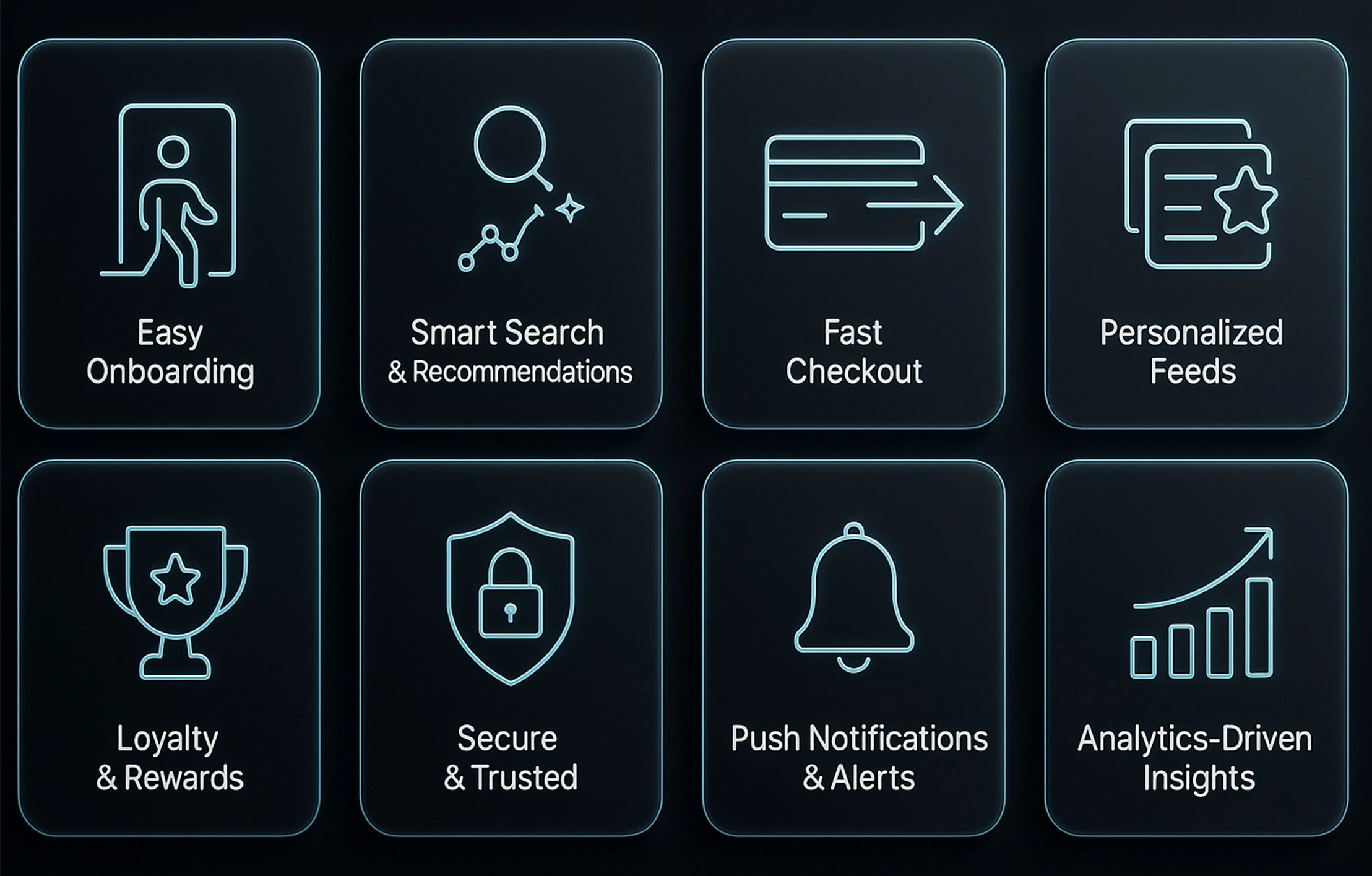
We live in a tech-driven era, where building an app is easy, but building one that keeps users coming back is not. So, now look at the ecommerce mobile app features that define the top-performing apps in 2025.
- Seamless Onboarding
No one wants to fill out long forms. Thus, you need to ensure smart onboarding with social logins, guest checkouts, and intuitive navigation to make users stick from day one. - Smarter Product Discovery
It is also one of the most crucial ecommerce app features because users don’t scroll endlessly. AI-powered search, personalized recommendations, and even voice-based shopping help them find what they want instantly. - One-Click Checkout
Multiple payment options, digital wallets, and instant checkout reduce cart abandonment. Shopify reported that apps with one-click checkout increase conversions by over 20%. - Personalized Journeys
Shopping feels better when it feels personal. Tailored product feeds, targeted offers, and behavior-driven suggestions make users feel understood. Additionally, integrating virtual reality in ecommerce will help you to offer a more personalised experience to your users. Thus, they would love to navigate your app. - Loyalty and Rewards
Several features, such as badges, cashback, and gamified shopping loops, keep users engaged for a long time. A loyalty program costs less than acquiring new customers. - Security and Trust
SSL, two-factor authentication, and visible trust badges reassure users. For e-commerce startups, trust is the silent feature that drives conversions. You must pay attention to seamlessly integrating advanced security features into your app. - Push Notifications & Alerts
Timely reminders, flash sales, and updates on favorite products keep users engaged and returning regularly. Properly used, notifications can boost sales and help increase the overall revenue. - Analytics-Driven Insights
Built-in analytics let startups track user behavior, monitor feature usage, and continuously improve the app. Data-driven tweaks help apps evolve based on real user needs. Along with that, you can also boost your ecommerce business with AI-powered mobile apps to get more useful insights.
When you hire app developers who specialize in retail apps, these features are not add-ons to your app; they are baked into the product design.
Ready-to-Market E-commerce App Solutions: Faster Launch, Smarter Scale
Not every startup has the luxury of building an app from scratch. Investors push for faster launches, competitors release updates weekly, and customers expect polished experiences from day one. That’s where ready-to-market e-commerce app solutions make sense. There are several advantages of a B2B ecommerce platform for business growth. They allow startups to enter the ecommerce market quickly, validate their ideas, and scale once traction is proven. Here are the main approaches:
White-Label Solutions
These are pre-built apps that cover the essentials such as product catalogs, carts, payments, and notifications. They’re easy to rebrand and are perfect for startups that want to test demand without draining budgets. However, they may not include some specific features or meet your unique needs and requirements. That’s why you can also invest in customized apps. You can reach out to a leading mobile app development company to build your custom app if white-label solutions don’t work for you.
Low-Code and No-Code Platforms
These platforms give you drag-and-drop functionality, pre-built integrations, and faster customization. They work well for MVP launches and early-stage experiments, especially when time-to-market is more critical than having a fully unique design. However, to leverage such emerging top ecommerce trends, you need to seek help from an industry expert.
Custom Development with Pre-Built Modules
Many startups choose a hybrid route, which is custom mobile app development supported by pre-built modules like payment gateways, shipping integrations, or analytics dashboards. This approach balances speed and scalability.
The real benefit is strategic: instead of spending 12–18 months in development, startups can go live in weeks. Early users provide feedback, which guides future updates. As you scale your business and grow, you can gradually transition into a fully custom app. This phased approach saves costs, reduces risks, and gives you a chance to stay ahead of your competitors.
Read Also: Key Reasons E-Commerce Businesses Should Opt for Cross-Platform Development
Understanding E-commerce App Development Cost
Now, before planning your budget, it’s crucial to understand what drives the cost of building an e-commerce app. Startups often underestimate expenses, which can hamper their overall growth or force compromises on advanced features. But, there are several benefits of ecommerce app development for your business. Thus, your investment will be worth it. The overall cost of ecommerce app development varies depending on the app’s complexity, platform, and features.
Key Factors Influencing Ecommerce App Development Costs :
- Design & User Experience: Sleek, intuitive interfaces with personalized journeys cost more than basic templates but improve retention. It helps you to provide the ultimate online shopping experience to your users.
- Platform Choice: Native apps for iOS and Android are costlier than hybrid or cross-platform solutions but often deliver better performance.
- Features & Integrations: AI recommendations, loyalty programs, payment gateways, and integration of augmented reality in eCommerce increase development time and cost. However, you can also avail mobile app development services to integrate features of ecommerce apps at budget-friendly prices seamlessly.
- Maintenance & Updates: Post-launch updates, bug fixes, and scaling features require ongoing spend. Regular app maintenance can also increase your overall cost to develop an ecommerce app.
Typical ranges for startup e-commerce apps:
- MVP / Basic App: $10,000 – $30,000
- Mid-Level App with Custom Features: $30,000 – $70,000
- Full-Scale, Feature-Rich App: $70,000 – $150,000+
Business owners must understand that these costs allow startups to make informed decisions about which features to prioritize, which platforms to launch on, and how to structure development phases. Once you know the ecommerce app development cost, you can plan your budget strategically to balance immediate needs with long-term growth.

Budget Planning Without the Guesswork
The ecommerce app development budget is often where startups struggle. Some spend too much upfront, while others cut corners that hurt growth. So, if you want to build an e-commerce app like Temu, you will need to consider several factors that will directly affect the cost. Thus, one should follow the right strategy.
The smart approach is to align your budget with growth goals. Affordable ecommerce app development services for startups may save money early, but ask yourself: will it scale when user numbers grow? Also, working with an industry expert ensures your budget covers both immediate needs and long-term sustainability.
Mistakes That Drain Startup Budgets in E-commerce App Development
Many startups lose time and money by repeating the same errors. Therefore, you need to avoid these common pitfalls:
- Over-engineering Features
Adding AR, chatbots, and social commerce before you validate your core offering burns resources. - Weak Onboarding
If users don’t see value in the first few minutes, they uninstall. Poor onboarding kills retention. - Misaligned Spend
Some startups invest heavily in development but ignore marketing. Without traffic, even the best app fails. - Wrong Partnerships
Freelancers or inexperienced agencies without retail knowledge may deliver apps that look good but fail under real-world pressure. Therefore, choosing a trusted application development company can save future headaches.
The smartest founders build lean, validate fast, and scale only when the numbers make sense.
Read Also : D2C Ecommerce App Development: A Step-By-Step Guide for Business Owners
Wrapping Up
The future of the ecommerce industry in 2025 is not limited to rushing an app to market; it is about building one that adapts, scales, and creates value for users. From identifying must-have features to exploring ready-to-market solutions and understanding cost factors, every decision shapes how your app performs in a competitive industry.
For startups, the smartest move is starting lean with an MVP, validating the idea, and then scaling with features that separate winning apps from the rest. Not only this, but budget planning and cost awareness are equally important. Thus, it ensures that you invest wisely while keeping growth in sight.
Your e-commerce app should not only look good, but it should also drive revenue, deliver trust, and keep customers engaged. The right approach today sets the foundation for long-term growth tomorrow. So, partner with the best ecommerce app development company and stay ahead of your competitors.

Frequently Asked Questions
1. Should startups go for custom app development or ready-to-market solutions?
Custom apps give flexibility and scalability but require more time and budget. Whereas, ready-to-market solutions help startups launch faster at lower costs. However, if you are looking for long-term growth, then you can go ahead with custom app development as well.
2. How long does it take to build an e-commerce app?
The timelines for building an e-commerce app vary. An MVP app may take 3–4 months, while a full-scale app with custom integrations may take 6–9 months or more.
3. How do I choose the right tech stack for my e-commerce app?
The tech stack should balance performance, scalability, and security. Business owners can consult with a dedicated mobile app development company that can help them pick the right tools for their business goals.
4. What is the role of an MVP in e-commerce app development?
An MVP helps test the market with core features, gather user feedback, and validate demand before investing in a full-scale product. A top-rated MVP app development company can provide you with a complete roadmap.
5. How do I maintain and scale my e-commerce app after launch?
Post-launch, focus on regular updates, adding new features, improving security, and optimizing performance. Continuous monitoring helps the app scale smoothly as your user base grows.

SHARE
WRITTEN BY

Ishan Gupta
CEO & Founder
Ishan Gupta is a seasoned entrepreneur and CEO with extensive 8+ years of experience in business and mobile app development landscape. He believes that the right digital product allows companies to focus on what they do best, while technology handles the rest. With deep exposure to global markets, he understands what makes an app succeed. His approach translates business needs into clear product strategies, ensuring that every feature contributes to measurable ROI.
View All Articles