

Finance used to be all about numbers, precision, and discipline. But today’s users don’t want another serious-looking app that talks only in graphs and balances. They want interaction, motivation, and a sense of progress. That’s where gamification steps in and brings the fun and reward-driven mechanics of gaming into financial experiences.
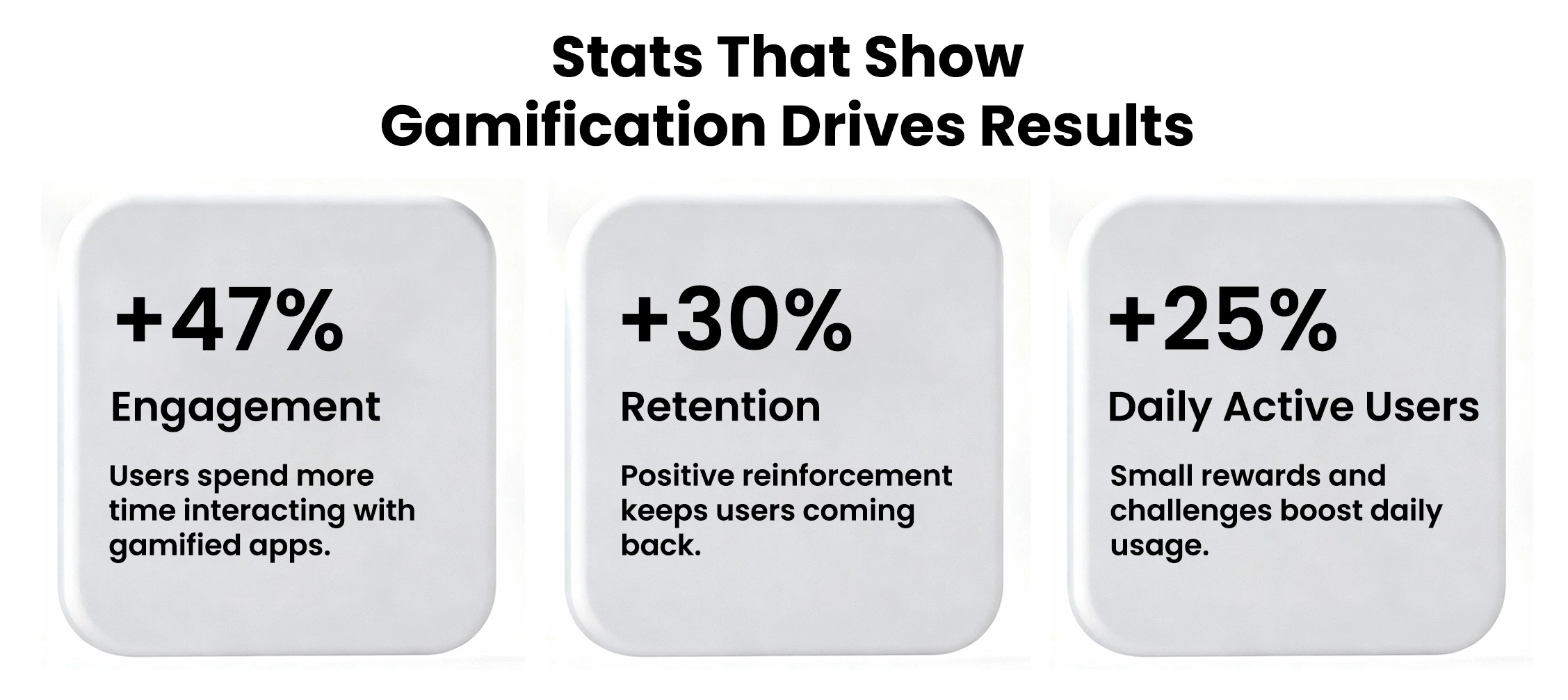
A study by Statista reveals that gamified apps show up to 47% higher engagement than traditional ones. For FinTech, where user retention is often a challenge, this is a complete game-changer. The blend of behavioral psychology and smart app design keeps users hooked, motivated, and loyal.
For startups and enterprises investing in fintech app development, gamification is no longer an add-on. It’s a strategic driver of growth. It turns financial management into something users want to do, rather than having to do. So, if you are looking to enhance engagement and retention in financial applications, this guide will show you how gamification makes that happen, step by step. So, stay tuned till the end :
Table of Contents
What Is Gamification in FinTech Apps?
Gamification is the application of game mechanics, such as rewards, progress bars, challenges, and levels, to enhance user experiences. In FinTech apps, it transforms routine financial activities into enjoyable, habit-forming interactions.
From digital banking gamification to budgeting apps with reward systems, the goal remains the same: motivate consistent user action and build loyalty.
Examples include:
- Revolut is offering cashback rewards for completing spending goals.
- Step encouraging Gen Z users to build savings streaks through daily challenges.
This user-first design not only increases app usage but also enhances financial literacy and trust.
Why FinTech Apps Need Gamification Today
FinTech users have endless options. What keeps them from switching apps? Engagement. Gamification bridges this gap by giving users reasons to stay longer and interact more.
1. Simplifies Complex Financial Concepts
Finance often feels complex and overwhelming. But with Fintech app development, adding visuals, levels, and goals turns complexity into clarity. It makes learning about money simple and even fun. Users enjoy exploring your app instead of feeling lost in it.
2. Builds Habitual Engagement
Reward loops create daily app visits. Users return not just to check balances but to complete goals, earn badges, and track progress. This consistency turns engagement into a habit. Therefore, boosting retention and lifetime value.
3. Encourages Financial Discipline
By gamifying budgeting and saving, users learn self-control naturally. It promotes consistent saving and reduces impulsive spending, and that too without external push.
4. Personalizes User Motivation
Gamified FinTech apps can adapt rewards and challenges to each user’s financial behavior. Whether it’s hitting a savings milestone or reducing expenses, personalization keeps users emotionally connected to their progress. For startups building custom mobile app development solutions, that translates to happier users and stronger retention.
5. Turns Finance into a Community Experience
Leaderboards, challenges, and social sharing features inspire friendly competition. When users see peers achieving their financial goals, it motivates them to stay active and strive for similar success.
Core Gamification Strategies for FinTech Apps
Now, let’s explore the main mobile app gamification strategies transforming financial applications. These FinTech user engagement strategies go beyond simple reward systems as they blend behavioral psychology, design, and data-driven personalization to keep users consistently active. The app gamification strategies aim to make financial management more intuitive, habit-forming, and rewarding.
1. Points and Badges: The Foundation of Motivation
Users earn points for actions like paying bills, saving regularly, or referring friends. No doubt that points act as instant gratification. They are something humans naturally respond to.
Badges, on the other hand, symbolize achievement. They make progress visible and socially shareable. For a globally recognized fintech app development company, designing a badge system encourages retention through recognition.
2. Progress Bars and Levels: Tracking Financial Growth
Progress visualization is powerful. Showing users how close they are to a goal like saving ₹10,000 or repaying a loan creates positive reinforcement.
Each level achieved strengthens the user’s trust and emotional connection with the app to a great extent.
3. Challenges and Missions: Turning Routine Into Excitement
Introducing weekly or monthly challenges keeps engagement alive. For example, a “No-Spend Week Challenge” or “Save ₹5000 in 30 Days” sparks curiosity and competition.
Startups investing in professional IT consulting services can leverage analytics to personalize these missions for every user segment.
4. Leaderboards and Social Sharing: Driving Friendly Competition
Competition drives commitment. Leaderboards let users compare progress with friends, fostering community engagement. This approach works well for gamified financial apps that encourage referrals or team-based savings goals.
5. Rewards and Incentives: Tangible Motivation
Rewards like cashback, vouchers, or loyalty points give users a clear reason to stay engaged. They turn every financial action, such as saving, investing, or paying bills, into something instantly satisfying. FinTech startups leveraging mobile app development service can design smart, multi-tiered reward systems in fintech apps that keep users motivated while maintaining profitability.
How Gamification Impacts User Behavior in FinTech
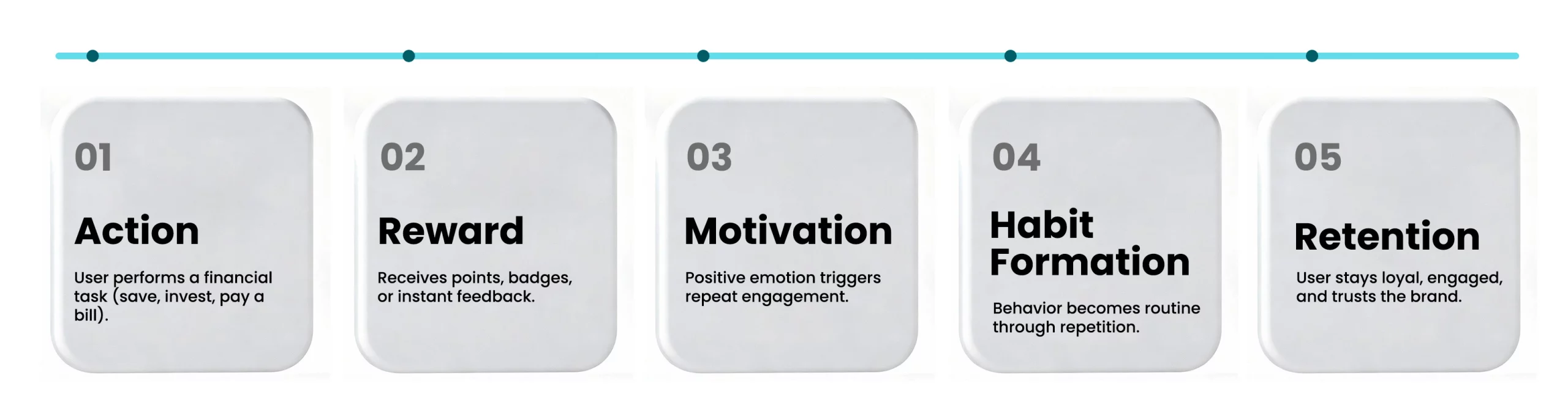
Gamification is not about making apps “fun.” It’s about driving specific behaviors through psychology, emotion, and consistent feedback to keep users engaged. Here’s how it transforms the user journey step by step :
1. Action: Turning Financial Tasks into Triggers
Everything begins when a user performs a task such as saving, investing, or paying a bill. Instead of being a chore, these actions become meaningful milestones that lead somewhere rewarding. By connecting every action to a visible goal, users instantly understand the value behind their efforts. This small shift transforms passive participation into active involvement.
2. Reward: Delivering Instant Satisfaction
Every completed action triggers a small win. It may include points, badges, or progress notifications. These rewards close the motivation loop and give users an immediate sense of achievement. Not only this, but it keeps them emotionally connected to your app. The quicker the feedback, the stronger the engagement; users crave that sense of “I did something right,” which keeps them coming back. Rewards also increase trust & transparency, which improves when users see clear results of their actions.
3. Motivation: Reinforcing Positive Emotions
With every reward, the brain releases a positive response. This emotional lift becomes the reason users come back. Over time, motivation grows not from obligation, but from the satisfaction of progress. When users feel appreciated for even small actions, they start associating financial management with emotional fulfillment instead of stress.
4. Habit Formation: Building Daily Financial Routines
Repetition turns action into habit. As users repeatedly engage in several activities such as checking goals, tracking savings, and completing challenges, financial management becomes part of their daily rhythm without extra effort. Gradually, these micro-actions evolve into long-term routines that strengthen user loyalty and improve financial well-being.
5. Retention: Creating Loyalty and Trust
Once the habit forms, users stay for a long time. They not only trust the app but also associate it with personal growth. Especially for FinTech startups, this behavioral design leads to long-term engagement and stronger brand relationships. Users begin to see the app not as a tool but as a trusted financial partner that understands and rewards their progress.
Read Also : Top Fintech App Development Companies
Real-World Examples: FinTechs Winning with Gamification
Several FinTech apps have successfully turned financial tasks into engaging, habit-forming experiences. Several top brands use reward systems, progress tracking, and social challenges to keep users coming back. These apps don’t just provide services, but they try to create an interactive journey where every transaction, goal, or milestone feels rewarding.
By studying these app gamification examples, startups and enterprises can see how thoughtful gamification drives higher engagement, builds trust, and strengthens user loyalty. So, here are a few of them:
1. Revolut
Revolut uses achievement badges and spending analytics that show how close users are to specific goals. Mobile app gamification drives its user engagement and retention, which is one of the major reasons it’s leading the digital banking market.
2. Monobank
Monobank in Ukraine turned credit management into a playful experience with achievements for timely payments and spending targets.
3. Step Finance
A teen-focused app, Step rewards users for maintaining streaks, inviting friends, and hitting savings goals. It combines gamified missions with personalized guidance.
4. Acorns
Acorns gamifies investing by rounding up spare change from purchases and rewarding users for consistent saving. The visual growth tracking makes the investing approachable for first-time users.
These examples show that gamification applications don’t need to be complex, but they need to be consistent and meaningful.
Design Principles for Effective FinTech Gamification
1. Align with Core Business Goals
Gamification should enhance business outcomes like higher retention, transaction volume, or subscription upgrades. Random rewards without purpose create noise, not value.
2. Keep User Psychology at the Center
Understand what motivates your target audience. Gen Z responds to instant rewards, while professionals may value long-term achievements.
3. Ensure Simplicity and Accessibility
Gamification should simplify for users, not complicate the financial experience. Try to keep interfaces intuitive and messages clear.
4. Maintain Security and Compliance
Financial data security cannot be compromised. Work with an experienced mobile app development company in New York that understands compliance with data protection laws like GDPR or PCI DSS.
5. Personalize the Experience
Using analytics and AI, tailor challenges and rewards for each user. Personalized gamification keeps users emotionally connected and returning frequently.
The Business Value: Why Startups Should Invest in Gamified FinTech Apps
Gamification is not just about increasing your app engagement, but it’s more about measurable growth. Here’s how it impacts the bottom line:
1. Increased App Retention and Loyalty
Gamified feedback loops keep users active. They spend more time in-app and are more likely to continue using it over competitors.
2. Reduced Customer Acquisition Costs
Engaged users are your best marketers. They share achievements, refer friends, and contribute to organic growth. Thus, helping startups lower overall FinTech app development costs by cutting down on heavy marketing and retention expenses.
3. Higher Lifetime Value (LTV)
Regular users are more open to premium upgrades, paid features, and integrated financial products.
4. Data-Driven Insights
Gamification interactions reveal patterns in user behavior. FinTechs can use these insights to improve personalization, upsell opportunities, and user experience.
5. Competitive Differentiation
In a saturated market, gamified design gives startups an emotional edge. It humanizes finance and creates experiences that users truly value. Startups leveraging professional MVP development services can use gamification to test these engaging features early. You can set your app apart while validating core concepts with real users.
Comparison Table: Gamified vs Non-Gamified FinTech Apps
| Feature | Non-Gamified Applications | Gamified Applications |
| User Engagement | Low and short-term | High and consistent |
| Retention Rate | 25–30% | 55–60% |
| Average Session Time | 3–4 mins | 8–10 mins |
| Emotional Connection | Minimal | Strong (due to rewards & progress) |
Emerging Trends in FinTech Gamification for 2026
1. AI-Driven Personalization
By 2026, the role of AI in fintech will power dynamic challenges, adaptive rewards, and context-aware interactions. FinTech apps will predict user behavior and modify gamified journeys in real-time.
2. Behavioral Analytics for Deeper Insights
Behavioral science will merge with app analytics. FinTechs will decode why users act a certain way and design interventions that encourage positive habits.
3. Social Gamification Features
Expect more community-driven models. There will be team-based saving goals, group investment leagues, and social leaderboards. This collective engagement fosters trust and virality.
4. Virtual Economies and Tokenization
Gamified digital tokens or loyalty coins will integrate into broader ecosystems. Users will earn, trade, or redeem them across partner platforms. Therefore, making gamification part of a larger economy.
5. AR/VR-Enabled Financial Education
Immersive gamified tutorials using AR or VR will simplify complex finance topics, making them accessible to all age groups.
6. Voice-Enabled Gamification
Voice assistants will deliver daily financial missions, budget streaks, or investment challenges. Thus, integrating convenience with engagement.
Read Also: An Ultimate Guide to Fintech Software Development: Key Features, Benefits, And Cost
How to Implement Gamification in Your Fin Tech App
To design gamified experiences that deliver business impact, startups should collaborate with an industry expert and follow the roadmap :
1. Define Clear Objectives
Identify whether your goal is education, engagement, or retention. Align every gamified feature with measurable outcomes.
2. Choose the Right Mechanics
Select from points, levels, leaderboards, or rewards based on your target user base and business model.
3. Integrate Data Analytics Early
Track metrics like session duration, conversion rate, and challenge completion to optimize gamification performance.
4. Test and Iterate
A/B test different game mechanics to find what works best. Continuous iteration ensures sustained engagement.
5. Partner with Experienced Developers
To bring these ideas to life, hire mobile app developers skilled in UX psychology, security, and FinTech compliance. The right team ensures your gamified applications scale with innovation and safety.
Wrapping Up
Gamification is no longer an add-on feature for FinTech apps, but it’s a core strategy for driving adoption, engagement, and loyalty. By turning everyday financial actions into rewarding experiences, apps create stronger emotional connections with users.
As AI and behavioral analytics evolve, the next wave of FinTech innovation will be defined by personalization, where every reward, challenge, and goal feels tailor-made. Moreover, fintech apps that blend security, usability, and motivation will not only attract users but also keep them engaged in the long run. So, if you’re planning to enhance your FinTech app, start small but think long-term. Build features that make users return, explore, and trust your brand every day. The more value they feel, the stronger your retention and revenue outcomes will be.
FAQs
Q1. What are the key gamification features for FinTech apps?
Popular features include reward systems, achievement badges, referral bonuses, and daily challenges. These elements create a sense of progress and satisfaction that encourages consistent app use.
Q2. Can gamification increase app adoption rates?
Yes. Gamified onboarding and instant rewards attract first-time users. When users see value quickly, they’re more likely to complete registration and stay engaged.
Q3. How can FinTech startups integrate gamification effectively?
Startups should align game mechanics with user goals like saving money or learning finance. Using micro-rewards, streaks, and personalized progress insights can build habits without overwhelming users.
Q4. Is gamification secure for financial applications?
Absolutely. Gamification enhances user experience but doesn’t affect transaction security. Therefore, developers must ensure all reward and progress systems comply with financial data protection standards.
Q5. How does gamification impact user retention in FinTech apps?
Gamification builds emotional connection and habit loops. When users feel rewarded for consistent actions, retention rates rise, and long-term loyalty strengthens naturally.

SHARE
WRITTEN BY

Prankur Haldiya
Chief Technical Officer
A tech innovator and engineering leader, Prankur Haldiya drives RipenApps’ product development strategy and oversees cutting-edge solutions in mobility, AI, and cloud ecosystems. He is passionate about building high-performance teams and helping brands launch secure, scalable, and user-centric digital products.
View All Articles