

Food waste will cost the industry $540 billion by the end of 2026. That breaks down to $1.5 billion per day, or $1 million per minute. This waste is not because the solutions do not exist. Not because operators lack expertise. But because the majority of food businesses are still running on manual forecasting, reactive inventory management, and gut-feel procurement.
AI-equipped competitors eliminate these losses as they are not the ones waiting for AI to mature. AI in food industry is not solving these problems theoretically. It is solving them right now by helping you choose the intelligence layer that will determine the operational and financial future of your business.
Many operators fall into the “efficiency plateau mindset” trap, assuming their current systems are sufficient for today’s scale. The cost of delaying AI adoption can become 3x higher by the time inefficiencies surface.
The message for CTOs and founders is clear. AI is transitioning from a strategic advantage into a baseline capability. In the coming years, the competitive gap will no longer be between businesses using AI and those leading with AI. It will be between those using AI and those struggling to catch up.
To move from awareness to action, you need to partner with a leading restaurant app development company that provides you with a clear strategic roadmap. This guide explains how AI automation is transforming food businesses and what it takes to build an AI-ready operation designed for scale, resilience, and long-term profitability.
Key Takeaways
- Food waste costs the industry $1M/min because most food businesses are still running on manual forecasting.
- AI in food industry operates across 7 value chain layers, from smart cultivation to predictive supply chains.
- Delaying AI adoption costs food businesses 3x more by the time inefficiencies surface.
- Computer Vision inspects 1,000+ units per hour, while a human inspector can manage 500 units per a normal workshift.
- Generative AI, reinforcement learning, and digital twins are reshaping food operations, eliminating kitchen bottlenecks at scale.
Table of Contents
Why AI Adoption is Becoming a Competitive Necessity
The food industry is under pressure from every direction at once. Labour is scarce, margins are thinner, and delivery expectations are rewriting operational systems. These pressures consequently make AI adoption more of a survival imperative, rather than a choice for startup founders and CTOs. Now, let’s examine these forces behind the AI adoption as a boardroom priority:
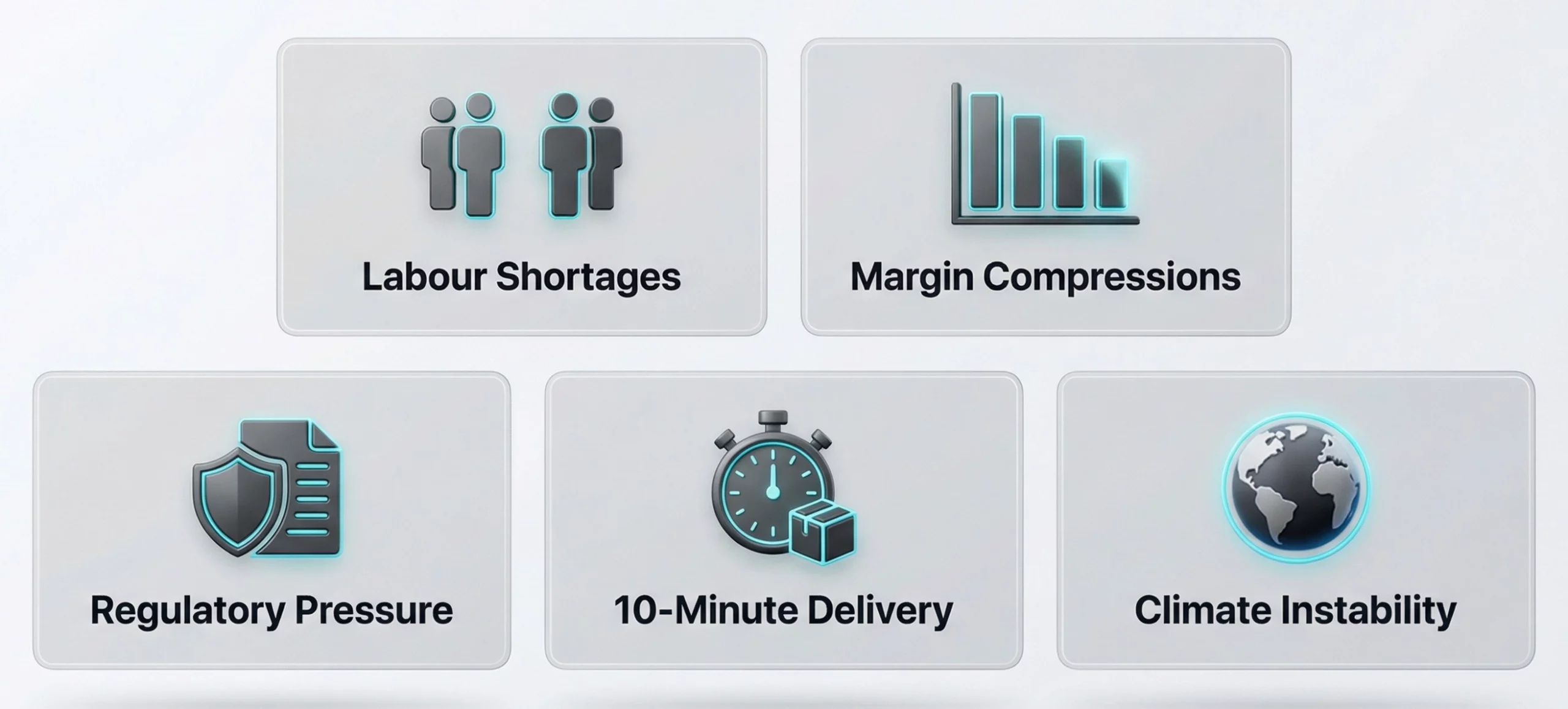
Labour Shortages
The labour crisis impacting food businesses is not isolated; it is part of a broader hospitality workforce shortage. According to the World Travel and Tourism Council report, the hospitality industry faces an expected gap of 8.6 million workers, around 18% below the staffing levels needed. (Source)
This problem of unfilled roles and shortages isn’t going away with the economy shifting and changing user expectations related to the food sector. Many winning organisations right now are using AI to make fewer people capable of upholding new and more responsibilities.
It is the core promise of Industry 5.0 terminology, a philosophy where AI in food industry isn’t replacing human workers but amplifying their handling of repetitive and low-skill tasks. AI isn’t an emerging technology anymore; it now handles demand forecasting, shift scheduling, workflow orchestration, and optimisation. This improves runtime efficiency, thus enhancing user expectations and brand value.
Margin Compressions
Average net margins in restaurants are between 3 to 6%. In catering, the numbers are even lower. Using AI and a small shift towards demand forecasting or digital inventory management planning can work in making improving these margin percentages.
Demand forecasting models trained on various pointers such as point-of-sale data, local events, weather patterns, and social media signals can predict what will sell and what is the required precise quantities that no human can match.
Once demand becomes predictable, AI-driven inventory management systems can automatically track the stock levels and optimise the timely reorders and ingredient usage workflows. This directly leads to improved margins and prevents stockouts that can result in loss of potential sales.
Regulatory Pressure
With the regulatory environment accelerating at a maximum pace, the regulatory governance stack is not just a static layer that you visit annually. It has become a dynamic, evolving framework, and the architecture decisions you make today will determine whether your organisation is meeting obligations from legal regulations like HIPAA, GDPR, FDA, and FSMA.
Moreover, AI in food industry is emerging as the only scalable way to manage this complexity related to compliance. This is because it now extends beyond basic food safety, and this evolving market shift is turning compliance into a technology and infrastructure challenge. Your organisation can utilise computer vision, Edge Computing and On-device AI systems that enable food safety monitoring in the long run.
10-Minute Delivery
The off-premise dining shift has already rewritten the operational rulebook, and now it is rewriting it again. What began as a 45-minute delivery window has compressed to 10 minutes door-to-door. This number is not a fake marketing claim; instead, it is a user expectation trend that has become the new baseline.
Without AI, this level of operation precision is impossible and becomes financially unsustainable. AI enables your food business to build digital twins for supply chains. A digital twin creates a real-time replica of your entire operational environment. This model can then create simulations of demand, inventory, and delivery logistics in real-time.
Climate Instability
This factor has been emerging as one of the operation-disruptive forces that food brands and businesses have ever had to absorb. Now it is accelerating, and unpredictable harvests, water scarcity, and shifting agricultural zones are the early signs that directly impact the overall supply chain reliability and total ingredient availability.
Traditional forecasting models are not sufficient if you have this type of unpredictability related to weather patterns, crop yields, and more. With AI, your organisation can utilise a much more predictive and adaptive supply chain planning model.
Moreover, the use of Gen AI in the research and development (R&D) pipeline can rapidly prototype ingredient substitutions without sacrificing product integrity.
Business Benefits Of AI Automation In The Food Industry
For founders and CTOs, AI in food industry is a direct lever that helps them to build AI-driven systems. But there are various benefits that are increasingly accelerating AI adoption. Below are these core benefits:
1. Faster Time-to-Market
Generative AI in R&D gives you the ability to launch into emerging categories before the window closes. What previously took 18 months of iterative development now takes weeks. Brands that move first into leveraging emerging technologies, functional ingredients, GLP-1-compatible portions, capture early demand, search ranking, and consumer attention that your competitors simply cannot buy back.
2. Higher Customer Lifetime Value
Hyper-Personalisation through nutrigenomics (a tailored nutrition plan based on individuals’ metabolic profile) converts a transactional customer into a retained one.
When a brand’s product recommendation reflects an individual’s metabolic profile, dietary goals, and consumption patterns, switching cost rises organically. This level of loyalty built on genuine relevance is structurally more durable than loyalty built on a points programme or a discount strategy.
3. New Revenue Streams
The Circular Economy model (transition from a linear “take-make-waste” system to a sustainable lifecycle), enabled by AI, identifies commercial uses for surplus or leftover ingredients that manual processes would never surface. For example, spent grain is sold to artisan bakers, fruit pulp is directed to ingredient markets, and whey is routed to sports nutrition channels.
Instead of paying for disposal, this way AI can help your organisation to turn waste into new revenue streams at scale.
4. Premium Contract Eligibility
AI helps food businesses automatically track sustainability data like carbon emissions, supply chain impact, and ESG metrics. This kind of verified reporting is now required for many large contracts, including corporate catering, healthcare institutions, and major retail partnerships. Organisations without this infrastructure are not losing on price. They are not qualifying at all.
5. Investor and Valuation Appeal
An AI-automated food operation separates revenue growth from headcount growth. With Industry 5.0 infrastructure in place, the cost of scaling from ten locations to fifty is fundamentally lower than in a traditional operating model. This stronger unit economic profile, driven by improved EBITDA margins at scale, reduced operational risk, and fully auditable data across the business, is exactly what institutional investors and acquirers are rewarding with premium valuations today.
6. Brand Differentiation
“Clean Label” AI gives brands a defensible, verifiable positioning that marketing claims alone cannot deliver. When your formulation process is governed by an AI system that continuously audits ingredients against evolving user standards, transparency becomes a structural feature and not a campaign claim. In a market where consumers are reading ingredient lists more carefully than ever, that distinction is commercially meaningful.
7. Data as a Proprietary Competitive Asset
Every AI deployment in product development, whether Computer Vision on the production line or Reinforcement Learning optimising delivery routing, generates operational intelligence that accumulates over time into a dataset that competitors cannot replicate. The demand patterns, quality benchmarks, supplier performance records, and consumer preference signals your systems are capturing today become a proprietary advantage that widens with every passing month of operation.
8. Scalability Without Proportional Cost
The growth model that Industry 5.0 enables is structurally different from conventional food business scaling strategies. A demand forecasting model serving ten locations costs nearly the same to run as one serving 100 locations. This means that once the AI system is built and running, the cost of using it doesn’t increase as much as the number of locations grows. This makes growth more efficient and profitable.
9. First-Mover Positioning
Generative AI in R&D combined with real-time social and behavioural signal processing means brands can identify, prototype, and launch into emerging consumer categories, including functional nutrition, GLP-1-adapted formats, and hyper-local sourcing, before those categories are crowded.
The commercial value of being first to leverage these doesn’t just gain initial sales. It helps you to secure long-term brand recognition and market leadership after competitors arrive.
10. Improved Risk Profile
Edge AI in quality control, continuous traceability through OCR pipelines, and predictive maintenance data make a food business more reliable and transparent. This strengthens its position with insurers assessing liability risk, investors evaluating operations, and enterprise clients conducting supplier due diligence.
A lower risk profile is not only a safety advantage; it also reduces the total cost of ownership (TCO), improves contract terms, and strengthens key business relationships.
Top Use Cases of AI in Food Industry
The AI food industry is evolving to serve a growing population while maintaining speed, quality, and sustainability at scale. AI is now the intelligence layer that enables food businesses to operate with higher precision, responsiveness, and resilience. This is done not by automating isolated tasks; instead, by optimising the entire food value chain, from cultivation and production to logistics and last-mile delivery.
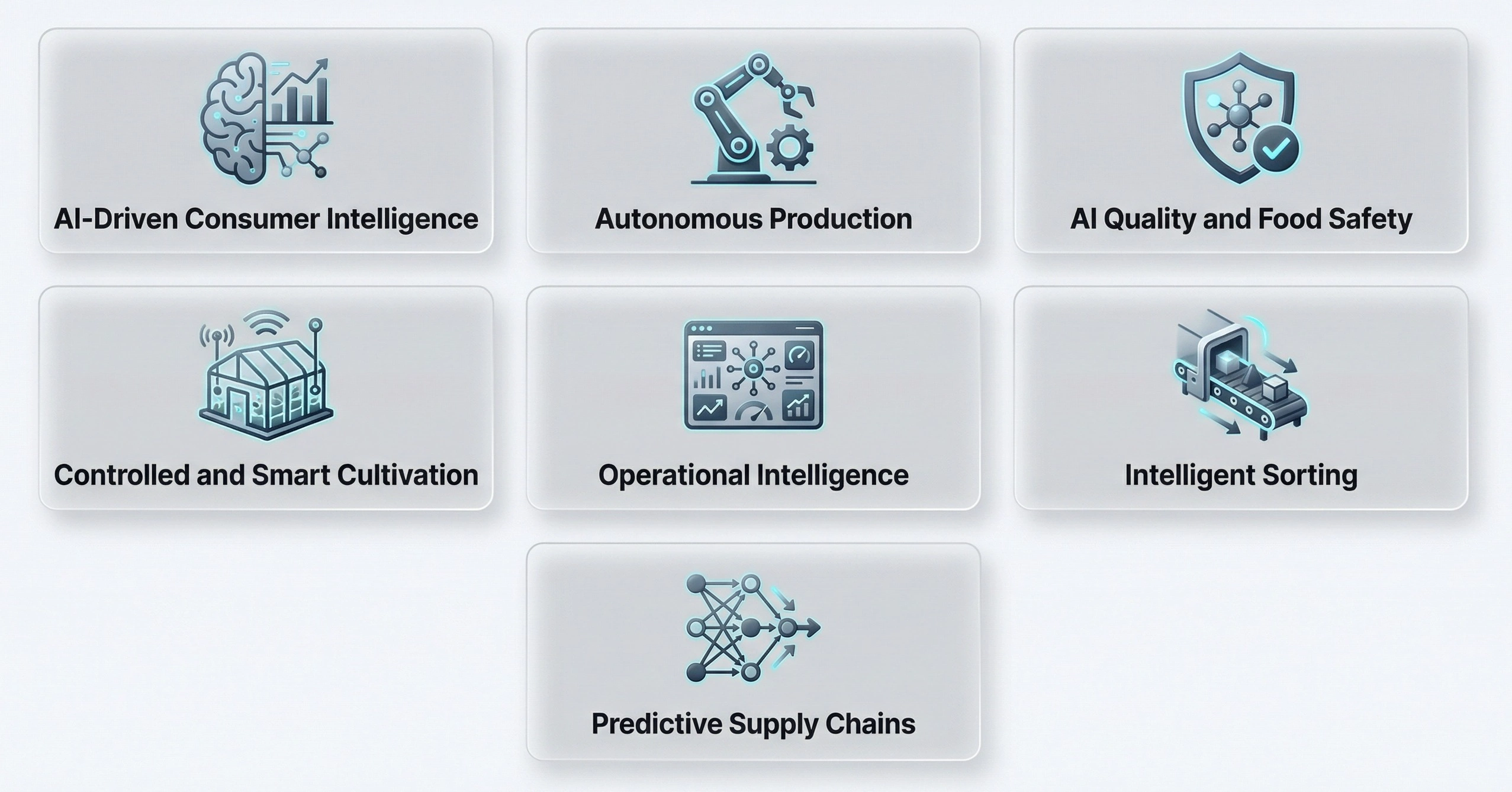
Below are the core use cases where AI in food industry is already creating measurable operational and commercial impact.
AI-Driven Consumer Intelligence
Most food businesses track trends after they have already peaked. By the time a menu item is reformulated or a new product is greenlit, the window has closed and a competitor has already moved. If your product strategy is built on lagging market data, you are not competing. You are catching up.
AI changes that entirely. By analysing point-of-sale data, weather patterns, local events, and real-time social signals, AI systems identify emerging food preferences before they go mainstream. Generative AI in R&D simulates recipe variations, tests flavour combinations, and analyses consumer sentiment continuously. The result is fewer failed launches, faster time-to-market, and a brand that consistently arrives ahead of the trend.
Autonomous Production
Labour is your most unpredictable cost. One bad hiring month, one resignation wave, one seasonal surge, and your production capacity is in jeopardy.
A business that cannot produce consistently cannot scale.
Reinforcement learning models continuously analyse preparation time, order volume, staffing levels, and kitchen capacity to eliminate bottlenecks and improve throughput in real time. The result is a self-optimising kitchen that increases output without increasing headcount. On margins of 3 to 6%, that is the difference between scaling profitably and scaling yourself into the ground.
AI Quality and Food Safety
One contamination incident can erase years of brand equity overnight. One failed audit can cost you an enterprise contract that took two years to win. Manual inspection cannot prevent either outcome. Human inspectors miss things. They get tired. They have bad days. Computer Vision and Edge AI systems do not.
These systems run continuously, flag deviations in real time before they become recalls, and generate the audit trail that regulators and enterprise clients now demand as a baseline condition. Without this infrastructure, you are not just exposed to risk. You are structurally unqualified for the contracts that drive real growth.
Controlled and Smart Cultivation
Ingredient quality problems rarely start in the kitchen. They start in the field, weeks before they show up in your production line. By the time a supply issue is visible, the damage is already done.
AI transforms cultivation into a predictive, data-driven process. Smart sensors, drones, and machine learning models monitor soil health, crop growth, irrigation patterns, and pest activity in real time. Growers adapt to climate instability before it becomes a supply shortage.
When you can predict ingredient quality weeks in advance, your entire supply chain becomes more reliable, and your production model becomes structurally more resilient than your competitors.
Operational Intelligence
In traditional food operations, diagnosing a production problem is slow, expensive, and reactive. By the time the root cause is identified, the marginal damage is done and the customer experience is already compromised.
AI continuously scans production data, supply chain activity, and equipment performance for anomalies, surfacing issues before they escalate. Over time, every issue your system identifies adds to a growing intelligence layer.
Six months in, your system is not just reacting faster. It is preventing problems it has already learned to recognise.
Intelligent Sorting
Sorting and classifying ingredients is exactly the kind of repetitive, low-skill work that drains your team, consumes your payroll, and adds zero strategic value to your business. AI-powered robotic systems using Computer Vision automate this process with greater accuracy and consistency than any manual workflow can deliver.
In a labour market where every hour is scarce and every dollar of payroll is scrutinised, that reallocation is a competitive advantage.
Predictive Supply Chains
The 10-minute delivery expectation has not just raised the bar. It has rewritten the game entirely. Without real-time supply chain intelligence, meeting that expectation at scale is operationally impossible and financially unsustainable.
Digital twins for supply chains create live simulations of demand, inventory levels, logistics, and delivery routes simultaneously. Disruptions are predicted before they occur. Routing is continuously optimised. Inventory is positioned accurately across multiple locations without manual intervention.
This is not an incremental logistics improvement. It is the infrastructure that makes ultra-fast delivery economically viable at scale.
Critical AI Technologies Every Food Business Must Deploy
With the evolution of AI, the AI food industry is not the same as it was even 18 months ago. It started as a basic automation and forecasting strategy and has evolved into a technology stack. And if you are still thinking of AI as “something to explore in the next quarter”, you are already behind in this competitive race.
Here are the technologies behind the transformation of the AI food industry:
Computer Vision and Visual AI
Computer Vision uses cameras and machine learning models to “see” and analyse food products in real time. Edge AI runs these models locally on devices, removing the need for constant cloud connectivity and enabling instant decision-making on the production floor.
Why It Matters:
Manual quality inspection is often slow and expensive, as a human inspector working an 8-hour shift can review approximately 500 units. And one contaminated batch slips through, and the fallout can escalate into six-figure recall costs, regulatory penalties, lost contracts, and long-term brand damage.
While computer vision systems inspect 1000 or more per hour with zero fatigue. These systems detect contamination, measure portion consistency, verify packaging integrity, and flag deviations before defective products leave the line.
Real-World Example:
Domino’s deployed its “DOM Pizza Checker”, a Computer Vision system that scans every pizza before it leaves the kitchen. The system, now operational across hundreds of locations in Australia and New Zealand (with ongoing global expansion), uses cameras mounted above the cut bench to analyse pizza quality in real time.
Generative AI in R&D
Generative AI models like GPT, DALL-E, and other custom formulation engines in the Research and Development phase analyse millions of recipes, ingredient databases, consumer reviews, and nutrition data to generate new product concepts or packaging workflows in 3 to 4 hours instead of months.
Why It Matters:
With traditional R&D models, you go slowly and ideate, formulate, test, reformulate, test again, and then launch in 12-18 months. Gen AI eliminates most of this timeline.
It can simulate thousands of recipes and their variations instantly, predict flavour profiles based on molecular composition, and thus generate product concepts before your competitors have even started their traditional R&D phase.
Real-World Example:
NotCo, the Chilean plant-based food company valued at $1.5 billion, built its entire product development process around a proprietary Generative AI platform called “Giuseppe.” The system has been instrumental in developing NotMilk, NotBurger, NotIceCream, and other products now sold across the U.S., Latin America, and beyond.
Reinforcement Learning
Reinforcement Learning (RL) is a type of AI that learns through trial and error, and it continuously improves its decision-making. RL models control kitchen workflows, optimise prep sequences, adjust cooking times, and coordinate staffing to maximise throughput while minimising waste.
Why It Matters:
Manually managing all the ingredient deliveries and equipments erode margin on waste, missed orders, and overtime, leading to kitchens running at 60 to 70% efficiency.
Reinforcement Learning models learns what works, what does not, and enable your organisation to get better every single day. Observes your kitchen in real time, from prep times, order flow, and equipment status to staff schedules, to eliminate bottlenecks.
Real-World Example:
Chipotle has been deploying AI-driven kitchen optimisation systems across its fleet of over 3,000 locations. While not all locations run full Reinforcement Learning systems, Chipotle’s “Autocado” (automated avocado processing) and digital kitchen display systems powered by AI demonstrate how RL principles are being applied to improve throughput during peak hours.
NLP for Consumer Intelligence
Natural Language Processing analyses text data and then reviews social media posts, search queries, and customer support tickets to extract insights about end users’ preferences, sentiment, and emerging trends. It understands context, sarcasm, slang, and regional language variations.
Why It Matters:
Most food businesses track consumer feedback reactively. You wait for reviews to pile up, manually read through hundreds of comments, and try to identify patterns. This approach is slow.
With natural language processing (NLP) technology, you can process thousands of reviews, social posts, and support tickets in minutes. It quickly identifies what consumers love, what they hate, and which ingredients they are requesting.
Real-World Example:
Starbucks’ “Deep Brew” AI initiative includes sophisticated NLP systems that analyse customer feedback, social media conversations, and order data to optimise menu development, marketing campaigns, and store operations.
Predictive Analytics and Digital Twins
Predictive Analytics uses historical data, machine learning models, and external signals (weather, events, social trends) to forecast future demand, supply chain disruptions, and operational bottlenecks. Digital Twins create virtual replicas of your entire operational kitchen, supply chains, and delivery network. It allows you to simulate changes before implementing them in the real world.
Why It Matters:
Every major decision in food operations, like opening a new location, changing suppliers, adding a menu item, or expanding delivery radius, involves risk. Make the wrong call, and you waste capital, burn margin, and damage customer experience. Make it without data, and you are gambling.
Predictive Analytics removes this type of guesswork. It tells you what will sell tomorrow, next week, and next quarter based on patterns your manual forecasting would never detect. Digital Twins let you test operational changes in simulation before you risk your real money.
Real-World Example:
McDonald’s acquired Dynamic Yield in 2019 for $300 million specifically to deploy AI-driven predictive analytics and personalisation across its global restaurant network. The system powers dynamic menu boards that change in real time based on predictive models.
Challenges While Deploying AI and Its Technologies (How to Overcome Them)
The actual difference between a success and a failure is how you plan for the challenges. Businesses that ignore these challenges are the ones that spend 6 to 12 months building something they cannot use profusely.
Data Readiness: Your Foundation is Probably Broken
Your business operates in a fragmented data environment, which is not just unreliable; it is actively dangerous because it creates false confidence and even results in bad predictions.
You cannot train a demand forecasting model on incomplete sales data. You cannot deploy Computer Vision quality control if your quality standards are documented in three different formats across five locations.
Plan of Action:
Before you sign a contract with any top product development agency, you should conduct a data audit. This will enable you to identify where your data lives, how clean it is, and what is required to make it usable at scale.
Vendor Selection: Avoid Lock-In That Kills Flexibility
The AI vendor landscape for food businesses is expanding rapidly, and not all solutions are built with the same depth or longevity. Choosing a vendor that provides structured MVP development services is critical because it allows you to evaluate performance, integration complexity, and vendor reliability before committing to large-scale contracts.
If your vendor goes out of business or decides to 10x their pricing, and you cannot migrate your data or replace their system without starting from scratch, you do not own your AI infrastructure. You are actually renting it.
Plan of Action:
Prioritise vendors who support open standards, offer API-accessible data, and have clear data portability commitments. Evaluate not just the capability of the product today, but the architectural flexibility it provides as your needs evolve.
ROI Visibility: Your Investment Probably Does Not Justify
The initial upfront cost of AI deployment can be significant. From infrastructure and vendor contracts to staff training and integration work, you ned to commit $100,000 to $500,000 if you need to run on 3 to 6% net average margins.
This isn’t a casual decision, and if you cannot articulate the ROI to your investors or board in specific numbers, the project will never get funded.
You need a proper business case, not like “we think this will improve efficiency”. Something like “this will reduce waste 5% approximately and save $140,000 annually, with an 11-month payback”.
Plan of Action:
You need to scope every AI investment around measurable outcomes from day one. Tie each deployment to a specific operational metric that you can baseline before deployment and measure after.
Before deployment, establish the baseline. After deployment, measure the delta. If you cannot measure it, do not fund it.

AI Implementation Roadmap for Food Businesses
If you are waiting for the “perfect time” to adopt AI, you are already late. The organisations winning in 2026 are not experimenting with AI. They are operationalising it. Here is a phased execution roadmap while leveraging AI in food industry:
Phase 1: Identify High-Impact Use Cases
Duration of this phase: 0 to 3 Months
Start where ROI is measurable and fast. Demand forecasting, inventory optimisation, quality monitoring, and delivery routing are typically the highest-return entry points. Your goal in this phase is not transformation. Your goal is proof of value.
Phase 2: Build the Data Foundation
Duration of this phase: 3 to 6 Months
AI cannot scale on fragmented systems. Consolidate POS data, supply chain data, customer feedback, and operational metrics into a unified data layer. This step determines whether your AI investment compounds or stalls.
Phase 3: Deploy Pilot Systems
Duration of this phase: 6 to 9 Months
Launch controlled pilots in a limited number of locations or production lines. Measure waste reduction, throughput improvements, delivery time changes, and labour cost impact. This phase creates the business case for scaling.
Phase 4: Scale Across Operations
Duration of this phase: 9 to 18 Months
Once ROI is proven, expand deployment across locations, supply chain partners, and production facilities. This is where the economics change. AI infrastructure scales. Headcount does not.
Phase 5: Build Continuous Optimisation
Duration of this phase: 18+ Months
At maturity, AI becomes your operational intelligence layer. Forecasting improves continuously. Supply chains adapt automatically. Quality monitoring becomes fully automated. At this final stage, AI in food industry is no longer a project. It is core infrastructure.
Wrapping Up
AI adoption in the food industry is no longer an innovation initiative. It is an operational survival strategy. If you are still running forecasting in spreadsheets, managing kitchens with static schedules, or relying on manual quality checks, you are not competing on a level playing field. You are operating with a structural disadvantage. The next category leaders are being built today. You need to decide whether you want to be one of them.
Whether you are planning a full operational transformation or exploring your first AI use case, you should partner with a modern software development company that provides strategy and engineering expertise for measurable ROI. At RipenApps, we architect intelligent food-tech platforms.
We have helped startups and global brands like WhereToGo that simplifies users’ travel planning and social outings, and EmmyHealth, a digital healthcare platform that streamlines patient engagement through smart technology.
FAQs
1. How much does AI implementation cost for a food business?
Initial AI deployments typically range from $100,000 to $500,000, depending on scope, infrastructure, and integration complexity. However, most organisations target payback periods of 12 to 18 months through reduced waste, labour optimisation, and improved demand forecasting.
2. What is the fastest AI use case to implement in food operations?
Demand forecasting and inventory optimisation usually deliver the fastest ROI. These systems can reduce food waste by 20 to 30% and improve stock availability within the first few months of deployment.
3. Do small and mid-sized food businesses need AI, or is it only for large enterprises?
AI adoption is no longer limited to global brands. Cloud infrastructure and AI platforms have lowered the barrier to entry. Smaller businesses can deploy targeted AI solutions and achieve meaningful efficiency gains without enterprise-scale budgets.
4. How long does it take to see ROI from AI adoption?
Most organisations begin seeing measurable operational improvements within 6 to 9 months. Full-scale ROI typically becomes visible within 12 to 18 months as deployments expand across operations.
5. What is the biggest mistake companies make when adopting AI?
Treating AI as a technology experiment instead of a business strategy. Successful adoption starts with measurable business outcomes, clear data readiness, and a phased rollout plan aligned with operational goals.

SHARE
WRITTEN BY

Manish Kumar

Manish is a Senior Technical Content Writer at RipenApps. He has over 7+ years of experience and holds immense tech knowledge. His educational background in science and expertise in the IT domain has made him an expert writer. He has authored various tech blogs and guest posts for leading sites. When he is not writing, he researches on the latest market trends and reads sci-fic novels.
View All Articles