

With changing customer expectations, people no longer want to wait on hold or fill out long support forms to get simple answers. They expect instant responses, personalized interactions, and real-time solutions. This is where AI chatbots come in, driven due to advancements in natural language processing (NLP), machine learning, and AI.
According to Gartner insights, utilizing AI chatbot development trends drove up the customer satisfaction score to 75% and reduced escalations. The market overview of AI chatbots has been tremendous and has witnessed massive growth since businesses and startups across industries are increasingly investing in AI chatbot trends to stay competitive.
In fact, it’s growing at a CAGR of over 23.3% and is expected to reach $27.29 billion by the end of 2030. In the USA chatbot market, it’s thriving due to a strong emphasis on customer experience and operational efficiency. But how the modern AI chatbots evolved from simply being a predefined, rule-based assistant to intelligent chatbots that understand intent and deliver accurate results?
In this blog, we will provide a brief overview of AI chatbots, how they differ from traditional ones, key benefits, and top AI chatbot development trends shaping 2026. We will also help you understand the real-world use cases of AI chatbots and the challenges or considerations to overcome.
Table of Contents
The Evolution of AI Chatbots & How They Work
Traditionally, early chatbots were designed to follow a predefined script, and these chatbots could only respond to specific and basic commands, making the interactions rigid. As user expectations were evolving, these rule-based bots often failed to deliver meaningful and flexible conversations, especially when users typed anything outside their fixed rules.
With the advent of major technological transformations, such as improved NLP technology and machine learning algorithms, modern AI chatbots emerged and became capable of understanding context and natural human language. AI chatbots are software or mobile applications that use artificial intelligence, ML algorithms, and NLP to engage with users like humans through text or speech.
ow, you must be wondering how they work after the required human assistance for training and supervision. These modern AI-powered chatbots analyze user inputs and determine their intent to generate relevant and customised responses. They also learn from interactions and enable you to provide natural and complex, human-like conversations.
Traditional Chatbots Vs. AI Chatbots: A Brief Comparison Table
To understand how both types of chatbots, that is, basic rule-based chatbots and AI chatbots, differ from each other, it’s crucial to look at the comparison table below. The table highlights the various parameter and their core capabilities side by side. So, let’s get into this:
| Factor | Traditional Chatbots | AI Chatbots |
| Conversation Flow | Fixed and predefined, rule-based replies | Dynamic responses with intelligent recommendations |
| Personalization | Not available | Highly personalized and customized experiences |
| NLP Usage | Not supported, very limited | Uses advanced natural language processing models |
| Human-like Interactions | No, rigid and fixed responses | Yes, natural and fluid conversations |
| Multilingual Support | Limited, as you have to predefine all the rules manually | Supports multiple languages and caters to global audiences |
| Handling Complex Queries | No accurate results while facing vague or critical inquiries | Provide accurate and natural conversations that enhance user experience |
| Scalability | Depends on manual staff efforts for updates | Have self-learning capabilities that provide highly scalable AI chatbot solutions |
This comparison clearly highlights the need to develop AI chatbots that are smart and provide intelligent and instant interactions. To successfully develop an AI chatbot that completely resonates with modern business goals, you must consider leveraging reliable mobile app development services in USA. These top services can help you build a scalable and high-performing AI chatbot solution that is perfectly tailored to industry-specific needs.
Why Businesses Today Need AI Chatbots: Key Reasons & Benefits
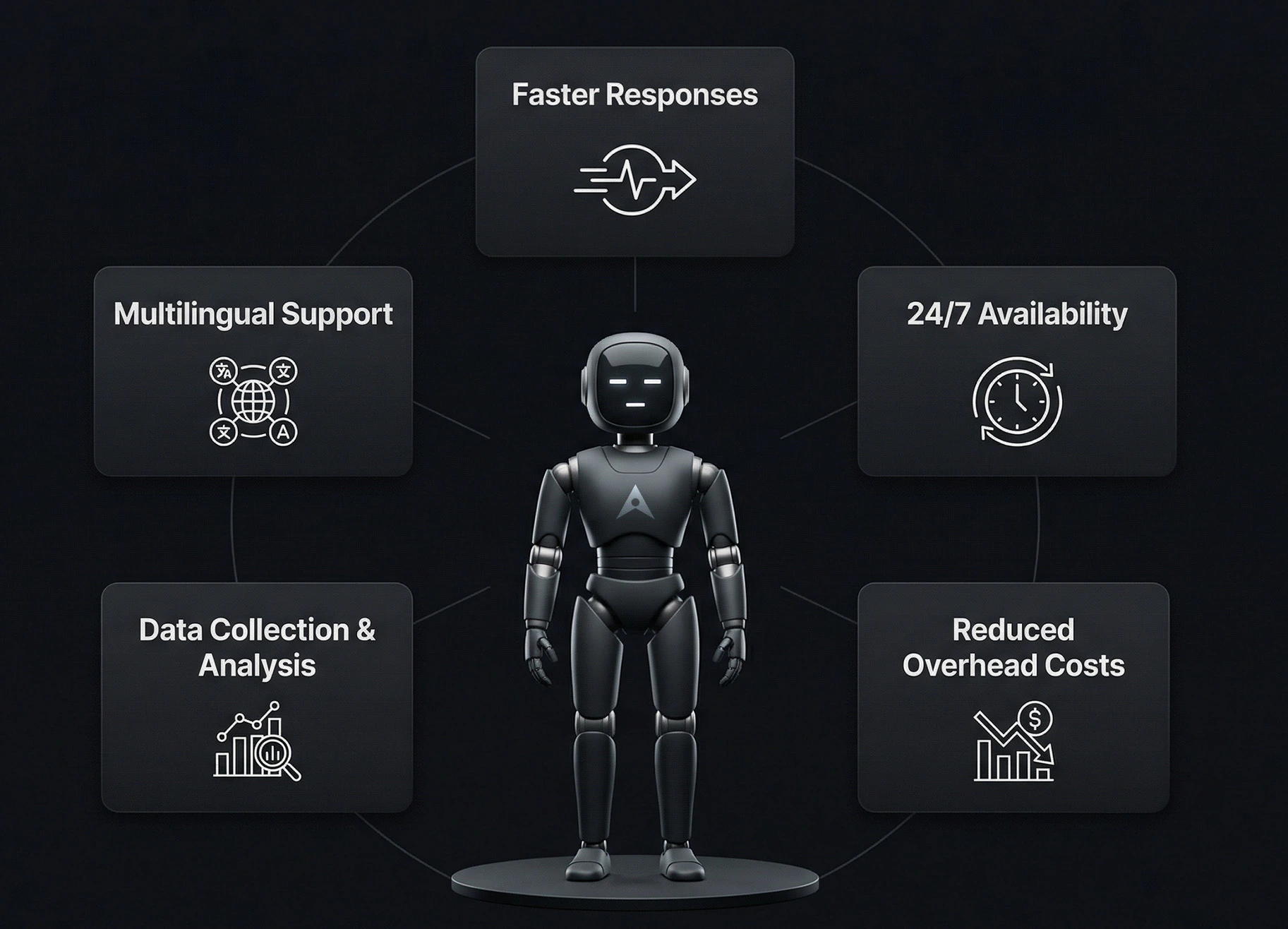
With increasing demand for users preferring smart and instant conversations with no particular rule-based limitations, modern AI chatbots have become a necessity for all types of industries. Some of the key industries utilising AI chatbots are retail, banking, healthcare, education, etc. These industries and many businesses are adopting AI chatbots to deliver faster, smarter, and more flexible customer support to their end users.
Below are some of the top business benefits you can have access to while developing next-gen AI chatbots:
1. Faster Responses
AI chatbots are designed to work in such a way that users will have access to quick answers to their common questions. This means that, with an AI bot, you can reduce the overall wait time and increase the user satisfaction levels.
2. 24/7 Availability
These chatbots also work as a virtual receptionist, providing round-the-clock user support. This means that these can function without any human agent and offer users support at any time, especially after working hours.
3. Reduced Overhead Costs
Instead of having a live staff working 24/7, developing and managing AI customer service chatbots is a cost-effective way to handle queries. By choosing an AI chatbot, you can provide assistance after working hours, resulting in lower chatbot development costs, and human agents can work on complex tasks rather than managing simple queries as well.
4. Data Collection and Analysis
AI chatbots can analyze and predict insights if they’re designed to collect useful user data by consent. This helps you in improving your end users’ experiences and providing them with better services and products.
5. Multilingual Support
By building an advanced AI chatbot, which has a multilingual processing system, you can cater to a larger user base. This is because your advanced AI chatbot can understand and respond to multiple languages, which results in improved accessibility.
Key AI Chatbot Development Trends: A Curated List
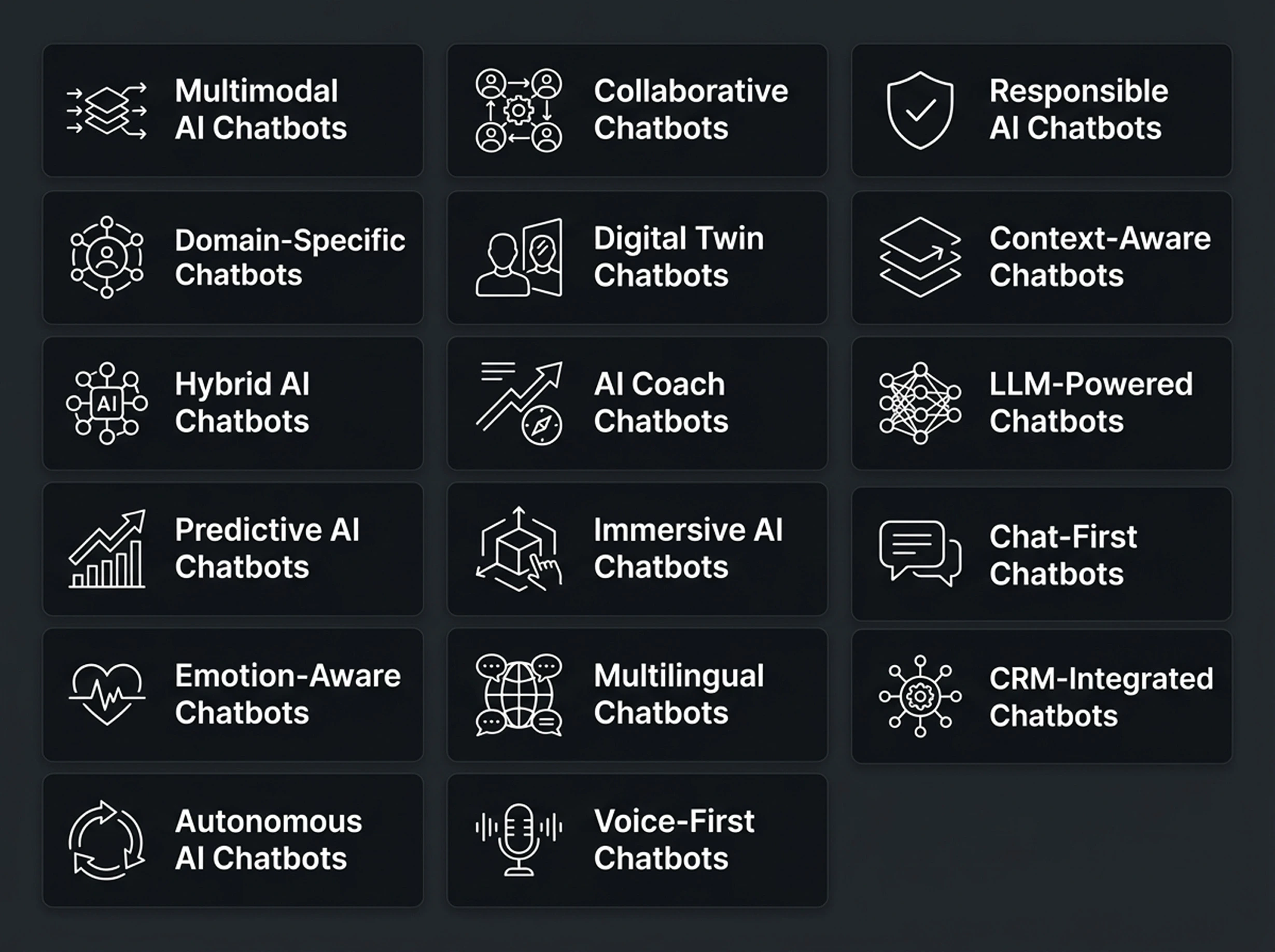
Many organizations are finding new strategies for developing chatbot apps like ChatGPT. Businesses are adopting advanced AI chatbots and their development trends to support real-time and personalized conversations and enable users to experience seamless and human-like interactions across multiple platforms. Now, let’s explore these AI chatbot development trends below:
1. Multimodal AI Chatbots
Modern-day users no longer want to engage with bots that can only converse with users through text. This is why enterprises are utilizing this crucial AI chatbot development trend and increasingly adopting multimodal bots that support text, audio, video formats, and visual input. According to Gartner research, by 2027, 40% of all new enterprise chatbots will be multimodal.
But what are multimodal AI chatbots all about? Multimodal chatbots allow users to communicate naturally using multiple channels listed above. For example, a user can ask a question via voice and can receive the response by text, while simultaneously viewing images or videos.
Business Benefits:
- Visual and auditory support, thus higher engagement
- Better accessibility, catering to a diverse audience
- Improved user experience by enabling multiple interaction options
2. Domain-Specific or Specialized Chatbots
From general chatbots to domain-specific intelligent AI chatbots, enterprises today are shifting towards this major trend in conversational AI, according to Forbes’ research-based blog. These domain-specific chatbots are tailored for one of the particular industries, including healthcare, finance, or eCommerce.
This is one of the top AI chatbot development trends that provides accurate and relevant responses, with the help of industry-focused training. As a result, it gains knowledge through extensive training, resulting in reduced errors while answering queries. It leverages specialized knowledge and workflows and ensures the chatbot understands the regulations and needs of the particular industry or sector.
Technical components:
- Custom-trained AI chatbots or models
- Specialized data pipelines and workflows
- Industry-specific fine-tuned algorithms
3. Hybrid AI Integrated with Human Chatbots
A hybrid AI chatbot combines the best of both worlds, making it another top AI chatbot development trend shaping 2026. Hybrid AI chatbots combined with a customer support staff help you to save time and effort in daily work by combining the 24/7 automation with the intelligence of human agents.
This means that these AI chatbots handle repetitive tasks on their own, and when a complex or high-risk interaction comes in, it transfers this to the human representative of the particular company.
Use Case Scenarios:
- Transferring escalation of complex customer complaints
- Real-time support for some enterprise-level customers
- Handling financial decision validations
4. Hyper-Personalization with Predictive Automation
Next-gen AI chatbots or virtual assistants rely heavily on advanced machine learning algorithms for delivering in-depth predictive analytics and proactive automation support. This AI chatbot development trend enables chatbots to anticipate user needs instead of waiting to react to their queries or common questions.
To do so, you need to refine your workflows and train the enterprise AI chatbot in such a way that it has advanced capabilities, which include the following:
- Automated bug detection for identifying and instantly resolving issues
- Predictive training & modeling to know the user intent
- Sentiment tracking in real-time
- Hyper-personalized recommendations using behavior analysis
- Intelligent routing, whenever needing the human agent support
5. Emotionally Intelligent Chatbots
Imagine an AI chatbot that has the power to understand users’ emotions and respond in a more empathetic and human way. Yes, this is possible as the next generation of AI chatbots is being developed using advanced sentiment analysis and emotion-detection algorithms and AI models.
By analyzing sentiment, these bots can tailor responses and adjust them according to the user’s mood, thus creating a more natural and engaging experience. It leads to reduced churn rate and helps you build a strong connection with your loyal user audiences.
Key Features:
- User tone and intent recognition
- Real-time sentiment analysis and detection
- Voice-based emotion recognition
- Adaptive and deeper conversation flow
6. Autonomous AI Agents
The top 2 real-world examples of autonomous AI agents are AI copilots that are connected to enterprise systems and workflow automation agents in CRM or DevOps tools. This AI chatbot development trend is commonly known as autonomous agentic AI and has become increasingly integral to enterprise operations.
They are advanced chatbots that can execute tasks independently without consistent human supervision, helping you reduce the total AI agent development cost. Instead of responding to the users’ queries with basic answers, they can plan and trigger workflows to proactively provide users with predictive insights.
Core Capabilities:
- Independent task execution
- Proactive decision-making logics
- Workflow automation
- Self-learning capabilities
7. Collaborative AI Chatbots or Systems
Imagine an AI assistant that lays down a well-coordinated workflow between chatbots from various departments, such as HR, sales, finance, and IT departments. This is one of the newest AI chatbot development trends, utilizing the multi-agent reinforcement learning strategy (MARL). It enables multiple chatbots to simultaneously communicate and solve complex tasks together.
Every AI agent or chatbot that is involved in this collaborative system needs to cross-check data and confirm it before providing any decision to the end user base. This means that decisions are taken in a decentralised way instead of a single AI chatbot controlling and handling everything.
Workflow Impact:
- Reduced manual assistance in complex operations
- Faster and improved internal communication efficiencies
- Smarter and intelligent task distribution for automation
8. Digital Twin Integration Chatbots
Digital twin integration chatbots are another top AI chatbot development trend that is designed to work with systems or environments in real time. These AI chatbots can access operational data for predicting potential issues that can result in failures, helping you optimize workflows.
This is done with the help of conversational interfaces that allow you to monitor performance and manage complex systems without any interventions. They can guide your end user base through system diagnosis and provide you with suggestive proactive maintenance steps, helping you visualize outcomes before changing any significant workflow.
Infrastructure Requirements:
- Secure data simulation systems
- Real-time IoT integration
- High-performance cloud computing systems
9. AI Coaches and Training Assistants
Many leading mobile app development companies, especially an AI app development company, are adopting this as the main AI chatbot development trend. This is due to the fact that these AI coaches and training assistants chatbots assess user behavior and provide tailored e-learning recommendations to help individuals learn faster and effectively.
They act as virtual mentors and dynamically adjust training materials, thus offering better guidance, useful reminders, and real-time feedback. This creates a more results-driven learning ecosystem that helps you improve productivity and knowledge retention.
Enhancements to add:
- Gamification tools for boosting adoption and progress tracking
- Performance feedback systems for evaluations and improvement
- Adaptive learning workflows according to the user performance
10. Holographic or Immersive AI Chatbots
Holographic AI chatbots majorly leverage AR/VR technologies, deep learning models, and spatial computing to create highly interactive and human-like AI digital assistants that help you increase customer engagement levels. Instead of interacting through a basic and flat screen, your users will get an AI chatbot system that has 3D avatars or highly immersive projections that simulate human-like presence and movement.
Utilizing this AI chatbot development trend, you can deliver user experiences that urge users to utilize the holographic AI chatbot frequently. These holographic AI chatbots work like virtual humans and assist users with shopping activities, e-learning, and live events.
Key Advantages:
- Highly engaging user experience
- Natural and human-like interactions
- Improved customer retention and satisfaction
11. AI-Powered Multilingual Support
AI-driven multilingual chatbots are another one of essential AI chatbot development trends to know. These AI chatbots come with advanced multilingual support capabilities that help businesses communicate with a much larger user base. This means that, by leveraging top AI chatbot development services, you can use advanced NLP and language translation models that will ultimately help you in delivering accurate and culturally specific responses.
AI chatbots that are powered by NLP can remove the language barrier, thus making customer support accessible for global and inclusive users across international markets. This trend enables users to interact with businesses using natural speech or text in their preferred language.
Scalability Factors to know:
- Real-time translation engine integration
- Centralized data management
- Cloud-based infrastructure for global performance
12. Voice-First and Hands-Free AI Chatbots
Voice-first AI chatbots are built and designed to prioritize voice interactions, which allows users to communicate without typing, that is, working as a hands-free AI chatbot. This AI chatbot development trend integrates speech recognition and natural language understanding (NLU) principles that enable users to seamlessly convey their queries through their voice only.
This typical trend is beneficial in situations where users are in situations such as driving or multitasking, restricting them to contact the AI chatbots through voice formats only. To provide this type of high-level convenience, your business needs to integrate a voice-only AI chatbot into your existing environment or IoT edge devices.
Adoption Challenges:
- Speech recognition accuracy even in noisy environments
- Significant privacy and safety concerns about users’ voices and accents
- Meeting accessibility standards and real-time processing constraints
13. Responsible AI Chatbots with Regulatory Compliance
Developing a responsible AI chatbot with regulatory compliance is another major AI chatbot development trend that helps you build your chatbot with responsible AI principles. This means that the overall AI chatbot development process will be conducted keeping in mind strict guidelines for a high level of user privacy, data use, and complete transparency.
By aligning the process with legal and ethical standards or frameworks such as HIPAA and GDPR, you can build trust within your user base that their interactions are safe and unbiased. This ultimately helps your organization prevent legal risks while offering intelligent and automated AI chatbot services.
Security Considerations:
- End-to-end data encryption for data storage and transmission
- Role-based access controls (RBAC)
- Audit logging system for safer chatbot interactions
14. Contextual Memory & Digital Assistants
AI chatbots with contextual memory capabilities is another key AI chatbot development trend. It enables your organization to make conversations more natural and personalized based on previous interactions and ongoing user tasks. This contextual memory capability within the digital AI chatbots maintains sessions and their context, which eliminates the need for users to prompt for the information repeatedly.
You can utilise this trend within your advanced workflows, like task tracking, process automation, and more. Furthermore, these AI-driven virtual assistants become a powerful tool that properly safeguards data and also delivers tailored user experiences.
Data Requirements:
- Secure data storage systems for user preferences
- Clear consent mechanisms
- Data minimization and retention policies
15. Conversational AI with LLMs
Adopting LLM-driven chatbots with conversational AI is another one of the key AI chatbot development trends. Large Language Models (LLMs) enable these models to understand complex queries and generate dynamic conversations across multiple languages and industries. It does this by transforming conversation AI capabilities, thus successfully developing more fluid and accurate human conversations.
LLM-powered chatbots provide powerful features such as intent prediction, contextual knowledge, zero-shot learning, etc. Utilizing this trend enables you to reduce workload on your human staff and also customizes responses that elevate user experiences.
What to Integrate:
- LLMs with fine-tuning capabilities
- Multimodal capabilities (text, voice, images)
- Real-time multilingual capabilities
Read Also : Integrating Conversational AI into Healthcare Apps: What Every Enterprise Should Know
16. Chat-First AI Chatbots
Businesses are preferring the development of Chat-first AI chatbots as modern-day users now prefer on-demand customer support rather than searching and navigating through complex web pages. For users, this AI chatbot development trend serves as the main gateway that makes accessing the services or information easiest.
To develop this AI chatbot, you need to design your conversation interfaces in such a way that it works efficiently, and its primary use case is to enhance user interaction, not a support-only feature. It simplifies complex tasks, enhances engagement, and ultimately leads to a more personalized experience.
Top Advantages:
- Higher user engagement and satisfaction levels
- Faster task execution
- Personalized recommendations and workflows
17. Integration with CRMs and SaaS Tools
Developing a modern AI chatbot isn’t enough, as it needs to be integrated within your existing ecosystem. This is why AI chatbots built with a focus on seamless integration with CRMs or SaaS platforms is the last major AI chatbot development trend, which we’ll discuss.
While building the AI chatbot, you need to connect it directly with sales, marketing, and customer support management systems. This trend enables your business to turn the basic chatbot into an intelligent business assistant that not only communicates but also automates lead capture and updating customer record activities.
Real-World Impact:
- Faster follow-ups and lead qualification
- Reduced manual data-related errors
- Improve data synchronization
Real-World AI Chatbot Use Cases: Our Top Picks for You
As discussed above, the top AI chatbot development trends, it’s clear that AI chatbots are shaping the future of businesses. These AI chatbots enable them to deliver a much more enhanced customer experience with real-time and personalized experiences.
Moreover, leading enterprises today aren’t just developing and managing a basic AI chatbot; they’re building and deploying intelligent and task-oriented bots to make a measurable and high-volume impact.
Below are some of the top real-world use cases of modern AI chatbots:
1. AI Chatbot as a Virtual Shopping Assistant
In the eCommerce and retail industry, AI chatbots act as virtual shopping assistants that help users by suggesting products based on their past preferences and purchase decisions. These AI chatbots guide users and also offer styling advice, leading to higher user engagement levels.
Example: Sephora and Amazon
2. AI Chatbot for Customer Service & Support Automation
An enterprise-level AI chatbot stands up to the modern customer expectations, that is, having instant and accurate support and service. By leveraging an AI chatbot development strategy and building an impactful customer service chatbot, you can handle a high volume of user queries and provide 24/7 automated responses. It helps you offer consistent support without needing additional staff support.
Example: Flipkart, Zendesk, and HDFC Bank
3. AI Chatbot as a Lead Generation & Sales Tool
AI chatbot development plays a powerful role in the sales industry, helping businesses collect and analyze only the essential customer information. To do so, these AI chatbots engage with visitors and qualify the potential leads using their real-time capabilities, such as user behavior tracking, intent detection, and automated human-like conversations.
Example: HubSpot and Drift
Read Also: AI in Product Development: Key Benefits, Use Cases & Costs
Challenges & Considerations to Watch For in AI Chatbot Development
While AI chatbot trends are reshaping businesses and startups by providing them with enormous potential growth, several challenges and considerations are there that you should watch for. These are:
1. Developing an unbiased AI chatbot
An AI chatbot depends on large datasets to learn and provide your user base with accurate and human-like conversations or queries to their FAQs. Sometimes, datasets can contain bias or wrong information that can lead to unfair responses.
To overcome this challenge, you need to conduct an in-depth, diverse training of your particular datasets and involve the use of unbiased testing methods.
2. User data privacy and security
Chatbots often manage private data, which includes customer details or their health records, making data privacy and security a top priority and concern, too. To build a fool-proof AI chatbot and secure your brand’s name in the targeted market, make sure to align your AI chatbot development process with various data protection laws. Some of these are AI evolving regulations, GDPR, and HIPAA legal regulatory bodies.
3. Managing the conversations
Maintaining context and human-like conversation flow while facing a complex query can be a challenge. AI chatbots that are prepared with the least data training and best practices lose track of intent and often continue to provide inaccurate answers to complex questions.
This is why it’s important to start the AI chatbot development process that includes advancements such as contextual NLP training, dialogue management, and memory retention capabilities.
4. Integration with legacy systems
Many companies still utilize incompatible technologies that make chatbot integration difficult. You need to connect modern AI systems to legacy databases or CRM software, which requires additional development effort. This is why you need to use well-defined APIs, middleware tools that can simplify the process of integration and also eliminate any possible disruptions.
Final Thoughts
AI chatbots are no longer just an optional tool to reduce operational costs; they have become a strategic asset in this modern app market and industry. It is an ideal solution for businesses looking to deliver faster and smarter personalized experiences and improve customer engagement.
From multimodal AI chatbots, voice-first chatbots, to conversational AI with LLMs, the future of chatbots lies in creating human-like conversations that make users engaged and want to come back. These AI chatbot development trends help you build stronger user connections and leading to position your brand for sustainable and long-term growth.
At Ripenapps, we deliver the best custom application development services that are fully aligned to develop next-gen AI chatbots. Our team of trusted experts designs, builds, and successfully integrates the scalable AI chatbot within your existing platforms. We have worked with brands such as Auricle (Medical eLearning App), Hungama (Entertainment App), and Cobone (Daily Deals App), and helped them achieve measurable ROIs and high-impact growth. Each of these brands gained successful digital platforms or apps that enhance user engagement and deliver performance-driven solutions.
FAQs
Q1. What are the top AI chatbot development trends shaping 2026?
The top AI chatbot development trends include the following:
- Multimodal AI Chatbots
- Autonomous AI Chatbots
- Emotionally Intelligent Chatbots
- Voice-first Chatbots
- Hyper-personalized Chatbots
By utlizing these AI chatbot development trends, you can deliver faster and human-like conversations or interactions across multiple platforms.
Q2. Why should businesses invest in AI chatbot development?
By investing in AI chatbot development, you can automate repetitive tasks, reduce operational costs, and ultimately provide 24/7 assistance to your targeted user base. It also helps you in maintaining a consistent flow and providing users with accurate answers, thus leading to improved customer experience.
Q3. What are the main challenges businesses face when deploying AI chatbots in 2026?
While developing a modern AI chatbot, the main challenges and key considerations to know are data privacy, seamless integration with existing legacy or enterprise systems, and conversational accuracy. To overcome these challenges, you must involve the process of continuous datasets and AI model training, along with performance monitoring.
Q4. How do multimodal AI chatbots benefit businesses?
Multimodal AI chatbots are one of the important AI chatbot development trends to follow. It enables you to communicate through multiple formats such as text, voice, images, and video. By leveraging this AI chatbot development trend, you can improve user engagement, leading to better conversion rates and higher satisfaction levels.
Q5. What industries will benefit the most from AI chatbot trends in 2026?
If you want to know which industries benefit the most by building AI chatbots, you need to look at this list:
- Healthcare
- Finance
- eCommerce
- Travel
- Real Estate
- SaaS
Almost all sectors can benefit by building relevant AI chatbots that provide instant 24/7 support, personalize services, and reduce human staff efforts. It also helps in improving overall business efficiency, thus achieving greater ROIs.

SHARE
WRITTEN BY

Vaibhav Sharma
Business Head
Vaibhav Sharma bridges product vision with real-world execution. He shares consultation with startups and enterprises to shape digital strategies, refine user journeys, and create app experiences that feel intuitive from day one. His strength lies in transforming early concepts into clear development roadmaps that set products up for long-term success.
View All Articles