

AI agents have moved from tech hype to real business necessity. More than 71 percent of global organizations already use AI automation in their workflows. Support teams rely on AI agents that replace manual query handling. Operations teams run automated decision flows. Sales teams engage leads without human effort. And productivity across enterprises increases by up to 40 percent when AI agents are integrated into systems with CRM and ERP data access.
Yet, despite the demand, most founders and decision makers feel confused about development costs. Pricing is unclear. Estimates vary a lot, and you get generic numbers like $20000 to $100000 without explaining the structure. This comprehensive guide solves that gap. It explains the real cost breakdown. It covers every component that affects pricing. It shows how to plan a budget smartly. You will also get ROI clarity with measurable value.
So, if you are an entrepreneur planning to integrate AI agents into customer service automation, workflow optimization, logistics, healthcare systems, finance tools, HR automation, or internal operational intelligence, this guide is for you. Stay tuned till the end for some useful insights :
Table of Contents
Why Understanding AI Agent Development Cost Matters Today
There is a seismic shift in global demand. According to the latest industry reports, more than 70 percent of enterprises are prioritizing automation investment. And, nearly 65 percent of software leaders report leveraging AI in software development to improve efficiency and product quality.
However, there is no fixed pricing model. The cost of artificial intelligence depends on the depth of intelligence, level of integration, infrastructure usage, and learning requirements.
Without understanding true pricing logic, businesses risk:
• Overspending on unused features
• Inaccurate ROI forecasting
• Paying hidden infrastructure bills later
• Lack of scalability planning
Decision makers need clear, data-driven cost insights to make informed investment choices. This guide provides that clarity, helping you plan smarter budgets while maximizing ROI. However, you can also partner with a top-rated AI software development company to ensure the right guidance on budget planning and resource allocation.
Key Factors Influencing AI Agent Development Cost
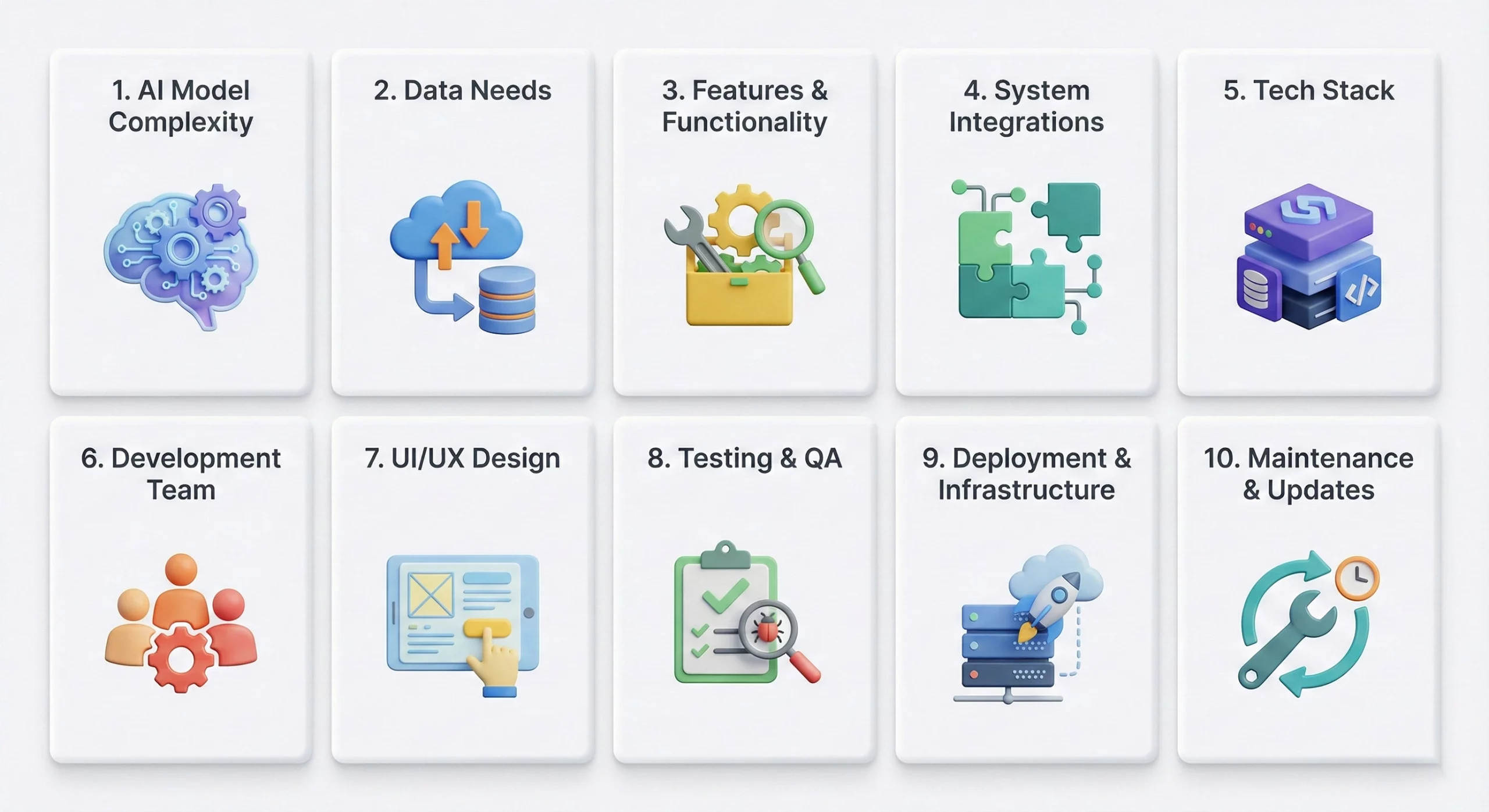
AI Agent Software Development cost is not about guesswork. The cost changes based on decisions related to intelligence level, control, scale, and real-world complexity. These choices define how much engineering, infrastructure, training, and security are required to build and operate an AI system reliably. Below are the factors that strongly influence the AI agent cost breakdown for startups and enterprises.
AI Model Complexity and Intelligence Depth
The cost of AI agent software development depends on how advanced the agent needs to be. Basic rule-based agents are cheaper, while reasoning-based autonomous agents increase the AI agent development cost due to deeper logic, NLP layers, and custom model engineering. Higher intelligence delivers higher automation, which means more development hours and higher infrastructure needs. Thus, AI model complexity increases cost. Here is a tabular presentation based on intelligence level and capability depth.
Agent Type |
Capability |
Estimated Cost |
| Basic Rule Agent | Predefined responses, no reasoning | $6k to $15k |
| Smart Conversational Agent | NLP, context, multi-turn conversations | $15k to $40k |
| Autonomous Workflow Agent | Connects to CRM, ERP, finance, HRMS, and executes decisions | $50k to $150k+ |
| Fully Autonomous Multi-Agent System | Distributed reasoning, multi-step task planning | $150k to $250k+ |
When founders ask how expensive it is to develop an app like an AI agent, the real driver is reasoning complexity, not UI or interface. Working with a custom software development company helps define the capability scope clearly, which is the first step in accurate AI project cost estimation.
Data Preparation and Model Strategy
AI accuracy depends on data quality and volume. Data cleaning, labeling, and structuring consume a major share of software development costs and determine pricing for AI. More datasets, multi-language support, or real-time learning raise the overall AI Software Development Cost and future retraining expenses.
Model Choice |
Benefit |
Cost Impact |
| Foundation Model APIs (OpenAI, Gemini, Claude) | Fast development, low entry cost | Best for MVP, token usage cost only |
| Fine-tuned Models | Personalized accuracy | Dataset cleaning and training cost |
| Fully Custom Models | Proprietary intelligence | Most expensive, requires ML experts |
Model choice directly affects long-term AI infrastructure costs. Each request processed by LLMs incurs token usage charges, similar to pricing in platforms like seamless.ai and other AI software. These operational costs are often overlooked but can significantly impact your budget over time.
Feature Set and Functional Scope
Costs vary based on the features the AI agent must deliver, such as automation, analytics, predictions, workflow execution, or user role permissions. More features increase backend complexity, which raises the total cost for AI and artificial intelligence cost estimation.
Moreover, Security, compliance, and governance also increase AI development costs significantly. Security constraints shape architecture and internal checks. Thus, it impacts long-term artificial intelligence cost estimation.
Integration Requirements With Business Systems
AI agents often connect with CRM, ERP, HRMS, finance tools, or custom systems. In fintech software development, these integrations drive engineering time for secure APIs, data sync, and testing. The more digital touchpoints involved, the higher the AI project cost estimation and long-term system maintenance.
Technology Stack and Architecture Decisions
Choosing the right tech stack, cloud platform, and deployment architecture affects cost and performance. Complex stacks requiring GPU compute or hybrid cloud raise AI infrastructure cost. Technology decisions shape scalability, speed, and private AI cost.
Development Team Skills and Engineering Hours
A senior-level AI software developer or machine learning engineer costs more than junior resources because of specialized skills. Team distribution across data science, AI developers, backend engineers, and QA specialists drives the total AI agent software development cost. Many businesses rely on professional software product development services to reach out with the right expertise and maintain predictable delivery timelines.
UI and UX Design Experience
AI agents succeed when users adopt them easily. Designing conversational interfaces, dashboards, multi-device access, and accessibility flows impacts overall application development cost. More customization results in increased design and engineering time.
Testing and Quality Assurance
AI agents require more than standard testing. AI accuracy validation, dataset evaluation, stress testing, and workflow simulation influence software development costs. Thorough QA ensures reliable performance in real-world scenarios.
Deployment and Infrastructure Expenses
Cloud hosting, GPUs, storage, and autoscaling affect runtime cost for ai. Public cloud is affordable, while on-prem or private deployment increases AI pricing due to dedicated hardware and enterprise security needs. Scaling decisions shape how expensive it is to develop an app powered by AI.
Ongoing Maintenance and Model Updates
AI requires continuous optimization. Regular retraining, bug fixes, new feature rollouts, and monitoring add recurring AI costs. Most businesses ignore this part while calculating initial artificial intelligence cost estimation and face higher budgets later. However, discussing with the best AI development company helps manage updates proactively and control long-term spending through structured maintenance cycles.
AI Agent Cost Breakdown: Real Phase-Based Pricing
Phase |
Cost Range |
| Research and blueprint | $2k to $6k |
| Data preparation and cleaning | $5k to $20k |
| Model development and fine-tuning | $8k to $25k |
| Frontend chat UI and UX | $5k to $15k |
| Backend and APIs | $5k to $20k |
| Integrations | $4k to $20k |
| Compliance and security | $8k to $30k |
| QA and stress testing | $5k to $15k |
| Cloud deployment | $2k to $8k |
| Yearly maintenance | $10k to $50k |
Estimated Total:
- Startup MVP: $15k to $35k
- Mid-level automation: $45k to $80k
- Enterprise automation ecosystem: $100k to $150k+
These figures reflect a realistic AI Agent Cost Breakdown based on today’s engineering and infrastructure standards. However, these are estimated costs and vary based on capability scope, integrations, and infrastructure needs. So, for an accurate estimation, you must reach out to an industry expert.
Read Also: Green Cloud Sustainability in 2026: Market Stats, AI Innovations & Future Outlook
ROI that Makes AI Agent Development Worth the Investment
Cost is only one part of the decision. Real value comes from the returns businesses see once AI agents start running in real environments. Companies are reducing repetitive workload, responding to customers instantly, and closing support tickets in minutes instead of hours. Faster resolution creates happier users and lowers support pressure on internal teams.
Automation replaces thousands of manual hours that drain operational budgets. AI agents streamline workflows, cut human error, and enable smaller teams to deliver more output. Many global reports highlight that these outcomes align with top AI trends, where businesses shift from basic automation to intelligent decision-making systems that drive measurable ROI. Organizations adopting these strategies are reporting lower operational expenses and stronger customer experience. This leads to long-term revenue growth.

ROI of AI Agent Software Development
AI agents generate measurable returns. Organizations achieve exponential value through workforce automation.
ROI Metric |
Expected Impact |
| Support cost reduction | Up to 60 percent |
| Resolution time reduction | From hours to seconds |
| Revenue conversion boost | Up to 35 percent |
| Manual task reduction | 45 percent to 70 percent |
| Customer satisfaction improvement | Strong NPS impact |
| 24×7 engagement | Always-on experience |
How to Reduce AI Agent Development Costs
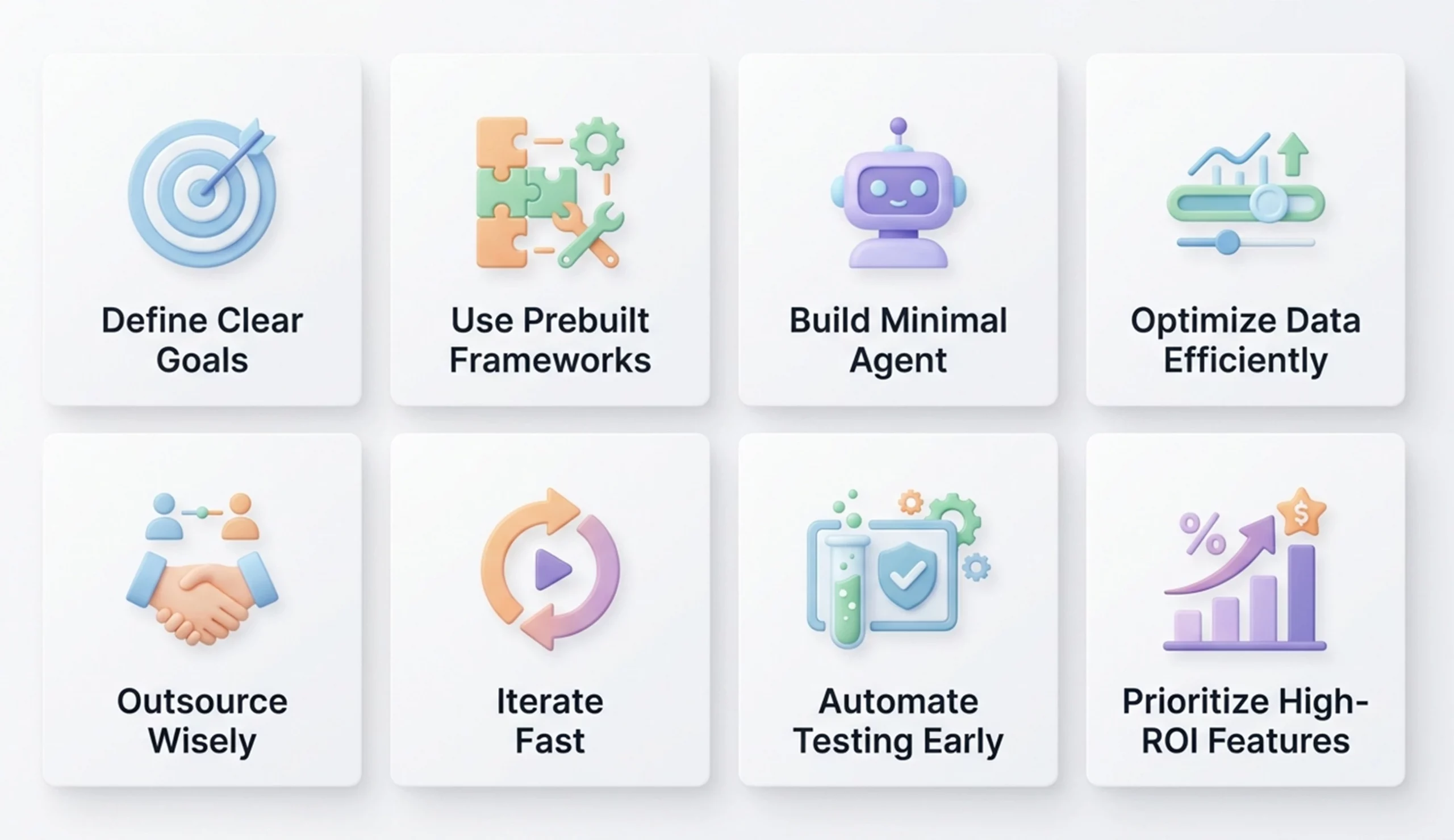
Before you start reducing AI agent development costs, remember one thing. Smart planning wins over heavy spending. You do not need the biggest budget. You need the right strategy. Here are some of the best ways to reduce the overall cost of developing an AI agent :
Start With Intent, Not Assumptions
First, you need to define goals because clarity saves time and money. When you define the problem and expected outcome early, decisions become faster and development stays aligned with real business goals.
Build On What Already Works
Use trusted AI prebuilt frameworks instead of reinventing them. It shortens development time, improves stability, and reduces engineering hours.
Launch Small, Learn Fast
Create a basic working version or Minimal Agent before scaling features. The main reason is that real feedback reveals what matters most, so you avoid paying for features users ignore. Many startups work with a top-rated MVP development company to validate ideas quickly and iterate based on real user needs instead of assumptions.
Treat Data Like Fuel
Clean and organized data improves model accuracy and lowers computing expenses. Better data reduces costly reprocessing and training time.
Partner With Experts When Needed
Outsourcing to a globally recognized mobile software development company prevents expensive trial-and-error with in-house experimentation. You get faster delivery with predictable cost control.
Improve Continuously, Not All At Once
Short development cycles reduce risk and prevent budget blowouts. Quick iterations help teams learn, adjust, and ship better upgrades.
Make Testing Automatic, Not Manual
Automated testing catches issues early and keeps systems stable. It protects you from last-minute failures that become expensive to fix.
Invest Where Returns Are Real
Focus resources on features that deliver measurable revenue or operational impact. Balanced decisions ensure every dollar generates visible value.
Read Also: AI App Development Cost in 2026: A Complete Business Guide

Wrapping Up
Building an AI agent is a financial decision as much as a technical one. Cost depends on several factors such as goals, data quality, integrations, and timeline. The smartest approach is to plan early, choose features with real business impact, and track ROI from the start. A clear scope protects the budget and speeds delivery.
Teams that combine strategy, stable frameworks, and fast feedback cycles reach profitability faster. AI agents are already improving efficiency, reducing manual work, and shaping intelligent digital experiences. So, if you want to understand what your investment will return and how to optimize the build without overspending, a realistic cost assessment is the first step. Your strategy determines your success.
FAQs
1. What is the most cost-effective strategy to start AI agent development?
Beginning with an MVP-first approach helps validate performance before investing in a full build. It lowers the initial AI agent software development cost and supports real usage-based improvement instead of assumptions.
2. How long does it take to develop an AI agent?
Development timelines range from 3 to 12 months based on capability depth, use-case complexity, testing cycles, and deployment architecture. Faster delivery is possible with an MVP-first strategy and API-based AI creation.
3. Do different industries have different AI pricing models?
Yes. Healthcare, finance, retail, and customer support use cases require specialized compliance and data protection. Thus, increasing cost for AI and software development compared to standard automation use cases.
4. How do integrations impact the cost of AI agent development?
Integrating AI into CRMs, ERPs, HRMS, finance tools, or internal platforms demands custom API work, workflow mapping, and testing. More integrations increase the total artificial intelligence cost estimation and deployment timeline.
5. Do AI agents come with recurring costs after launch?
Yes. Ongoing AI costs include cloud hosting, token usage, infrastructure scaling, and training updates. These expenses vary by workload volume and should be included while estimating long-term AI agent development costs.
SHARE
WRITTEN BY

Ishan Gupta
CEO & Founder
Ishan Gupta is a seasoned entrepreneur and CEO with extensive 8+ years of experience in business and mobile app development landscape. He believes that the right digital product allows companies to focus on what they do best, while technology handles the rest. With deep exposure to global markets, he understands what makes an app succeed. His approach translates business needs into clear product strategies, ensuring that every feature contributes to measurable ROI.
View All Articles