

The landscape of mental healthcare app development has shifted from a “nice-to-have” digital library to a critical frontline in global health.
Imagine a founder who launches an aesthetically designed meditation app, only to find that users drop off after three days because the platform feels like a static book rather than a supportive companion.
Nowadays, business owners aren’t just competing with other apps; they are competing with the skepticism of a user base that has seen it all. The “engagement gap” is the single greatest threat to your ROI, and closing it requires moving beyond the basic features.
Building a platform that truly resonates and stays compliant in an increasingly regulated market is a high-stakes investment. On average, a market-ready mental healthcare app requires an investment of $35,000 to $65,000 for a robust MVP, while enterprise-grade platforms featuring AI diagnostics often exceed $120,000. This isn’t just a development cost; it’s the price of building a clinically validated sanctuary for your users.
As a decision-maker, your challenge is no longer “How do I build this?” Success in this space now demands a marriage of empathetic UX and rigorous data sovereignty. This guide is a strategic blueprint to help you navigate the nuances of the modern mental health market, ensuring your product thrives and heals.
Table of Contents
Key Takeaways
- The global mental health app market is projected to reach $17.8 billion by 2030, with a CAGR of 23.6%.
- A basic mental health MVP costs between $30,000 and $55,000, while advanced enterprise-grade AI platforms exceed $150,000.
- A market-ready MVP typically takes 4 to 6 months to build, while complex AI-integrated platforms can take 9 months or longer.
- Core features include secure onboarding tele-consultation, integrated scheduling, and an emergency crisis button.
- Cutting-edge apps now feature generative AI chatbots for 24/7 support, biometric mood tracking via wearables, and predictive analytics to prevent relapses.
- Success requires adherence to global standards like HIPAA (USA), GDPR (EU), and the DPDP Act (India), alongside end-to-end encryption.
- Flutter and React Native are the top frameworks for building cross-platform mental healthcare apps, chosen for their ability to deliver calm UI and rapid clinical integrations.
Uncovering the Global Mental Health Crisis
Mental health conditions aren’t isolated to a few countries or communities. They affect people everywhere, across age groups and income levels. Recent global health reports make this clear: mental disorders are a major public health issue, and the world is far from having adequate support systems in place.
Global Overview
- Over 1 billion people worldwide live with a mental health condition such as anxiety, depression, bipolar disorder, or schizophrenia. This figure represents a significant portion of the global population and underscores the scale of the challenge. (Source)
- Among adolescents aged 10-19, about 1 in 7 experience a mental disorder, with depression, anxiety, and behavioral disorders leading the burden in this age group. (Source)
These numbers show mental health isn’t a marginal issue. It’s central to global well-being and contributes significantly to disability and lost productivity worldwide.
United States
In the United States, recent national data highlights ongoing mental health struggles:
- 23.4% of U.S. adults (about 59 million people) experienced any mental health illness in the past year.
- 17.7% of adults in the U.S. had a substance use disorder (SUD) in the past year. totalling over 46 million people.
- 5.5% of adults reported experiencing serious thoughts of suicide, totaling over 14 million people.
- 11.3% of youth (12-17) in the U.S. experienced a major depressive episode (MDE) with severe impairment in the past year, meaning it impacted their functioning at work, school, or home.
These figures reflect ongoing demand for mental health support and the importance of accessible care across age groups.
India
India faces an immense mental health burden, compounded by limited care resources:
- According to WHO estimates, India’s mental health conditions contribute 2443 disability-adjusted life years (DALYs) per 100,000 people – an indicator of health loss in the population.
- Data suggests more than 50 million Indians are affected by depression and 38 million by anxiety disorders.
- Recent reporting highlights that nearly 60% of mental illness cases now affect people under age 35.
- Despite this scale, experts have said that over 80% of Indians with mental illness do not receive timely care, showing a large treatment gap.
This combination of high prevalence and limited access to care suggests broad systematic needs in India.
Australia
Australian statistics point to widespread mental health conditions as well:
- Australia is among the countries with a high age-standardized prevalence of mental disorders according to international mental health data. (Source)
- Independent reports also indicate conditions like ADHD and general mental health concerns are increasingly recognized across different age groups.
Australia’s situation reflects both rising awareness and ongoing health system challenges.
United Kingdom
In the UK, recent data shows mental health challenges, especially among young people:
- Surveys find that young adults aged 16-24 are particularly affected, with about one in four reporting common mental health conditions.
- Wider social and economic pressures continue to drive demand for mental health support services.
Understanding the Digital Mental Health Market
The mental health and behavioral wellness market has shifted from niche to mainstream. Rapid adoption of smartphones, growing awareness around mental well-being, and acceptance of digital care have driven sustained market expansion.
As of 2025, the global mental health app market is projected to reach $17.8 billion, growing at a CAGR of 23.6% from 2024 to 2030. Consumer demand for accessible, on-demand care continues to outpace traditional services, especially among younger demographics and working professionals.
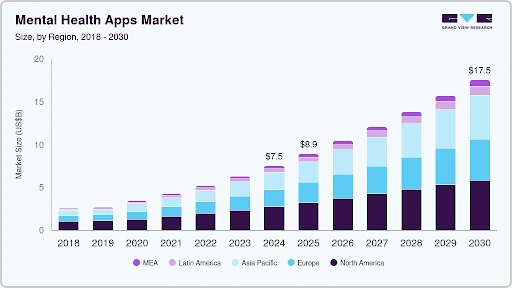
Mental health solutions now account for a substantial share of overall investment and usage in behavioral health software. This growth shows a clear business opportunity for companies interested in wellness app development and delivering scalable digital care.
Market Size of Mental Healthcare Services
The market for digital mental healthcare services includes therapy apps, self-help tools, mood trackers, guided programs, and AI-assisted support features. Key numbers that illustrate the opportunity:
- The global mental health app market size is projected to hit 10.06 billion in 2026. (Source)
- In 2024 alone, investments in mental health startups exceeded $4 billion, signaling strong investor confidence. (Source)
- Smartphone users now spend more time in wellness apps than in many traditional categories, such as fitness or productivity.
Growth Trends in Mental Healthcare App Usage
User behavior data highlights demand and engagement for digital mental wellness tools:
- First-time downloads of top mental health and wellness apps in the US grew by over 35% YoY in 2024.
- Popular platforms like Calm and Headspace consistently ranked among the top healthcare apps worldwide, with over 100 million cumulative downloads each.
- Demand for remote therapy and digital counseling services jumped during and after the pandemic, with platforms like BetterHelp reporting continued monthly growth in user engagement, often doubling year-over-year.
- Search interest in “mental health apps” has grown sharply, outpacing related categories such as fitness and meditation on many major search engines.
Expansion in Mental Healthcare App Development
Beyond downloads and usage, the ecosystem of apps themselves has grown significantly:
- In 2013, there were fewer than 100 widely recognized digital mental health applications.
- By 2024, research estimates suggest over 10,000 mental wellness apps available across major app stores – spanning therapy, meditation, journaling, habit tracking, and peer support.
This surge reflects broader interest from both consumers and healthcare providers in digital tools that support mental health journeys and wellness goals.
Why This Matters For Businesses and App Builders?
If you are evaluating mental health app development, this data is enough to help you understand:
- Strong user demand for easily accessible care
- Expanding market size and investment appetite
- Room for innovation in app features like personalized flows, mood analytics, AI-assisted support, and flexible care pathways.
Businesses that act now to partner with a healthcare app development company to invest in mental health and wellness apps can position themselves ahead of the competition.
Benefits of a Mental Healthcare App Development
The surge in the mental healthcare app development market is a response to a global necessity. For entrepreneurs and healthcare providers, how to develop a mental health app is a question of both impact and profitability. Understanding the mental health app market growth is key to recognizing why now is the time to invest in and explore healthcare app ideas.
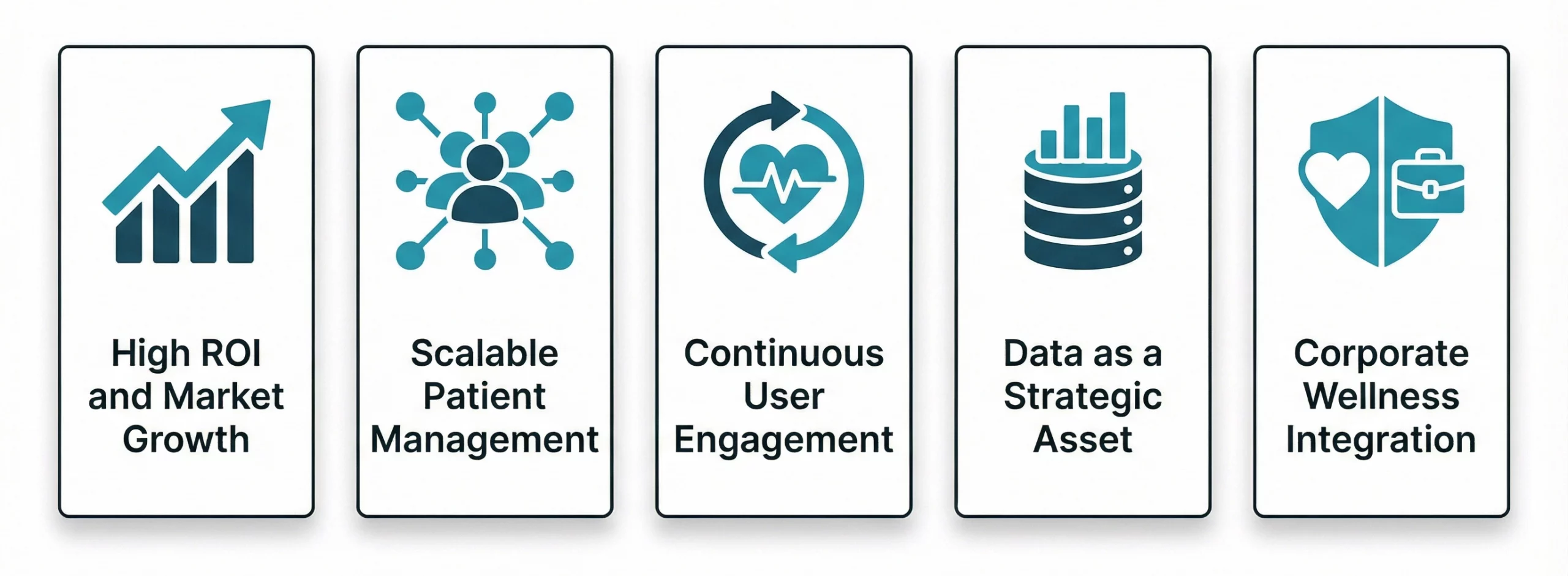
1. High ROI and Market Growth
The mental healthcare app development market is witnessing a massive CAGR of over 15%. Businesses that collaborate with experienced health app developers to launch a unique product can tap into a rapidly expanding revenue stream. Whether through B2B corporate wellness contracts or direct-to-consumer subscriptions, the financial potential is significant.
2. Scalable Patient Management
For clinical providers, mental healthcare app development acts as a force multiplier. It allows doctors to monitor hundreds of patients simultaneously through automated mood tracking and progress reports. Mental health app features like telepathy integration, AI personalization, and automated scheduling reduce administrative overhead while expanding the reach of enhanced patient care.
Read Also: How AI in Healthcare Apps Can Help You Enhance Patient Care?
3. Continuous User Engagement
The “sticky” nature of self-improvement app development ensures high retention. By utilizing mental health app ideas like gamified habit tracking or community forums, businesses can build a loyal user base. This steady engagement provides a wealth of anonymized data that can be used to further refine the app and dominate the market.
4. Data as a Strategic Asset
When you create a mental health app, you gather invaluable, anonymized data on user behavior and emotional trends. For a business, this data is gold. It allows the use of predictive analytics, where the app can suggest a therapy session before a user even realizes they are spiraling. This proactive care model is what separates the best mental health apps from the rest of the market.
5. Corporate Wellness Integration
Workplace burnout costs the global economy nearly $1 trillion annually in lost productivity. There is a massive B2B opportunity in self-wellness app development tailored for the corporate sector. All you need is to hire app developer with expertise in this domain. Businesses can license their application for mental health to large enterprises as a “Burnout Prevention Suite,” creating a stable, recurring revenue model through corporate contracts.
Types of Mental Health Applications
Businesses exploring mental healthcare app development need to understand one thing clearly. This market is not one-size-fits-all. Different user problems require different digital formats. The strongest products combine clinical understanding, behavioral science, and thoughtful UX to deliver a personalized mental health journey, not just features.
Below are the major categories shaping today’s mental health app market growth.
|
Solution Type |
What It Does |
Core Users |
Key Mental Health App Features |
Business Opportunity |
|
Self-Guided Therapy Apps |
Provide structured programs based on CBT, DBT, or mindfulness without live therapists |
Users managing stress, anxiety, mild depression |
Mood tracking, journaling, CBT exercises, guided audio sessions, progress analytics |
Highly scalable model, strong subscription potential, low operational overhead |
|
Teletherapy Platforms |
Connect users with licensed therapists through video, chat, or voice |
People needing professional counseling |
Secure video sessions, scheduling, therapist matching, encrypted messaging, treatment history |
Higher trust and retention, insurance integrations, strong B2B2C potential |
|
Meditation & Mindfulness Apps |
Focus on relaxation, sleep, and emotional regulation |
General wellness users, corporate employees |
Guided meditations, sleep stories, breathing tools, focus music |
Large global audience, strong corporate wellness demand |
|
Mood & Habit Tracking Apps |
Help users monitor emotional patterns and behavioral triggers |
Users focused on self-awareness and improvement |
Daily mood logs, behavioral insights, AI pattern detection, reminders |
Valuable user data insights, integration with broader wellness ecosystems |
|
Peer Support Communities |
Enable anonymous sharing and emotional support among users |
People seeking connection and shared experiences |
Community forums, moderation tools, crisis alerts, topic channels |
High engagement model, strong retention, requires robust safety systems |
|
AI Mental Health Assistants |
Offer conversational support, check-ins, and coping suggestions |
Users wanting immediate, private support |
AI chatbots, sentiment analysis, adaptive conversations, escalation to human care |
24/7 availability, lower cost per user, strong differentiation with personalization |
|
Crisis & Emergency Support Apps |
Provide immediate help during high-risk mental health situations |
Users in acute emotional distress |
SOS buttons, hotline integration, geolocation, safety planning tools |
Public health partnerships, high-impact category, regulatory focus |
|
Corporate Mental Wellness Platforms |
Deliver mental health programs for employees |
HR teams, enterprises, and distributed workforces |
Burnout tracking, stress programs, therapy access, engagement dashboards |
Strong B2B revenue model, recurring enterprise contracts |
Core Features To Consider During Mental Healthcare App Development
When determining how to develop a mental health app that thrives in 2026, you must distinguish between the foundational “table stakes” and the cutting-edge differentiators that drive user retention. To compete with popular mental health apps, your product must satisfy both clinical rigor and modern user expectations.
The Must-Have Features
These are the non-negotiable mental health app features that you must include to ensure a safe, functional, and professional user experience.
- Secure Onboarding & Profile Management: Trust starts at the login screen. Use streamlined signup processes with clear consent flows. Profile should allow users to note specific goals to enable a personalized experience.
- Self-Monitoring Tools: Use simple input methods like emoji scales or color-coded sliders to help users recognize behavioral patterns without feeling overwhelmed.
- Tele-Consultation: High-definition and secure video conferencing is essential for clinical impact. This allows for seamless remote therapy sessions that feel as personal as in-office visits.
- Integrated Appointment Scheduling: A built-in calendar with automated reminders and one-tap rescheduling reduces the administrative burden on both patients and providers.
- Resource Libraries: Provide an organized library of audio meditations, breathing exercises, and self-guided Cognitive Behavioral Therapy (CBT) modules.
- Emergency Crisis Button: Responsible business owners must include an easily accessible emergency button that connects users directly to crisis helplines or pre-set emergency contacts.
Advanced “Innovative” Features
To truly dominate the mental health app market growth, businesses must move toward creating a mental health app that acts as a proactive companion rather than a reactive tool.
- Generative AI Chatbots: Replace rigid, scripted bots with context-aware, LLM-based conversational AI assistants. These provide 24/7 burnout treatment and flexible support, offering empathetic, real-time reflections and coping strategies.
- Biometric & Wearable Integration: By syncing with Apple HealthKit or GoogleFit, your mental application can track heart rate variability (HRV) and sleep quality. This allows the app to detect physiological stress markers before the user even realizes they are anxious.
- AI-Driven Predictive Analytics: Use machine learning to analyze user journals and mood patterns to predict potential relapses, alerting the care team or suggesting a check-in session proactively.
- Gamification & Behavioral Incentives: Improve retention in self-improvement app development by using streaks, achievement badges, and rewards.
- Digital Phenotyping: Use passive data to assess mental states. This provides a deep, non-intrusive understanding of a user’s well-being over time.
- Real-Time Sentiment Analysis: By flagging specific keywords or tone shifts in digital journals, the app can offer immediate intervention or escalate to a human professional, ensuring a higher standard of patient safety.
The Strategic Insight for Businesses
The mental health app market size is increasingly rewarding “Hybrid Care” models, platforms that seamlessly blend these automated AI tools with human clinical expertise. When you create a mental health app, prioritizing a mix of these features ensures you build a product that is both technologically superior and clinically effective.
Ensuring Compliance & Security in Mental Healthcare App Development
In mental healthcare app development, security is the foundation. Given the sensitivity of patient journals and therapy logs, your app must navigate a complex web of global regulations to gain user trust and avoid catastrophic legal liabilities.
Global Privacy Standards: Professional health app developers must build with a “Compliance-First” mindset. Depending on your target market, you must adhere to:
- HIPAA (USA): The gold standard for protecting PHI (Protected Health Information).
- GDPR (EU): Requiring explicit “Granular Consent” and the “Right to be Forgotten.”
- PIPEDA (Canada): Focused on personal data privacy in the private sector.
- DPDP Act (India): India’s new digital data framework that imposes strict penalties for data mishandling.
End-to-End Encryption: For patient-doctor chats and video calls, this ensures that even if data is intercepted, it remains unreadable. As a leader in healthcare app development services, we implement AES-256 encryption at rest and TLS 1.3 for data in transit.
Ethical AI & Liability Management: When you use AI in mental healthcare, you must include a clinical guardrail layer. Ethical AI ensures that chatbots never provide a formal diagnosis or medical advice that could lead to harm. Instead, they act as supportive listeners who escalate to human professionals during crisis moments.
Mental Healthcare App Development Process: A Step-by-Step Roadmap
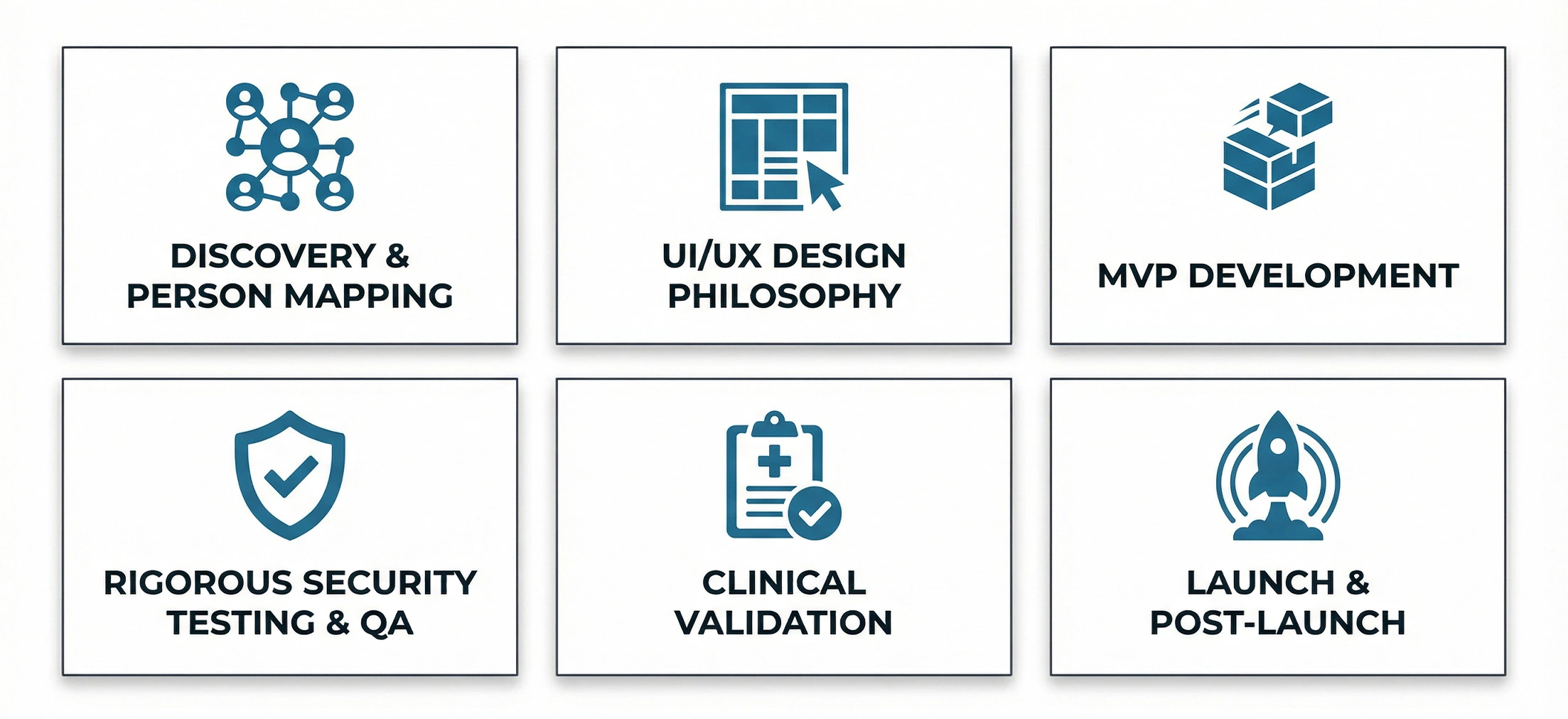
Developing a mental health app requires a disciplined, clinical approach. Following a structured lifecycle to ensure your investment translates into a high-performance mental application.
- Discovery & Person Mapping: Start by defining exactly who the app is for. Is it a mobile app for burnout treatment for corporate employees, or a clinical tool for licensed therapists? Mapping these personas ensures every feature serves a specific pain point.
- UI/UX Design Philosophy: Mental health users are often in a state of stress. Utilizing a calm UI approach and removing choice paralysis through minimalist navigation ensures a personalized experience for the mental health journey.
- MVP Development: To capitalize on the mental healthcare app development market, you need to launch a Minimum Viable Product quickly. The MVP development cost is lower due to the inclusion of basic features like mood tracking and secure messaging. It also helps businesses gather real-world user feedback early.
- Rigorous Security Testing & QA: Perform intensive penetration testing and vulnerability scanning to ensure no backdoors exist for data leaks.
- Clinical Validation: Before a full launch, we suggest a pilot phase with mental health professionals to verify that the app’s interventions are clinically sound.
- Launch & Post-Launch: After the app hits the stores, use built-in analytics to monitor performance and ship regular updates, keeping your product ahead of the best mental health apps in the market.
How Much Does Mental Healthcare App Development Cost?
The cost of creating a mental health app is driven by three main factors: the complexity of the AI layer, the level of regulatory compliance required, and the number of third-party integrations (like EHRs or wearables).
|
App Complexity |
Estimated Cost (2026) |
Typical Timeline |
|
Simple Wellness App (Mood tracking, journals) |
$30,000 – $55,000 |
3–4 Months |
|
Mid-Range Clinical App (Tele-therapy, scheduling) |
$60,000 – $110,000 |
5–7 Months |
|
Enterprise AI-Powered Platform (Predictive analytics, Crisis AI) |
$150,000+ |
9+ Months |
Some other factors that influence the overall cost are compliance & security, platform selection, development team location & expertise, UI/UX design, development approach, and ongoing maintenance & updates.
Final Thoughts
Mental healthcare app development is more than a business opportunity; it is a chance to reshape how humanity accesses support. By combining the latest in AI innovation with a trust-first compliance strategy, your platform can bridge the gap between those in need and the help they deserve.
Choosing the right mobile app development company is the difference between a product that scales and one that stalls. At RipenApps, we bring a wealth of experience in the healthcare sector, combining technical prowess with deep empathy for the end-user. Having over a decade of experience in the industry, we build secure, life-changing digital health ecosystems. Our priority is features that drive user retention and long-term maintenance, ensuring your wellness app development remains a profitable asset for years.
Our portfolio includes life-altering platforms like In The Room, which provides a 24/7 recovery lifeline to over one million members. Through QuitSure, we’ve empowered thousands to navigate emotional struggles using AI-driven journaling. By focusing on mental healthcare app development that prioritizes empathy and clinical precision, we create digital sanctuaries. Our commitment ensures that every solution we launch measurably improves global health outcomes and user reliability.
FAQs
Q1. How long does it take to develop a mental health app?
On average, a market-ready MVP takes 4 to 6 months. More complex application mental health platforms with deep AI integrations may take 9 months or longer.
Q2. Is my data safe in a mental healthcare app?
Yes, provided the app is built with end-to-end encryption and follows standards like HIPAA or GDPR. At RipenApps, we prioritize Privacy by Design in every line of code.
Q3. Can AI replace a therapist?
No. Current self-wellness app development focuses on augmentation. AI provides 24/7 support and tracks data, but it is meant to complement, not replace, the expertise of a human therapist.
Q4. What is the best mental healthcare app development framework?
In 2026, Flutter and React Native are the dominant choices for mental healthcare app development. However, the best choice depends on whether you prioritize fluid, calming UI (Flutter) or rapid integration with web-based medical systems (React Native).
SHARE
WRITTEN BY

Ishan Gupta
CEO & Founder
Ishan Gupta is a seasoned entrepreneur and CEO with extensive 8+ years of experience in business and mobile app development landscape. He believes that the right digital product allows companies to focus on what they do best, while technology handles the rest. With deep exposure to global markets, he understands what makes an app succeed. His approach translates business needs into clear product strategies, ensuring that every feature contributes to measurable ROI.
View All Articles