

The startup landscape in 2025 is moving at lightning speed. With innovation hubs evolving globally and competition intensifying across every niche, startups today don’t just need a good idea. They need to execute it fast, smart, and lean. The pressure to deliver products quickly, adapt to market feedback on the fly, and stay within tight budgets has never been higher.
That’s exactly where full stack development steps in as a game-changer.
Instead of juggling multiple specialists for frontend, backend, and everything in between, startups are increasingly turning to full stack development that can handle it all.
From building the MVP to scaling it into a market-ready product, full stack development empowers startups with the kind of flexibility, speed, and cost-efficiency they need to thrive in today’s high-stakes digital playground.
In this blog, we’ll unpack exactly how full-stack development helps startups build smarter, move faster, and ultimately win bigger.
Table of Contents
What is Full Stack Development?
Simply put, full stack development is the ability to create both the front end and back end of a computer system. On the frontend side, full stack developers deal with building anything a user interacts with-whether it be buttons, layouts, animations, or responsive design.
On the backend side, they take care of databases, servers, and APIs, and all the logic that infuses life into any software. Essentially, they help with everything from the front end to the back end to create a product from scratch.
What makes the full stack approach so effective, especially for startups, is that it’s not a siloed affair for full stack developers. They act as a bridge between design, development, and deployment. That translates into quicker applications, smoother teamwork, and fewer inter-team stumbles regarding communication.
Benefits of Full Stack Development for Startups
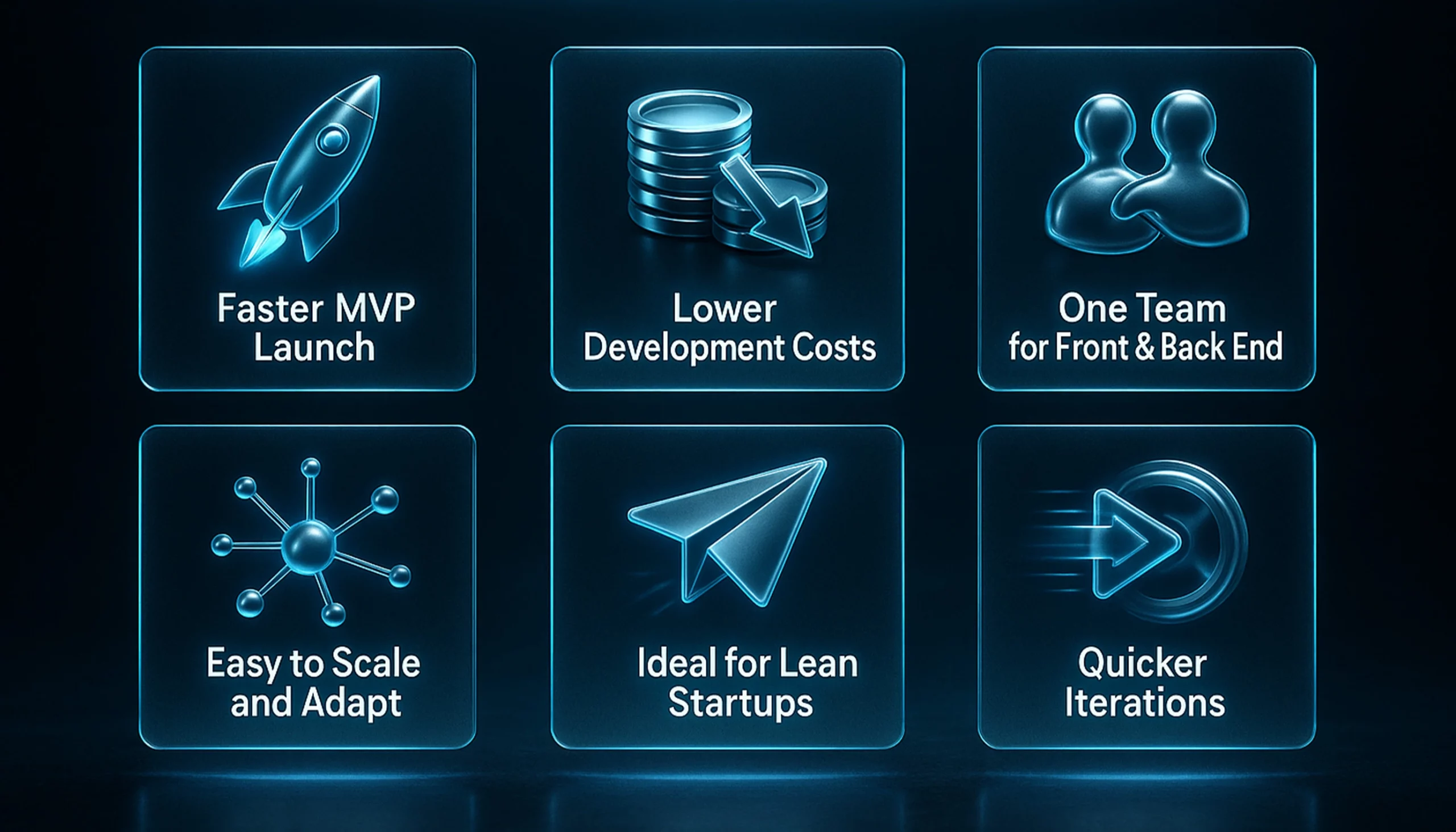
1. One Team, Multiple Skills – Less Chaos, More Clarity
Startups thrive on agility, and full stack development delivers just that. You build smaller teams, sometimes just a few developers who may understand the entire product ecosystem- instead of a separate frontend and backend one. This results in better communication, faster decision-making, and fewer dependencies.
The end-to-end ownership absolutely changes the game, especially in the early days when every minute and every cent counted. That’s one of the key benefits of full stack development. It makes collaboration easy and keeps the momentum going without unnecessary bottlenecks.
2. Rapid MVP Development Without Compromise
Speed-to-market is everything in 2025. Whether you want to validate some idea or put it in front of the investor, a polished MVP cannot take forever. Full stack developers can prototype, build, and iterate within flash because they speak the languages of the front- and back-end logic.
In fact, if you’re wondering, “Why You Should Hire Full Stack Developers For MVP Development?”, the answer is simple: they offer a perfect blend of speed, cost-efficiency, and product thinking. They understand product goals, which leads to a more purposeful MVP.
3. Budget-Friendly for Startups
Every startup does not always have the luxury of a very heavy tech budget. Having a full stack development team means fewer people but not fewer skills. So lower hiring costs, less overhead, and a more compact development process are all but guaranteed, not always meaning compromise on quality either. Partnering with a reliable full stack development company allows startups to remain slim and laser-focused on business outcomes, whilst still providing for the best user experience.
4. Smooth Iterations and Faster Feature Releases
Once your product is out there in the market, your users start contributing their feedback. That is when changes have to happen swiftly- minor tweaks to user experience, performance optimizations, new features.
With full stack developers, these iterations happen swiftly and holistically, bearing in mind that they already know how every single layer of your app operates. An MVP with this kind of agility evolves flawlessly into a solution based on genuine user insights.
5. Future-Proofing the Tech Stack from Day One
Several times, startups make the mistake of going for flashy tech rather than sustainable, scalable solutions. Having full stack developers in your teams encourages more strategic thinking.
They will go for tools and frameworks that will grow alongside your product. Whether your startup is implementing MERN, MEAN, or a customized architecture, a full stack development company will accompany you in laying down a strong foundation with an eye for the future.
6. Flexibility to Pivot Without Rebuilding Everything
Sometimes, what you think users want is not what they need. One oft-overlooked advantage of full stack development for startups is allowing lighter pivots. Because one team understands the full product, changes can be made much faster and smarter.
7. Access to Versatile Tech Talent That Thinks Like Founders
When you hire full stack developers, you’re often bringing in individuals who think like product owners. They’re resourceful, adaptable, and often more aligned with startup culture than specialized engineers. They understand trade-offs, know when to be scrappy, and care about user outcomes as much as functionality.
8. Faster Time-to-Market: From Idea to App in Record Time
Full stack development accelerates your entire product cycle by dismantling the silos in front-end and backend development. Be it UI designing, API setting, or production deployment, they handle everything simultaneously, more often. This coordinated workflow allows your product to hit the market much sooner than by conventional approach.
And it’s not just “being first” for a startup to launch sooner. Instead, it is all about garnering user feedback sooner, fetching traction faster, and staying a little bit ahead of the competition. If moving fast without breaking things is your goal, consider full stack your ace now.
Choosing the Right Full Tech Stack for Your Startup
When it comes to building your dream product, the tech stack is much more than code. It is the mechanism that will guarantee good performance, scalability, and user experience for the app. For startups, especially, the decision of choosing the right full stack is one of those major decisions that affect everything-from the speed of development to who would be hired later. Sure, we will contextualize some of the 2025 trends in making the winning choice for your venture.
Popular Full Tech Stacks in 2025
Full-stack development is a mature field by now, and in 2025, there remain just a few stacks that keep ruling the startup scene for all the good reasons:
1. MERN Stack (MongoDB, Express.js, React, Node.js)
Suitable for dynamic single-page applications and real-time platforms. React makes for a highly performative front-end, whereas Node.js is equally fine on the backend; hence, it is a preferred choice by many startups.
2. MEAN Stack (MongoDB, Express.js, Angular, Node.js)
For those who love Angular, this one’s for you! It’s for the one that is intended to grow into an enterprise app very quickly.
3. LAMP Stack (Linux, Apache, MySQL, PHP)
Classic and still relevant for content-heavy apps and CMS platforms or quick MVP deployments.
4. JAMstack (JavaScript, APIs, Markup)
Fast, secure, and SEO-friendly—great for startups focusing on static sites, blogs, and marketing platforms.
5. Flutter with Firebase (For Full Mobile + Backend Coverage)
Not a traditional stack, this pairing is all the rage among early-stage startups targeting both Android and iOS with a single codebase.
Each of these full stacks varies by niche and is evolving with the latest full stack web development technologies to push the boundaries of scalability, performance, and developer productivity.
Factors to Consider While Choosing a Full Stack Technology
On the other hand, how would you decide which stack is right for your startup? It depends on quite a few practical (and strategic) considerations:
1. Project Requirements & Complexity
Are you building a lightweight MVP or a feature-heavy product from day one? Complex apps might demand a robust framework like Angular, while a fast MVP can do wonders on MERN.
2. Developer Availability and Community Support
Choosing the best stack is only part of the process. It’s also about finding the right people to develop it. Choose a stack that has an active developer community and talent pool, particularly when working with a startup app development company or when you anticipate scaling up your internal team.
3. Scalability and Performance Needs
Your stack should be able to grow with you. Node.js and MongoDB offer flexibility and performance at scale, while Firebase simplifies backend infrastructure. That makes it ideal for apps with sudden spurts in growth.
4. Time to Market
Some stacks are simply quicker to deploy. If time-to-market is important (which it often is for startups), go with stacks like MERN and JAMstack that help get a prototype out quickly and fast deployment.
5. Security and Maintenance
Do not overlook long-term maintainability. Popular stacks will generally have more know-how on security, stable libraries, and good documentation of which is paid for in the long run.
6. Budget Constraints
A key insight from A Business Guide To Web Application Development For 2025 is that budget efficiency often lies in choosing tech that balances modernity with maturity. Sometimes, tried-and-true solutions (like LAMP) deliver more ROI than trendy ones.
7. Frontend and Backend Compatibility
Ensure that both ends of your stack play well together. Full stack development services thrive when there is a smooth integration between frontend frameworks and backend technologies.
Common Challenges in Full Stack Development
Full stack development offers agility, efficiency, and the power to do more with less—especially for startups. But like every superhero, it comes with its own set of challenges. If you’re venturing into full stack development for startups, it’s smart to know what hurdles may lie ahead. Let’s break down the most common roadblocks and what they actually mean in the real world of product building.
1. One Developer Has to Do Everything
Full stack developers are often expected to do it all—backend, frontend, databases, APIs, and sometimes even DevOps. While that sounds impressive on paper, in practice, it can lead to burnout or shallow expertise across layers.
In a startup app development environment where every hour and dollar counts, this multitasking can either be a blessing or a bottleneck. The key is balance—let your developers focus where they shine and support them with the right tools or team structure.
2. Staying Updated with Too Many Technologies
From JavaScript frameworks to cloud infrastructure, staying updated is like trying to drink from a firehose. For someone managing both frontend and backend, keeping up with everything in the full stack web development world is an ongoing challenge.
This is where smart teams either assign specialized roles within the stack or hire app developers who bring deep expertise in specific areas. It means ensuring quality doesn’t get compromised for the sake of speed.
3. Integration Challenges
One of the underrated challenges is making all the moving parts play well together. You might have a beautiful frontend and a rock-solid backend. But if your API connection is buggy or your database structure doesn’t align, everything falls apart.
Smooth integration requires thoughtful architecture from the beginning, especially when building a Minimum Viable Product that needs to scale later without being torn apart and rebuilt.
4. Short-Term Fixes Can Hurt Long-Term Growth
A common trap in early development is over-optimizing for the now. Many startups make this mistake by building features that only work well in limited use cases. But when your user base starts growing, that “quick fix” can break everything. That’s why scalability must be baked into your tech decisions early on. Even if you’re just launching a pilot or MVP, full stack development allows flexibility, but it still needs foresight.
5. UX vs Performance Trade-offs
Front-end developers want stunning interfaces. Backend developers want tight logic and efficient queries. Full stack teams have to juggle both, and that can lead to trade-offs.
Want a fast-loading app? You might need to simplify UI elements. Want a sleek UX? It may slow down performance if the backend isn’t optimized. And if you’re comparing a Progressive Web App vs a Website, these UX-performance trade-offs get even more complex depending on your audience, devices, and geography.
6. Debugging Can Get Complicated
Full stack apps are beautiful, but debugging them? Not always fun. When something breaks, you’re not just checking the frontend code—you’re tracing backend logic, server logs, database queries, and sometimes even third-party services.
For startups with small teams, this can eat up valuable time. Building robust error-handling, setting up logging systems, and having a clear debugging protocol are must-haves for peace of mind.
7. Security Sometimes Overlooked
In the rush to build and launch fast, security often gets pushed down the priority list. But vulnerabilities can exist at every layer, from frontend forms to backend APIs to database configurations.
In full stack development for startups, security should be built into every stage of the product—not just treated as a “patch-it-later” task. Data breaches or leaks can destroy trust even before your product finds its footing.
Final Thoughts
Full stack development for a startup-friendly and efficient strategy that aligns with how modern founders work: agile, resourceful, and laser-focused on outcomes. From frontend to backend and everything in between, having a unified tech approach means fewer silos, faster releases, and tighter control over your product’s future.
But success in this space isn’t just about choosing the right stack. It’s about partnering with the right people. A reliable full stack development company can help you go beyond just “building” and actually shape a digital experience that users love and investors notice. And RipenApps is one such reliable destination that holds years of proven expertise in full stack development for startups.

FAQs
Q1. How can startups benefit from hiring full stack web developers?
When you hire a full stack web developer, you’re choosing an adaptable technology professional who can do it all, from UI design to server-side logic-thus helping your startup scale with leaner teams.
Q2. What tech stacks are best for startup app development in 2025?
Some good stacks for startups are MERN (MongoDB, Express.js, React, Node.js), MEAN, and LAMP. Choosing between them depends on how complex your application will be and on your desired scaling goals, and how skilled your team is.
Q3. Why is full stack web development more cost-effective for early-stage startups?
Full stack development implies that frontend and backend require no separate entity nowadays. This, consequently, makes it a less costly option for a company that wants to get its MVP running quickly without compromising on its quality.
Q4. What should I look for in a full stack development services provider?
They must be able to corroborate their experience in almost all popular tech stacks, have an understanding of product-market fit, and be capable of fast app iterations—any reputed full stack development service partner will have these qualities.
Q5. Can a startup app development company help with full stack solutions?
Yes, a startup app development company would usually provide ready, full-stack solutions for lean teams, MVPs, and fast-paced market strategies.
Q6. Is full stack development suitable for scaling beyond MVP?
Yes indeed! The full stack frameworks are modular and scalable, so that you will be able to extend your applications’ functionalities as your startup grows.
SHARE
WRITTEN BY

Prankur Haldiya
Chief Technical Officer
A tech innovator and engineering leader, Prankur Haldiya drives RipenApps’ product development strategy and oversees cutting-edge solutions in mobility, AI, and cloud ecosystems. He is passionate about building high-performance teams and helping brands launch secure, scalable, and user-centric digital products.
View All Articles