

Android apps no longer compete on design alone. They compete on intelligence. Users expect apps to learn, adapt, and respond in real time. This shift is driving rapid adoption of machine learning in Android app development across industries.
From camera apps that recognize faces instantly to streaming platforms that predict what users want next, machine learning now powers many everyday Android experiences. Android dominates the global smartphone market, which makes it the primary platform for deploying ML-driven features at scale.
As businesses race to deliver smarter, faster, and more personalized mobile experiences, applying machine learning in Android apps has become a strategic priority. ML enables features like image recognition, predictive analytics, voice processing, automated decision-making, and behavior-based recommendations. All without manual rule-setting.
Android also offers mature ML frameworks, on-device processing, and cloud integration options. This makes it easier to build intelligent features without compromising performance or user privacy.
So, if you plan to build an Android app that stands out through personalization, automation, and data-driven intelligence, understanding ML integration and choosing the right Android application development services becomes equally important. This guide explains practical ways to integrate machine learning into Android app development, real-world use cases that deliver value, and how businesses turn ML investments into measurable impact. So, let’s get started:
Table of Contents
What is Machine Learning?
Machine learning is a subfield of artificial intelligence (AI). It focuses on the development of self-learning algorithms and models. These ML models enable a system or software application to learn. As a result, it assists in making predictions and decisions without being explicitly programmed.
It is concerned with developing systems, web, and mobile applications equipped with automated capability. This enables applications to automatically analyze, interpret complex data, and recognize patterns. Consequently, it empowers the app to make intelligent decisions or predictions based on the input provided.
The primary objective of machine learning is to enable applications to learn from experience or data and improve performance over time. For this, it identifies patterns and relationships in the data. And then, its algorithms generalize, and thus make predictions or take actions on new, or unseen data.
Popular examples of machine learning apps:
- Google Assistant
- Snapchat
- Netflix
- Spotify
- Duolingo
- FaceApp
- Tinder
Why Is The Integration of Machine Learning in Android apps growing?
Machine learning is an important branch of artificial intelligence. It is used in several ways to build automated and super-intelligent functionalities for developing software and applications. Android is an open-source operating system. It provides a wider scope for creating innovative features.
Android smartphones come with a great number of top-notch features allowing users to do many useful and exciting things. Advancements in ML techniques, demand for personalized experiences, and increasing availability of data are contributing factors to the machine learning market.
By applying ML in Android app development, developers can create fast and efficient app solutions. Many top Android app development companies deploy ML algorithms to build highly personalized and industry-specific app solutions. Therefore, startups and businesses also look for developing ML-based apps for leveraging the power of AI & ML and develop next-gen apps.
And this increased adoption of ML app development, the growth of integration of ML & AI in mobile app development is enhancing.
As per a report released by Grand View Research, the global machine-learning market size is projected to touch $282.13 Billion by 2030 at a CAGR of 30.4%.
The global mobile artificial intelligence (AI) market is expected to attain $84.80 Billion by 2030 at a CAGR of 26.44% according to Allied Market Research.
Hence, seeing the current market trends and statistics, it is evident how significantly the demand for machine learning is expanding in the app development industry. So, you should also incorporate ML during the Android app development process.
Benefits of Applying Machine Learning in Android App Development
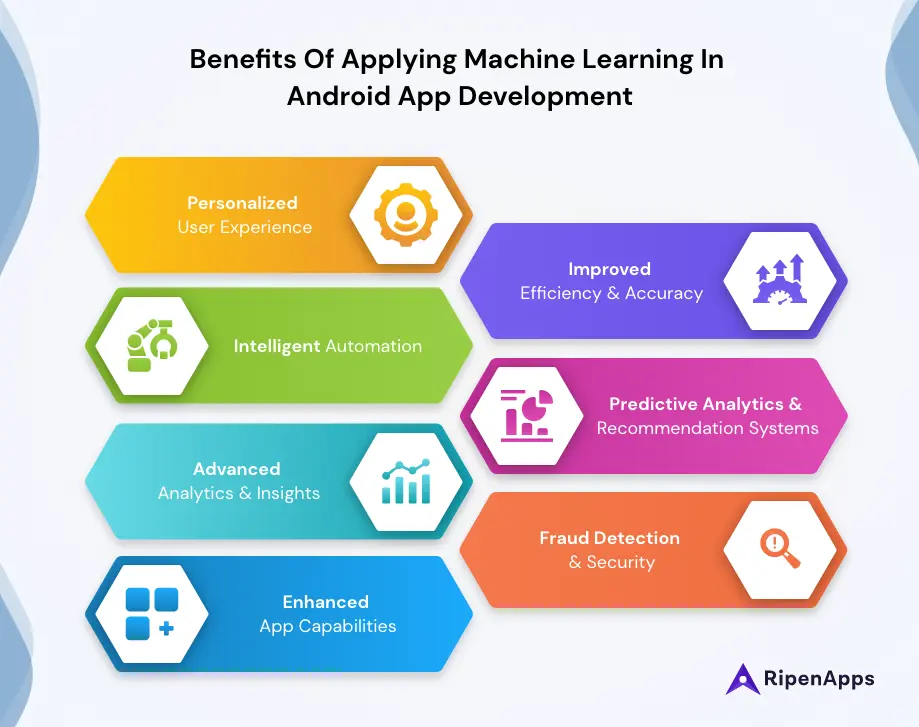
There are various benefits of the applications of Machine Learning in mobile apps. Developers integrate ML in Android app development to enhance app capabilities and enhance user experience, and more. These advantages help businesses meet the evolving needs of users and leverage market trends.
1. Personalized User Experience
ML enables apps to provide personalized experiences to users. By analyzing user data, inputs, and preferences, ML algorithms can customize contents and features specifically for each user. Therefore, this personalization enhances user engagement, satisfaction, and retention.
2. Intelligent Automation
Machine learning can automate various tasks within an app. It can reduce manual effort and improve efficiency. For instance, chatbots powered by machine learning and natural language processing. They can handle customer inquiries, provide support, and assist users in real-time. Hence, this automation enhances user experience, saves time, and improves customer service.
3. Advanced Analytics and Insights
ML enables powerful data analysis and predictive intelligence in Android apps. By analyzing user behavior, app usage patterns, and interaction data, ML algorithms generate actionable insights that help businesses make data-driven decisions and optimize performance. When combined with conversational UI in custom Android apps, these insights also improve intent recognition, response accuracy, and contextual interactions. Thus, creating smarter and more engaging user experiences.
4. Enhanced App Capabilities
Applying machine learning expands an app’s capabilities and makes it more intelligent. ML models can enable image recognition, natural language processing, sentiment analysis, and voice recognition functionalities. Hence, these capabilities empower apps to understand and interact with users in more intuitive and efficient ways.
5. Improved Efficiency and Accuracy
ML algorithms can automate complex tasks, reducing human error and increasing efficiency. For instance, in image recognition tasks, ML models can achieve higher accuracy rates than conventional algorithms. Thus, automating processes allows apps to save time, improve accuracy, and deliver better results.
6. Predictive Analytics and Recommendation Systems
Machine learning enables apps to make predictions and provide recommendations based on user data. For instance, eCommerce apps can leverage machine learning to suggest personalized products based on purchase history and user preferences. As a result, such predictive analytics and recommendation features enhance user engagement, boost conversions, and improve user satisfaction.
7. Fraud Detection and Security
ML algorithms can identify patterns and anomalies to detect fraudulent activities and enhance app security. By assessing user behavior and transaction data, ML models can identify suspicious activities, unauthorized access attempts, and potential security threats. As a result, ML improves app security, protects user data, and maintains app integrity.
8. Competitive Advantage
Implementing machine learning in Android apps can give a competitive advantage in the market. Users increasingly expect intelligent and personalized experiences. And apps that fulfill these expectations are more likely to stand out. Therefore, by leveraging machine learning, apps can stand out in the market, and eventually attract more users.
Read More: How To Develop A Chatbot App Like ChatGPT?
Steps To Apply Machine Learning In Android App Development
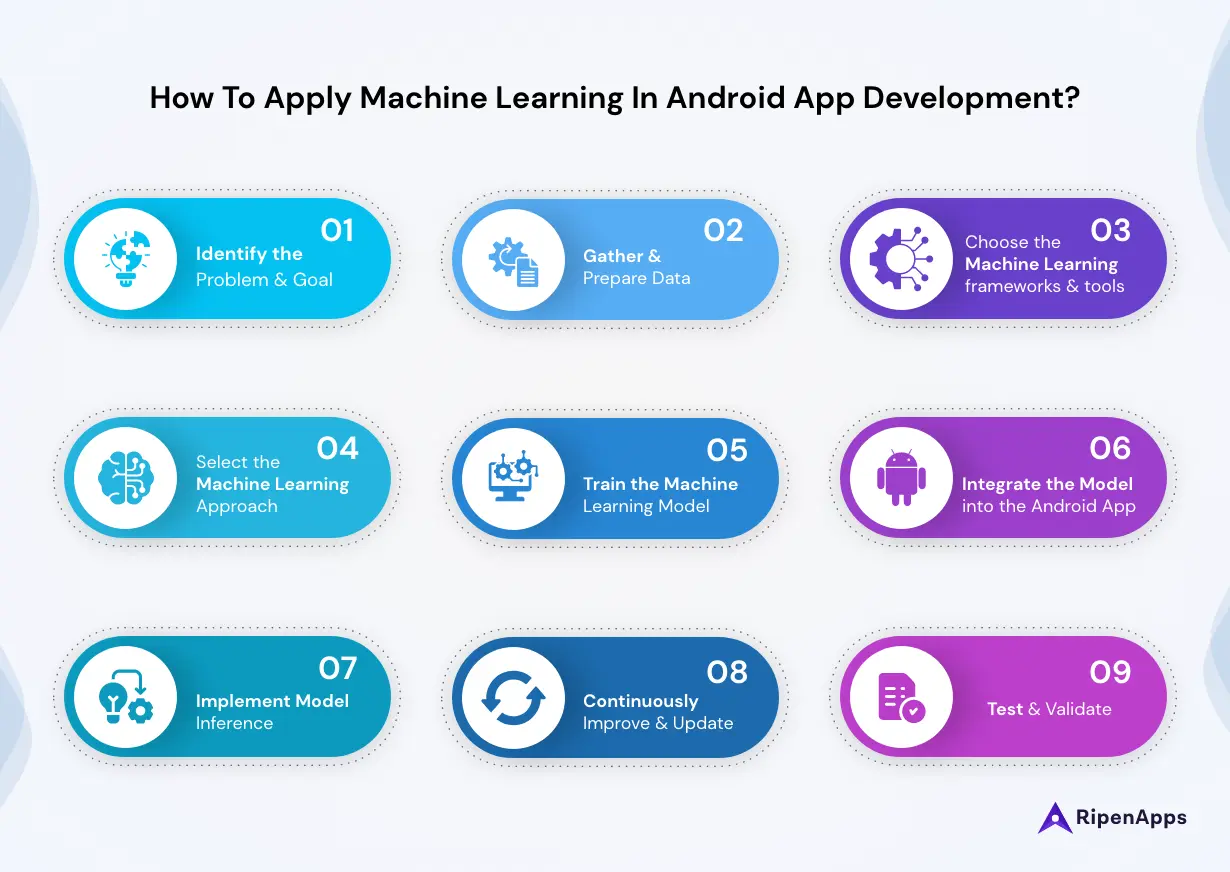
Machine learning is complex-level programming. Applying machine learning in Android app development requires a good understanding of ML development concepts. Make sure when you hire mobile app developers they have proficient programming skills, and expertise in utilizing machine learning frameworks, tools, and API integrations. Therefore, to apply ML in developing Android apps, you need to follow the below process:
1. Identify the Problem and Goal
Determine the specific problem or task in your app that can benefit from machine learning. It could be anything. For instance recommendation systems, predictive intelligence, natural language processing, and image recognition. Therefore, the first step is to define the goal you wish to obtain using machine learning.
2. Gather and Prepare Data
Data is essential for training machine learning models. Collect relevant and representative data which aligns with your problem and goal. Ensure the data is properly labeled and organized. And let the data be cleaned, normalized, and transformed as required.
3. Choose the Machine Learning Frameworks & Tools
There are several numbers of machine learning frameworks and tools for implementation in Android application development. Based on your ML approach and project requirements, you should appropriate ML tech stacks. Here are some of the widely-used ML frameworks & tools which you can incorporate into your machine learning app development for Android.
ML frameworks
- Android’s Custom ML Stack
- TensorFlow
- PyTorch
- OpenCV
- Microsoft Azure Machine Learning
- Amazon SageMaker (AWS)
- Google Cloud Machine Learning Engine
APIs for ML integration
- Google Cloud Vision API
- Google Cloud Natural Language API
- Microsoft Azure Cognitive Services
- Google Cloud Translation API
- Amazon Rekognition
- OpenAI GPT-3 API
- TensorFlow Lite API
4. Select the Machine Learning Approach
Choose the appropriate machine learning approach based on your goal and data. Standard ML approaches involve supervised learning, unsupervised learning, or reinforcement learning. You should select the algorithms or models that are suitable for your task. Decide if the ML project incorporates clustering algorithms, support vector machines, neural networks, or decision trees.
5. Train the Machine Learning Model
Divide the data into the sets of training and testing. Employ this training set to train your machine learning model. For this, you have to feed this with labeled data and adjust the model’s parameters to minimize errors. You can perform iteration, and refine the model as required. Use the testing set to evaluate the model’s performance. And then ensure this generalizes nicely to the unseen data.
6. Integrate the Model into the Android App
After your ML model is trained and evaluated, you need to integrate machine learning in android app. Depending on the complexity and requirements, you can choose different integration approaches:
On-Device Integration: If the model is small and can be run efficiently on the device, you can integrate it directly into the app. Tools like TensorFlow Lite or PyTorch Mobile can be used to convert and optimize the model for deployment on Android devices.
Cloud-Based Integration: For larger models or computationally intensive tasks, you can employ the model on a cloud server and make API calls from the app to transmit input data and receive predictions. Hence, this approach supports more resource-intensive computations and scalability.
7. Implement Model Inference
Implement the code in your app to perform model inference. It means using the trained model it would be able to make predictions or do classifications based on new given data. Then, pass the input data to the model, and process the output. And incorporate it into the app’s functionalities or user interface.
8. Continuously Improve and Update
You need to track the performance of your machine-learning model in real-world scenarios and gather feedback. Gather user data and iterate on your model to improve its accuracy and efficiency. And keep your model updated to adapt to changing data patterns and user needs. As a result, it will help your app perform consistently.
9. Test and Validate
Thoroughly test your app with integrated machine-learning features. Validate the performance and accuracy of the model in different scenarios and use cases. Ensure the app functions correctly and gives the desired user experience.
Performance Optimization Tips for Android Apps Using Machine Learning
Machine learning adds intelligence to Android apps, but poor implementation can impact performance, battery life, and user experience. Optimizing ML workflows is essential to ensure fast, reliable, and scalable Android applications.
1. Prefer On-Device ML Where Possible
On-device inference reduces network dependency and latency. Lightweight models improve response time while protecting user data. This approach works well for image recognition, face detection, and real-time personalization.
2. Use Optimized and Quantized ML Models
Smaller models consume less memory and processing power. Model quantization helps maintain accuracy while improving speed. This is critical when applying machine learning in Android apps with limited device resources.
3. Load Models Lazily
Avoid loading ML models at app launch. Load them only when required to reduce startup time and memory usage. This keeps the Android app responsive and user-friendly.
4. Leverage Hardware Acceleration
Android supports GPU, NNAPI, and TPU acceleration. Using device hardware improves inference speed and lowers battery consumption, especially for compute-heavy ML tasks.
5. Monitor Performance Continuously
Track inference time, crash rates, and resource usage post-deployment. Continuous monitoring ensures ML features scale without degrading app performance.
Cost of Applying Machine Learning in Android App Development
On average a machine learning project might cost between $50,000-$300,000. However, this is just for estimation. The cost of integrating machine learning in Android app development varies depending on multiple factors.
For instance, the number of resources, frameworks, ML models, data size, number of features, and more. Therefore, the best way would be to consult a professional Android app development company that specializes in Machine Learning development services. The final coly depends on your project requirements specifically.
Read Also: How Much Does Android App Development Cost?
Real-World Use Cases: Popular Android Apps Leveraging Machine Learning
Machine learning has become a core driver behind the success of many high-impact Android apps. Leading global brands use ML to deliver smarter experiences, automate decisions, and scale personalization across millions of users. These real-world examples show how machine learning in Android apps creates measurable industry impact.
1. Google Photos: Intelligent Image Recognition
Google Photos uses advanced machine learning in Android app development to power features like automatic photo categorization, face grouping, and smart search. By applying ML models directly within the app, users can search their photo library with simple keywords such as “beach,” “birthday,” or “dog,” improving engagement and simplifying media management.
2. Spotify: Personalized Recommendations
Spotify uses advanced machine learning to analyze listening habits, search behavior, and user preferences to generate personalized playlists such as “Discover Weekly.” By combining behavioral data with audio attributes, the platform delivers hyper-relevant content experiences. This highlights how building an app like Spotify and applying machine learning in Android app development helps improve user retention, session time, and overall satisfaction.
3. Snapchat: Real-Time AR Effects & Smart Lenses
Snapchat leverages on-device machine learning in Android to power real-time facial recognition, AR filters, and intelligent lenses. The app continuously learns from user interactions to enhance accuracy and responsiveness. This showcases how businesses aiming to develop social media apps like Snapchat can apply machine learning in Android apps to drive higher engagement, creativity, and viral user adoption.
Common Mistakes While Applying ML in Android Apps
When businesses apply machine learning in Android apps without a clear strategy, performance and user experience often suffer. Understanding common pitfalls helps teams integrate machine learning in Android app development efficiently. Thus, ensuring scalability, accuracy, and long-term success.
- Ignoring performance impact: Heavy models slow down apps and drain battery when not optimized for Android devices.
- Overusing cloud-based inference: Excessive server calls increase latency and dependency on network quality.
- Poor data quality: Inaccurate or biased data leads to unreliable ML predictions and weak user trust.
- Loading ML models at launch: This increases app startup time and affects first impressions.
- Skipping model optimization: Not using quantization or compression results in bloated app size.
- Neglecting privacy and compliance: Mishandling user data risks security issues and regulatory violations.
- Lack of continuous monitoring: ML models degrade over time without updates and performance tracking.
Future of ML in Android Apps
The future of machine learning in Android apps is closely aligned with emerging Android app development trends, including deeper personalization, real-time intelligence, and privacy-first on-device processing. As Android frameworks continue to evolve, more businesses will apply machine learning in Android to deliver predictive experiences, adaptive interfaces, and context-aware features that respond instantly to user behavior.
For you, this means Android apps that function less like static tools and more like intelligent assistants, learning continuously, reducing manual effort, and driving long-term engagement. As ML models become lighter and faster, even startups will find it easier to integrate machine learning in Android apps and compete with industry leaders.
Wrapping Up
Machine learning has become a foundation for building intelligent, adaptive, and user-focused Android apps. From personalization and predictive insights to real-time automation, applying machine learning in Android app development helps businesses deliver experiences users expect today. When aligned with the right use cases and optimized for performance, ML transforms Android apps into scalable growth drivers rather than simple digital tools.
At RipenApps, we help businesses turn machine learning into measurable outcomes through tailored Android application development services. By combining strong ML expertise, performance-first architecture, and business-aligned strategy, our professional team enables brands to build smarter Android apps that drive engagement, efficiency, and long-term value in competitive markets.
FAQs
Q1. How much does it cost to integrate machine learning into the mobile app?
On average, it might cost between $30,000-$200,000 to integrate Machine Learning into mobile app development. However, the exact figuly depends on your specific project requirements. Thus, the best way would be to consult a professional mobile app development company. It is because they specialize in ML development. They would give you a quote based on your project.
Q2. How can ML be used in mobile apps?
There are various ways Machine Learning can be used in mobile apps. It can be integrated into mobile apps to automate data processing. And enable self-decision-making algorithms. Consequently, with ML, you can build smart or advanced features for the app.
Q3. Which programming language is best for implementing machine learning in mobile apps?
Machine learning is complex-level computer programming. It requires developers to have basic or foundational programming skills to use Machine learning in app development. Hence, by having essential skills, developers can use some most popular programming languages. For instance, Python, Java, JavaScript, and R for implementing ML in app development.
Q4. How To apply machine learning In android app development?
Machine learning in mobile app development offers benefits like personalized user experiences, smarter recommendations, enhanced security through fraud detection and biometric authentication, improved search functionality, and predictive analytics. It helps apps learn from user behavior, become more intuitive over time, and deliver more relevant and engaging experiences.
Q5. What types of mobile apps benefit most from machine learning?
Apps that rely on personalization, large data sets, or real-time user interaction gain the most value from machine learning. These include entertainment apps, eCommerce platforms, healthcare apps, social media apps, and fintech solutions where ML in the finance industry drives smarter decisions in the long-run.

SHARE
WRITTEN BY

Ishan Gupta
CEO & Founder
Ishan Gupta is a seasoned entrepreneur and CEO with extensive 8+ years of experience in business and mobile app development landscape. He believes that the right digital product allows companies to focus on what they do best, while technology handles the rest. With deep exposure to global markets, he understands what makes an app succeed. His approach translates business needs into clear product strategies, ensuring that every feature contributes to measurable ROI.
View All Articles