

Suppose you’re a business owner with a groundbreaking app idea. You need a high-performing, scalable, and cost-saving solution to realize your vision. But you are stuck at one of the biggest debates in the industry: React Native vs Native apps. Which one offers the best performance, scalability, and cost-effectiveness?
On one side, Native apps provide fast performance, deep integration with device features, and UI modern toolkits like SwiftUI and Jetpack Compose. However, they are costly due to longer development cycles, higher expenses, and the maintenance of separate codebases for iOS and Android.
React Native, on the other hand, provides faster development, cross-platform compatibility, and efficiency. Also, with the introduction of the New Architecture (JSI, TurboModules, and Fabric), its performance has grown and is now closer to native than ever before.
So, which one is the right choice? Should you invest in a native app for blazing-fast performance, or leverage React Native to scale faster and control development costs? This blog dives deep into this debate.
We’ll provide a thorough comparison of native vs React Native apps, focusing on significant factors. By the end of this blog, you will have in-depth knowledge about both, helping you decide which one is best for your business in 2026.
Table of Contents
What is a Native Application?
A native app is developed specifically to be used on a particular platform, such as iOS or Android or a device. These applications can be built using languages like SwiftUI for Apple devices of Kotlin for Android, which makes them capable of using device-specific hardware and software.
Native apps can communicate directly with device hardware and OS APIs, thus providing seamless integration with capabilities like Artificial Intelligence, Machine Learning, and AR/VR technologies.
For building native apps, you are required to maintain separate codebases for iOS and Android, which can lead to increased development effort and overall cost. However, it delivers maximum control, UI/UX design precision, and long-term scalability for complex types of apps.
What is a React Native Application?
React Native is a popular cross-platform app development framework that is used to build applications for both iOS and Android platforms using JavaScript. This framework uses native UI components to render a user interface. One of the benefits of React Native is that it gives the same native look and feel while still providing extra portability and a familiar technology.
In 2026, it has evolved significantly with the introduction of its New Architecture, which consists of the following 3 core components:
- JavaScript Interface (JSI) for direct communication with native code
- TurboModules for faster module loading
- Fabric Renderer for improved UI performance
Talking about its history, it was built by Facebook (now Meta) to provide a smooth and easy cross-platform mobile development. Businesses choose React Native for mobile app development because it uses JavaScript as the primary language, which is easy to learn and use.
React Native Vs Native Apps: Head-to-Head Comparison
After understanding React Native and native apps, it’s time to jump into our main topic and explore the debate: React Native vs native apps. These applications have provided the best results to businesses across industries and helped them achieve success and greater ROIs.
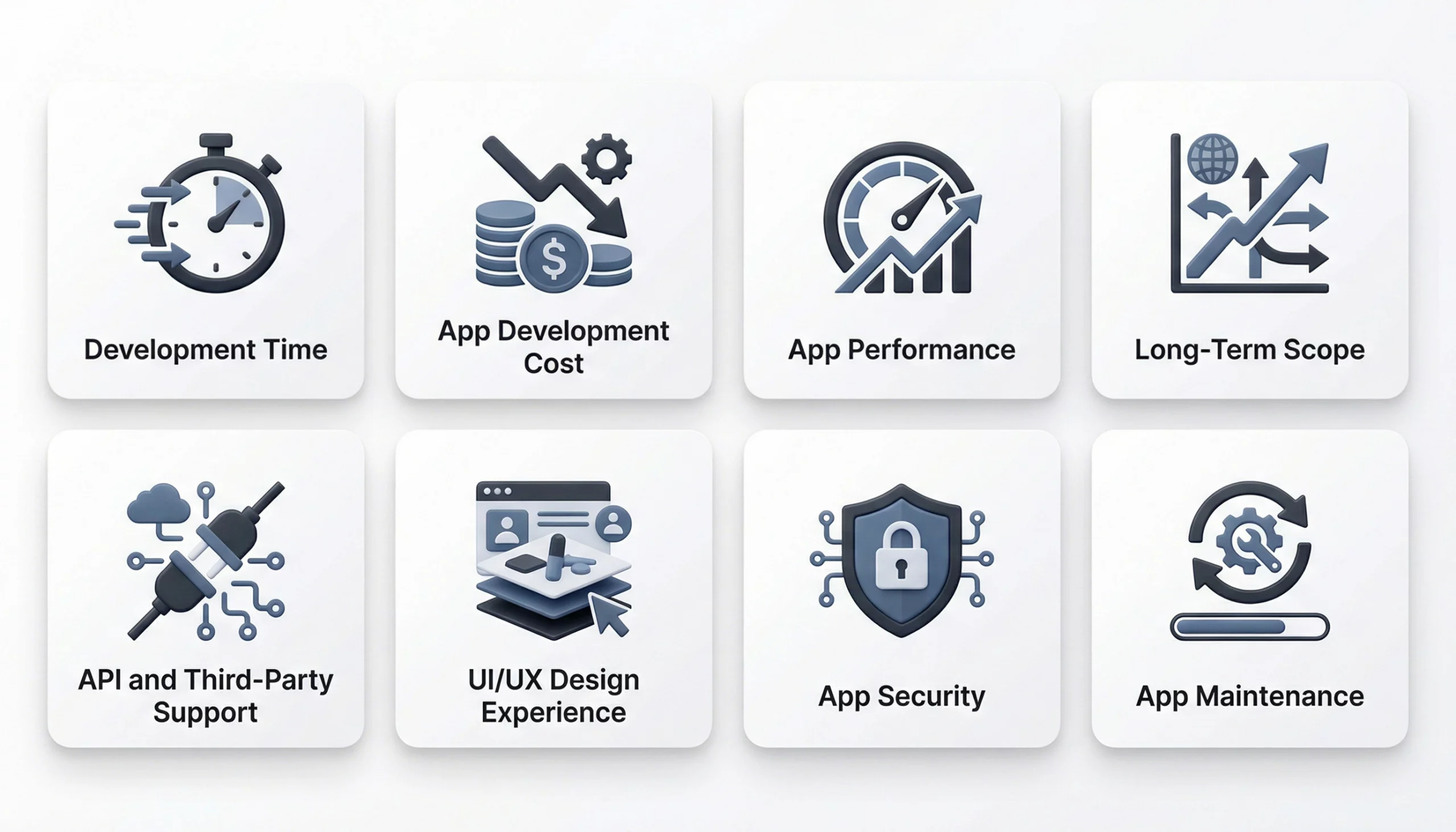
Let’s explore a thorough comparison between React Native vs native apps:
1. Development Time
The most significant factor to evaluate when choosing between React Native vs native apps is the development time. In native app development, the code is written individually for both Android and iOS platforms due to technical variations. You need to assign two different app development teams for iOS and Android, respectively. Alongside, for every change required, you need to rebuild and re-run the project. This can result in extra development time due to some extra efforts.
On the other hand, React Native works on a single codebase, which means you can build apps for Android and iOS using the same code. Hot reloading or fast refresh makes it easier to deploy the project without rebuilding it every time, cutting down the effort and time. Leveraging top IT consulting services promises to build mobile apps before the deadline.
So, it’s clear that React Native helps you build applications earlier than native, winning the React Native vs native app development debate in this factor.
2. App Development Cost
Building a native app costs more because you need to build separate codebases for iOS and Android. It also increases the development time, maintenance efforts, and the need for specialized developers for each platform. While tools like Kotlin and others allow some shared logic codebase, native apps still need more resources and effort.
On the other hand, the React native app development cost is typically 30-35% less than native app development. This is due to its capability of utilizing a single shared codebase across many platforms. So, React Native wins the native vs React Native development debate in terms of cost.
3. App Performance
When comparing React Native vs Native performance in 2026, the gap is now narrower than in previous years. The traditional React Native relied on the JavaScript Bridge technology. This helped bridge the gap between React Native and native code, but also caused latency due to data serialization and single-threaded operations.
However, with “The Death of the Bridge” and the introduction of “NEW ARCHITECTURE”, apps now can have a more efficient and direct communication method. Key architectural changes include core components:
JSI (JavaScript Interface): JSI allows the JavaScript code and native layers to communicate directly by holding references to objects, eliminating the serialization overhead.
TurboModules: This system enables native modules to be lazy-loaded, meaning they are only loaded whenever needed. It challenges a common performance bottleneck in the legacy architecture and significantly reduces the app’s memory consumption rates.
Fabric Renderer: It introduces a concurrent rendering pipeline model that fully aligns with React’s latest version, that is. React 19.2.3. It allows React to prioritise urgent user interactions and thus have a more responsive user experience.
But on the other hand, Native apps still outperform when building:
- 3D graphics applications
- Real-time multimedia processing
- Spatial computing apps
- Heavy on-device ML apps
Overall, native wins the performance battle for complex performance needs, and React Native now wins for speed and budget in the native app vs React Native app development.
4. Long-Term Scope
Businesses look for a long-term scope when deciding to build a mobile app. It helps them stay relevant and future-ready. So, let’s explore which one provides a long-term scope in this React Native vs native apps development debate.
Native apps are supported and backed by Google and Apple, which helps them easily get access to new OS features, hardware APIs, and tools. This helps you implement any functionality, resolve errors, and update the app without impacting the usability.
On the other hand, React Native does not provide updates in sync with Apple and Google. However, it has gained long-term stability thanks to Meta’s support and community contributors such as Microsoft and Expo.
So, Native leads in long-term platform alignment. In contrast, React Native remains a strong long-term option for teams priortizing cross-platform reach and faster iteration cycles.
5. API and Third-Party Support
Native app development frameworks have the ability to use all types of APIs directly, but the same is not possible with React Native. The cross-platform framework supports most common APIs, but advanced or device-specific capabilities may still require native modules. React Native also depends on a bridging layer to access platform features, although the New Architecture has reduced some of these limitations.
So, native app development generally wins the battle over React Native when it comes to full and immediate API access.
6. UI/UX Design Experience
UI/UX experience is another significant factor in the native vs React Native apps debate. However, one of the top cross-platform app development frameworks, React Native, allows developers to reuse the functionality code and write platform-specific code separately when needed. However, it can be challenging to create complex UI layouts, such as custom views, navigation patterns, seamless transitions, and high-end animations in React Native app development.
On the other hand, native development allows designers to work individually on every screen for both Android and iOS devices, resulting in a higher mobile app UI/UX experience.
So, native apps emerge winners in the React Native vs native apps debate in terms of UI/UX design precision and performance.
Read Also: Top React Native UI Libraries to Build Intuitive Mobile Apps with Ease
7. App Security
React Native is based on JavaScript, which is not a strongly typed and compiled language like Swift, Kotlin, or Java. However, React Native databases and secure storage can be used to improve security, but vulnerabilities may arise if native modules are not properly implemented.
But that’s not the case with native app development; it provides wonderful app security and secures the application from normal attacks. With full OS-level protection and strongly typed languages, native is the winner of the react native vs native mobile app development debate if we consider security.
8. App Maintenance
Talking about app maintenance in the React Native vs native apps debate, it’s a tedious and more time-consuming task for native app development. Paying attention to bugs on both native platforms and resolving them separately can take a lot of time.
But using React Native for mobile app development can help you resolve bugs easily on both platforms. That’s why partnering with a top custom software development company is essential, as they will provide post-launch support that aligns with your business needs.
React Native vs Native Apps: A Quick Comparison Table
We have discussed the top factors that are necessary while deciding the best between React Native vs native app development.
Now, let’s summarize these things and understand the comparison in a tabular format. The table can help you understand the different things easily.
Take a look at the table below:
Factor |
React Native |
Native Apps |
| Development Time | Faster speed due to the single shared codebase that works on both Android and iOS. | Slower speed due to separate codebases, but using Compose & SwiftUI now accelerates UI |
| App Development Cost | 30 to 40% lower due to shared development | Higher upfront cost due to multiple teams |
| Performance | Near-native with JSI, TurboModules, and Fabric | Full native performance, ideal for heavy computation |
| Long-Term Scope | Strong support via Meta, community contributors and enterprise ecosystem | Direct support from Apple/Google with immediate access to OS tech |
| API and Third-Party Support | Most APIs supported, but native bridging still needed for edge cases | Direct access to all OS APIs and new SDKs |
| UI/UX Experience | Native-like UI, but complex UIs need more effort | Provides a higher mobile app experience using platform-specific animations |
| App Security | Strong with type modules and secure runtime | Best choice for regulated and enterprise compliance |
| App Maintenance | Easier, as it enables maintenance with minimal cost | More time-consuming due to double updates |
| Best For | Startups, MVPs, cost-effective solutions, and apps with simple to medium complexity | High-performance apps, gaming, fintech, healthcare, and enterprise apps |
React Native vs Native: TCO (Total Cost of Ownership) Comparison Table
When estimating the true cost of an app, you need to look beyond the initial development cost and also consider the Total Cost of Ownership (TCO). The total cost of ownership includes everything from initial build expense to maintenance and security.
Now, let’s look at the table below that compares both mobile app development approaches in terms of the final lifetime cost:
TCO Factor |
React Native Apps |
Native Apps |
| Initial Development Cost | Lower, as it uses a single codebase | Higher, as it builds separate codebases for various platforms |
| Time-to-Market | Faster feature delivery, as it ships codebases to iOS and Android simultaneously | Slower delivery to independent builds and then team reviews |
| Maintenance and Updates | Changes get updated in both platforms, so lower maintenance costs | Two codebases require a separate maintenance phase, so a higher maintenance cost and time |
| Security and Compliance Costs | May need extra native plugins or modules for enterprise-level security, so higher costs | Has a dedicated, built-in platform protection system, so less security costs |
| Overall Lifetime Cost | Lower TCO for most use cases | Lower initial cost but higher TCO for larger or complex apps |
React Native Vs Native Apps: Which One Should You Choose?
We have provided you with a detailed comparison to help you choose the best. It’s important to understand that selecting between React Native vs native apps depends on your business goals, budget, and target audience. To help you further, we are going to tell you when you should select native or React Native.
When Should You Choose Native Apps?
You should prefer native app development for your mobile app project if:
- You are building a complex, performance-heavy application such as a messenger, streaming, or gaming app.
- You are planning to update frequently and need instant access to new OS features.
- You are building spatial computing, AI-driven, or IoT-based applications.
- Providing the best possible native user experience is your top focus.
- You need deep access to device hardware (sensors, biometrics, camera pipelines, etc.).
When Should You Choose React Native Apps?
You should consider building a React Native application for your business if:
- You are building a simple, content-first or uniform application.
- Launching the application on cross-platform is your top priority.
- You are concerned about the budget for app development and want code reuse.
- Entering the market at the earliest is your primary goal.
- You are building an e-commerce app, marketplace, SaaS dashboard, or social platform.
After choosing between React Native vs native apps, you need to partner with a globally-recognized mobile app development company that understands both approaches. The right company will assess your requirements and build a solution that ensures performance, scalability, and user engagement. However, you can choose to hire React Native developers to build your desired product.
Real-World Apps Built With React Native And Native App Development
When choosing between React Native vs native apps, you should take a look at the real-world famous applications built using these technologies. This list can help you understand how they are helping businesses achieve success.
Let’s take a look at these real-world examples:
1. Facebook
Facebook created React Native to accelerate feature development across iOS and Android while maintaining native performance. The framework allowed Facebook to reuse UI logic and push updates faster. It reduces engineering effort and enables rapid iteration across products like Facebook and Instagram.
2. Walmart
Walmart leveraged React Native to enhance performance and user experience across both mobile platforms while optimizing engineering resources. By reusing nearly 96% of its codebase, Walmart significantly reduced development time. It enables faster feature delivery and a stronger competitive edge in the retail marketplace.
3. Uber Eats
Uber Eats is an online food ordering application under Uber. It was facing some problems and utilized native code to boost the performance of its application. They used native to ensure precise GPS tracking, real-time order updates, and smooth updates. Their core services, such as payment and order tracking, also use native technologies.
4. Netflix
One of the biggest streaming platforms, Netflix, primarily uses native technologies for consumer-facing applications. Having a native app enables Netflix to optimize video playback, offline downloads, and real-time content delivery. For better security and speed, video compression and adaptive streaming are also handled natively.

Final Thoughts
Choosing between React Native vs native apps is crucial for your app project. We hope this blog has helped you understand which is best for your business in 2026. React Native offers benefits like cost-saving, faster development, and cross-platform compatibility, but it also comes with a few drawbacks. On the other hand, native app development provides blazing-fast performance, but it demands more resources and time.
However, the final decision depends on your business requirements, target audience, and future goals. If you are still confused about choosing one, then you should partner with an experienced cross platform mobile app development company to make the best decision and start the development.
At RipenApps, we help you create a product that delivers real business value and keeps your users engaged. We don’t just execute the development phase; instead, we guide startup founders and enterprises to make technology that evolves easily and pays off today. With our unique approach, we have supported brands such as YCASA (A Real Estate Rental App), emmyHealth (A Wellness Management App), ServiVet (An On-Demand Home Services App), and more such fast-growing brands.

FAQs
Q1. Is React Native slower than native apps?
No, it is not that much slower than native apps. Thanks to React Native’s New Architecture (JSI, Fabric, TurboModules), performance differences using React Native are minimal for building most business applications. Native only keeps a lead in highly specialized, compute-heavy cases.
Q2. Can I convert my Native app into a React Native app?
Yes, you can convert your existing native app (Android or iOS) into a React Native app, but it involves rewriting significant parts of the code and keeping some core logic and integrating React Native components into your existing native app.
Q3. How does React Native help reduce mobile app development costs?
React Native significantly reduces mobile app development costs by allowing developers to create a single codebase for both iOS and Android applications, eliminating the need for building separate apps for each platform.
Q4. Does React Native support AI, Machine Learning, or IoT integrations as well as Native apps?
Yes, both React Native and Native apps allow integration with advanced technologies such as AI, machine learning, and IoT by enabling developers to incorporate external libraries and tools. Leveraging machine learning in React Native app development helps businesses build smarter applications.
Q5. Can React Native be used to build apps for wearables or devices like the Apple Watch or Vision Pro?
React Native can support companion experiences and shared logic for wearables and spatial devices, but UI layers for Apple Watch, Wear OS, and next-gen AR platforms like Vision Pro still require native development. Most businesses use React Native for the primary mobile app and pair it with native modules for device-specific extensions.

SHARE
WRITTEN BY

Prankur Haldiya
Chief Technical Officer
A tech innovator and engineering leader, Prankur Haldiya drives RipenApps’ product development strategy and oversees cutting-edge solutions in mobility, AI, and cloud ecosystems. He is passionate about building high-performance teams and helping brands launch secure, scalable, and user-centric digital products.
View All Articles