

In today’s ever-changing app industry, you are under constant pressure to launch faster, scale smarter, and maintain consistent performance across various apps. Here, Flutter addresses these demands by combining native-level performance with rapid development capabilities. With its expressive UI system, seamless animations, and growing multi-platform support, it allows you to deliver premium digital experiences without the complexity of managing separate development teams for each platform.
Flutter has firmly established itself as one of the most influential frameworks shaping modern app development. It began as a cross-platform UI toolkit and has evolved into a powerful, production-ready ecosystem. It enables you to build high-performance applications across mobile, web, desktop, and emerging platforms. Its ability to deliver visually rich, consistent, and scalable user experiences from a single codebase.
But the main question is, why is Flutter emerging as the future of app development, and how can it help you build products that scale with your long-term goals? Well, don’t worry, this blog answers this exactly.
We’ll examine Flutter’s market growth, real-world adoption, key features, and the top reasons it continues to outperform many cross-platform frameworks. If you’re evaluating the right technology to build scalable, high-impact digital products, this blog is for you. So, deep dive into this:
Table of Contents
The Current Market Landscape Of Flutter App Development
Flutter was introduced by Google as a UI toolkit. It was built to support the creation of single-code applications for web, mobile, and desktop platforms. This means that developers can build near-native performance Flutter apps using a single codebase. It is a feature-rich UI framework that enables developers to create intuitive UIs and responsive features. Thus, it helps businesses reduce development effort, optimise costs, and accelerate time-to-market.
In the past few years, Flutter has evolved and matured into one of the top cross-platform app development frameworks in the app development market. It started as an emerging technology, and now it is a trusted solution that is used by growing startups and enterprises. Many businesses and startups hire app developers to build customised mobile apps for Android and iOS, thus meeting modern-day users’ demand related to consistent UI, smooth and faster iterative deployment cycles.
As per recent insights by 6sense, Flutter’s market share is holding an estimate of 0.96% market share in the application development category and is actively used by 26,856 customers worldwide. It is ranked at 11 position globally among top development technologies.
According to the latest mobile app industry statistics, Flutter’s dominance over the mobile app development market has increased substantially. It has gained a competitive edge over its top rival, React Native and other popular cross-platform app development tools also. Its performance-driven architecture, multi-platform capabilities, and strong backing from Google continue to strengthen its position in the market.
Flutter is widely adopted by globally recognised app development companies that offer services such as web development, software development, and digital marketing. Here is the chart that depicts Flutter’s versatility across multiple busines domains:
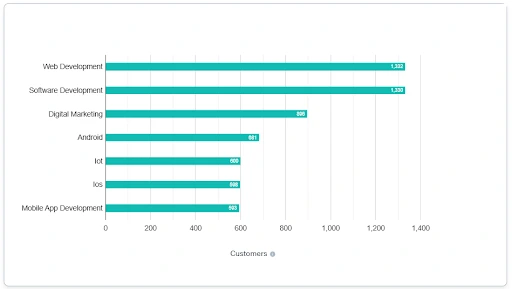
The chart above shows that Flutter is most commonly used in web development (about 1,332 customers) and software development (1,330 customers). It is followed by digital marketing (896), Android (681), and iOS (598). This distribution clearly indicates that Flutter is a flexible and scalable framework, and developers can benefit from diverse development use cases.
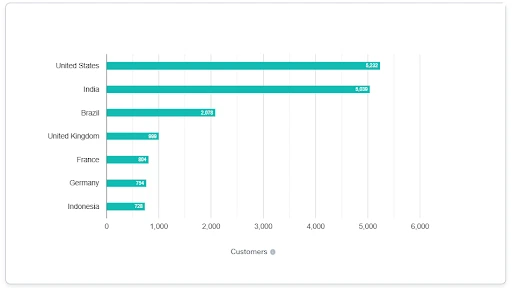
Furthermore, from a geographical standpoint, Flutter continues to see strong adoption across key global markets. The United States leads with 5,232 customers, India with 5,039, Brazil with 2,078 customers, and more. Look at the chart below to find a detailed breakdown of Flutter customers by geographic location:
Examples of Successful Apps Built with Flutter
Flutter has been used by various companies, including leading brands. There are many popular mobile apps built with Flutter that contribute to business growth. Below are some notable examples that demonstrate Flutter’s real-world adoption:
1. Alibaba Group’s Xianyu
Xianyu is one of China’s largest online marketplaces for second-hand goods. It serves millions of users with a smooth and responsive app experience. The platform leverages Flutter to handle complex UI interactions at scale while maintaining consistent performance. Its adoption highlights Flutter’s suitability for high-traffic, consumer-facing marketplace applications.
2. Google Ads
Google developed the Google Ads mobile app using Flutter, showcasing the framework’s capability to handle complex, data-driven interfaces. The app allows advertisers to manage campaigns, track performance, and optimise budgets in real time. This implementation reflects Google’s confidence in Flutter for enterprise-grade internal and customer-facing products.
3. Tencent’s Nowcoder
Nowcoder is a learning platform focused on IT and software engineering education, built to support high user engagement and performance. Flutter enables the platform to deliver a consistent learning experience across devices and operating systems. Its usage demonstrates Flutter’s effectiveness in education and content-driven applications.
4. Reflectly
Reflectly is a popular mindfulness and journaling app known for its visually rich and interactive user interface. Flutter helps power smooth animations and a highly personalised user experience within the app. The app is often cited as an early success story that showcased Flutter’s UI capabilities.
5. eBay Motors
eBay Motors, a branch of eBay focused on automotive sales, used Flutter to develop its app. The app supports vehicle listings, browsing, and detailed product views with reliable performance. Its implementation shows how Flutter can support feature-rich commerce applications.
6. The New York Times Crossword
The New York Times chose Flutter to build the mobile app for its renowned crossword puzzle. Flutter enables fast rendering and seamless interactions essential for daily puzzle engagement. This use case highlights Flutter’s ability to handle media and content-heavy applications.
7. Nubank
One of Brazil’s leading digital banks, Nubank, employed Flutter to power its mobile banking app for speed, reliability, and scalability. Flutter helps deliver a consistent and secure user experience across platforms. Its adoption reflects Flutter’s growing role in fintech and regulated industries.
8. Dream11
It is a fantasy sports platform in India that utilises Flutter to enhance the user experience of its app. The app supports real-time interactions and user engagement during live sporting events. This demonstrates Flutter’s capability to scale during peak usage periods.
9. Hamilton
The official app for the hit musical “Hamilton” was built with Flutter. The app enhances audience engagement through exclusive content and immersive experiences. Flutter enables smooth multimedia performance across devices.
10. Hookle
Hookle is a social media management and content scheduling app that leverages Flutter for efficient cross-platform performance. The app allows users to plan, publish, and analyse content across multiple social platforms. Its development highlights Flutter’s suitability for SaaS and productivity tools.
What Features Make Flutter a Better Cross-Platform Development Framework?
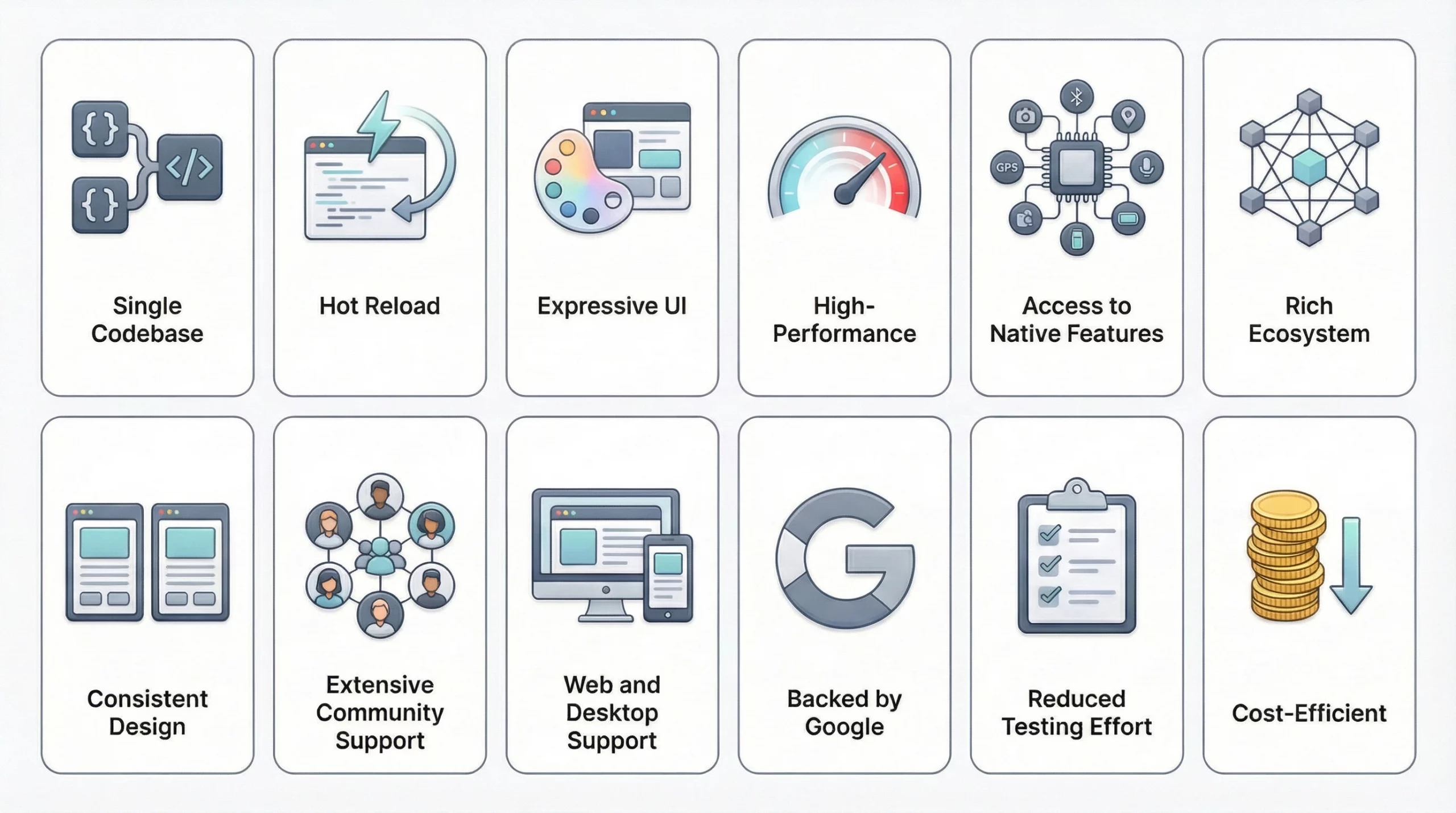
Flutter has gained popularity as a leading cross-platform development platform. It stands out from other frameworks due to several reasons. Here’s a detailed explanation of the features that make Flutter a good choice for building feature-powered mobile apps.
So, let’s look into these key features:
1. Single Codebase
Flutter allows developers to write code once and use it across multiple platforms. Some of them are Android, iOS, web, and desktop. This single codebase approach significantly reduces development time and the overall Flutter app development cost.
As a result, it helps in saving a significant amount of the cost of app development. This Flutter app development approach is widely adopted for providing apps that have faster time-to-market and scalability in the long run, thus achieving sustainable business success.
2. Hot Reload
Another key feature that makes it the top choice for enterprise app development is its “Hot Reload” functionality. Developers can instantly see the impact of code changes in the app without restarting it. This feature accelerates development and improves collaboration between developers and designers. It continues to be a key productivity advantage for iterative and agile development workflows.
3. Expressive UI
Flutter provides a rich set of customizable widgets that allow developers to create visually stunning and highly customised user interfaces. Unlike some other cross-platform frameworks that use native components, it renders its widgets directly on the canvas. Consequently, it allows for pixel-perfect UI control and delivers high-quality mobile app design.
4. High-performance
Flutter’s architecture includes a high-performance rendering engine called Impeller. This engine ensures smooth animations and fast UI rendering. It is particularly important for applications that require a fluid and responsive user experience. With native ARM compilation and Impeller’s predictable rendering pipeline, Flutter apps can now deliver near-native performance across devices in 2026. Therefore, apps built with Flutter deliver excellent app performance.
Additionally, Flutter 4.0 version is expected to introduce advancements and the Impeller 2.0 rendering engine. It will have a next-gen rendering pipeline that is anticipated to improve the rendering efficiency and GPU utilisation to a next level.
5. Access to Native Features
Flutter allows developers to access native platform features and APIs using platform channels. This means that developers can seamlessly integrate platform-specific functionalities into their Flutter app. With this level of advanced flexibility, it remains a suitable choice for building enterprise-level, feature-rich, and complex Flutter apps.
6. Rich Ecosystem
Flutter has a growing ecosystem of packages and plugins available on the Flutter documentation repository. These packages cover a wide range of functionalities. For instance, database integration, state management, and third-party service integration.
As a result, this extensive library of packages simplifies development and speeds up the whole Flutter app development process. It also reduces the need for duplicate codebases, thus enabling developers to focus more on enhancing the user experiences and core business logic.
7. Consistent Design
Flutter’s widgets are designed to follow the Material Design guidelines and provide material widgets for the Android platform. Whereas, for the iOS platform, Flutter offers Cupertino widgets that adhere to Apple’s human interface guidelines. This ensures that the app maintains a consistent look. And also gives the same feel on both platforms while allowing for customisation.
Read Also: Android vs. iOS User Behavior: Which Platform is Best for Your App?
8. Extensive Community Support
Flutter has a passionate and active developer community. This community contributes to the framework’s growth by creating plugins and useful tutorials. It provides support on forums, tutorials, and other helpful resources, and developers can benefit from these. Thus, this community support is highly useful for developers and helps them adopt the Flutter framework to maintain the app in the long run.
9. Web and Desktop Support
Flutter’s ability to target web and desktop platforms gives an additional advantage. This means developers can use Flutter to build applications that run across multiple environments using a single codebase. As a result, it empowers developers to expand their user reach across all platforms. Currently, Flutter’s web and desktop support is production-ready and widely used for multi-platform product development.
10. Backed by Google
Flutter is an open-source framework that benefits from community contributions and is not tied to any proprietary platform. This framework is backed by Google, which adds credibility and ensures ongoing development and support. With its open-source nature, it helps you build apps that implement modern mobile app development trends and encourages stability and complete transparency in the long run.
11. Reduced Testing Effort
Since Flutter uses the same codebase across platforms, testing becomes more streamlined. Developers can focus on testing the core functionality of their app once. Consequently, reducing the testing effort improves overall app quality.
It also provides a robust testing phase that includes integration testing, unit testing, and widget testing cycles. This enables development teams to identify issues in the early stage and improve the app to maintain consistency across various OS platforms.
12. Cost-Efficient
Developing with Flutter can be more cost-effective for businesses. This is because it reduces development time and effort. It also minimises the need for platform-specific developers and provides a consistent user experience across platforms. Hence, Flutter helps in building mobile apps at reduced costs.
Comparison of Flutter with Other Cross-Platform Development Frameworks
Here is a brief comparison table between Flutter and other cross-platform app development frameworks:
| Feature | Flutter | React Native | .NET MAUI | Ionic | Kotlin Multiplatform |
| Founded Year | 2017 | 2015 | 2022 | 2012 | 2017 |
| Primary Language | Dart | JavaScript or TypeScript | C# | HTML, CSS, and JavaScript | Kotlin |
| Supported OS Platforms | Android, iOS, Web, and Desktop | Android and iOS | Android, iOS, Windows, and macOS | Android, iOS, and web | Android, iOS, Web, and Desktop |
| Code Reusability | High | High | High | High | Medium to High |
| Perfomance | Near-native (ARM + Impeller) | Near-native (Fabric or Turbo Modules) | Near-native | Moderate (Web View-based) | Native |
| UI Rendering | Custom widgets | Native UI components | Native UI components | Web-based UI | Native UI |
| Hot Reload Functionality | Yes | Yes | Yes | Yes | Partial |
| Developer Learning Curve | Moderate | Low | Moderate | Low | Moderate to High |
| Backed By | Meta | Microsoft | Open-Source Community | JetBrains | |
| Community & Ecosystem | Large and Rapidly Growing Community | Large Community | Large Community | Large (web-focused) Community | Growing Community |
Top Reasons Indicating Why Flutter is the Future of App Development
Flutter’s status as the future of app development is rooted in its unique features and advantages. It addresses many of the challenges faced by app developers today. Being open-source, Flutter benefits from continuous improvements.
And it also updates from its active developer community and Google. This ensures that it remains up-to-date with the latest industry trends and technologies. Here are the following key reasons why Flutter is shaping the future of mobile app development:
1. Long-Term Performance Scalability
Flutter compiles native ARM code. This results in high app performance. It offers smooth animations, fast UI rendering, and excellent responsiveness. By leveraging its rendering engine and a predictable rendering pipeline, it is well-positioned to handle future performance demands across platforms and devices. Eventually, it stands out as an ideal choice for building apps that require high-standard features.
2. Widget Ecosystem Maturity
Flutter comes with a rich set of pre-designed widgets for common UI elements. Additionally, the Flutter community actively contributes to a vast library of packages and plugins that extend functionality. This growing widget ecosystem maturity ensures developers that their apps will reduce dependency on custom app development as applications scale. Hence, its usage to integrate various features into apps will increase more in the future.
3. Multi-Platform Product Strategy
Flutter has expanded beyond mobile to support web and desktop application development. Developers can use a single codebase to target multiple platforms. Thus, developers and mobile app development companies will use Flutter predominantly due to its multi-platform support. This unified development approach makes Flutter suitable for businesses building multi-device Flutter apps.
4. Strong Developer Community and Resources
Flutter has a rapidly growing and engaged developer community. This means that developers have access to a variety of resources. For instance, tutorials, documentation, etc. It keeps updating its resources to help developers overcome challenges. So, new Flutter developers will have good community support that can help them start their app development journey.
5. Backed by Google and Roadmap Stability
Google continues to invest in Flutter. The tech giant is always working to ensure its long-term viability. Google’s backing adds credibility and reassurance for developers and businesses alike. This sustained investment positions Flutter as a future-ready framework for growing startups and enterprises, thus having enhanced roadmap stability.
6. Sustainable Cost-Effectiveness at Scale
Flutter’s cross-platform nature and faster development times translate to cost savings for businesses. With this framework, developers can deploy the same codebase and also use natively-complied components for Android and iOS. As any Flutter app needs to scale, it reduces maintenance effort and faster iteration cycles, thus strengthening long-term cost efficiency. Hence, it allows startups and enterprises to build high-quality apps within budget constraints.
7. Expanded Industry Adoption
Flutter is being adopted across various industries, including finance, e-commerce, entertainment, healthcare, and education. This widespread adoption is a testament to its versatility and suitability for diverse app needs. Therefore, businesses across different industries will prefer Flutter for building market-ready apps.
8. Readiness for Embedded Technologies
Flutter’s adaptability extends to embedded systems. It is suitable for developing user interfaces for devices beyond smartphones and tablets, such as smart TVs, IoT devices, and more. As the demand for Flutter development services increases for emerging technologies. So, Flutter’s development adaptability will make it a prominent framework in the future.
9. Enterprise-Grade Stability and Scalability
Flutter has increasingly proven its capability to support enterprise-grade applications that require stability, scalability, and long-term maintainability. Its structured architecture, predictable release cycles, and strong tooling support enable developers to manage large codebases efficiently. As businesses scale their digital products and user bases, Flutter provides the reliability needed to support complex workflows, high traffic, and evolving business requirements.
10. Alignment with Modern App Development Trends
Flutter aligns closely with modern app development trends such as rapid iteration, modular architecture, and experience-driven design. Its support for responsive layouts, smooth animations, and integration with cloud services makes it suitable for building contemporary digital products. As user expectations continue to evolve, Flutter’s flexibility allows developers to adapt quickly to new technologies and design paradigms, reinforcing its relevance in the future.
Wrapping Up
Flutter has emerged as a true pioneer in the realm of mobile app development. Its unique combination of features and capabilities has propelled it to the forefront of modern app development. Rather than being a short-term trend, it has proven to be a transformative framework that continues to evolve with industry demands.
As we look ahead, Flutter’s trajectory seems destined to redefine the way we build, deploy, and experience applications. With strong backing from Google, a rapidly growing ecosystem, and expanding adoption across industries, its role future of mobile app development is not a surprise.
For businesses looking to leverage Flutter for building future-ready and scalable apps, partnering with the right app development company like RipenApps is crucial. At Ripenapps, we help businesses and startups turn their ideas into production-ready mobile solutions using modern architectures and best practices. With a strong focus on performance and scalability, we have helped innovative brands like Hungama (A Feature-Rich OTT App), Auricle (A New-Age Medical Education App), Pranic Healing Sounds (A Dedicated Spiritual App), and more.

FAQs
Q1. Why is Flutter considered the future of app development?
Flutter is considered future-ready because it enables you to build high-performance, scalable applications across multiple platforms using a single codebase. Its consistent UI rendering, strong ecosystem, and ongoing evolution make it well-suited for long-term product development.
Q2. Can Flutter apps deliver native-like performance?
Yes, Flutter uses native ARM compilation and a modern rendering pipeline. It allows you to build apps that deliver smooth animations, fast UI rendering, and responsive interactions. With proper architecture and optimisation, Flutter apps can achieve near-native performance for most use cases.
Q3. Is Flutter suitable for enterprise and large-scale applications?
Flutter has matured into a production-ready framework that supports enterprise-grade applications. It offers scalability, modular architecture, and strong tooling, making it suitable for complex apps with high user traffic and evolving business requirements.
Q4. Does Flutter support web and desktop app development?
Yes, Flutter supports web and desktop platforms in addition to mobile. You can use a single codebase to build applications for Android, iOS, web, Windows, macOS, and Linux, enabling a unified multi-platform development strategy.
Q5. When should you choose Flutter over other cross-platform frameworks?
Flutter is a strong choice when you need consistent UI across platforms, faster time-to-market, and long-term scalability. It is particularly suitable for applications that require rich user interfaces, smooth animations, and the flexibility to expand across multiple platforms.

SHARE
WRITTEN BY

Ishan Gupta
CEO & Founder
Ishan Gupta is a seasoned entrepreneur and CEO with extensive 8+ years of experience in business and mobile app development landscape. He believes that the right digital product allows companies to focus on what they do best, while technology handles the rest. With deep exposure to global markets, he understands what makes an app succeed. His approach translates business needs into clear product strategies, ensuring that every feature contributes to measurable ROI.
View All Articles