

Sports have always been competitive. Now it is driven by intelligence. Every pass, sprint, swing, and tackle generates data. Every match produces thousands of measurable signals. Today, AI in sports converts those signals into intelligence. That intelligence drives performance, monetization, fan engagement, and operational efficiency.
Artificial intelligence in sports is no longer limited to elite leagues. Startups, fantasy platforms, sports academies, broadcasters, and betting operators are investing in intelligent systems. According to industry projections, the AI in sports market is expected to grow upto to $2.61 billion by 2030, expanding at a CAGR of 16.7 percent from 2024 to 2030. This growth reflects a structural shift in the industry’s operations.
If you are building a digital product in this space, understanding how AI integrates into modern sports applications is critical. This blog explores how AI is used in sports, real-world AI in sports examples, emerging trends like generative AI in sports, and what businesses must build to stay competitive. So, let’s get started:
Table of Contents
Market Statistics of AI in Sports App Development
Artificial intelligence in sports is accelerating growth across the global sports ecosystem. As teams, leagues, and startups invest in intelligent platforms, AI is moving from experimental pilots to full-scale deployment. Data-driven decision systems now define competitive advantage across performance, fan engagement, and revenue models.
According to a MarketsandMarkets report, the AI in sports market is projected to reach $2.61 billion by 2030, growing at a CAGR of 16.7%. Key growth drivers include AI-powered chatbots, virtual assistants, real-time player tracking, predictive analytics, and automated content generation.
North America holds the largest share due to strong sports infrastructure and early adoption of sports artificial intelligence. Asia Pacific is the fastest-growing region, fueled by mobile-first audiences, rising fantasy sports participation, and rapid digital transformation in sports and technology.
Role of AI in Sports App Development
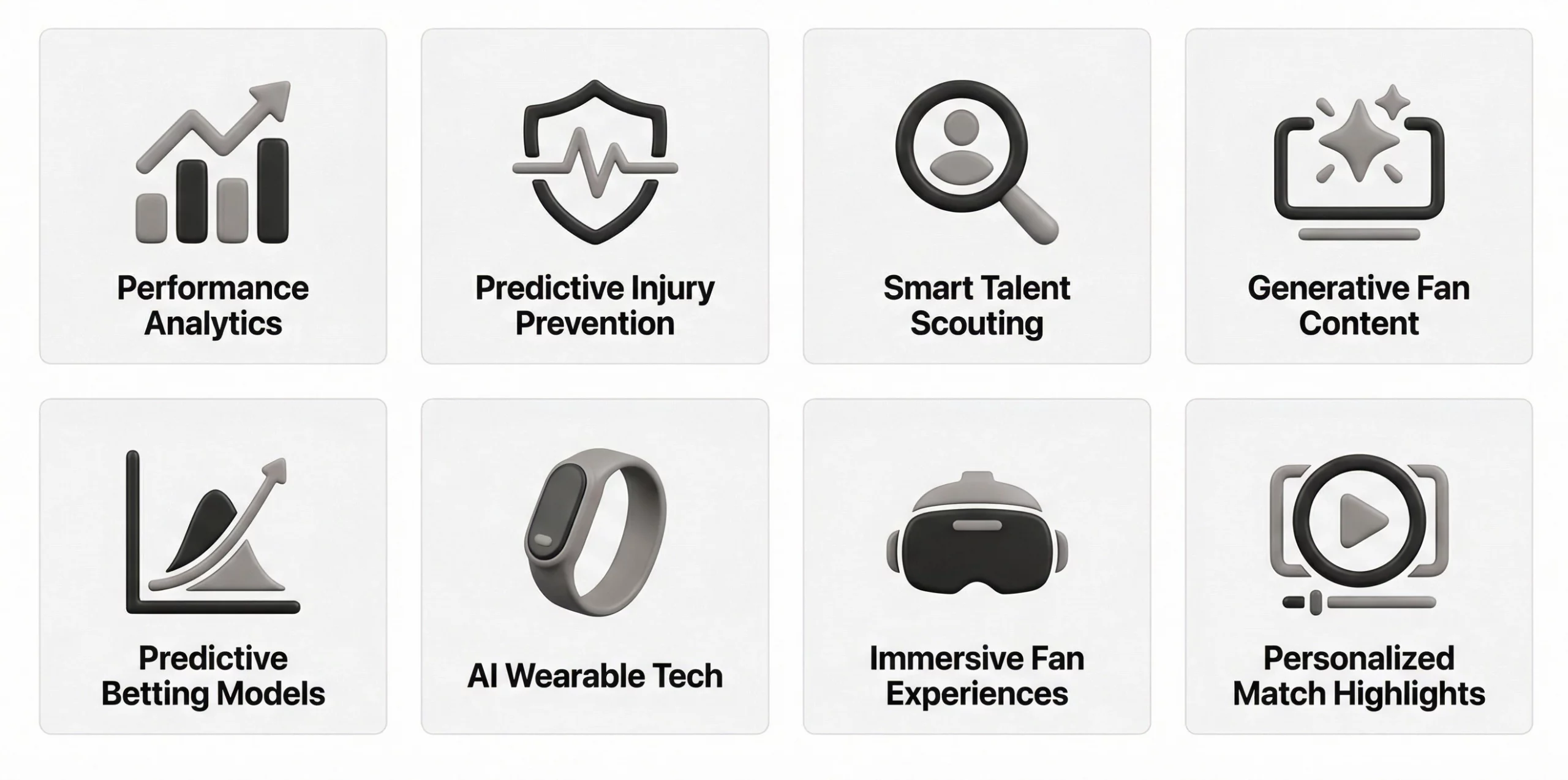
Undoubtedly, the demand for AI in sports is further creating the demand for AI-based sports app developers and sports app development guides. Do you know why? AI benefits the sports industry in several ways. Here are some of them showcasing the role of AI in sports.
1. AI in Sports Analytics: Performance Intelligence at Scale
Performance tracking forms the backbone of AI in sports analytics. In the English Premier League, advanced camera systems track player movement in real time. AI models process positional data, sprint intensity, acceleration bursts, and fatigue patterns. Heat maps reveal spatial dominance across the pitch.
Similarly, teams in the National Basketball Association deploy optical tracking systems that capture every dribble, pass trajectory, defensive formation, and shot efficiency metric.
These systems generate advanced performance indicators such as:
- Player impact ratings
- Offensive and defensive efficiency
- Spacing optimization
- Load management metrics
This is where sports and AI intersect at operational depth. Coaches no longer rely only on post-match analysis. They receive predictive recommendations before and during matches.
Therefore, you need to work with an experienced sports app development company to seamlessly integrate advanced AI-powered features into your sports app. They have the expertise in AI sports Analytics means building real-time dashboards, historical performance databases, Machine learning-based predictive modules and custom visualization layers.
2. AI in Sports Injury Prevention: Predictive Health Intelligence
Injury risk is one of the most expensive variables in professional sports. Contracts, sponsorships, and team performance depend on athlete availability. AI in sports injury prevention is transforming how teams manage health.
Modern AI models analyze:
- Muscle fatigue through wearable sensors
- Gait and movement asymmetry
- Joint stress accumulation
- Recovery time patterns
- Historical injury datasets
Wearables connected to ecosystems like Apple devices feed biometric data directly into AI-powered sports apps. These systems provide early injury risk alerts, recovery optimization plans, personalized training intensity adjustments, and rehabilitation progress tracking.
Artificial intelligence sports applications reduce long-term downtime. They protect both the athlete’s health and financial investment. Availing professional AI application development services enables seamless integration of wearable data, predictive health models, and real-time analytics within sports platforms.
3. Intelligent Recruitment & Data-Driven Talent Scouting
Recruitment has moved beyond highlight reels and raw statistics. In leagues such as Major League Baseball, AI-powered scouting systems analyze thousands of variables before contract decisions are made.
These include:
- Biomechanics
- Consistency patterns
- Performance under pressure
- Injury history
- Adaptability across tactical systems
Machine learning models forecast future player value rather than relying solely on historical performance. For startups building scouting platforms, artificial intelligence in sports enables automated athlete ranking systems, performance comparison engines, and even predictive salary valuation tools.
This data-first approach reduces recruitment bias and improves long-term team-building strategies.
4. Generative AI in Sports: Automated Content and Engagement
Generative AI in sports represents the next wave of innovation. It stands among the top AI Trends shaping the future of technology in sports and redefining digital fan experiences. Sports platforms now deploy generative models to create:
- Instant match summaries
- AI-generated sports highlights
- Personalized fantasy league updates
- Automated multilingual commentary
- Social media-ready clips within seconds
Broadcasters benefit from reduced editing time. Fans receive customized content streams. Fantasy players access AI-generated performance predictions. Generative systems analyze live match feeds, identify high-impact moments, and assemble highlight reels automatically.
This reduces operational costs while increasing engagement velocity. Sports startups can hire app developer team to seamlessly integrate generative AI, which means offering real-time highlight generation, personalized content feeds, smart commentary layers, and AI-powered content monetization strategies.
5. AI in Sports Betting and Predictive Modeling
AI in sports betting app development has expanded rapidly due to predictive modeling capabilities. Modern betting systems process:
- Historical performance statistics
- Player injury updates
- Weather conditions
- Tactical formations
- Live in-game data
AI models adjust odds dynamically based on probability recalculations. Advanced behavioral analytics detect suspicious betting patterns and reduce fraud.
This integration enhances the accuracy of predictions, user trust, platform security, and revenue optimization. Thus, within the broader AI in sport ecosystem, predictive betting engines represent one of the fastest-growing segments.
6. AI Sportswear and Smart Wearable Technology
AI sportswear combines hardware and software intelligence. Smart jerseys and sensor-embedded gear measure:
- Acceleration and deceleration
- Muscle tension
- Heart rate variability
- Reaction time
- Body temperature
This data integrates into sports applications, enhancing analytics dashboards and performance tracking systems. The combination of sports and technology at the wearable level creates new monetization channels, including subscription-based analytics access and personalized training programs.
7. Intelligent AR/VR for Fans
AR and VR in sports apps are reshaping how audiences consume live games and digital content. AI-powered immersive systems allow fans to experience matches from multiple camera angles, access real-time stats overlays, and step into virtual stadium environments from home.
Platforms built with advanced artificial intelligence in sports integrate spatial computing, computer vision, and predictive analytics to deliver contextual insights during live streams.
In modern AI sports app development, AR features enable:
- Real-time player statistics layered over live matches
- Interactive 3D replays with motion tracking
- Virtual meet-and-greet simulations with athletes
- In-stadium navigation through AR overlays
For sports startups and broadcasters, combining AI and sports with immersive environments increases fan retention, premium subscription conversions, and engagement time. Intelligent AR and VR systems are no longer experimental add-ons. They are becoming core components of next-generation sports app platforms.
8. AI in Sports Highlights and Fan Personalization
AI in sports highlights goes beyond editing. It’s becoming more contextual. Moreover, Machine learning models detect:
- Game-changing plays
- Emotional crowd reactions
- High-intensity sequences
Platforms generate personalized highlight reels based on a user’s favorite players or teams. AI-driven personalization engines recommend upcoming matches, relevant content, merchandise, ticket promotions, and much more. Thus, fan engagement shifts from broadcast-driven to user-driven.
Read Also: Incredible App Ideas for Sports Industry That Businesses Shouldn’t Ignore
AI-based Technology Used in Different Sports
AI is being used in different sports, be it Football, baseball, or cricket. Here are the real use cases of AI technology in different sports.
Football
- Goal-line technology
- Video Assistant Referee (VAR)
- Broadcasts with real-time translation of subtitles
- Electronic Performance and Tracking Systems (EPTS)
- FIFA Ultimate Team (FUT)
Baseball
- Robo-ump
- Velocity measurement of the ball
- Evaluating the efficiency of players
- The angle of impact and accuracy of the throw
- Radar technology
- Spin Rate Analysis
- Trajectory analysis
Cricket
- Batsense (speed, power, twist)
- Bowling Chips inside balls
- Third Umpire (Snickometer, Hotspot, Hawkeye)
- Duckworth-Lewis Method
Read Also: Top Sports Industry Challenges: How Mobile Apps Can Resolve Them?
Real-World Examples of AI in Sports App Development
The impact of AI in sports is not theoretical. Leading leagues and sports tech platforms already rely on artificial intelligence in sports to enhance performance, officiating, fan engagement, and analytics. Here are real-world examples that show how sports and AI work together at scale.
1. Indian Premier League: AI-Based Match Analytics & Broadcast Intelligence
The IPL integrates Hawk-Eye, player tracking, and predictive match analytics into broadcasts and digital apps. AI models analyze ball speed, impact prediction, and field positioning.
These features improve umpire decisions and enrich live streaming sports apps with real-time statistics. This demonstrates how artificial intelligence sports ecosystems combine analytics with immersive fan experiences.
2. Major League Baseball: Automated Officiating & Predictive Modeling
Major League Baseball integrates AI-driven systems such as Statcast and robo-ump technology. These tools analyze pitch velocity, spin rate, trajectory, and strike zone accuracy in real time.
This shows how sports artificial intelligence supports decision-making while reducing human error. It also feeds predictive modeling systems that power fantasy apps and AI in sports betting platforms.
3. NBA: AI-Powered Performance & Fan Insights
The NBA uses advanced tracking systems powered by computer vision and machine learning to analyze player movements, shot selection, and defensive positioning. These insights fuel AI in sports analytics. Thus, helping coaches refine strategy and improve performance metrics.
On the fan side, AI personalizes highlights, recommends content, and enhances in-app viewing experiences. This is a strong example of how AI in sports highlights and fan personalization directly increase engagement and retention.
Build an AI-rich Sports App with RipenApps
RipenApps holds years of expertise in providing the best sports app development services. Our team knows how to embed artificial intelligence in mobile and web apps using machine learning and big data. Our expert sports app developers deployed intelligent algorithms in sports apps, making them unique and futuristic.
Whether it is about machine learning, voice assistance development, natural language processing, 3d visualizations and fusions, AI chatbots, or more, we are experts in the complete AI-based application development space. So, if you are searching for the top mobile app development company in USA to build an AI-based sports app, look no further than us.
Wrapping Up
AI in sports has moved from experimentation to execution. From performance analytics and predictive injury prevention to generative content, smart wearables, betting intelligence, and personalized highlights, artificial intelligence in sports is reshaping how athletes train, how teams strategize, and how fans engage. Sports and AI now define the new standard for digital sports platforms, where data drives decisions and experiences feel tailored in real time.
If you plan to build or scale a sports platform, integrating AI is no longer optional. The right strategy, backed by an experienced AI app development company, determines how effectively you turn data into engagement and revenue. At RipenApps, we build intelligent sports applications that align technology with measurable business outcomes, helping you stay competitive in a fast-moving sports tech market.
FAQs
Q1. What is the role of artificial intelligence in sports app development?
Artificial intelligence in sports app development enables real-time performance tracking, injury prediction, AI-driven highlights, fan personalization, and predictive analytics. Modern sports apps integrate AI for sports to deliver smarter training tools, dynamic betting engines, and immersive user experiences. It turns a regular sports app into a data-driven ecosystem.
Q2. Why are AI-powered sports apps important for teams and businesses?
AI-powered sports apps enhance athlete performance, strengthen fan engagement, automate content creation, and unlock new revenue streams. With the rapid expansion of artificial intelligence in sports and the rising role of AI in mobile app development, teams and businesses gain data-driven decision power, operational efficiency, and long-term scalability.
Q3. What are some real examples of AI in sports?
Common AI in sports examples include VAR systems in football, Hawk-Eye in cricket, AI-powered performance tracking in professional leagues, AI in sports betting platforms, and automated AI in sports highlights generation. These technologies show how sports and AI work together to enhance fairness, engagement, and revenue.
Q4. Why should businesses invest in AI and sports platforms?
Investing in AI and sports platforms helps you turn real-time data into measurable growth. From performance analytics and fan personalization to predictive insights and new revenue models, AI in sports strengthens engagement, retention, and long-term profitability.
Q5. How is generative AI used in sports?
Generative AI in sports creates instant match summaries, automated commentary, multilingual subtitles, and personalized highlight reels. Broadcasters and fantasy platforms use generative AI to deliver faster content production and tailored fan experiences.

SHARE
WRITTEN BY

Ishan Gupta
CEO & Founder
Ishan Gupta is a seasoned entrepreneur and CEO with extensive 8+ years of experience in business and mobile app development landscape. He believes that the right digital product allows companies to focus on what they do best, while technology handles the rest. With deep exposure to global markets, he understands what makes an app succeed. His approach translates business needs into clear product strategies, ensuring that every feature contributes to measurable ROI.
View All Articles