

Imagine you have just launched your startup that has a clear and lean cloud setup and business growth goals. Your product starts gaining traction. Users are increasing rapidly. But with this unusual growth pace, your cloud infrastructure is evolving. What started as a simple environment is now quickly adding new services and complex data layers to keep up with user demand.
Soon, you’ll know the outcome. Your cloud bill is unexpectedly higher, and your cloud systems were never designed to control or manage the total cloud costs. This is where the cloud cost optimization concept becomes critical. With a structured cloud optimization strategy, you can gain cost visibility and also control the total cloud spending.
According to recent industry reports, organizations that implement smart cloud cost optimization practices and use tools reduce the cloud cost by 20 to 35% within the first year. This is why embedding cloud cost optimization can help you gain early predictability in terms of cloud spending and costs.
For CTOs, cloud cost optimization is not about saving money. It’s about ensuring that the infrastructure can support growth without becoming a structural liability. Also, businesses that implemented structured cost optimization strategies have improved infrastructure efficiency and successfully aligned cloud costs directly with user growth and transaction volume.
So the main question is: how do you scale your cloud infrastructure while managing and controlling the overall cloud costs? That’s exactly what this guide is designed to answer. By reading this blog, you will learn what cloud cost optimization means, why it’s a CTO-level responsibility, the key cost metrics to track, and the best cloud cost optimization strategies.
Table of Contents
Understanding the Term “Cloud Cost Optimization”
As finance teams struggle to manage sudden and inflated budget spikes, modern businesses react to them and try to fix cloud spending that has already drifted out of control. This often results in unexpectedly high bills, and a reactive approach treats cloud costs as a financial problem.
That framing is flawed as they’re not a financial problem; instead, a design problem.
Here, “Cloud Cost Optimization” addresses this challenge. When new startups or growing businesses hear this term, they find it as a one-time cost-saving exercise. However, in reality, it’s a continuous discipline, rather than an operational task.
Cloud cost optimization combines strategies, techniques, best practices, and tools to help businesses analyze, monitor, reduce, and control their cloud costs over time. In simple terms, cloud usage reflects what teams consume today; cloud optimization determines whether that consumption remains viable in the future.
Why Cloud Cost Optimization Is a CTO-Level Concern
Many startups begin their cloud journey, launch fast, scale quickly, and then worry about the costs later. Every choice of how applications are designed, how critical data is stored, and how environments are managed directly impacts cloud spending.
This is why cost optimization-related decisions should be made by the engineering team under the CTO’s leadership, not by the finance team. Below are the reasons why cloud cost optimization needs to be a firm on one of the CTO’s agendas:
- Uncontrolled cloud spending can lead to delays in growth and innovation plans. Utilizing strategic cloud cost optimization techniques under proper guidance can align technology investments with infrastructure that scales efficiently, without any budget spikes.
- Web application architecture decisions, if made early, can result in long-term financial consequences. A CTO-led architectural planning can prevent this and will help businesses improve inefficient cloud environments or designs.
- Cloud costs are usually driven by architecture and the type of scalability models. Only the engineering team and the CTO have the technical context and knowledge to optimize systems.
Ultimately, cloud cost optimization demands full technical leadership. With well-defined engineering decisions, new startups or growing businesses can control costs without sacrificing innovation or security. When optimization is embedded early while aligning the technology strategy, the cloud spending can be predicted, and the infrastructure can scale effectively.
Difference Between Cost Optimization, Cost Cutting, and Cost Management
Managing core business operations and, at the same time, the overall cloud expenses effectively requires more than just reducing cloud costs. Many organizations often get confused between the three major cloud strategies, which are: cost optimization, cost cutting, and cloud cost management solutions. This confusion is dangerous. It is because each strategy produces very different long-term outcomes.
This is why it’s crucial for you to look at the comparison table that highlights the differences between these 3 cloud strategies using various factors.
Feature |
Cloud Cost Optimization |
Cloud Cost Cutting |
Cloud Cost Management |
| Approach | A strategic approach that focuses on eliminating unnecessary costs while maintaining performance | A reactive approach that focuses on reducing the overall cloud expenses quickly | A continuous process that focuses on planning, monitoring, and controlling the cloud costs |
| Main Objective | Achieve cloud efficiency while optimizing cloud computing and costs | Achieve immediate cost reduction targets | Achieve better financial health and increased profitability |
| Impact on Performance | Doesn’t affect the performance; instead improves it | Can negatively affect performance or the cloud environment’s quality | Doesn’t focus on the performance criteria; instead works on cloud control |
| Impact on Scalability | Enables sustained scalability by aligning the cloud spending with business value | Restricts scalability and can even hinder future growth due to aggressive cost reductions | Supports predictable scalability and is enhanced by reducing cloud cost and resource wastage |
| Impact on Innovation | Encourages innovation opportunities | Slows down innovation | Supports informed innovation opportunities |
| Risk Level | Low to moderate | High | Low |
| Time Horizon | Long-term | Short-term | Ongoing |
| Cloud Example | Rightsizing cloud instances and optimizing storage of cloud resources | Turning off cloud services to reduce the overall spending and save costs | Budgeting, tagging, tracking, and forecasting cloud spending |
To be precise, Cloud Cost Cutting saves your money today and costs growth tomorrow, whereas Cloud Cost Management software creates visibility but not efficiency. Lastly, Cloud Cost Optimization requires engineering maturity or an approach that leads to providing you with sustainable and long-term cost-saving benefits. Lastly, you should consider expert IT consulting services that help align technical decisions with business goals.
How Cloud Cost Optimization Works in Practice
Effective cloud optimization relies on smart and data-driven adjustments or best strategies, which include:
- Using the rightsizing method to compute and network resources based on their actual and real-time usage.
- Identifying and eliminating idle or underutilized cloud resources
- Implementing auto-scaling to dynamically adjust various cloud resources
- Optimizing storage tiers and cloud resources
- Cleaning up legacy cloud systems or workloads after the cloud migration process
- Applying cloud application security practices that are controlled based on the overall service workload risk
- Monitoring cloud costs or total spending based on the user, transaction, API call, and environment
- Using cloud usage tracking or cloud cost optimization tools to improve cost allocation
Without implementing these cloud cost optimization strategies or adjustments, and after adopting cloud migration services, cloud environments will continue to scale. This will result in inefficient cost structures becoming deeply embedded within the ecosystem, making your overall optimization process expensive.
Measuring the Impact of Cloud Cost Optimization: Key Metrics to Track
Metrics explain why there is a sudden spike and where the decisions are breaking down. When compared with cloud cost optimization tools or dashboards, tracking key metrics can reveal whether your systems are scaling efficiently or not. These key cloud cost metrics can also predict if your teams are going in the right direction and are building an ecosystem with an intention.
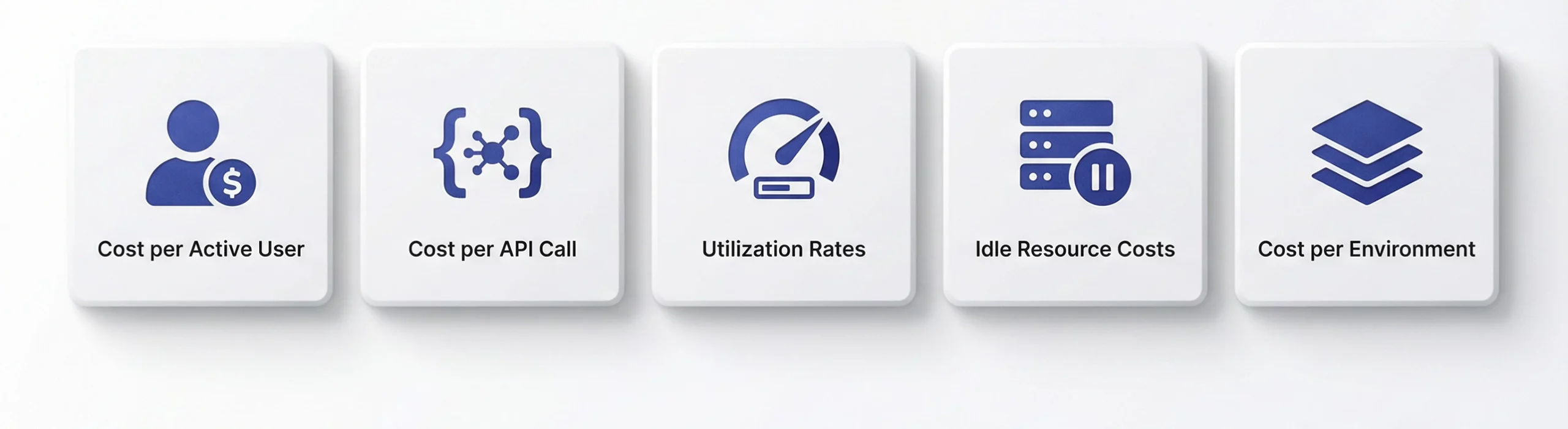
Here are the core cloud optimization metrics that you should know about:
1. Cost Per Active User or CPU
It measures how much it costs to support or acquire a user who engages with your service, cloud product, or infrastructure. It is one of the most important metrics to track as it connects the overall cloud infrastructure or service cost directly to the user value. This metric will reveal whether:
- The shared services like databases, caches, or caches are becoming potential bottlenecks
- Onboarding new users results in adding overhead costs, known as the marginal cost
- The entire cloud ecosystem benefits from scaling
Insight to Know:
CPU or the actual cost per active user should decrease as you scale. But if it is not flattening or decreasing, the cloud cost optimization becomes urgent.
2. Cost Per API Call
Cost per API call or transaction basically ties your cloud costs directly to the number of unified API requests, transactions, or core operations made in a cloud based software development environment.
If handling 1 million cloud transactions or API requests costs you twice, then your system is not scaling efficiently. This metric is important to track as it can help you answer: Does the cloud system scaling improve margins or destroy them?
Based on the regular usage of API calls or transaction volume, this metric is ideal for event-based platforms, usage-based or pay-as-you-go pricing models, or data-heavy systems.
Insight to Know:
If the cost per transaction doesn’t stabilize and remains almost the same while scaling, then your system is not cloud-native, but it’s a traditional cloud-hosted system.
3. Utilization Rates
Tracking utilization rates for various foundational components, such as CPU, memory, database, and storage, is another key metric that no one actually talks about. It tracks the actual percentage of allocated resources that are being used over time.
Businesses often relate a low utilization rate to safety. In reality, it’s usually a sign of architectural fear, not stability. Also, some startups try to overprovision cloud resources to utilize the unused capacity.
The infrastructure may look stable, but it is operating at 10 to 20% utilization in real time. Always remember that the unused capacity is not resilience; it’s a waste. Your end goal should be having healthy cloud utilization with the flexibility to add or remove resources as demands change.
Insight to Know:
If your utilization rates are consistently low, your architecture is not being efficient, and you should consider redesigning workloads or adopting auto-scaling strategies.
4. Idle Resource Costs
This is often the most shocking metric for newly growing startups or enterprises when calculated carefully and honestly. It is referred to as the total cost of cloud resources that are running but doing no useful work, or are idle at that moment.
Some of the idle resources include:
- Unused virtual machines
- Load balancers that have no user traffic
- Databases with no active connections
- Test environments that were left running 24/7
- Old backups or disks that were created but not used
When looked at individually, these costs look insignificant, but when considered collectively, they can represent 20 to 50% of total cloud spending.
Insight to Know:
Idle resource cost is not a tooling problem; it’s a failed ownership and governance control.
5. Cost Per Environment
This metric, cost per environment, measures how much each cloud environment, like development, testing, or production, costs to operate within a given period. For startups or growing businesses, tracking this metric is essential because cloud spending increases when the cloud environments are not legally compliant.
Reviewing this key metric from a cloud migration & data security point of view, your teams should clearly examine:
- Which environments that are migrated are retiring on time?
- Are there some legacy workloads that are fully put out of action on time?
- Are there multiple environments running in parallel continuously without clear ownership?
Knowing the answers to these questions and laying out a structured cloud migration and data security checklist enables you to keep cloud costs aligned with actual workload demand.
Insight to Know:
If temporary environments are using too much of your cloud budget, it means that the migration task was not executed properly or the setups are more complex.
Read Also: How To Ensure Cloud Application Security: Compromises & Best Practices
Tools and Technologies for Cloud Cost Optimization
Choosing the right tool for cloud cost optimization is critical, as it will enable you to gain transparency and visibility into your overall cloud spending. This way, you can identify any underutilized cloud resources or inefficiencies, and ensure that these are eliminated or strategized to reduce or optimize the cloud cost.
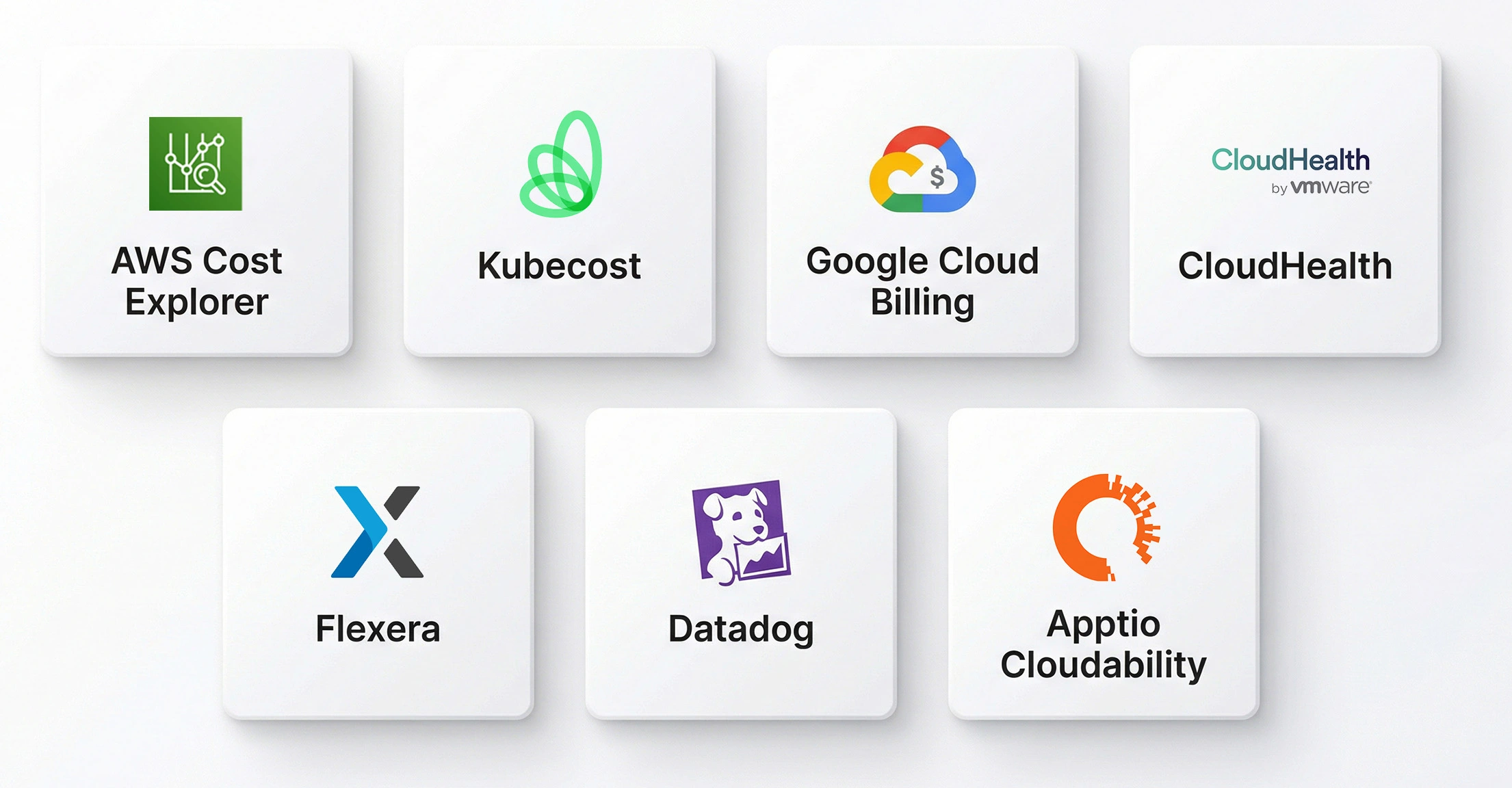
Below is a curated list of top cloud cost optimization tools that you can utilize, depending on your business value and requirements:
1. AWS Cost Explorer
This tool helps your engineering teams to analyze, visualize, and manage your overall AWS spending or costs over time. It has a user-friendly interface that helps your teams to analyze your data at a high level and detect if there are any anomalies. By analyzing the historical data using usage trends and advanced dashboards, your engineering teams can detect services that consume high-level cloud costs.
Best for: AWS-only environments or EC2/RDS/Lambda type of workloads
2. Kubecost
Kubecost is a Kubernetes cost optimization tool. It provides real-time cost visibility and useful insights for your engineering teams that use Kubernetes. Utilizing this as a cloud cost optimization tool, your teams can break down costs based on the type of service or deployment criteria, resulting in an analysis of inefficiencies.
Best for: Kubernetes-based environments, Amazon EKS clusters, or microservices architectures
3. Google Cloud Billing
Another one of the top cloud cost optimization tools that helps your teams monitor, manage, and predict costs across various Google Cloud Platform projects is Google Cloud Billing. It offers essential cost breakdowns, budget alerts, and project-level basic reporting to provide you with cloud cost insights.
Best for: GCP (Google Cloud Platform) environments, data analytics, or AI/ML workloads on GCP
4. CloudHealth
It is a comprehensive cloud cost optimization and management platform that provides centralized cloud cost governance across multiple cloud providers, such as AWS, Azure, and Google Cloud Platform. By offering detailed cloud insights and complete control over complex cloud spending, it helps your engineering teams to rightsize cloud resources, reduce waste, and identify idle resources.
Best for: Multi-cloud environments (AWS, Azure, and GCP)
5. Flexera
Flexera is one of the enterprise-grade cloud cost optimization tools that helps organizations gain actual insights and cost visibility. It will help you control the overall cloud spending across public, private, and hybrid environments. This will enable your engineering team to identify unused resources and control overspending on unnecessary databases or cloud systems.
Best for: Heavy cloud environments or batch processing workloads
6. Datadog
This is one of the crucial cloud cost optimization tools that enable you to have access to cost-related insights by correlating infrastructure performance metrics with the total cloud spending. It helps your engineering teams to identify underutilized resources and inefficiencies that may directly influence your overall cloud costs.
Best for: DevOps-driven teams that prioritize cost optimization or production-grade cloud environments
7. Apptio Cloudability
It delivers advanced cloud financial management capabilities that may include cloud cost allocation, forecasting, and predictive data analytics. It enables organizations to align cloud spending with important business KPIs and supports mature FinOps practices across large and complex environments.
Best for: Hybrid and multi-cloud model setups
Top Cloud Cost Optimization Practices to Follow
Cloud cost optimization is not achieved by tools alone; you need to implement smart practices that are driven by disciplined engineering practices, governance models, and continuous accountability. For startups, adopting the right cloud cost optimization practices helps prevent architectural debt, uncontrolled or high-level spending, and scalability bottlenecks as the business grows.
Utilizing the following best practices will ensure that your cost awareness goals align well with daily engineering decisions while ensuring that there is no disruption to performance, security, and innovation. So, let’s deep dive into these cloud cost optimization practices:
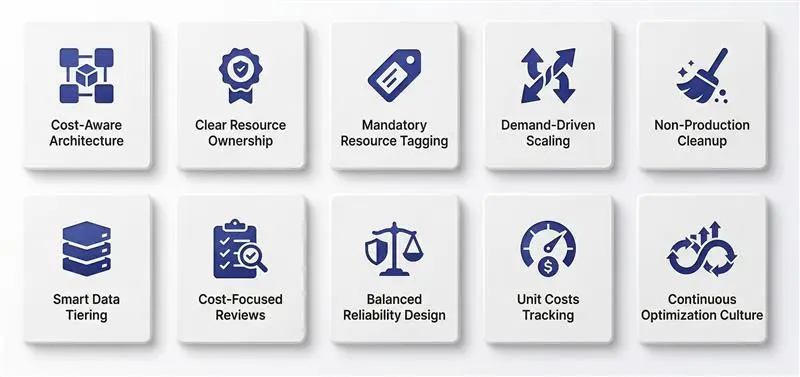
1. Design Cost-Aware Architectures from Day One
Cost-aware design means building cloud systems with cost implications in mind from the very beginning, not after the usages keep on increasing. This is important as cloud costs are heavily influenced by architectural decisions made during the early stages of product development.
To reduce the overall cloud spending and long-term infrastructure overhead costs, you need to choose stateless services, asynchronous processing, and modular components. Having a Cost-aware architecture ensures scalability that remains aligned with the overall cloud cost budget and real business value.
2. Enforce Clear Ownership of Cloud Resources
Every cloud resource should have a clearly defined owner, whether a team, project, or service. Without ownership, resources tend to remain idle, environments are rarely shut down, and accountability disappears. This is why clearly enforcing ownership is a must.
When the ownership is clearly defined, you can identify and remove the idle resources, and cloud optimization becomes proactive. This practice helps your engineering teams to drive responsibility, thus making your teams more conscious of how their design and usage decisions impact cloud costs.
3. Implement Mandatory Resource Tagging Policies
Resource tagging cloud policies are the core foundation of cloud cost visibility. Basically, with these tagging policies, your teams can create a clear link between costs and business units for a successful data-driven optimization. It also enables you to conduct accurate cost allocation and cloud visibility consistently across various environments.
Implement mandatory resource tags such as environment, service name, owner, and business unit, and allow your teams to track spending patterns and identify waste quickly. Without tagging discipline, cloud costs become opaque and difficult to control.
4. Align Scaling Strategies with Business Demand
Scaling infrastructure without understanding usage patterns leads to unnecessary spending. Startups should align scaling strategies with real business metrics such as active users, transaction volume, or API usage. This ensures infrastructure grows proportionally with value delivered, not just traffic spikes.
Regularly reviewing historical usage trends alongside growth forecasts allows teams to fine-tune scaling thresholds. This helps prevent provisioning resources for short-term demand bursts and ensures capacity planning remains aligned with long-term business goals.
5. Continuously Review Non-Production Environments
Development, staging, and testing environments often account for a surprising portion of cloud spend. These environments should follow strict schedules, usage limits, and lifecycle policies. Regular reviews help eliminate forgotten resources that silently drain budgets over time.
Establishing ownership and automated cleanup rules for non-production environments ensures temporary setups are retired on time. This reduces waste while preserving the flexibility required for rapid development and testing cycles.
6. Optimize Data Storage Based on Access Patterns
Not all data requires the same level of performance or availability. Segmenting data based on access frequency helps reduce storage costs significantly. Frequently accessed data can remain on high-performance tiers, while infrequently used data should move to lower-cost storage options.
Clear data classification also improves long-term storage planning by aligning retention policies with business and legal compliance laws such as GDPR or HIPAA. This prevents unnecessary spending on premium storage for data that delivers limited ongoing value.
7. Integrate Cost Reviews into Engineering Workflows
Cloud cost optimization should be part of regular engineering reviews, similar to performance or security assessments. Reviewing cost implications during design reviews, sprint planning, or post-deployment analysis ensures that optimization is proactive rather than reactive.
Including cost discussions in engineering workflows builds financial awareness across teams. This shared responsibility helps surface inefficiencies early and reduces the need for disruptive cost corrections later.
8. Balance Cloud Reliability with Cost Efficiency
Over-engineering for worst-case scenarios often leads to excessive or high-level cloud spending. While resilience and cloud availability are critical, your engineering teams should balance reliability requirements with actual risk exposure. Designing for realistic failure scenarios prevents unnecessary overprovisioning.
Periodically reassessing reliability needs ensures infrastructure investments remain proportional to real-world impact. This approach maintains system stability while avoiding unnecessary financial overhead.
9. Monitor Cloud Unit Costs Alongside Growth Metrics
Tracking unit costs connects the total cloud spending directly to business value. It tracks cloud spend without correlating it to business value, creating blind spots. Monitoring unit costs metrics, such as cost per user, transaction, or API call, will reveal whether the cloud growth is improving efficiency or not.
By tracking these unit cost metrics, your teams can also identify inefficiencies early and transform cloud cost optimization into measurable progress. This practice helps startups validate whether scaling is financially sustainable.
10. Establish a Continuous Optimization Culture
Cloud cost optimization is not a one-time initiative or an activity. It requires ongoing refinement as products evolve, workloads change, and usage patterns shift. This is why establishing a continuous optimization culture within your existing cloud ecosystem is another key cloud cost optimization practice.
Encouraging a culture where your engineers regularly monitor cloud efficiencies and improve designs enables you to have access to long-term cost control without slowing down innovation. It also ensures long-term cloud resilience and improvement rather than short-term fixes.
By embedding these best practices into architecture, governance, and daily workflows, startups can achieve predictable cloud spending while maintaining performance, scalability, and innovation velocity.

Wrapping Up
For startups, the real objective of utilizing a well-defined cloud cost optimization strategy is not for short-term cloud cost savings but for having sustainable growth. If your startup treats cloud costs as a side effect of growth and often struggles with high-level cloud bills, you need to change your strategy first. With the right balance of cloud visibility, governance, and continuous optimization, you can ultimately manage your cloud costs.
With over a decade of experience delivering cloud application development services, RipenApps has helped many businesses build cloud-ready and scalable applications. We have successfully helped fast-growing brands, such as Hanchens (Food Ordering App), eGurukul (Medical Entrance Exam App), and Swish (Child’s Activity Tracker App).
Our team of experienced cloud architects and developers can help you design cost-aware cloud architectures and select the right cloud cost optimization tools and practices that balance performance and spending. By aligning cloud strategies with long-term business goals, RipenApps enables you to scale confidently without facing unexpected budget spikes or any limitations.
FAQs
1. What is cloud cost optimization?
Cloud cost optimization involves the ongoing practice of analyzing, monitoring, and improving cloud resource usage to reduce unnecessary spending. A right cloud cost optimization strategy will execute in such a way that it doesn’t disrupt the cloud ecosystem’s performance or security.
2. Why is cloud cost optimization important for startups?
For startups, cloud costs can grow faster than revenue if not managed early. Cloud cost optimization helps you to avoid budget overruns, improve unit economics, and scale infrastructure predictably without slowing down innovation or compromising system reliability.
3. How is cloud cost optimization different from cloud cost management?
Cloud cost management focuses on visibility by tracking, budgeting, and forecasting cloud spend. On the other hand, cloud cost optimization goes further, and it also improves architecture and overall resource efficiency. This enables you to actively reduce waste and improve performance over time.
4. Which cloud cost metrics should startups track first?
Startups should prioritize key metrics such as cost per active user or CPU, cost per API call or transaction, utilization rates, idle resource costs, and cost per environment. These metrics directly link and align to the total cloud spending to usage, scalability, and architectural efficiency.
5. What are the common cloud cost optimization strategies?
Common cloud cost optimization strategies include:
- Rightsizing compute, storage, and database resources
- Identifying and removing idle cloud resources
- Implementing auto-scaling to adjust resources dynamically
- Optimizing storage tiers for hot, warm, and cold data
- Tracking utilization rates to reduce overprovisioning
- Monitoring cost per user, transaction, and environment
- Cleaning up legacy workloads after cloud migration
- Applying security controls based on workload risk
6. How do cloud migration and data security affect cloud costs?
Cloud migration and data security decisions have a direct impact on cloud costs. Consequences, such as running parallel environments, failing to put out of action some legacy workloads, or applying heavy security controls uniformly, can increase or flatten the overall cloud cost. This is why it’s crucial to follow a well-defined cloud migration and data security checklist, thus helping you balance compliance, performance, and cost over time.

SHARE
WRITTEN BY

Ishan Gupta
CEO & Founder
Ishan Gupta is a seasoned entrepreneur and CEO with extensive 8+ years of experience in business and mobile app development landscape. He believes that the right digital product allows companies to focus on what they do best, while technology handles the rest. With deep exposure to global markets, he understands what makes an app succeed. His approach translates business needs into clear product strategies, ensuring that every feature contributes to measurable ROI.
View All Articles