

Imagine a world where people don’t just shop online; they live inside digital marketplaces.
A single parent in Chicago orders eco-friendly baby products from five different local sellers, without leaving one app. A handcrafted jewellery artist in New York earns a full-time income selling to buyers across the globe, without ever setting up their own store.
And the entrepreneur behind it all? They don’t own the inventory. They own the infrastructure. Welcome to the age of multi-vendor eCommerce, where digital marketplaces don’t just connect buyers and sellers; they orchestrate economies.
Platforms like Amazon, Etsy, and Alibaba have already proven the power of marketplace-driven commerce. Now, if you’re reading this, chances are you’re not looking to join someone else’s eCommerce marketplace solution. But rather, you’re here to build your own.
A multi-vendor marketplace that runs 24/7, connects hundreds of vendors, handles transactions, logistics, customer support, and grows smarter with every interaction, right? So the question arises, how to build this scalable digital marketplace? That’s exactly what this guide is for.
We’ll break down the business models, technology architecture, monetisation strategies, and operational systems required to go from idea to fully functional marketplace. Whether your goal is to empower local sellers or launch a global commerce ecosystem, this complete guide to Multi-Vendor eCommerce Marketplace Development will help you build and scale with confidence. So why wait then? Let’s get started:
Key Takeaways
- Building a multi-vendor marketplace means owning infrastructure and enabling an ecosystem rather than managing inventory directly.
- The marketplace development costs range from $15,000 for MVP to $200,000 or more for enterprise platforms.
- Modern marketplaces rely on scalable MACH architecture, automation, and AI-powered features to support long-term growth.
- Success depends on balancing buyer and vendor growth while maintaining trust, payments, and a seamless user experience.
- Monetisation comes from commissions, subscriptions, listings, advertising, and premium seller visibility features.
Table of Contents
What is a Multi-Vendor eCommerce Marketplace?
We must understand single-vendor stores before understanding Multi-Vendor eCommerce Marketplaces.
For a Single Vendor eCommerce marketplace, think of it as a specific store. For example, if you want to buy a smartphone, you might go to Samsung’s official website and purchase the selected products. And if you want to look at other vendors, you have to switch to another vendor’s website.
In short, Single vendor eCommerce platforms are stand-alone stores selling products to multiple customers with a limited niche and product range.
For a Multi-Vendor eCommerce marketplace, think of it as a shopping mall where multiple vendors open their shops. Once the customers enter the mall, they have a wide range of options to choose from multiple vendors and multiple niches.
Similarly, when users enter into a multi-vendor eCommerce platform and have a number of vendors selling the same or different products. They don’t have to leave the marketplace if they want to search for different vendors or product categories. In short, it is an all-in-one marketplace.
This all-in-one multi-vendor marketplace app is nowadays built using AI agentic commerce, headless commerce, or composable commerce models. It means that everything operates under one infrastructure, and the frontend experience is separated from the backend for flexibility and scalability.
The Rise of the Global eCommerce Economy: Market Stats & Insights
For customers, the experience of utilising a modern multi-vendor marketplace app is becoming increasingly seamless. What once started with a simple product search and checkout flow has evolved into a scalable multi-vendor marketplace that supports invisible checkout, omnichannel commerce wallets, and even BNPL (buy now, pay later) options.
But what led to the rise of this epic transformation?
The answer lies in the rapid expansion of digital commerce and eCommerce industry.
Check out these latest stats in the eCommerce industry:
- The global eCommerce market revenue is projected to generate approximately $3.89 trillion by 2026. This stat highlights the continued dominance of digital commerce worldwide.
- Between 2026 and 2030 forecast period, the market is expected to grow at a steady CAGR of 6.27%, pushing total revenue close to $4.96 trillion by 2030.
- The United States is anticipated to remain the largest contributor, generating around $1.24 trillion in 2026 alone. This highlights its mature and high-spending digital user base.
- In the eCommerce market, the number of users is expected to amount to 4 billion users by 2030.
- User penetration is expected to increase from 54.5% in 2026 to 56.4% by 2030. This stat means more than half of the world’s population will actively shop online.
- The projected Average Revenue Per User (ARPU) is expected to reach $1.14K, demonstrating increasing consumer spending across digital platforms.
(Source of these statistics: Statista)
These figures reinforce one clear insight: the growth of eCommerce is no longer experimental. In 2026, it is structural. To stand out, you need to build multi-vendor marketplaces that are powered by scalable infrastructure and is buil on several modern principles like MACH architecture (Microservices, API-First, Cloud-Native, Headless) principles.
How does a Multi-Vendor Marketplace Work?
Multi-Seller eCommerce platforms work on a similar model. All of them have three entities: marketplace owners, vendors, and customers. Marketplace owners basically work as mediators between customers and vendors.
In modern multi-vendor marketplace platforms, this mediation layer is powered by MACH architecture that allows the platform to scale vendors, transactions, and traffic without any operational-related friction.
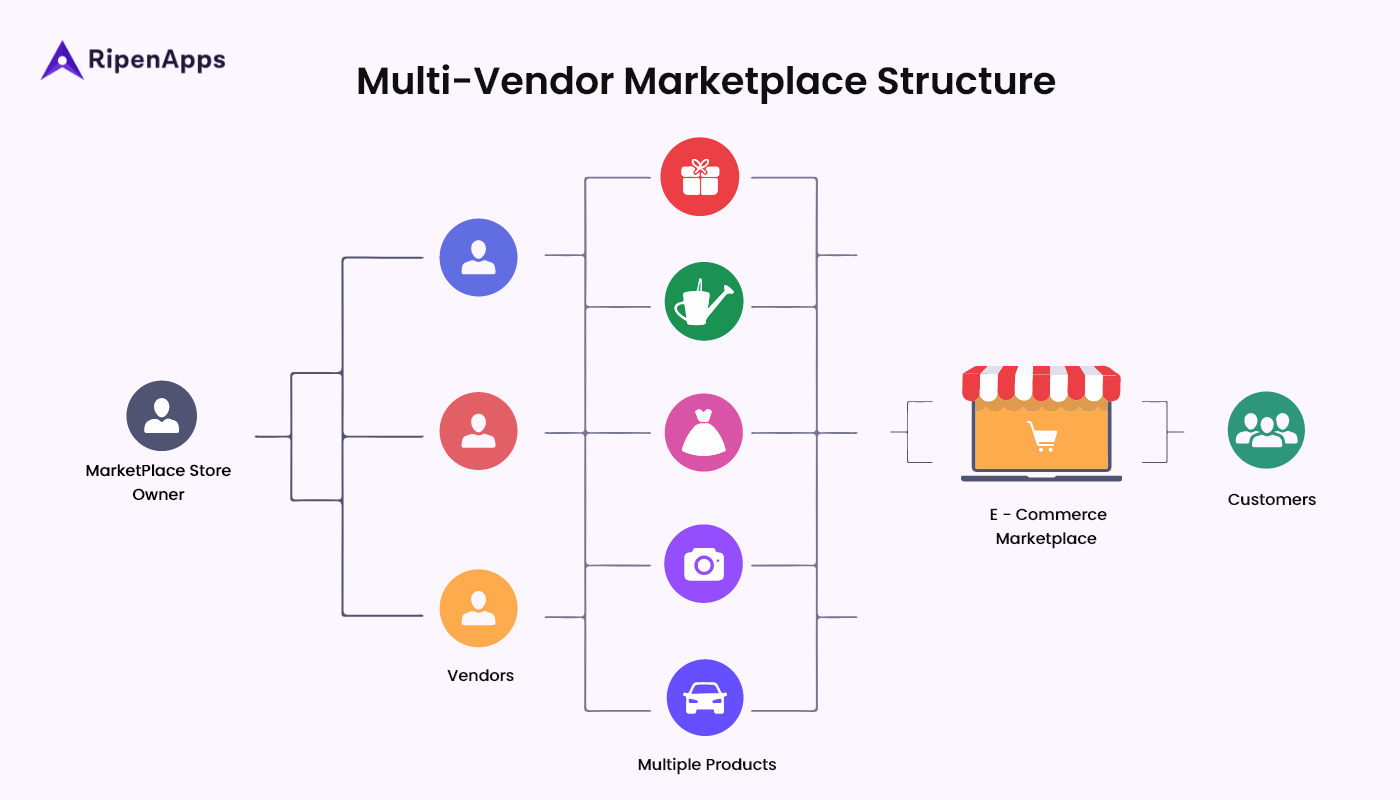
How does the multi-vendor marketplace model work for customers?
- Customers register on multivendor eCommerce websites. This onboarding and login system acts as a permit to buy and sell items. Your multi-vendor marketplace platform should support secure identity verification by leveraging omnichannel wallet integration.
- Customer searches in the universal bar for products offered by multiple vendors at different prices. To stand out in this competitive world, this search is enhanced by AI-powered recommendation engines and automated product tagging.
- The site has a buy option or add to card option to let customers check out their products by filling address and payment details. To build a modern marketplace app, you should integrate invisible checkout flows, a BNPL option, and secure third-party payment gateways, achieving customer success for secure vendor payouts.
How do multi-vendor marketplace model work for vendors?
- The vendor registers with the eCommerce marketplace. To reduce fraud-based activities and speed up the approval request and process phase, your scalable multi-vendor eCommerce platform should have an automated (know your business) KYB verification and also leverage Artificial Intelligence (AI).
- A dashboard to manage their listings or add new ones. Many marketplaces now support dynamic pricing tools and AI-based inventory insights to help vendors stay competitive.
- All the order demands are present in the dashboard, which includes shipping updates and fulfilment tracking. Currently, the marketplaces are launched using a hyperlocal or hybrid model. This enables vendors to manage service bookings along with product deliveries.
- The money and invoice management tabs allow vendors to track earnings. Advanced payment systems use automated commission splitting and escrow mechanisms to ensure secure and transparent financial flows.
The above-mentioned pointers explaining how a multi-vendor eCommerce platform works remain common across most platforms.
Types of Multi-Vendor eCommerce Marketplace
There are three main types of Multi-Vendor eCommerce marketplaces that you can build:
1. Business-to-Business (B2B) Multi-Vendor Marketplace:
These marketplaces are designed for businesses. Multiple businesses buy and sell products within a single, unified marketplace platform. A key difference in B2B is that both parties usually have their own end users. In other words, they are not the final consumers of the product.
Generally, businesses use B2B platforms to buy products that will act as raw materials or assets to build products for their end customers.
2. Business-to-Consumer (B2C) Multi-Vendor Marketplace:
In this model, businesses sell directly to customers through the marketplace. Customers are the end users who actually use the products they purchase. This is one of the most common marketplace models, where multiple businesses list their products and customers browse, compare, and buy from different sellers within a single platform.
3. Consumer-to-Consumer (C2C) Multi-Vendor Marketplace:
These marketplaces are meant to benefit individual customers. In this multi-vendor eCommerce platform type, customers sell products directly to other customers. The items sold here are used or second-hand products. Consumers who want to buy products at cheaper rates and are fine with second-hand products register on these sites.
Types of Business Models in the Multi-Wendor eCommerce Marketplace
Further, we can also categorise multi-vendor eCommerce platforms based on their business focus and market reach. Here are the 3 types of business models:
1. Vertical Marketplace
These marketplaces are designed for specific niches. For example, there can be a dedicated marketplace platform for clothing, handmade goods, or automotive parts. Although multiple vendors are available in these stores, the category of products is limited to a particular niche.
2. Horizontal Marketplace
A horizontal marketplace business model offers products across multiple categories and niches. The products belong to multiple niches, and you can find all the products here, ranging from groceries to fashion and gadgets. A well-known example of a horizontal marketplace is Amazon. Here, numerous vendors sell products across diverse categories under one ecosystem.
3. Global Marketplace
Some of the marketplaces only work in their regions and are limited to a specific country. But some models follow an international approach where they sell and ship products internationally. These platforms enable cross-border commerce, which gives vendors access to an international user base.
Read Also: Marketplace App Development is the Need of Modern Businesses
Benefits of Multi-Vendor eCommerce Marketplaces
It is not fixed that every eCommerce app development project brings benefits to a business. However, by shortlisting the right eCommerce development company, you can unlock these benefits. Here are the benefits that you unlock once your application is successful.
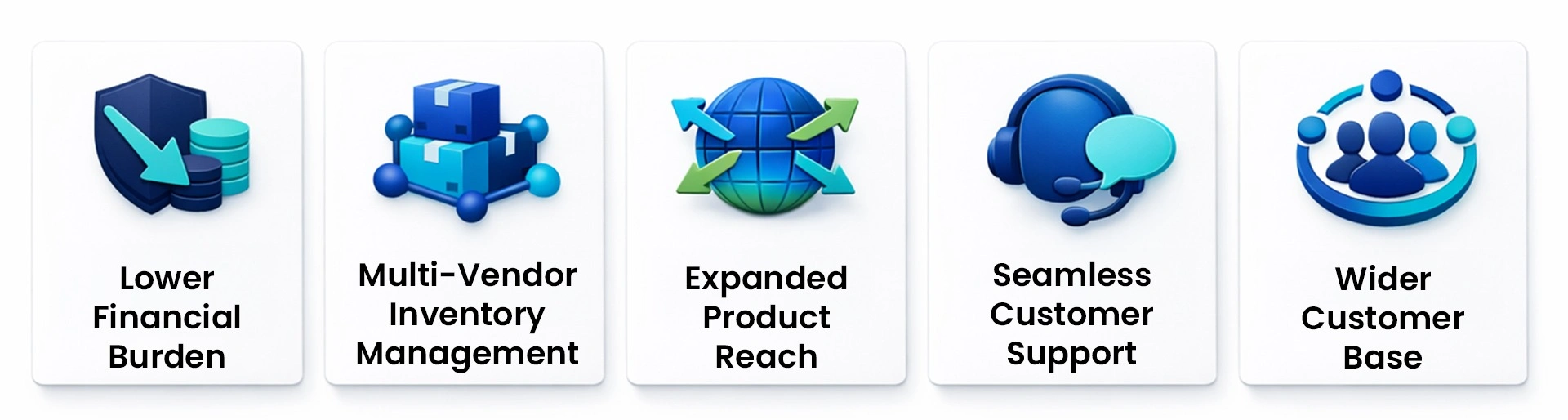
1. Lower Financial Burden
Businesses that want to sell their products online have to build a website. Building a website is itself a complex process. Similarly, the process further increases the complexities if you want to build your app.
But when vendors register with an established website, they decrease the financial burden. They do not have to invest in these complex steps and can directly start the business. This means that they can leverage a marketplace infrastructure that supports shared technology and various cloud deployment models (Public, Private, Hybrid, or Multi-Cloud), without building their own platform from scratch.
2. Multi-Vendor Inventory Management
For vendors, a marketplace provides robust inventory management service right from anywhere. How many orders are pending? How many orders are successfully delivered? And what is the current inventory number? All these complex management questions are answered right in the dashboard of the multi-marketplace management system.
To build an advanced multi-vendor marketplace architecture, many organisations integrate AI-driven inventory forecasting and dynamic pricing tools. This helps vendors optimise stock levels and thus maximise revenue.
3. Expanded Product Reach
While using the traditional shopping model, vendors had to buy huge spaces to display multiple products. But with a modern multi-vendor eCommerce platform, you can revolutionise the method of display.
Vendors can display a wide range of categories to customers without any kind of space requirement, like in traditional shopping. This variety strengthens the platform’s network effect, where more vendors attract more customers and more customers attract more vendors, creating a scalable growth loop.
4. Seamless Customer Support
If you have ever shopped from an online eCommerce store, you are familiar with 24/7 customer support. Since operations are digitally managed, marketplaces can provide continuous assistance to both vendors and customers, improving the overall shopping experience.
Beyond traditional support, online marketplaces now offer real-time chat assistance, automated ticket handling, and AI-powered chatbots to resolve common queries instantly. This ensures faster response times, reduced operational load, and a smoother experience across the platform.
5. Wider Customer Base
Through multi-vendor marketplace development, businesses gain access to a significantly broader customer base. For example, a customer purchasing a smartphone may also need a case, tempered glass, or other accessories from different sellers within the same platform. This interconnected buying behaviour increases cross-selling opportunities.
As more vendors join the marketplace, product variety expands, thus attracting more customers. This creates a natural network effect, where growth on one side of the platform strengthens growth on the other.
Challenges of Running an Online Multi-Vendor Marketplace
While there are multiple benefits of running an online multi-vendor marketplace architecture, there are also some strategic challenges that come with running a multi-vendor marketplace. Here are the most commonly known challenges:
Wrong Tech Stack
While building a multi-vendor marketplace architecture, you have to choose a tech stack. Whether you hire an eCommerce development company or avail scalable product design services, you must understand the long-term scalability of the tech stack being used. Do not rush things and end up choosing an incomplete and low-cost tech stack.
Nowadays, many organisation leverages top cross-platform app development frameworks and scalable architectures such as MACH (microservices, API-first, Cloud-native, headless) and composable commerce models. This ensures you achieve sustainable business growth and long-term adaptability.
Balancing the Focus on Buyers and Sellers
Every marketplace business owner needs to attract customers as well as vendors. For a multivendor eCommerce marketplace, maintaining this balance is a vital element. Marketplaces offer discounts and coupons to buyers and sellers to attract them to list products on their sites.
However, managing budgets, marketing spend, and pricing strategies for both sides can become complex. Without a strong network effect, growth may slow down on one side of the marketplace, affecting the entire marketplace ecosystem.
Maintaining the User Experience
User experience and mobile app design play a vital role in the success of any eCommerce platform. A marketplace must offer smooth navigation, fast loading speeds, secure payments, and a seamless checkout process.
Regular maintenance is necessary to fix bugs, improve performance, and introduce new features. However, adding new functionalities without proper testing can disrupt existing workflows. To maintain a consistent and appealing user experience, platforms must invest in scalable infrastructure, PWA optimisation, and continuous performance monitoring.
Must-have Features for a Successful Multi-Vendor eCommerce Marketplace Development
To build a competitive multi-vendor marketplace platform, your platform should combine intelligent automation, scalable app architecture, and operational stability. Below are the top features that every modern multi-vendor eCommerce platform integrates nowadays:
1. Product Management System
A robust product management system allows vendors to create, edit, and manage product listings from a centralised dashboard. This system allows sellers to upload images, manage product variants, update descriptions, modify pricing, and monitor stock levels.
To build a well-structured product management system, you need to leverage category mapping, SKU management, bulk uploads, and multi-variant configurations. This ensures better search visibility, accurate listings, and improved conversion rates across the marketplace.
2. Order Management System
An efficient order management system is critical when multiple vendors operate on the same platform. From tracking the shipping to managing invoices, you have to deliver all the necessary order management features. The same goes for the customers.
Building a scalable order management system ensures that your customers receive real-time notifications, tracking updates, and invoice access. This results in reduced operational errors and enhanced transparency between buyers and sellers.
3. Vendor Profile Dashboard
The vendor dashboard is the operational control centre for sellers. It should provide you access to:
- Sales performance tracking
- Commission breakdowns
- Revenue insights
- Inventory status
- Order history
If you want to build an advanced and real-time dashboard within your multi-vendor marketplace, you must include performance analytics, customer feedback metrics, and growth recommendations.
These tools and recommendations will help vendors to monitor their specific business performance and also optimise their strategies according to the results presented by the real-time dashboard.
4. Customer Management System
A seamless customer management system enhances user retention and loyalty. By using this smooth system, customers should be able to create and manage profiles, view order history, track returns, and save multiple addresses. Customers can also access their past invoices and billing details.
With this basic feature, if you add more personalised recommendations, wishlist features, and saved payment methods, your marketplace business can then further enhance the overall shopping experience. It will lead to encouraging repeat purchases and thus higher user satisfaction levels.
5. Payment Management System
Multi-vendor marketplaces’ architecture involves complex financial workflows. The platform must integrate secure and reliable payment gateways that support multiple payment methods, currencies, and high transaction success rates.
To build a winning marketplace, your system should also automate commission deductions, maintain transparent transaction records, and apply secure data encryption standards. This ensures financial accuracy, operational stability, and platform trust.
6. Seamless Checkout & Smart Payments
Nowadays, with rising customer expectations, your modern marketplace must reduce friction during the overall checkout process. Invisible checkout allows returning customers to complete purchases with minimal steps.
Additionally, you can leverage the advanced omnichannel wallet integration. This enables seamless payments across devices, while Buy Now Pay Later (BNPL) options increase purchasing flexibility and improve conversion rates. These mobile app features directly influence revenue growth and customer retention.
7. Automated Vendor Onboarding (KYB)
Scalable marketplaces must onboard vendors efficiently while maintaining regulatory compliance. Automated KYB (Know Your Business) systems verify business credentials, tax documents, and identity details without manual review delays.
This accelerates seller activation, reduces onboarding bottlenecks, and minimises fraud risk. A streamlined onboarding process supports faster marketplace expansion.
8. AI-Powered Product Tagging
Manual categorisation becomes inefficient as marketplace inventory grows. AI-powered product tagging automatically classifies products based on images, descriptions, and attributes.
This improves search accuracy, enhances recommendation systems, and ensures consistent product organisation across thousands of listings. Automated tagging also reduces manual workload for vendors.
Read Also: How Digital Asset Management Drives Efficiency and Revenue in eCommerce
9. Dynamic Pricing Engine
A dynamic pricing engine allows vendors to automatically adjust product prices based on demand patterns, competitor pricing, inventory levels, and seasonal trends.
This functionality increases competitiveness, maximises revenue potential, and enables real-time pricing optimisation. It also helps vendors respond quickly to market fluctuations without manual intervention.
10. Escrow-Based Multi-Vendor Payout Automation
In a multi-vendor setup, payments must be securely distributed among multiple parties. An escrow-based payout system temporarily holds funds until order confirmation before automatically splitting payments between vendors and the marketplace.
This mechanism ensures secure transactions, reduces disputes, and maintains financial transparency. Automated payout distribution strengthens trust among vendors and protects the platform’s reputation.
Steps to Build a Modern Multi-Vendor Marketplace: A Curated Process
Building a successful multi-vendor marketplace architecture requires strategic planning, the right technology foundation, and continuous optimisation.
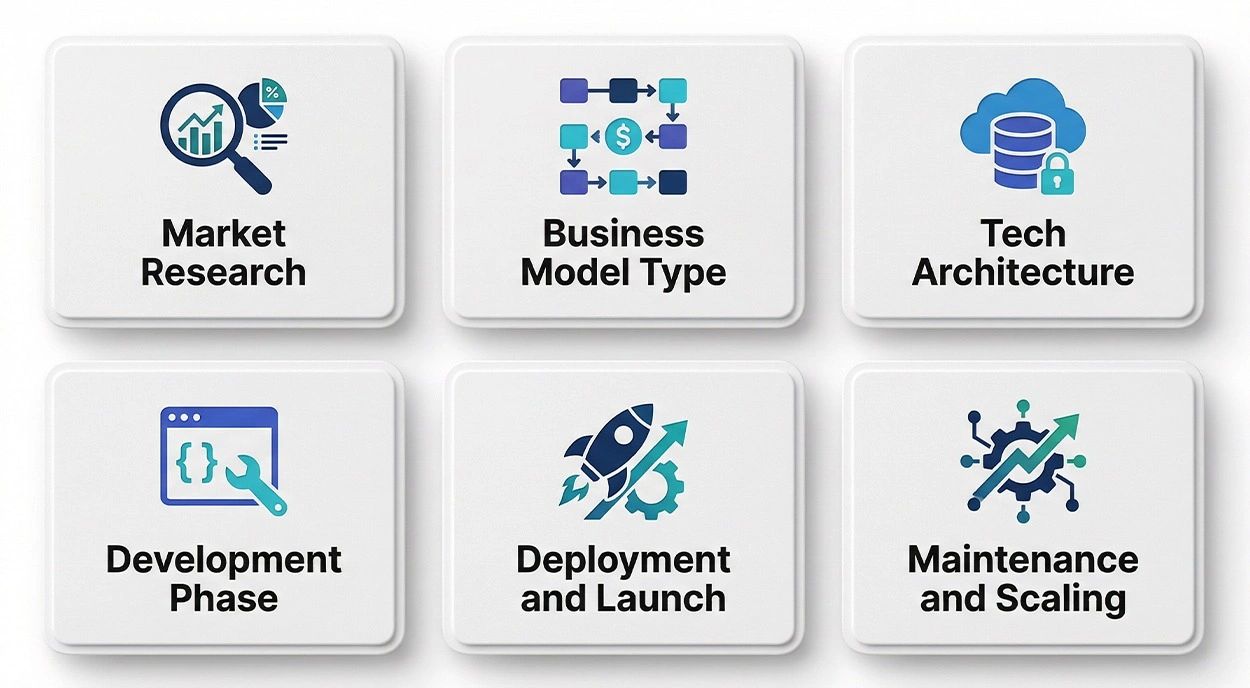
Below are the essential steps to take your marketplace idea from concept to scale:
1. Market Research and Roadmapping
Every successful marketplace begins with deep market research. Start by identifying your target audience, analysing competitors, and understanding existing gaps in the market.
If you plan to operate in multiple regions (for example, the USA and South Africa), you must evaluate regional demand, pricing expectations, purchasing behaviour, and logistics feasibility. The stronger your research, the stronger your positioning.
2. Define Your Business Model
Before development begins, clearly define your marketplace structure:
- Will it be B2B, B2C, or C2C?
- Vertical or horizontal?
- Regional or global?
- What monetisation model will you use (commission, subscription, listing fees)?
A well-defined business model ensures that product development aligns with revenue strategy and long-term scalability.
3. Choose the Right Tech Architecture
Your technology foundation determines the platform’s scalability, flexibility, and performance.
Choose a tech architecture that supports multi-vendor workflows, secure payment processing, and high traffic loads. Modern marketplaces often adopt scalable approaches such as microservices-based systems, API-first integrations, cloud-native hosting, and headless front-end structures to ensure long-term adaptability.
Selecting the correct tech stack early saves both time and development costs later.
4. Development and Implementation Phase
Once planning and architecture decisions are finalised, the development phase begins.
You can hire an in-house team or partner with an experienced custom software development company in USA. During the development and implementation phase, you need to:
- Ensure vendor onboarding flows are seamless
- Integrate secure payment gateways
- Build intuitive dashboards for vendors and customers
- Test checkout, order management, and payout systems
Regular communication with your development team is essential to maintain alignment and quality control.
5. Final Deployment and Launch
After development and testing, prepare for launch with a strong marketing strategy.
You need to attract both vendors and buyers simultaneously. This may include:
- SEO and content marketing
- Paid advertising campaigns
- Social media promotions
- Vendor acquisition campaigns
A marketplace cannot grow if only one side of the ecosystem is active.
6. Maintenance and Platform Scaling
Launching your marketplace is just the beginning.
Continuous maintenance is necessary to fix bugs, optimise performance, and introduce new features. As traffic increases, you must scale infrastructure, improve user experience, and refine monetisation strategies.
Long-term success depends on your ability to evolve with user demand while maintaining system stability and operational efficiency.

Monetisation Methods for Multi-Vendor eCommerce Marketplace
Now that you have enough information about the development of your marketplace app, you must be wondering about the monetisation methods. We have covered that too for you.
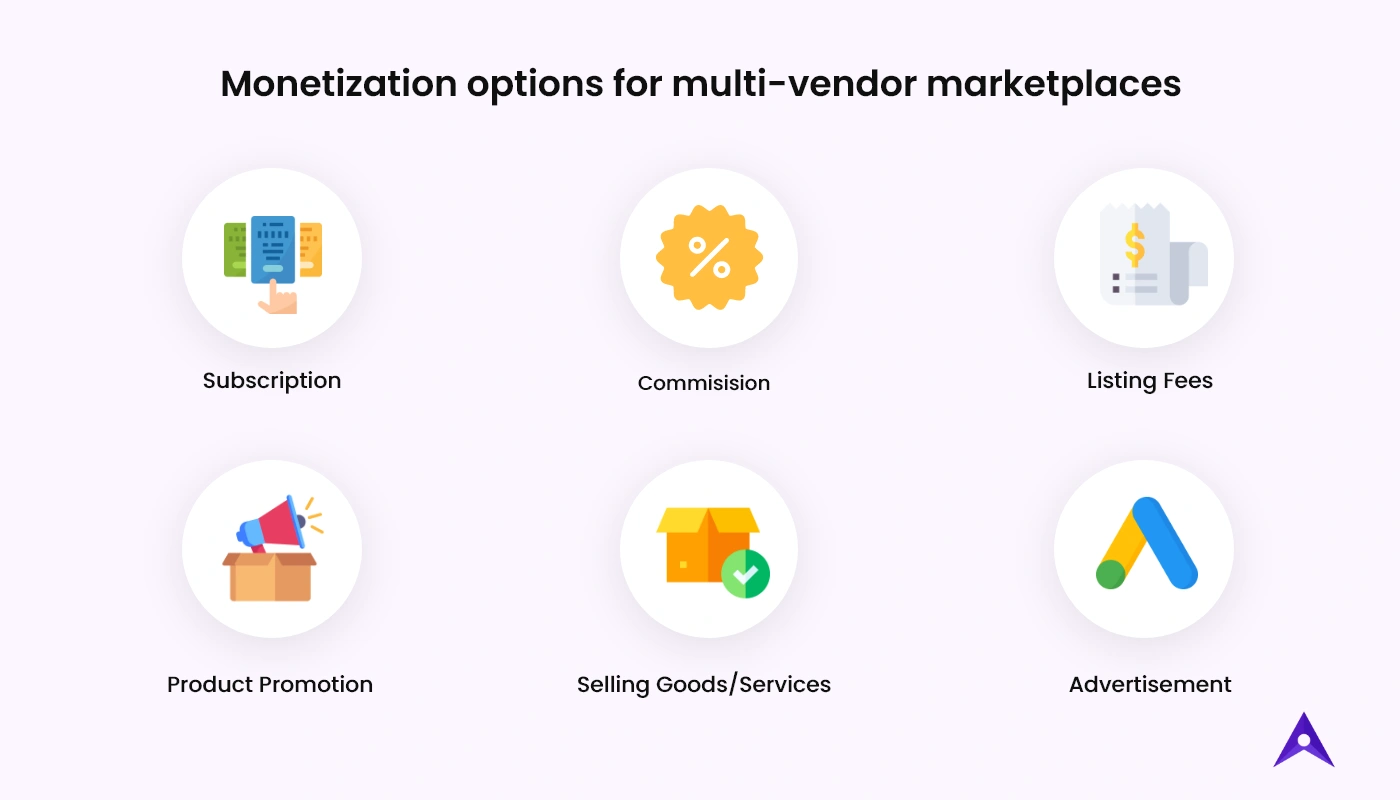
- Listing Fees: Sellers get an established platform in advance when they list their products on your marketplace. You can charge a small fee from sellers for listing their pages.
- Advertising: You can opt for third-party advertisement banners on your website to make extra income.
- Commission Fees: For every purchase, you can charge a small commission fee from the sellers.
- Subscriptions: These are some special features, like competitive pricing plans, advanced analytics, lower commission rates, or enhanced visibility. You can offer these premium features to the sellers.
- Feature Listings: Since there will be so many sellers, you can further feature a few of the top sellers in return for paid commissions.
Estimated Cost of Building a Multi-Vendor eCommerce Marketplace
On average, the cost of developing a multi-vendor eCommerce marketplace can fall between $15,000 to $ 30,000 for a basic minimum viable product (MVP) marketplace platform to $80,000 to $200,000+ for an enterprise-level marketplace. However, the cost of building a multi-vendor eCommerce platform can vary significantly based on factors like features, technology stack, development model, scalability needs, and region.
You have to consider various key influencing factors that determine the final eCommerce marketplace development cost. For instance, multi vendor eCommerce development approach, features, complexity of the app, UI/UX design, technology Stack, and location of the multi-vendor marketplace developer or the IT solutions consulting company.
Below is a realistic cost table breakdown of building a multi-vendor eCommerce platform:
| Marketplace Type | Key Features Included | Estimated Cost (In USD) | Development Timeline | Best Use Case |
| MVP Marketplace | Basic product management, vendor registration & login, standard order tracking, and UI/UX design | $15,000 to $30,000 | 2 to 4 months | Startups validating product-market fit and testing marketplace demand |
| Mid-Level Marketplace | Advanced vendor dashboards, inventory management tools, basic analytics & reporting, and mobile-responsive design | $30,000 to $80,000 | 4 to 8 months | Growing businesses scaling vendor acquisition and increasing GMV |
| Enterprise-Grade Marketplace | AI-powered product tagging, real-time analytics dashboards, automated vendor onboarding, and a dynamic pricing engine | $80,000 to $200,000, or more | 8 to 12 months | Large enterprises building global, high-traffic, scalable marketplace ecosystems |
Closing Remarks
In the modern world of online shopping, eCommerce marketplaces are becoming the architecture of digital economies. They are bringing a transformative change to large-scale online shopping. However, you should also note that building a multi-vendor eCommerce marketplace is not about replicating Amazon or eBay. But it’s about how you create a multi-vendor marketplace solution with a unique and your own economic framework.
Your job is to make everything invisible that doesn’t need to be seen, and incredibly intuitive for what must be. The next wave of digital commerce is powered by those who understand systems, solve for experience, and scale with purpose.
And this is where you need help from an expert custom software development company that specialises in multi-vendor marketplace development. RipenApps is one such reliable destination that has an impressive proven track record in enabling eCommerce startups with a feature-powered multi-vendor eCommerce platform.
FAQs
Q1. What is a Multi-Vendor eCommerce Marketplace?
Multi-Vendor eCommerce brings multiple vendors from different niches under one single platform. Customers can buy anything from any vendor they want. Instead of operating separate stores, sellers use the marketplace infrastructure to list products, manage orders, and process payments.
Q2. How do you build a Multi-Vendor Marketplace?
First, you have to start by defining the product niches that your eCommerce app will have. Next, determine all the features and functionalities, and business models. Then, decide what revenue methods you would choose. Finally, build your app and publish it.
Q3. Is Shopify good enough for Multi-Vendor eCommerce Development?
Shopify is suitable for launching basic or small-scale multi-vendor marketplaces, especially for startups seeking a faster time-to-market. However, for complex marketplace ecosystems that require advanced commission automation, custom vendor workflows, escrow-based payouts, and scalable architecture, Shopify may feel limited.
Q4. What is the estimated cost of multi-vendor eCommerce development?
The cost of building a multi-vendor marketplace architecture depends on feature complexity, architecture, scalability requirements, and development location. Here is an estimated cost breakdown based on the multi-vendor marketplace app type:
- An MVP marketplace typically ranges from $15,000 to $30,000
- A mid-scale platform may cost between $30,000 to $80,000
- An enterprise-grade marketplace can exceed $80,000 to $200,000+
Q5. What are the biggest challenges in scaling a Multi-Vendor Marketplace?
Scaling a multi-vendor marketplace involves more than adding new sellers. The biggest challenges include balancing buyer and vendor growth, maintaining platform trust, managing complex payment flows, and ensuring system scalability under increasing traffic.
As the marketplace grows, you must also focus on advanced fraud prevention, automated vendor onboarding (KYB), escrow-based payouts, and scalable architecture. Without strong infrastructure and intelligent automation, rapid growth can lead to performance bottlenecks and user dissatisfaction.

SHARE
WRITTEN BY

Manish Kumar

Manish is a Senior Technical Content Writer at RipenApps. He has over 7+ years of experience and holds immense tech knowledge. His educational background in science and expertise in the IT domain has made him an expert writer. He has authored various tech blogs and guest posts for leading sites. When he is not writing, he researches on the latest market trends and reads sci-fic novels.
View All Articles